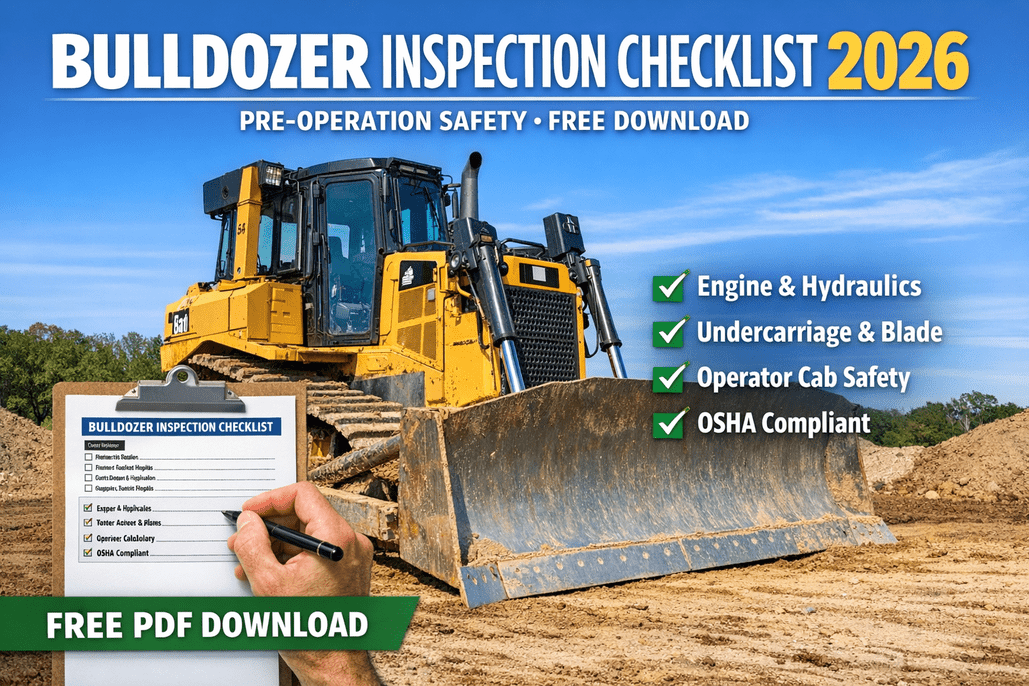
A bulldozer breakdown doesn't just stop one machine — it stalls grading, delays foundation work, and creates a cascade of subcontractor schedule failures costing $2,000+ per day. The average dozer breakdown costs $150,000 when you factor in emergency repairs, project delays, and rental replacement. The undercarriage alone represents 50% of a dozer's total lifetime maintenance cost — making track and roller inspection the single highest-value daily check an operator can perform. OSHA requires pre-shift inspections for earthmoving equipment under 29 CFR 1926.20 and 1926.600, with ROPS mandatory for dozers manufactured after 1972 (29 CFR 1926.1000). Fines start at $16,550 per serious violation and reach $165,514 for willful or repeated offenses. This checklist covers every bulldozer-specific inspection point across 7 systems and 50+ items — organized by the walk-around sequence for Cat D-Series, Komatsu D-Series, and all other dozer brands. Use it as a printable PDF or run it digitally in HVI with photo capture, GPS stamps, and instant defect routing. Book a quick demo to get this checklist configured for your dozer fleet.
10–12 min
Average Completion
50%
Of Dozer Cost = Undercarriage
Why Bulldozer Pre-Operation Inspections Matter
Poorly maintained dozers experience 45% higher operational costs and 35% more unplanned downtime. 80% of catastrophic dozer failures show detectable warning signs during daily inspections — hydraulic drift, track slack, blade play, abnormal engine noise — weeks before the failure becomes an emergency.
Undercarriage
50%
$35K – $85K replace
Track tension, roller/idler, sprocket, debris
Hydraulics
20%
$15K – $35K pump
Fluid level, hose condition, cylinder rods
Engine
15%
$45K – $125K rebuild
Oil, coolant, air filter, noise/smoke
Blade & Ripper
10%
$3K – $15K edge/tooth
Cutting edge, bolt torque, pin/bushing
Drivetrain
5%
$8K – $30K final drive
Final drive oil, steering, transmission
Complete Checklist: 7 Systems, 50+ Items
Perform before every shift with the engine cold and the machine on level ground. Cold checks give accurate fluid readings and better leak detection. Follow the physical walk-around path: start ground-level front, work around the machine, then the cab.
1Ground Level & Walk-AroundPOWER-OFF
M Ground under machine — fluid puddles (oil dark, hydraulic amber, coolant green/pink)
M Steps, handrails, grab bars — clean, secure, free of mud/ice/grease
M Guards and covers — all panels in place, properly secured
R Overall machine cleanliness — debris on engine compartment, cooling fins
M Fire extinguisher — present, charged, accessible, inspection tag current
R Warning decals and reflectors — visible, intact
2Undercarriage & TracksHIGHEST COST SYSTEM
M Track tension — sag at midpoint; adjust for soil type (looser in soft ground, tighter on rock)
M Track shoes/pads — grouser height wear; cracked, broken, or missing shoes
M Track links — stretched links, damaged seals, dry pins
M Top and bottom rollers — flat spots, leaking seals, abnormal wear
M Front idler — condition, alignment, leaking seals, proper float
M Sprocket teeth — wear profile; hooked teeth indicate replacement needed
M Track frame — no cracks, bends, damage to frame structure
M Debris buildup — clear rocks, mud, compacted material from rollers/sprockets
M Final drive oil level — check sight glass or plug (both sides)
R Track guide guards — intact, securing hardware present
3Blade & Push ArmsPOWER-OFF
M Cutting edge — wear pattern (even=good; uneven=alignment issue), remaining material
M End bits — wear, cracks, bolt security
M Cutting edge bolt torque — loose bolts accelerate edge loss; check for missing/sheared bolts
M Blade structure — cracks, dents, weld integrity on moldboard
M Push arms — pins, bushings, play at pivot points; keepers and clips in place
M Trunnion and mounting bolts — tight, no cracking at high-stress points
M Tilt/angle cylinders (if equipped) — rod condition, seal leaks, pin retention
M Blade lift cylinders — rod scoring, pitting, seal leaks, pin/bushing condition
4Engine & FluidsPOWER-OFF (cold)
M Engine oil — level, condition (no milky appearance, no metal on dipstick)
M Coolant level — proper mark, cap secure, no discoloration
M Fuel level — sufficient for shift; drain water separator
M Air filter indicator — restriction gauge; replace if in red zone
R Belt condition — cracking, fraying, proper tension
M Fan and fan guard — intact, no cracks, guard secure
R Exhaust system — leaks, DPF/DEF level, spark arrestor (if required)
R Battery terminals — clean, tight, no corrosion
M Radiator/oil cooler — fins clean, no debris restricting airflow
5Hydraulic SystemPOWER-OFF (cold)
M Hydraulic fluid level — check cold; within sight glass range
M Visible hose leaks — all hoses from pump to cylinders (blade, ripper, steering)
M Hose condition — cracking, abrasion, bulging, chafing against frame
M Fitting tightness — hand-check accessible fittings for seepage
M Hydraulic filter indicator (if equipped) — check bypass warning
R Hydraulic tank — cap seal, mounting bolts, brackets secure
6Ripper (If Equipped)POWER-OFF
M Ripper shank — cracks, bends, excessive wear
M Ripper tooth/tip — worn, missing, cracked; sufficient material remaining
M Ripper pins and locks — keepers in place, no excessive play
M Ripper cylinder — rod condition, seal leaks, pin retention
R Ripper frame mounting — bolts tight, no cracks at attachment points
7Cab, Controls & Operational TestPOWER-OFF → ON
M ROPS/FOPS — intact, no modifications, no cracks; ROPS bolt torque (vibration loosens them)
M Seat belt — functions, retracts, latches securely
M Mirrors — clean, adjusted, not cracked
M Horn — functional
M Backup alarm — functional, audible at 15+ feet
R Lights — work lights, headlights, tail lights, strobe/beacon
M Emergency engine shutoff — accessible, functional
R Windshield and wipers — no obstructing cracks, wipers functional
M Start engine — abnormal noise, vibration; check smoke color
M All gauges — oil pressure, coolant temp, hydraulic temp, voltage normal during warm-up
M Blade controls — raise, lower, tilt, angle; smooth response, no drift
M Ripper controls (if equipped) — raise, lower; smooth with no drift
M Steering/steering clutch — both directions, smooth, no pulling
M Transmission — forward/reverse, all gears engaging properly
M Service and parking brakes — test holding power
Item Flags:M Mandatory — Machine fails inspection if defect affects safe operation. Tag out of service. R Recommended — Document with photo, create work order, schedule repair. Machine may operate if safe.
Want This Checklist on Your Dozer Operators' Phones?
HVI digitizes this entire checklist — guided walk-through, photo capture, GPS stamps, hour-meter logging, and instant defect alerts. Under 12 minutes per inspection.
OSHA Requirements for Bulldozers
29 CFR 1926.20
"Frequent and regular inspections" of job sites, materials, and equipment by competent persons
29 CFR 1926.600
Equipment needing repair must be tagged and not operated. Equipment left unattended requires lights/reflectors.
29 CFR 1926.602
Earthmoving equipment: seat belts required, audible reverse alarm, ROPS on equipment manufactured after 1972.
29 CFR 1926.1000
ROPS required for dozers after 1972. ROPS must not be modified. Seat belt mandatory when ROPS installed.
Documentation
OSHA 2025-2026 enforcement emphasizes timestamped documentation. Paper: 73% audit pass. Digital: 96%.
Penalties
$16,550/serious. $165,514/willful. Per-instance penalties possible for multiple equipment deficiencies.
Common Bulldozer Defects & Repair Costs
These defects appear most frequently across dozer inspections — ranked by cost impact. Every one is detectable during a 10-minute walk-around.
1
Undercarriage wear — tracks, rollers, sprockets
Loose tracks cause sprocket damage; tight tracks accelerate roller/idler wear. Packed debris causes exponential wear. 50% of total dozer lifetime maintenance cost.
$35,000 – $85,000 full replacement
2
Hydraulic hose leaks and pump wear
Blade drift, slow response, hose abrasion. Contaminated fluid damages pumps. 45% higher failure rate without systematic inspection.
$2,000 – $8,000 hose; $15,000 – $35,000 pump
3
Cutting edge and end bit wear
Worn edges reduce productivity 20-30% before operators notice. Loose bolts damage the moldboard. Uneven wear signals alignment problems.
$3,000 – $8,000 edge replacement
4
Engine overheating — clogged radiator/oil cooler
Dozer environments are extremely dusty. Debris packs radiator fins daily. Restricted airflow causes overheating leading to engine damage.
$45,000 – $125,000 engine rebuild
5
Final drive oil leaks
Seal deterioration causes oil loss. Operation without adequate final drive oil = catastrophic gear failure. Simple sight-glass check prevents it.
$8,000 – $30,000 per side
6
ROPS bolt loosening from vibration
Dozer vibration loosens ROPS mounting bolts. Loose ROPS compromises rollover protection — the #1 safety system on a dozer.
$16,550+ OSHA fine + liability
PM Intervals Beyond Daily Inspections
Using This Checklist in HVI App
Guided Walk-Around
Same 7-system path. Operators cannot skip mandatory items. Pass/fail tap with photo and notes at every defect.
Undercarriage Tracking
Log track shoe height, link pitch, roller diameter over time. Trend analysis predicts replacement timing — the most valuable data for your highest-cost system.
Hour-Meter PM Alerts
PM schedules trigger based on engine hours — 250, 500, 1,000, 2,000. Automatic alerts. No missed intervals.
Instant Defect Routing
Failed items auto-generate work orders with photos, severity, asset ID. Maintenance notified in under 60 seconds.
Offline on Jobsites
Full functionality without cellular signal. Photos, GPS, digital signature. Auto-sync when connectivity returns.
Fleet Analytics
Defect trends by system and machine. Cost-per-hour tracking. Which dozers have the most undercarriage issues.
Frequently Asked Questions
Q: How long should a daily bulldozer inspection take?
10-15 minutes with paper, under 12 minutes with HVI's digital checklist. Covers all 7 systems: ground level, undercarriage, blade, engine, hydraulics, ripper, and cab/operational test. This prevents failures costing 10-15 hours of downtime and $150,000 in emergency repairs.
Q: Does this checklist work for all dozer brands?
Yes — system-based, not brand-specific. Works for Cat D-Series (D3-D11), Komatsu D-Series (D37-D475), John Deere, Liebherr, Case, and any other brand. In HVI, add manufacturer-specific items or remove items that don't apply.
Q: How do I track undercarriage wear over time?
Measure key dimensions (grouser height, link pitch, roller diameter, sprocket tooth profile) every 500 hours. Compare against manufacturer wear limits. HVI stores measurements with trend analysis — projecting replacement timing and cost for your highest-cost system.
Q: What about dozers with GPS/machine control?
GPS and machine control don't replace physical walk-arounds. They help operators grade to plan but won't catch hydraulic leaks, loose ROPS bolts, or worn cutting edges. In HVI, add GPS-specific items (antenna mount, cables, display) to the template.
Q: Is OSHA's dozer inspection different from excavator requirements?
Both fall under 29 CFR 1926.20/1926.600/1926.602. The key dozer-specific requirement: ROPS is mandatory for dozers manufactured after 1972 (29 CFR 1926.1000) with seat belt required when ROPS installed. Dozers also have unique blade, ripper, and steering clutch items.
Q: Can digital records replace paper for OSHA compliance?
Your Highest-Cost System Deserves Your Best Inspection
Undercarriage is 50% of dozer lifetime cost. HVI's digital checklist catches the wear, leaks, and defects that paper misses — with trend data that lets you predict replacements instead of reacting to failures.