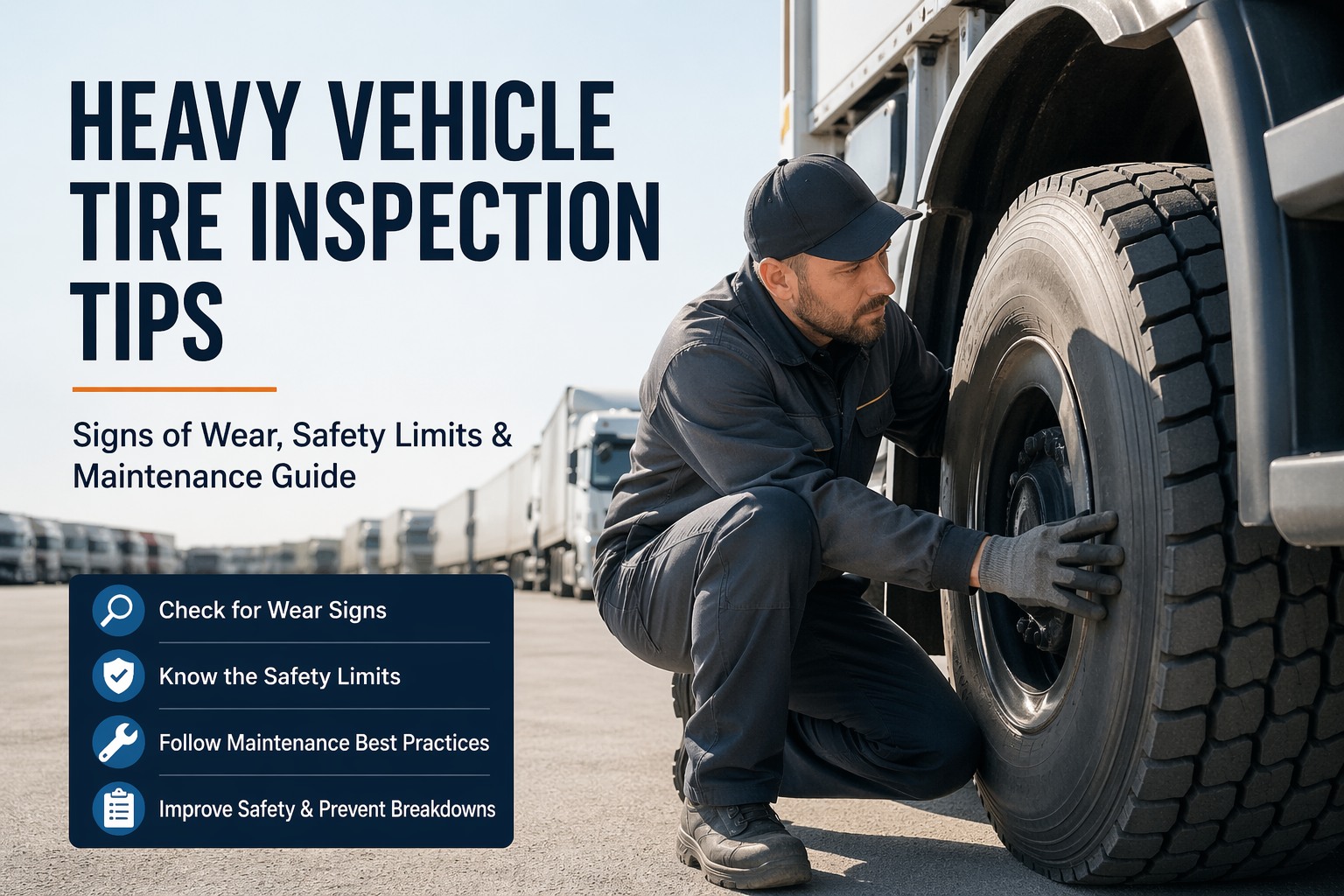
A heavy vehicle tire inspection is a systematic check of tread depth, inflation pressure, sidewall condition, and wear patterns performed on every commercial tire to catch defects before they become roadside failures.For fleet operators, tires are the third-largest expense behind labor and fuel — and improper tire management costs the average commercial fleet $2,500–$4,000 per vehicle annually through premature replacements, wasted fuel, and avoidable breakdowns. Yet most carriers still look at tread depth and stop there. Tires also cause 53.5% of all roadside breakdowns — the single largest breakdown category in the industry, and tire violations accounted for 21.4% of all vehicle out-of-service orders during the 2025 CVSA International Roadcheck. The fleets that avoid these outcomes do something specific: they train drivers and technicians to read wear patterns like diagnostic reports. Every uneven edge, every shoulder dip, every feathered rib is telling you what's wrong with your inflation, your alignment, or your suspension — and catching these signals early means replacing one tire instead of four. This guide covers the complete tire inspection playbook every heavy vehicle fleet needs: the 5-minute inspection routine, the 8 wear patterns every driver must recognize, the legal safety limits, and the maintenance practices that extend tire life 20-40%. Start your free HVI trial to digitize tire inspections with photo evidence and tread-depth tracking, or book a 30-minute demo to see fleet-wide tire analytics in action.
Capture tread depth, photo-document wear patterns, and route defects to maintenance automatically. HVI replaces paper tire checklists with a digital workflow that catches problems weeks before they become roadside failures.
The legal safety limits — what tread depth actually passes
Before reading wear patterns, know the numbers that determine whether a tire is legal to operate. These depths are federal FMCSA standards under 49 CFR § 393.75 — any vehicle found below these thresholds is placed out of service immediately.
Steer tires carry higher safety stakes — a blowout compromises vehicle control. Best practice: replace at 6/32" regardless of regulatory floor.
Drive and trailer positions have more lenient thresholds but still produce 21.4% of all vehicle OOS violations at roadside. Measure every tire, every inspection.
The 5-minute tire inspection routine
A complete tire check runs 5 minutes when done systematically and catches 90% of defects before they become roadside violations. Here is the sequence every driver and technician should follow on every pre-trip.
Circle the vehicle. Look for obvious damage — sidewall cuts, bulges, exposed cord, flat-and-rolling duals, objects embedded in tread. Note any tire visibly different from its mates on the same axle.
Use a tread depth gauge — never visual inspection alone. Measure at three points across each tire to detect uneven wear (center vs shoulders). Steer: 4/32" DOT min. Drive/trailer: 2/32" DOT min. Flag anything approaching thresholds.
Pressures must be checked cold — before driving or after 3+ hours off-duty. Use a calibrated gauge. Reference the load-specific inflation chart, not a single fleet-wide PSI. A tire 20% underinflated looks normal but loses 15% of tread life.
Run your hand along the tread surface. Feel for feathering (smooth one direction, sharp the other), cupping (wavy surface), and irregular rib wear. Drivers' hands detect alignment and suspension issues weeks before visual inspection catches them.
Look for rust trails around lug nuts — indicates loosening. Verify all lugs present and torqued. Check for hub oil leaks and bearing seal condition. A missed lug check causes the rare but catastrophic wheel separation event.
The 8 wear patterns every fleet must recognize
Tire wear is a diagnostic report card on your entire maintenance program. Each pattern tells you exactly what's wrong — inflation, alignment, suspension, or driver behavior. Here are the 8 patterns TMC Recommended Practice 219 identifies as most common on commercial vehicles.
Center rib worn faster than shoulders. Cause: Overinflation — too much PSI puts excessive load on the center of the contact patch. Fix: Reduce PSI to load-chart spec, not tire sidewall max.
Both inner and outer shoulders worn faster than the center. Cause: Underinflation — tire sags, weight shifts to edges. Generates heat; #1 cause of blowouts. Fix: Inflate to load-chart spec, check TPMS.
Only one shoulder worn, other side normal. Cause: Camber misalignment — wheel tilted from vertical. Fix: Check and correct alignment. Inspect suspension for worn components.
Wavy dips spaced around tread edge — hills and valleys. Cause: Worn shocks, bad bearings, or unbalanced tires. The most destructive pattern. Fix: Replace shocks, check bearings, balance.
Tread smooth on one side, sharp/angled on the other — felt by hand, not always visible. Cause: Toe misalignment. Fix: Align toe immediately; 1/16" off = tire drags 8 feet sideways per mile.
Localized patch of tread worn significantly thinner than surrounding area. Cause: Wheel lockup, hard braking, skid events, brake-controller issues. Fix: Inspect brakes; retrain driver on hard braking.
Pieces of tread literally missing — visible gouges and chunks. Cause: Off-road use, gravel surfaces, sharp debris, underinflation. Fix: Review application vs tire spec; consider off-road-rated tires.
Accelerated wear on outside of one drive tire, inside of the opposite — or trailer not tracking straight behind tractor. Cause: Drive axle misalignment or trailer axle misalignment. Fix: Axle alignment at qualified shop.
The inflation rules that prevent 60% of tire failures
Improper inflation pressure is the single most common cause of commercial tire failure. The U.S. DOT estimates underinflated tires waste approximately 5 million gallons of fuel daily nationwide. Here is the Goldilocks zone every fleet should operate in.
- Both shoulders wear faster than center
- 15% tread life lost at 20% underinflation
- 3–5% more fuel consumed
- Excessive heat buildup
- #1 cause of blowouts
- Even wear across the full tread
- Maximum tread life
- Optimal fuel economy
- Consistent handling & braking
- Lowest total cost per mile
- Center worn faster than shoulders
- Reduced contact patch
- Harsher ride, more impact damage
- Higher puncture vulnerability
- Less traction in rain
The 5 maintenance practices that extend tire life 20-40%
Good inspection catches defects. These maintenance practices prevent them from developing in the first place — extending average tire life 20-40% across the fleet.
Typically every 5,000–8,000 miles for on-road trucks. Rotation evens out position-specific wear. Never rotate to hide a problem — diagnose the cause first, then rotate. Rotating worn tires onto new positions just transfers the problem.
Curb strikes, pothole damage, and component replacement can shift alignment. A 1/16" toe misalignment drags the tire 8 feet sideways per mile — 40,000 feet of sideways drag per 5,000-mile cycle. Annual alignment at minimum.
Worn shocks are the #1 cause of cupping — the most destructive wear pattern. Include shocks, struts, bushings, and wheel bearings in every PM. A $400 shock replacement prevents $800+ in premature tire replacement.
Same make, model, size, and tread depth on paired duals and same axle. Mismatched tires create unequal rolling circumference, causing scrub wear, uneven heat generation, and premature failure across the pair.
Jackrabbit starts, hard braking, and curb strikes cause tire damage that looks like mechanical wear. Tires tell on driver behavior — use that data for driver coaching, not punitive action.
Frequently asked questions — heavy vehicle tire inspection
Digitize tire inspections and stop replacing tires too early.
HVI captures tread depth at every inspection, stores photo evidence of wear patterns, and tracks trends across every vehicle in your fleet. Defects auto-generate maintenance work orders. Tread-depth trending forecasts replacement dates weeks in advance. Drivers document what they feel and see — HVI turns those observations into fleet-wide tire intelligence.
No credit card required · Tire inspection workflow live in minutes · Photo evidence + tread depth tracking on every inspection