The Driver Vehicle Inspection Report (DVIR) is not a single signature on a single form — it is a federally mandated chain of accountability connecting three people across two regulations. 49 CFR § 396.11 and § 396.13 together require up to three separate signatures per defect cycle: the driver who finds the defect, the mechanic who certifies the repair, and the next driver who acknowledges the repair before operating the vehicle. Miss any one signature and the entire chain breaks — creating the most cited DVIR-specific violation in DOT audits, exposing carriers to $15,420 per-occurrence fines for dispatching unrepaired vehicles, and creating significant litigation exposure if the truck is later involved in a crash. The most commonly missed signature is #3 the Driver B acknowledgment — drivers get handed keys, the DVIR sits in a folder somewhere, and the truck rolls out without the chain ever completing. Paper systems make this fragile by design; digital platforms enforce the chain structurally, blocking dispatch until every signature is captured. With FMCSA's February 19, 2026 final rule (Docket FMCSA-2025-0115, effective March 23, 2026) explicitly authorizing electronic DVIRs in both regulating sections, 2026 is the cleanest moment in a decade to digitize the signature chain. This article explains exactly how each signature works, where chains break in practice, and how digital logbooks make the broken-chain violation effectively impossible.
HVI's digital DVIR blocks vehicle dispatch until every signature in the FMCSA 3-signature chain is captured. Driver, mechanic, next driver — every link enforced, every signature timestamped, every record audit-ready.
What is the DVIR 3-signature chain?
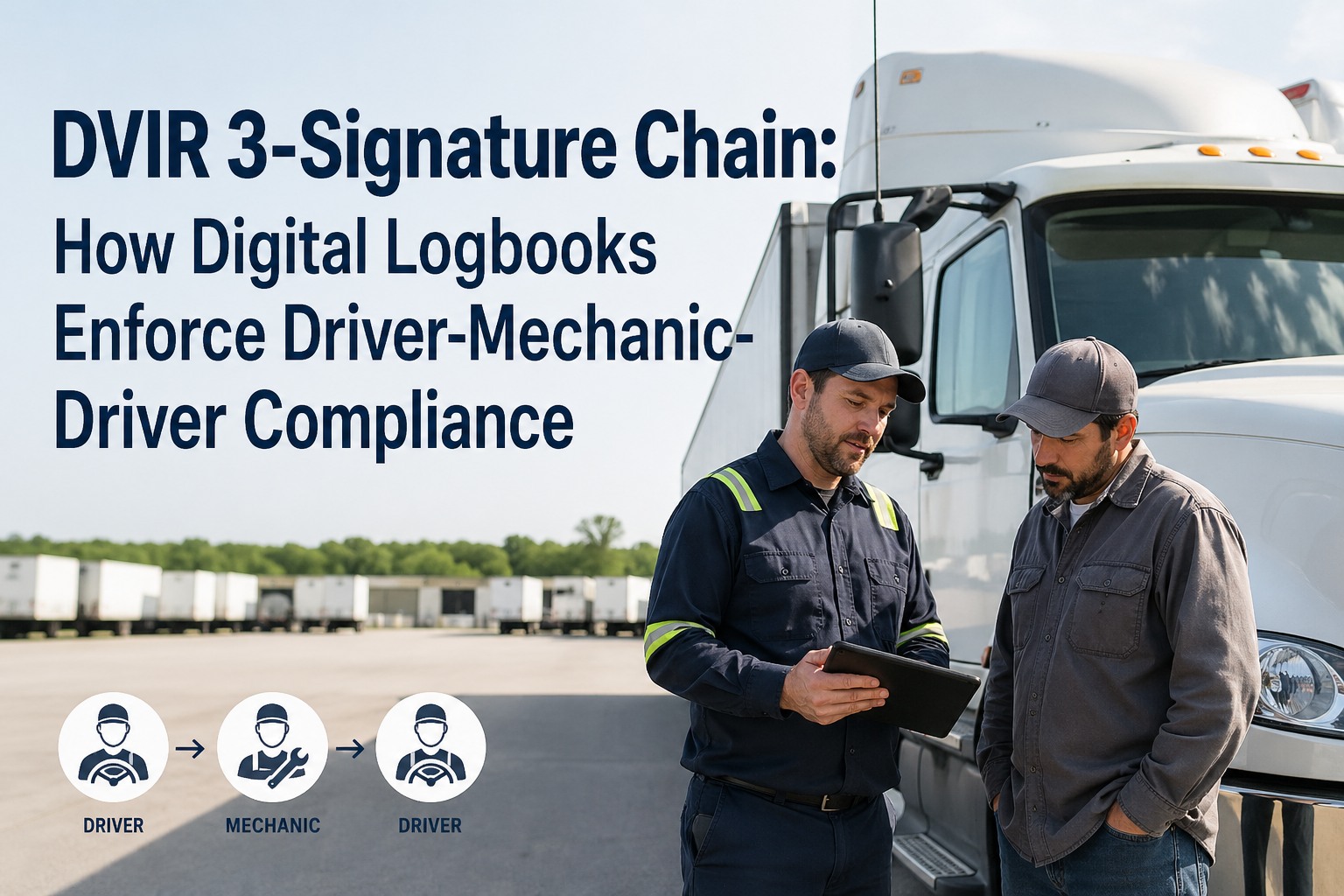
The 3-signature chain is the federally mandated sequence of three signatures that must occur on every DVIR cycle when defects are reported. Created together by § 396.11 (driver report and carrier certification) and $ 396.13 (next driver review), it documents an unbroken chain of custody from defect discovery through repair and back to operation.
Inspects vehicle at end of workday. Documents any defects with description, severity, and photo evidence. Signs DVIR certifying inspection was performed.
Receives defect report. Performs repair. Certifies on the original DVIR that defects are repaired or repair was unnecessary. Vehicle cannot dispatch until this signature exists.
Reviews most recent DVIR before operating. Confirms repair status. Signs acknowledgment that they have personally verified repairs are complete. Then proceeds with pre-trip.
Why each signature carries different legal weight
The three signatures look identical on paper but serve fundamentally different regulatory purposes. Understanding what each one actually attests to is the difference between a defensible chain and a citable violation.
Driver A's signature certifies that the post-trip inspection was actually performed and that any defects discovered during the day's operation are accurately documented. Falsification — signing without actually inspecting — carries up to $12,700 per occurrence and is the second-most-cited DVIR audit violation. Photo evidence and GPS timestamps make this signature legally defensible; a checkmark on paper does not.
The mechanic or carrier official's signature attests that defects affecting safe operation have been repaired — or, in some cases, that the noted condition does not actually require repair. This signature is the legal trigger that allows the vehicle back into service. Dispatching before this signature exists is the highest-cost DVIR violation at $15,420 per occurrence and creates the strongest litigation exposure.
Driver B's signature certifies that they have reviewed the prior DVIR, confirmed the repair status, and physically verified the repair before operating. This is FMCSA's accountability mechanism — it forces the next driver to participate in the chain rather than just inheriting the truck. It is also the most commonly missed signature, especially in slip-seat operations where vehicle handoffs happen quickly and the DVIR rarely follows the keys.
The 5 places paper DVIR chains actually break
Every broken-chain audit citation traces back to one of five specific failure modes. Each is a structural weakness of paper-based DVIR systems that digital platforms eliminate by design.
Driver fills out paper DVIR at end of shift, leaves it in a folder, on a clipboard, or in the cab. Maintenance team starts the next morning without ever seeing the defect report. Vehicle dispatches with the unrepaired defect.
Repair gets completed and documented on a separate work order. Mechanic signs the work order but never goes back to the original DVIR. From the auditor's perspective, the DVIR shows an open defect and no certification — chain broken.
The most common failure. New driver gets keys, performs their own pre-trip, drives off. Prior DVIR sits in a filing cabinet. Driver B's acknowledgment signature never happens. Especially common in slip-seat operations.
Multi-page paper DVIR forms. Driver keeps one copy, maintenance gets one, file copy goes somewhere else. By audit time, two of the three are missing. The remaining copy lacks the signatures captured on the others.
Driver B sees the form, sees the mechanic's signature, signs the acknowledgment without actually inspecting the repair. The chain looks complete on paper but the underlying purpose — physical verification — is defeated. Pure liability if anything fails later.
How digital logbooks enforce the chain structurally
The fundamental difference between paper and digital DVIRs isn't the form factor — it's the enforcement mechanism. Digital platforms turn the chain from a procedural request into a structural requirement that cannot be bypassed.
The penalty structure that makes broken chains so expensive
FMCSA's 2026 penalty schedule attaches different fine amounts to different links of the chain. Understanding which link maps to which penalty helps fleet managers prioritize where to focus enforcement.
Per-day penalty. Compounds rapidly across drivers and dates during audits. A 50-truck fleet missing one DVIR per truck per week accumulates $63,500+ over a single quarter.
Driver signed without performing actual inspection, or backdated the report. Often discovered through driver interviews and CCTV review during audits. Signature is the evidence.
The single highest-cost DVIR violation. Vehicle dispatched while the prior DVIR shows an unrepaired defect. Strongest litigation exposure if the vehicle is involved in a subsequent incident.
Skipping link 3 violates § 396.13. Cited as a separate violation from § 396.11. The most commonly missed signature in audits — and the one most easily prevented by digital enforcement.
Frequently asked questions — DVIR 3-signature chain
Stop relying on procedure. Enforce the chain structurally.
HVI's digital DVIR enforces the complete FMCSA 3-signature chain by design. Driver A submits via mobile app — defects route to maintenance instantly. Mechanic cannot close the work order without signing the original DVIR. Driver B's pre-trip workflow is blocked until they review and acknowledge the prior DVIR. Every signature timestamped, GPS-verified, photo-evidenced, and audit-ready. The broken-chain violation that catches 93% of carriers becomes effectively impossible.
No credit card required · Full 3-signature chain enforcement live in minutes · Audit-ready records by default