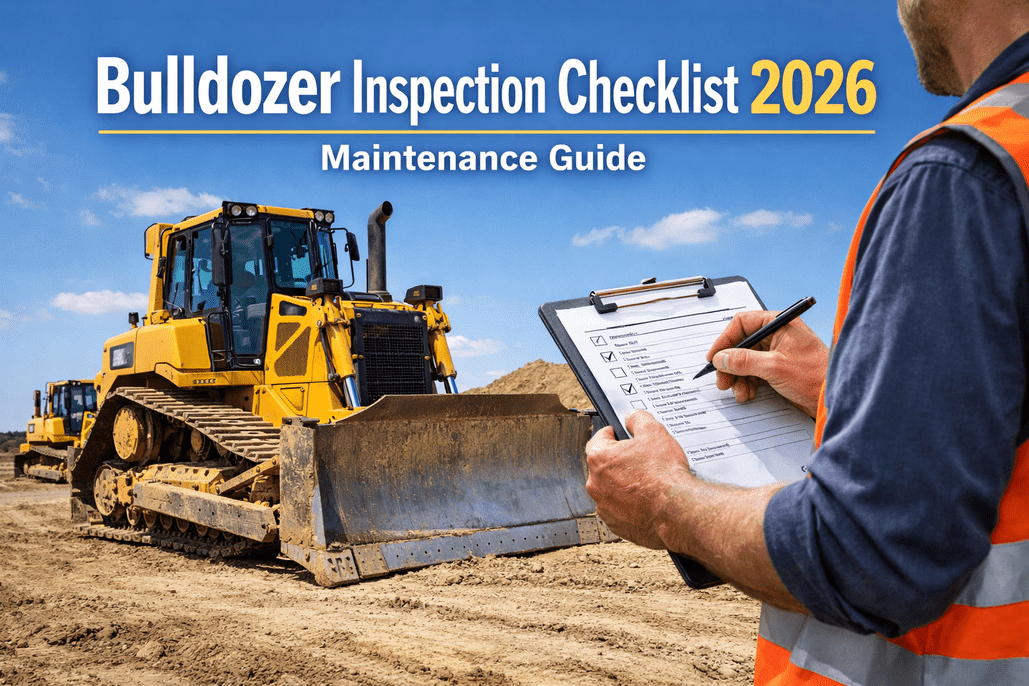
A bulldozer pushes more earth, absorbs more impact, and destroys its undercarriage faster than almost any other machine on a construction site. Industry data shows that poorly maintained dozers experience 45% higher operational costs and 35% more unplanned downtime than systematically serviced equipment — and the average breakdown costs $150,000 when you factor in emergency repairs, project delays, and rental replacement. The undercarriage alone represents 50% of a dozer's total maintenance cost over its lifetime, making track and roller inspection the single highest-value daily check an operator can perform. OSHA requires pre-shift inspections for construction equipment under 29 CFR 1926.20, and the consequences of skipping them go beyond fines — 75% of struck-by fatalities involve heavy equipment. This guide covers every bulldozer-specific inspection point: undercarriage and tracks, blade and cutting edge, hydraulic system, engine and drivetrain, ripper (if equipped), and cab safety — with daily, weekly, monthly, and annual PM intervals written for Cat and Komatsu dozer models. Book a demo to see HVI's dozer-specific digital checklists, or start your free trial.
Undercarriage, Blade, Hydraulics, Engine, Transmission & Ripper — for Cat D-Series & Komatsu D-Series Dozers
Daily Pre-Shift Inspection Checklist
Perform before every shift with the engine cold and the machine on level ground. A complete dozer walk-around takes 10-15 minutes and catches the failures that cost 10-15 hours of downtime. Cold checks give accurate fluid readings and better leak detection.
Deploy This Checklist on Your Operators' Phones — Today
HVI provides pre-built dozer inspection templates with photo verification, GPS stamps, hour-meter logging, and instant defect alerts. Operators complete inspections in under 12 minutes. Maintenance teams get real-time work orders.
Preventive Maintenance Intervals
Cat & Komatsu: Model-Specific Notes
Cat dozers use Product Link / VisionLink telematics for remote monitoring. Cross-reference overnight fault codes during daily inspections. Cat's S·O·S fluid analysis program detects internal wear before visual symptoms appear — integrate results into PM decisions. Cat's Undercarriage Management System (UMS) provides standardized wear measurement methodology. ACERT engines on Tier 4 models require DEF level checks. Differential steering on newer models requires separate steering clutch inspection points.
KOMTRAX telematics monitors fuel level, operating hours, location, and warning alerts remotely. Komatsu's KOWA oil analysis provides detailed component health data. Komatsu dozers feature Super Slant Nose (SSN) for improved visibility — verify cab glass and wiper condition for this design. Hydrostatic transmission on newer models (D51EXi, D61EXi, D65EXi) has different inspection points than torque converter models. Komatsu intelligent Machine Control (iMC) models require GPS/GNSS antenna and sensor verification.
Regulatory Requirements
Earthmoving equipment including bulldozers requires "frequent and regular" inspections by a competent person under 29 CFR 1926.20 and 1926.600. ROPS is mandatory for dozers manufactured after 1972 (29 CFR 1926.1000). Seat belts required when ROPS is installed. Penalties: up to $16,550 per serious violation, $165,514 per willful violation.
Paper inspection records achieve only 73% audit pass rates — digital systems achieve 96%. OSHA's 2025-2026 enforcement priorities emphasize timestamped documentation proving inspections occurred and defects were corrected. Digital platforms with photo evidence, GPS location, and hour-meter tracking provide the audit trail that survives OSHA scrutiny.
Frequently Asked Questions
A thorough daily pre-shift inspection covering all 7 sections (walk-around, undercarriage, blade, engine/fluids, hydraulics, ripper, cab/controls) takes 10-15 minutes. With a digital checklist app, experienced operators complete the full inspection in under 12 minutes with photo evidence. The undercarriage section takes the most time but is also the highest-value check — preventing the most expensive repairs in your fleet.
Dozers push heavy loads forward all day — every component in the undercarriage absorbs extreme force. Track shoes, links, pins, rollers, idlers, and sprockets all wear simultaneously and interact with each other. A worn sprocket destroys new track shoes. Packed debris accelerates wear exponentially. Improper track tension compounds all other wear patterns. An undercarriage rebuild on a mid-size dozer runs $15,000-$50,000+ — making daily inspection the highest-ROI activity an operator can perform.
Formal wear measurement (track shoe height, link pitch, bushing diameter, roller/idler diameter, sprocket tooth profile) should occur every 500-1,000 hours or at each major PM service. Record measurements digitally and compare against OEM wear limits. Cat uses the UMS system, Komatsu provides KOWA analysis and wear limit charts. Tracking measurements over time predicts replacement timing and budgets for the inevitable undercarriage overhaul.
Tag out of service for: ROPS structural damage or modified mounting, seat belt failure, hydraulic hose leak or burst, brake failure, track thrown or severely loose, blade structural crack, non-functional horn or backup alarm, steering malfunction, and any engine warning that indicates imminent failure (low oil pressure, high coolant temp, critical fault code). Document with photos and notify maintenance before the machine returns to service.
Track tension directly impacts wear rate, fuel consumption, and machine control. Too tight: accelerates wear on all undercarriage components and increases fuel consumption (the machine fights itself). Too loose: risk of derailing, uneven wear, and reduced pushing power. Tension should be adjusted for soil type — looser in soft/muddy conditions (to allow material to shed), tighter on hard/rocky ground. Check daily and adjust as conditions change.
Replace cutting edges before they wear through to the moldboard — replacing a cutting edge costs a fraction of repairing moldboard damage. Measure wear regularly and plan replacement at 70-80% wear. End bits protect the blade corners and typically wear faster than the center cutting edge. Some operators flip reversible cutting edges at the halfway point to extend life. Always verify bolt torque after replacement and at subsequent inspections — vibration loosens hardware rapidly.
Digitize Your Bulldozer Inspections — See HVI in Action
Pre-built dozer checklists covering undercarriage, blade, hydraulics, ripper, and cab safety. Operators complete inspections on their phone with photo verification. Undercarriage wear tracking over time. Defects auto-generate work orders.
No credit card • No hardware • Setup in under 10 minutes • OSHA compliant