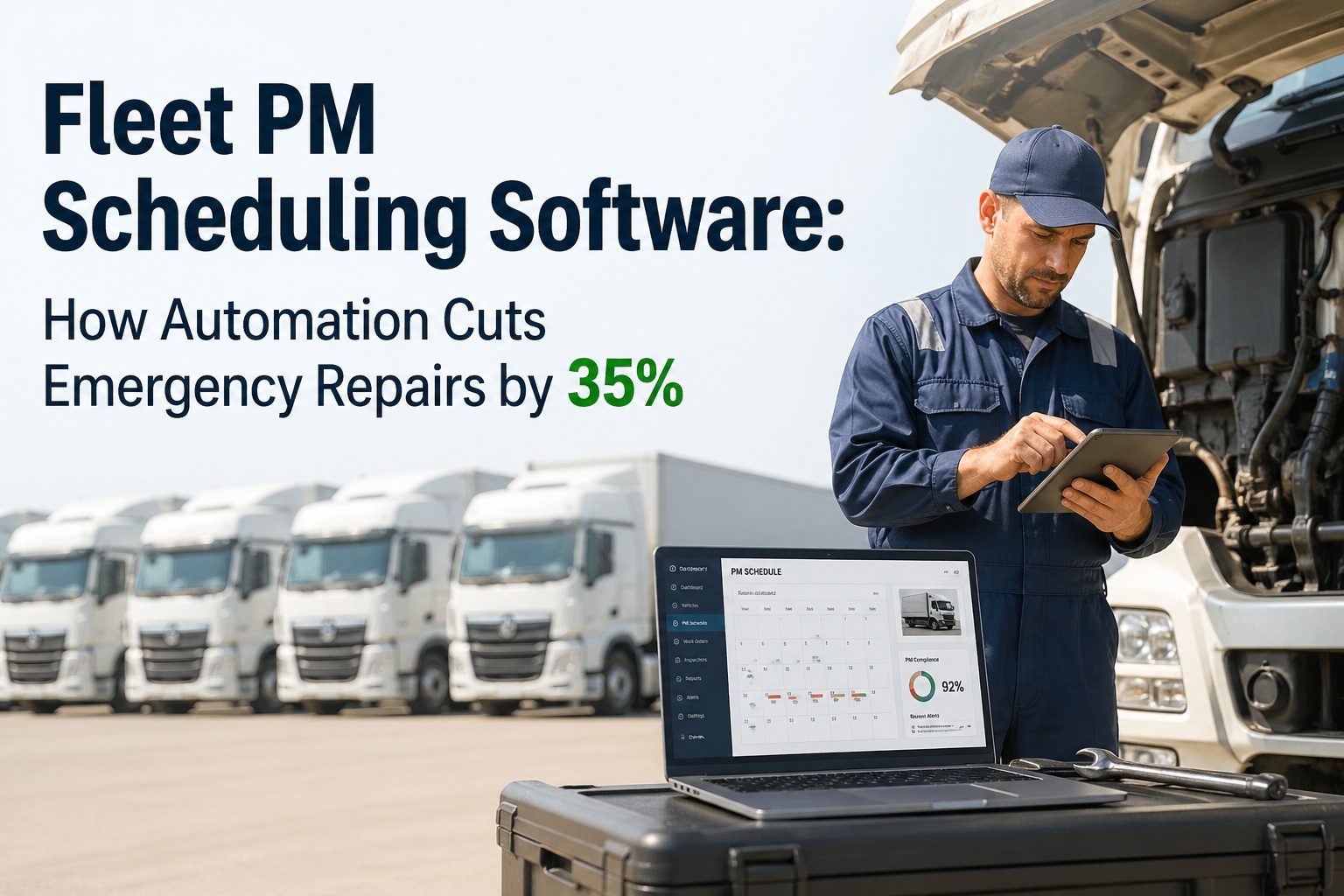
Reactive maintenance — fixing things when they break — costs commercial fleets 22-28% more per vehicle annually than scheduled maintenance, and 78% of unplanned breakdowns trace back to deferred or missed services that proper PM scheduling would have caught. Yet 60% of fleet managers still run preventive maintenance through spreadsheets, and 52% rely on paper documents — systems where service reminders quietly fall through the cracks until a $50 oil change cascades into a $2,890 emergency repair eight thousand miles later. Fleet PM scheduling software changes the economics by replacing manual tracking with automated, multi-trigger scheduling that fires alerts before services come due, auto-creates work orders, links parts inventory, and forecasts failures from sensor data. Fleets running automated PM scheduling report up to 45% less unplanned downtime, 30% lower maintenance costs, 35% fewer emergency repairs in the first quarter of deployment, and 95% positive ROI — with 27% achieving full payback within 12 months. This guide explains exactly how PM automation works, the 4 trigger types every fleet needs, the cost cascade that makes manual PM so expensive, and the ROI timeline operators can realistically expect. Start your free HVI trial to automate PM scheduling across your fleet today, or book a 30-minute demo for a custom ROI projection.
HVI automates PM scheduling by mileage, engine hours, calendar, and sensor data. Alerts fire before services come due. Work orders auto-create. Parts inventory links automatically. Most fleets see their first prevented breakdown within 30-45 days.
The 35% emergency-repair reduction is real — here's the data behind it
The numbers below come from the most recent 2026 fleet maintenance industry data. They illustrate why "automated PM" stopped being a nice-to-have and became operational table stakes for any fleet running 10+ vehicles.
The cost cascade — how missed PM becomes a $2,890 emergency repair
Every emergency repair was once a scheduled service that nobody got around to. Here's the actual progression of one missed oil change on a real Class-8 tractor — the cost cascade that automated PM software exists to prevent.
The 4 PM trigger types that automate everything
Different components wear at different rates depending on usage patterns. The right PM software supports all four trigger types and lets you combine them per service. Most fleets run all four simultaneously across different services.
Service triggered at specific odometer intervals. Most common for oil changes, tire rotations, transmission service. Best for vehicles with consistent driving patterns.
Service triggered by accumulated engine running time. Critical for vehicles that idle heavily, run PTO operations, or operate at low road speeds where mileage understates wear.
Service triggered by elapsed time regardless of usage. Required for time-sensitive components — DOT annual inspections, brake fluid replacement, fire extinguisher service, registration renewal.
Service triggered by sensor data and AI predictive models — vibration analysis, oil chemistry, fuel economy drift. The most efficient trigger type. Service exactly when needed, not on fixed intervals.
Reactive vs automated PM — the real cost comparison
Per-vehicle annual costs differ dramatically between fleets running reactive maintenance and those running automated PM. Here's the breakdown for a representative 50-vehicle commercial operation.
The 6 features that separate automation from glorified reminders
Many fleet platforms claim "PM scheduling" but only deliver calendar reminders. Real automation requires the six capabilities below — each driving measurable outcome reductions.
Schedule by mileage AND engine hours AND calendar AND sensor condition simultaneously per service. Whichever trigger fires first creates the work order.
Alerts fire 500 miles or 7 days before service is actually due — giving you scheduling flexibility instead of "service is overdue" panic notifications.
Service due = work order auto-created with vehicle details, last service history, parts list, and assigned technician. Zero manual data entry.
Work orders reserve required parts automatically. Inventory deducts on completion. Reorder triggers fire when stock runs low. Never delay a repair waiting for parts.
Every PM, repair, part replaced, and labor hour logged per vehicle. Identifies problem assets that drain budgets. Protects warranty claims with documented history.
AI models analyze sensor data, telematics patterns, and historical failures to forecast component issues weeks in advance. The premium tier of automation — pure prevention.
The ROI timeline — when does PM automation actually pay back?
Most fleets see measurable returns faster than they expect. Here's the realistic timeline based on 2026 industry data across hundreds of deployments.
Vehicles imported, PM rules configured, drivers onboarded to mobile app. First scheduled services start firing. Spreadsheet retirement begins.
Most fleets report their first averted emergency repair within this window — single event often pays for entire annual subscription. PM compliance rate climbs from 60-70% to 90%+.
Unplanned downtime drops 30-45%. Emergency repair frequency falls noticeably. Admin hours spent on PM scheduling drop from 8-12 hours/week to under 1 hour. ROI clearly positive.
Reactive culture replaced by proactive operation. Cost-per-mile drops measurably. Predictive failure data starts surfacing problem vehicles. Insurance underwriters notice the improved CSA scores.
27% of fleets achieve 100% payback within 12 months. 95% report positive ROI in the same window. Predictive features unlock additional 2-4x ROI in months 12-24 as historical data accumulates.
Frequently asked questions — fleet PM scheduling software
Get your first prevented breakdown in 30-45 days.
HVI runs every PM trigger type out of the box — mileage, engine hours, calendar, and condition-based — with auto work-order generation, linked parts inventory, predictive failure forecasting, and native ELD/telematics integration. Most fleets recover the entire year's subscription cost from a single averted emergency repair within the first 45 days.
No credit card required · PM automation live in under a day · 95% positive ROI in first 12 months