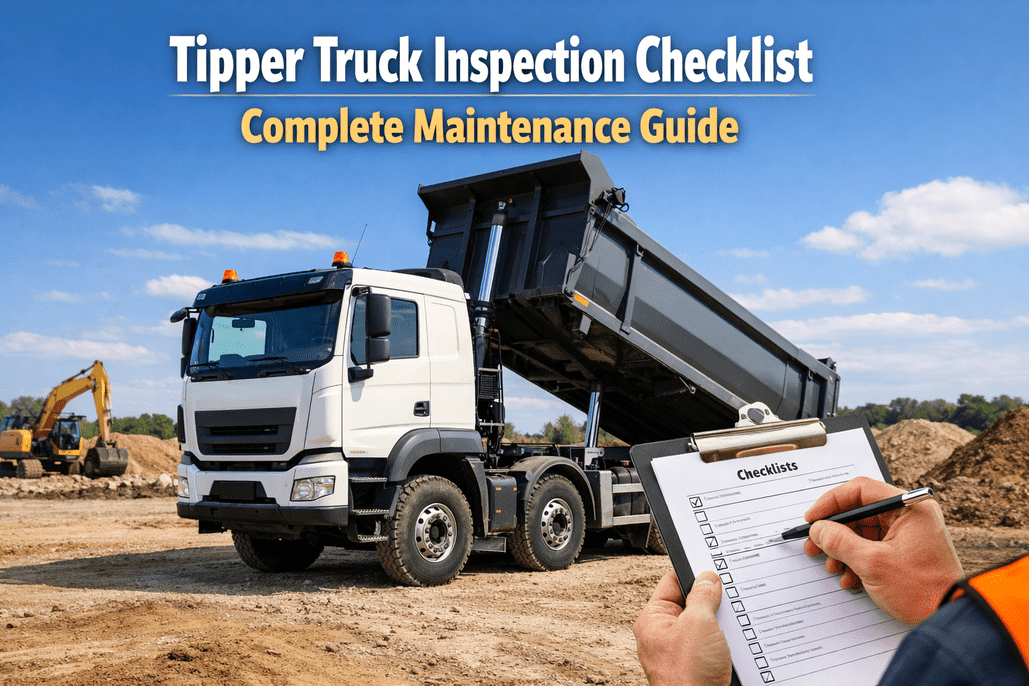
A tipper truck carries some of the heaviest loads on any job site — and unloads them using a hydraulic system that, when it fails, can drop tons of material without warning. Mechanical defects contribute to approximately 10% of commercial vehicle accidents (FMCSA), and dump truck hydraulic failures are among the most dangerous because they combine extreme weight with elevated load beds. OSHA requires pre-shift inspections under 29 CFR 1926.20 for construction-site equipment, while FMCSA requires pre-trip inspections under 49 CFR 396.13 for on-road commercial vehicles. Contaminated hydraulic fluid alone causes 85% of pump failures — a check that takes 30 seconds during a daily walkaround. This guide covers every inspection point specific to tipper trucks: the hydraulic tipping system, dump body, PTO, chassis, brakes, and cab safety — with daily, weekly, and monthly maintenance intervals. Book a demo to see HVI's tipper-specific digital checklists with photo verification, or start your free trial to deploy them today.
Hydraulic Tipping System, Dump Body, PTO, Chassis, Brakes & Cab Safety — Daily, Weekly & Monthly Checks
Daily Pre-Trip Inspection Checklist
Complete before every shift. Engine cold for fluid checks, machine on level ground. Follow the same clockwise pattern every time — consistency catches what random checks miss.
See HVI's Tipper Truck Checklists in Action
Pre-built templates covering hydraulic tipping systems, dump body, PTO, air brakes, and cab safety. Operators complete inspections in under 15 minutes on their phone with photo verification, GPS stamps, and instant defect alerts to maintenance.
Weekly, Monthly & Annual Maintenance Schedule
Top 5 Tipper-Specific Failures to Watch
A burst hose under load means instant loss of pressure — the bed drops uncontrolled. Inspect hoses at every pre-trip, focusing on flex points and fittings where most failures start. Replace hoses on a calendar schedule, not just when they show visible wear. Heat cycling degrades rubber internally before external signs appear.
Residual material that freezes or compacts in the bed shifts the center of gravity during dumping, causing tip-overs — one of the most common tipper fatality scenarios. Clean the bed after every load. In cold weather, treat the bed surface to prevent material adhesion.
PTO mounting bolts loosen from constant vibration. A separated PTO can cause catastrophic drivetrain damage and loss of hydraulic power mid-dump. Check PTO bolt torque weekly. Listen for unusual vibration during engagement — grinding or chattering means immediate service.
Tippers carry extreme weight — brake systems are under more stress than standard trucks. Overheated brakes lose stopping power (brake fade). Check brake adjustment, pad thickness, and drum condition at every PM. Driver training on proper descent technique (engine braking, gear selection) is essential.
A raised dump body strikes bridges, power lines, and overhead structures — causing fatalities and infrastructure damage. Verify the "Body Up" indicator light functions during every pre-trip. Some fleets install audible alarms that sound when the truck exceeds 5 MPH with body raised.
Regulatory Requirements
Commercial dump truck drivers must complete a pre-trip inspection covering brakes, steering, lighting, tires, horn, wipers, mirrors, coupling devices, and emergency equipment before every trip. The driver must be satisfied the vehicle is in safe operating condition. Defects must be documented on the DVIR. Records retained 90 days minimum.
Equipment on construction sites requires pre-shift inspection by a competent person under 29 CFR 1926.20. Dump trucks on-site fall under 29 CFR 1926.600 (equipment standards) and 29 CFR 1926.601 (motor vehicles at construction sites). Penalties: up to $16,550/serious violation, $165,514/willful violation.
All CMVs require annual periodic inspection by a qualified inspector. This comprehensive inspection covers every safety system — brakes, steering, suspension, frame, tires, lights, exhaust, and coupling. Proof of current annual inspection must be available (sticker or documentation). No/expired annual = automatic out-of-service.
Paper inspection forms achieve only 73% audit pass rates — digital systems achieve 96%. OSHA's 2025-2026 enforcement priorities emphasize timestamped documentation proving inspections occurred, defects were identified, and corrective actions were taken. Digital platforms with photo evidence, GPS stamps, and automated defect routing are the standard for modern compliance.
Frequently Asked Questions
A thorough daily pre-trip inspection covering all 7 sections (walk-around, engine/fluids, hydraulic system, dump body, PTO, brakes, cab/safety) takes 15-20 minutes. With a digital checklist app, experienced drivers can complete and document the full inspection in 10-15 minutes with photo evidence. This time investment prevents failures that cause hours or days of downtime.
The hydraulic tipping system. A hydraulic failure during dumping can drop tons of material without warning, creating an immediate crush/tip-over risk. Check fluid level and condition daily (milky = contamination, the cause of 85% of pump failures), inspect hoses for cracks and bulges, test raise/lower operation for smooth travel, and verify safety props are functional. Never work under a raised body without props engaged.
Beyond standard CMV checks (brakes, tires, lights), inspectors target: hydraulic system leaks, dump body structural integrity, tailgate latching mechanism, PTO condition, "Body Up" indicator functionality, safety prop presence, and proper load securement. Inoperable required lamps and no/expired annual inspection are the two most common violations fleet-wide.
Typically every 1,000-2,000 operating hours or annually, whichever comes first — but oil analysis can extend this interval. Replace hydraulic filters every 500-1,000 hours. Monitor fluid condition weekly: color change, milky appearance (water contamination), or burnt smell all indicate immediate service. Contaminated hydraulic fluid causes 85% of pump failures, so fluid management is the highest-ROI hydraulic maintenance task.
Tag out of service for: active hydraulic leak, non-functional brakes, inoperable "Body Up" indicator, missing or damaged safety props, dump body structural cracks, non-functional horn or backup alarm, steering excessive play, brake air pressure below 60 PSI, and any safety equipment failure. Document the deficiency with photos and notify maintenance before the truck can return to service.
Yes. FMCSA's February 2026 eDVIR Final Rule (effective March 23, 2026) explicitly permits electronic Driver Vehicle Inspection Reports for all commercial motor vehicles including dump trucks. Digital DVIRs provide timestamped records, photo evidence, GPS location, instant defect routing to maintenance, and 96% audit pass rates (vs 73% for paper). They are the new compliance standard.
Digitize Your Tipper Truck Inspections — See HVI Live
Pre-built templates for hydraulic tipping systems, dump body, PTO, air brakes, and cab safety. Operators complete inspections on their phone with photo verification. Defects auto-generate work orders. You get audit-ready records.
No credit card • No hardware • Setup in under 10 minutes • FMCSA eDVIR compliant