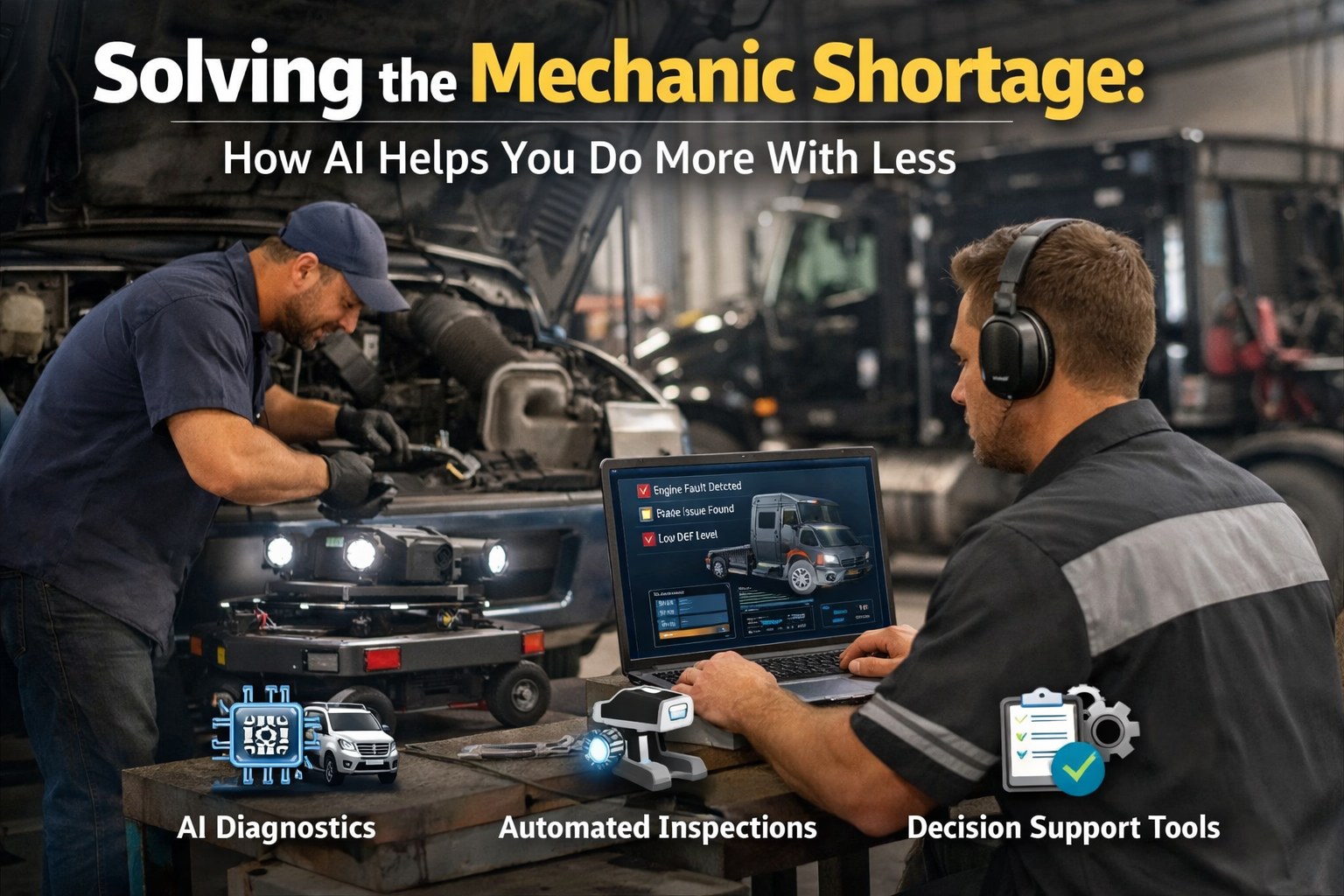
Your diesel mechanic just quit. The replacement you hired three months ago didn't show up after week one. You've got 73 trucks, two techs, and a growing backlog of repairs. Sound familiar? The mechanic shortage isn't getting better—the average fleet needs 4-5 qualified technicians but operates with 2-3. AI maintenance tools can't replace mechanics, but they can triple technician productivity by handling diagnostics, prioritizing repairs, and guiding less-experienced techs through complex work. Augment your maintenance team with AI instead of competing for scarce talent.
68,000
Diesel Mechanic Job Openings (Unfilled)
2.8x
More Productive With AI Diagnostic Support
47%
Less Time Spent On Diagnostics
$127K
Cost To Recruit And Train One Diesel Mechanic
Do More With The Team You Have
AI-powered maintenance tools amplify technician productivity by automating diagnostics, prioritizing work, and guiding repairs.
Try AI Maintenance
See Demo
The Mechanic Shortage Reality
- 68,000 unfilled mechanic positions - Industry-wide shortage worsening annually
- Average age 55+ - Experienced techs retiring faster than replacements entering
- 3-6 month hiring timelines - Takes months to find qualified candidates
- $85K-$127K recruitment costs - Advertising, signing bonuses, training expenses
- 40% first-year turnover - New hires leave for better offers quickly
Reality: Can't hire your way out of this problem
- Instant diagnostics - AI analyzes fault codes and symptoms in seconds
- Guided repairs - Step-by-step procedures for complex jobs
- Intelligent prioritization - AI ranks repairs by criticality and resource availability
- Knowledge amplification - Junior techs access senior-level expertise
- Automated documentation - AI generates service records automatically
Solution: Multiply productivity of existing team
5 Ways AI Multiplies Technician Productivity
AI Solution #1
Instant Fault Code Diagnosis
Traditional: Mechanic spends 45-90 minutes diagnosing fault codes, cross-referencing manuals, checking related systems. AI: Analyzes codes in 30 seconds, identifies root cause, suggests repair procedures, estimates parts/time needed.
Time Savings:
40-60 minutes per diagnostic session
AI Solution #2
Intelligent Repair Prioritization
AI evaluates repair backlog considering: vehicle utilization schedule, parts availability, technician skill match, safety criticality. Generates optimized work queue maximizing fleet uptime and tech productivity.
Efficiency Gain:
25-35% more repairs completed per technician
AI Solution #3
Guided Repair Procedures
AI provides step-by-step instructions with photos, torque specs, part numbers for unfamiliar repairs. Junior techs complete complex jobs without senior supervision. Reduces errors requiring rework.
Impact:
Junior techs perform at 80% senior tech efficiency
AI Solution #4
Predictive Parts Ordering
AI analyzes repair history and predicts needed parts before failures occur. Auto-generates purchase orders for common repairs. Ensures parts available when techs need them—no waiting 3-5 days for delivery.
Downtime Reduction:
Parts available 94% of time vs 67% manual ordering
AI Solution #5
Automated Documentation
AI generates service records, updates maintenance logs, tracks warranties, schedules follow-ups automatically. Eliminates 30-45 minutes paperwork per repair. Techs wrench more, write less.
Admin Time Saved:
5-7 hours per technician weekly
How AI Diagnostic Support Works
Driver reports issue or fault code triggers
Telematics uploads diagnostic data automatically
AI receives symptoms, codes, vehicle history
System accesses manufacturer databases instantly
Time: 30 seconds vs 20-30 minutes manual lookup
→
AI correlates codes with common root causes
Analyzes repair history for similar issues
Identifies most probable failures (ranked by likelihood)
Suggests diagnostic tests to confirm diagnosis
Accuracy: 85-92% first-diagnosis accuracy rate
→
AI provides step-by-step repair procedure
Lists required parts with OEM numbers
Estimates labor hours based on job complexity
Includes torque specs, photos, safety warnings
Benefit: Junior techs complete repairs confidently
→
Tech confirms diagnosis and documents repair
AI auto-generates service record
System learns from outcome to improve future predictions
Knowledge shared across entire fleet instantly
Outcome: System gets smarter with every repair
Real Fleet Productivity Transformations
Baseline: 2-week repair backlog, missing 4th mechanic position
Deployed AI diagnostic platform. Reduced diagnostic time 47%. Junior tech productivity increased 65% with guided procedures. Backlog eliminated in 45 days despite not hiring additional staff.
Result: Same team handles 40% more repairs monthly
Baseline: Senior mechanic retiring in 6 months, no replacement found
Implemented AI maintenance assistant to capture senior tech knowledge. Junior mechanic trained using AI-guided procedures. Transitioned smoothly when senior retired—no productivity loss.
Result: Junior tech operating at 82% senior efficiency
Baseline: Required 6 techs but could only staff 4, budget frozen
AI prioritization reduced emergency repairs 34% through better scheduling. Automated documentation saved 6 hours per tech weekly. Fleet operating at full capacity with 33% fewer techs than originally budgeted.
Result: $340K annual labor savings vs 6-person team
AI Maintenance Tools Comparison
| Challenge |
Traditional Approach |
AI-Powered Solution |
Productivity Gain |
| Fault Code Diagnosis |
45-90 minutes manual lookup and troubleshooting |
30-second AI analysis with ranked probable causes |
40-60 min saved per diagnosis |
| Repair Prioritization |
Manager manually reviews backlog, assigns work |
AI optimizes queue based on criticality and resources |
25% more efficient scheduling |
| Complex Repairs |
Junior tech waits for senior guidance or makes errors |
AI provides step-by-step procedures with specs |
Junior techs 65% more productive |
| Parts Availability |
Order parts after diagnosis, wait 3-5 days delivery |
AI predicts needs, auto-orders common parts |
94% parts ready immediately |
| Documentation |
30-45 minutes paperwork per repair |
AI auto-generates service records |
5-7 hours saved weekly per tech |
| Knowledge Transfer |
Years of apprenticeship to reach senior level |
AI makes senior knowledge accessible to all techs |
50% faster skill development |
Getting Started With AI Maintenance
No lengthy implementation—operational immediately
Install AI maintenance platform. Connect to telematics for automatic data feed. Import vehicle list and current maintenance records. Configure alert preferences. Train techs on interface (2-3 hours).
Timeline: Operational in 5-7 business days
See immediate diagnostic efficiency gains
Techs begin using AI for diagnostics. System learns fleet-specific patterns. Junior techs start accessing guided procedures. Documentation time decreases measurably.
Result: 20-30% diagnostic time reduction in month one
Achieve 2.5-3x productivity multiplier
AI prioritization fully managing work queue. Predictive parts ordering preventing delays. Junior tech productivity matches previous mid-level performance. Team handling significantly more volume.
ROI: 6-9 month payback vs hiring additional mechanic
AI Can't Replace Mechanics—But It Amplifies Them
What AI Does (And Doesn't Do)
✓ AI Handles
Diagnostics, data analysis, procedure lookup, documentation, scheduling, parts ordering, knowledge search
✗ AI Doesn't
Turn wrenches, replace parts, troubleshoot physical issues, make judgment calls on wear conditions
Result
AI eliminates 40-50% of non-wrench-turning time, letting techs focus on actual repairs
Productivity
3 mechanics with AI can handle work previously requiring 7-8 mechanics
Junior Techs
Perform at 75-85% senior tech level when AI-guided vs 40-50% traditional training
Cost Comparison
AI platform: $200-$400/month | New mechanic: $75K-$95K annually + benefits
The Mechanic Shortage Won't Resolve: Industry needs 68,000 mechanics but averages only 12,000 graduates annually—and 40% leave within first year. You cannot out-recruit this problem. The only viable solution is force multiplication: make existing techs dramatically more productive through AI-powered diagnostics, guided procedures, and intelligent automation. Fleets adopting AI maintenance tools report 2.5-3x productivity gains within 90 days.
See how AI can amplify your maintenance team without waiting months to hire.
Triple Your Maintenance Team's Output
HVI's AI maintenance platform provides instant diagnostics, guided repairs, and intelligent work prioritization.
Try AI Maintenance
See Demo
Frequently Asked Questions
Q
Can AI really replace the need for experienced mechanics?
No—AI doesn't replace mechanics, it amplifies them. Experienced techs still perform the physical work, but AI eliminates 40-50% of the time they currently spend on diagnostics, documentation, and parts lookup. This means 3 mechanics with AI can handle the workload previously requiring 7-8 techs. AI makes junior technicians immediately productive by giving them access to senior-level knowledge and guided procedures.
Q
How accurate are AI diagnostics compared to experienced mechanics?
Modern AI diagnostic platforms achieve 85-92% first-diagnosis accuracy—comparable to experienced mechanics but delivered in 30 seconds instead of 45-90 minutes. AI analyzes thousands of similar cases instantly, identifies patterns humans miss, and considers repair history your mechanic might not remember. For rare or unusual issues, AI provides ranked probable causes, letting techs verify systematically rather than guessing.
Q
What's the learning curve for technicians using AI tools?
Most techs become proficient in 2-4 hours of initial training. Modern AI maintenance platforms use intuitive interfaces—techs simply enter symptoms or scan fault codes, and AI presents diagnoses and repair procedures. No complex software to master. Younger techs comfortable with smartphones adapt immediately. Even tech-resistant veterans appreciate how AI eliminates manual lookup time and paperwork.
Q
How much does AI maintenance software cost vs hiring another mechanic?
AI maintenance platforms typically cost $200-$400 per month for small-medium fleets. Hiring one diesel mechanic costs $75K-$95K salary plus $20K-$30K benefits annually—total $95K-$125K. AI delivering 2.5x productivity increase means your existing 3-person team can handle work previously requiring 7-8 mechanics. ROI appears within 6-9 months compared to hiring additional staff—and you avoid recruitment costs and turnover risk.
Q
Will AI work with our mixed fleet of different makes/models?
Yes—comprehensive AI platforms support all major heavy vehicle manufacturers (Freightliner, Peterbilt, Kenworth, Volvo, Mack, International, etc.) and equipment brands (Caterpillar, Komatsu, John Deere, etc.). AI accesses multiple manufacturer databases simultaneously and learns your specific fleet's unique issues over time. Mixed fleets actually benefit more from AI since human mechanics can't possibly memorize procedures for 8-10 different manufacturers.
Q
How quickly will we see productivity improvements?
Immediate wins appear in first 2-3 weeks as diagnostic time drops 40-50%. Full productivity multiplication (2.5-3x) develops over 60-90 days as techs become comfortable with AI guidance, work prioritization optimizes, and predictive parts ordering prevents delays. Most fleets report clearing repair backlogs within 45-60 days despite not adding staff. Junior tech productivity improvements visible within first month.