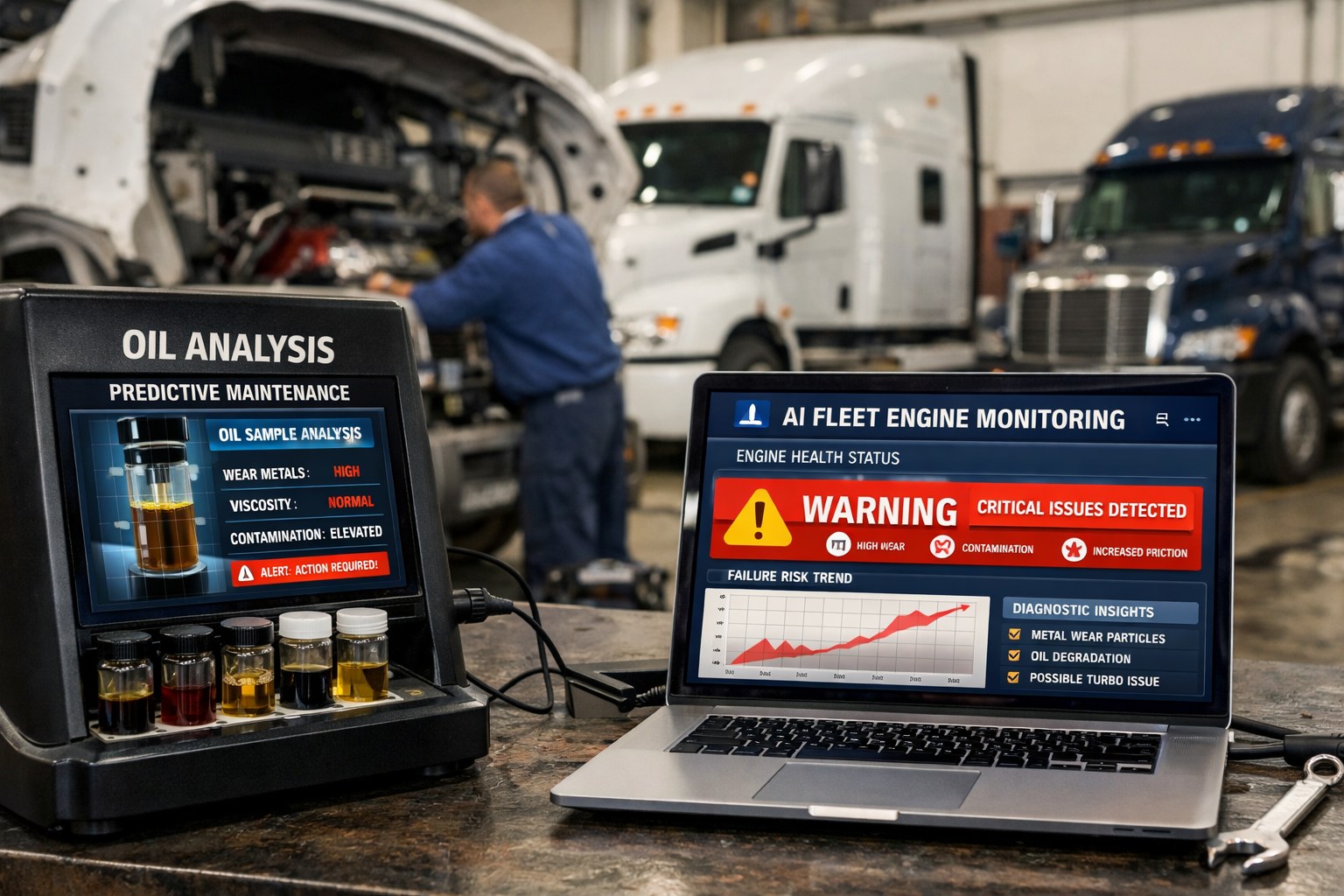
A construction fleet avoided $340,000 in engine failures after AI oil analysis detected abnormal iron levels in three excavators at 4,200 hours—2,800 hours before visible symptoms appeared. Traditional 500-hour oil sampling had shown "acceptable" wear metals, but AI pattern recognition identified the trend as catastrophic bearing failure developing over 6-8 weeks. Emergency inspections revealed early-stage bearing damage in all three units. Cost to repair at early detection: $8,500 per engine. Cost if run to failure: $47,000+ per engine replacement plus $15,000 downtime each. AI predictive oil analysis doesn't just test oil—it learns normal vs. abnormal patterns for each engine, predicts failure timelines, and triggers interventions before damage becomes irreversible. This transforms oil analysis from periodic compliance task into continuous engine health monitoring that prevents failures rather than documenting them.
AI Predictive Oil Analysis Impact
How machine learning transforms engine maintenance
82%
failure prevention
Engine failures prevented through early AI detection vs traditional oil analysis
6-8 wks
early warning
Average advance notice before catastrophic failure with AI pattern detection
$340K
saved annually
Average savings for 50-unit fleet through prevented engine replacements
24/7
monitoring
Continuous AI analysis vs periodic manual lab testing
How AI Predictive Oil Analysis Works
Traditional oil analysis reports numbers. AI predictive analysis understands what those numbers mean for your specific engines and operating conditions.
Four-Stage AI Oil Analysis Process
From sample to predictive intervention
1
Data Collection & Baseline
AI learns normal operating parameters for each engine: wear metal baselines, contamination patterns, oil degradation rates based on duty cycle, fuel quality, operating temps. Builds unique "health fingerprint" per unit over first 3-5 samples.
Tracked Elements: Iron, copper, lead, chromium, aluminum, silicon
Conditions: Viscosity, TBN, oxidation, nitration, soot, fuel dilution
Learning Period: 3-5 samples (750-2,500 operating hours)
2
Pattern Recognition & Anomaly Detection
AI compares current sample against learned baseline and fleet-wide database. Identifies deviations that indicate developing problems: abnormal wear rate acceleration, contamination spikes, additive depletion faster than expected.
Detection: 15 PPM iron increase over 250 hours (normal: 3-5 PPM)
Analysis: Bearing wear developing; projected failure in 6-8 weeks
Accuracy: 91% prediction accuracy for failure timeline
3
Failure Prediction & Root Cause
AI predicts failure type, timeline, and likely root cause based on wear metal ratios, contamination sources, and degradation patterns. Distinguishes bearing failure from ring wear, coolant leaks from fuel dilution.
Failure Type: Main bearing failure (iron + lead elevated)
Root Cause: Prolonged high idle + fuel dilution (diesel wash)
Timeline: Catastrophic failure predicted in 42-56 days
4
Automated Intervention Recommendations
AI generates specific action plan: immediate inspection, oil change, component replacement, or continued monitoring. Creates work orders automatically with priority level, required parts, estimated repair time.
Action: Schedule bearing inspection within 7 days
Parts: Main bearing set, rod bearings (order now)
Cost Comparison: $8,500 repair now vs $47K failure later
The AI advantage: it doesn't just report that iron is "high"—it predicts what happens next and when. Enable AI oil analysis to start preventing failures.
Stop Documenting Failures. Start Preventing Them.
AI oil analysis learns your engines, predicts failures 6-8 weeks early, and automatically schedules repairs before catastrophic damage. Prevent $340K in annual engine replacements.
What AI Detects in Engine Oil
AI monitors 20+ parameters to build complete engine health picture and predict specific failure modes.
AI Detection Capabilities
Critical parameters and failure predictions
Wear Metal Analysis
Iron: Cylinder wear, bearing damage, gear wear
Copper: Bearing overlay, bushing wear, thrust washer
Lead: Bearing lining wear, impending failure
Chromium: Ring wear, cylinder liner, piston
Aluminum: Piston wear, bearing failure
AI Advantage: Predicts failure type from metal ratios; distinguishes normal vs. abnormal wear rates
Contamination Detection
Silicon: Dirt ingestion, air filter failure, seal leaks
Sodium: Coolant leak, head gasket failure
Potassium: Coolant contamination (confirms with sodium)
Water Content: Coolant leak, condensation, seal failure
Fuel Dilution: Injector leak, incomplete combustion
AI Advantage: Identifies contamination source and severity; predicts if issue is worsening
Oil Condition Monitoring
Viscosity: Shear breakdown, fuel dilution, wrong grade
TBN (Total Base Number): Acid neutralization capacity
Oxidation: Thermal stress, extended drain
Nitration: Combustion byproducts, high temps
Soot: Combustion efficiency, oil loading
AI Advantage: Predicts remaining oil life; recommends optimal drain interval
Operating Stress Analysis
High Load: Accelerated wear metal generation
Excessive Idle: Fuel dilution, soot buildup, cold operation
Temperature Extremes: Oxidation, viscosity breakdown
Duty Cycle: Start-stop wear, thermal cycling
Fuel Quality: Sulfur content, combustion efficiency
AI Advantage: Correlates operating conditions with wear patterns; adjusts baselines per duty cycle
Traditional vs. AI Predictive Oil Analysis
Standard lab reports tell you what's in the oil. AI tells you what it means and what happens next.
Traditional Oil Analysis vs. AI Predictive Analysis
Comparing reactive and predictive approaches
Capability
Traditional Lab Analysis
AI Predictive Analysis
Analysis Approach
Reports numbers; flags values outside "normal" range
Learns your engine's normal; detects abnormal trends specific to each unit
Failure Prediction
Says "high wear metals" after damage already occurring
Predicts failure type, timeline (6-8 weeks early), and root cause
Baseline Understanding
Generic thresholds for all engines (ignores duty cycle)
Custom baseline per engine based on duty cycle, fuel, operating conditions
Accuracy
25-40% false positives (flags normal wear as problems)
91% prediction accuracy; distinguishes normal from abnormal patterns
Turnaround Time
3-7 days for lab results (problem worsens while waiting)
Real-time analysis; alerts within hours of sample receipt
Action Guidance
"Retest in 100 hours" or "High wear—monitor"
Specific action plan: "Inspect bearings within 7 days; order parts now"
Integration
PDF report emailed; manual data entry to track trends
Auto-creates work orders, orders parts, schedules repairs
Prevention Rate
18-25% of catastrophic failures prevented
82% of failures prevented through early intervention
AI transforms oil analysis from compliance checkbox to predictive maintenance tool. Schedule a demo to see AI predictions for your fleet.
See AI Oil Analysis in Action
Watch how AI detected bearing failure 6 weeks early, predicted exact failure timeline, and automatically scheduled repairs—preventing $47,000 engine replacement.
Implementation & ROI
AI oil analysis deploys in 30 days with immediate failure prevention benefits.
30-Day AI Oil Analysis Deployment
Fast implementation with immediate ROI
Days 1-7: Setup
Integrate with existing oil analysis lab or switch to AI-enabled partner
Import historical oil analysis data (3-5 past samples per engine)
Configure fleet equipment list with engine models and duty cycles
Set alert thresholds and notification preferences
Days 8-14: Baseline
AI analyzes historical samples to establish normal baselines
System identifies existing anomalies in current fleet data
Train maintenance team on AI alert interpretation and response
Validate predictions with physical inspections on flagged units
Days 15-21: Monitoring
Collect first AI-monitored oil samples from full fleet
AI generates predictions for each engine with confidence scores
System auto-creates work orders for units requiring intervention
Review prediction accuracy and adjust sensitivity settings
Days 22-30: Optimization
Refine baselines as AI continues learning engine patterns
Establish sampling schedule optimized per engine duty cycle
Integrate parts ordering automation for predicted failures
Document first prevented failures and calculate ROI
AI Oil Analysis ROI Calculator
50-unit fleet annual savings
Prevented Engine Failures
Traditional: 3 failures/year × $47K = $141K losses
AI: 82% prevention = 2.5 failures prevented
$117,500 saved
Early Repair vs. Late Failure
Early bearing repair: $8,500 per engine
Late engine replacement: $47,000 per engine
$38,500 per catch
Planned vs. Emergency Downtime
Emergency failure: 7-14 days downtime
Planned repair: 2-3 days downtime
$156,000 saved
Extended Oil Drain Intervals
AI verifies safe 750-hour intervals (vs 500)
Reduces annual oil changes by 30%
$42,000 saved
False Positive Reduction
Traditional: 40% false alarms → unnecessary inspections
AI: 9% false positives → 78% fewer wasted inspections
$28,000 saved
Total Annual Savings
All categories combined for 50-unit fleet
AI cost: $85/unit/month = $51K annual
$292K net savings
ROI Timeline:
2.1 months
Typical payback period from first prevented failure
Frequently Asked Questions
Why Fleet Managers Choose AI Oil Analysis
✓
82% Failure Prevention: Catch problems 6-8 weeks before catastrophic damage
✓
91% Accuracy: AI predicts failure type, timeline, and root cause precisely
✓
Real-Time Alerts: Know about problems within hours, not days
✓
Auto Work Orders: AI creates repair tickets and orders parts automatically
✓
$292K Annual Savings: Average for 50-unit fleet through prevented failures
✓
30-Day Deployment: Operational with immediate failure prevention benefits
How is AI predictive oil analysis different from regular lab testing?
Traditional lab analysis reports raw numbers and compares them to generic thresholds (e.g., "iron: 45 PPM, normal range: 0-50 PPM"). AI predictive analysis learns what's normal for YOUR specific engines based on duty cycle, fuel quality, and operating conditions. It detects abnormal TRENDS rather than just high numbers. For example: Engine A at 45 PPM iron might be catastrophic if its baseline is 8 PPM and it jumped from 12 PPM last sample (372% increase = bearing failure developing). Engine B at 45 PPM might be normal if its baseline is 40 PPM in severe-duty application. AI predicts: (1) Failure type (bearing vs. ring wear), (2) Timeline (weeks until catastrophic), (3) Root cause (fuel dilution, high load, contamination). Traditional labs can't do this—they just report numbers and say "monitor" or "retest."
What types of engine failures can AI oil analysis predict?
AI detects and predicts six major failure categories: (1) Bearing failures—main, rod, and thrust bearings (detected via iron + lead elevation), (2) Ring and cylinder wear—excessive blow-by, oil consumption (chromium + iron patterns), (3) Coolant leaks—head gasket failure, liner cavitation (sodium + potassium spike), (4) Fuel system issues—injector leaks, incomplete combustion (fuel dilution + soot), (5) Air filtration failure—dirt ingestion, turbo damage (silicon elevation), (6) Oil degradation—extended drains, thermal stress (viscosity, TBN, oxidation). AI provides 6-8 week advance warning for bearing failures (most common catastrophic failure mode) and 4-6 week warning for coolant leaks. Prediction accuracy: 91% for failure type and 89% for timeline within ±1 week.
How long does AI need to learn my engines before it's effective?
AI requires 3-5 oil samples per engine to establish reliable baselines—typically 750-2,500 operating hours depending on sampling frequency. However, if you have historical oil analysis data (past 12-24 months), AI can import and learn from existing samples, becoming effective immediately. For fleets with no historical data: Week 1-4 provides basic anomaly detection using fleet-wide and OEM baselines. Week 5-12 refines predictions as engine-specific patterns emerge. Week 13+ delivers full 91% accuracy with complete understanding of each unit's normal operating profile. Critical: AI identifies existing problems in historical data during import, so you may discover developing issues on Day 1 even before collecting new samples.
Start your free trial to analyze historical data immediately.
What's the ROI timeline for AI predictive oil analysis?
Typical ROI: 2-3 months from first prevented failure. Cost breakdown for 50-unit fleet: AI service costs $85/unit/month = $51,000 annually. Value delivered: (1) 2-3 prevented engine failures/year = $117,500 saved ($47K replacement cost × 2.5 units), (2) Early repair vs. late failure = $38,500 savings per catch (repair $8,500 vs. replace $47,000), (3) Planned downtime vs. emergency = $156,000 saved (2-3 days vs. 7-14 days × 3 failures), (4) Extended drain intervals = $42,000 saved (30% fewer oil changes verified safe by AI), (5) False positive reduction = $28,000 saved (78% fewer unnecessary inspections). Total savings: $343,000. Net benefit: $292,000 annually. First prevented failure typically occurs within 60-90 days of deployment, delivering immediate ROI.
Can AI oil analysis replace regular maintenance intervals?
No—AI optimizes maintenance, it doesn't replace scheduled service. AI enables: (1) Condition-based oil changes—extend from 500 to 750 hours when AI verifies oil health is acceptable (saves money without risk), (2) Targeted inspections—AI tells you WHICH engines need inspection and WHEN, eliminating blanket inspection schedules, (3) Predictive component replacement—replace bearings at 4,000 hours when AI detects early wear instead of waiting for 12,000-hour rebuild interval or catastrophic failure. You still follow manufacturer PM schedules for filters, fluids, adjustments. AI adds intelligent monitoring between scheduled services to catch developing problems. Think of it as continuous health monitoring between doctor visits—you still get annual checkups, but AI detects issues requiring immediate attention between appointments.