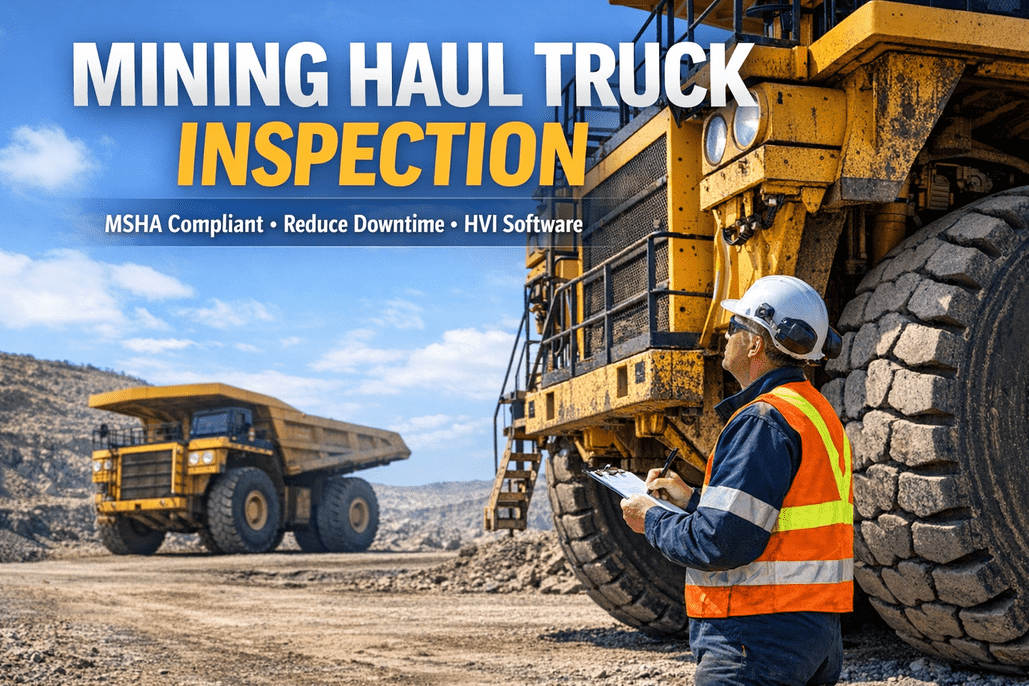
Every hour a haul truck sits idle is an hour of lost ore and lost revenue. Ultra-class haul trucks cost $5,000-$20,000 per hour in downtime. A single major breakdown can cascade to $2 million per day when factoring in lost production, idle loaders, and emergency repair premiums. Engine rebuilds alone cost approximately $400,000 for large haul trucks. Tires cost $40,000-$70,000 each with 4,000-6,000 hour life spans. Yet the difference between world-class mines (92-94% haul truck availability) and average operations (75-82%) is not the equipment — it is how inspections and maintenance are managed. MSHA requires pre-shift inspections before each operating shift under 30 CFR Part 56/57. Surface mines are inspected by MSHA at least twice per year; underground mines at least four times. Equipment deficiencies must be corrected before use. Maintenance records must demonstrate a systematic maintenance program. Mining conditions reduce standard PM intervals by 20-40% — dust, vibration, extreme temperatures, and continuous heavy loads accelerate wear dramatically. A typical haul truck runs 600+ hours per month, equivalent to two years of average driving compressed into a single month. HVI provides the digital inspection and maintenance platform built for this reality: mining-specific templates for every equipment type, full offline capability for remote pit locations, MSHA compliance documentation, hours-based PM scheduling, and instant defect-to-work-order routing. Operations using structured digital inspection programs report 42% fewer incidents and 35% improved equipment uptime. Watch HVI in a real mining operation — 10 min, or start your free trial.
Mining-specific inspections, offline capability, MSHA compliance, hours-based PM — built for haul trucks, excavators, drills, and underground equipment operating 24/7 in extreme conditions.
Equipment Coverage
Cat 797F (400 ton), Komatsu 980E-5 (360 ton), Liebherr T 284 (400 ton), Hitachi EH5000AC-3 (326 ton), BelAZ 75710 (450 ton). Pre-shift checklist covers: engine/drivetrain, service brakes + retarder, steering (< 2" play at rim), tires (TPMS < 185°F, pressure within 10%), hydraulic systems, body raise/lower, lighting, fire suppression, ROPS/FOPS integrity, payload system calibration.
Cat 6060 (52m³), Komatsu PC8000-11 (42m³), Liebherr R 9800 (47.5m³), P&H 4100XPC electric rope shovel. Checklist covers: hydraulic system (fluid level, hose condition, cylinder rods), boom/stick/bucket structural integrity, undercarriage (tracks, rollers, sprockets), swing bearing, electrical systems, counterweight mounting, ground engaging tools.
Cat MD6310, Epiroc PV-271, Sandvik DR461i. Pre-shift covers: mast alignment, hydraulic system, compressor, drill steel condition, safety interlocks, dust suppression system, cable reel (electric drills), leveling jacks. Drill rig downtime delays blasting which delays loading which delays hauling — cascade impact across the entire operation.
Cat R2900G LHD, Sandvik TH663i underground truck, Epiroc Boomer S2 jumbo. Underground-specific: emission system checks (DPF condition — diesel particulate is a primary health concern), ventilation-related items, confined-space safety equipment, proximity detection systems, fire suppression, ROPS/FOPS, battery-electric systems for BEV units.
Cat D11T, Komatsu D475A-8, Cat 24 motor grader. Undercarriage is 50% of dozer maintenance cost in mining — abrasive ground accelerates wear dramatically. Track shoe, sprocket, and idler wear measurements tracked over time. Graders maintain haul roads — poor road condition increases tire wear on every haul truck in the fleet.
Water trucks (dust suppression), fuel/lube trucks (field servicing), explosives vehicles, light vehicles, generators, pumps, mobile cranes. Often overlooked but critical — a broken water truck means dusty roads that destroy haul truck air filters and reduce visibility. HVI tracks the entire support fleet alongside production equipment.
Full Offline Capability — Built for Mine Sites
Complete pre-shift checklist on phone/tablet. Photo capture, GPS stamp, digital signature — all offline. No cell signal required.
Inspection data, photos, and timestamps stored securely on device. Multiple inspections can queue offline — no data loss.
When device reaches Wi-Fi, satellite, or cellular — data syncs automatically. GPS and timestamps from inspection time, not sync time.
Supervisors see completed inspections. Defects route to maintenance. Reports available for MSHA. Full visibility across all pits.
Pre-Shift Inspection Flow
Selects equipment by ID or scans barcode/QR. App loads the correct template for that equipment type (haul truck, excavator, drill, etc.). Previous shift defects displayed for review.
Step-by-step prompts for each inspection point. Required fields cannot be skipped. Defect found? Photo mandatory + severity level + description. GPS and timestamp auto-captured per item.
Digital signature confirms inspection complete. If no defects: equipment cleared for operation. If defects found: routed instantly to supervisor and maintenance team.
Supervisor sees defect with photo evidence. Decision: can operate with defect (minor) or must be repaired first (safety-critical). Decision documented with supervisor signature.
Safety-critical defects auto-create work order. Maintenance team notified with defect details + photos. Equipment tagged out of service until repair certified.
Mechanic completes repair, documents work done, attaches photos. Digital sign-off. Equipment released for next shift. Complete chain of custody: defect → repair → return.
MSHA Compliance — 30 CFR Part 56/57
Downtime ROI — The Business Case
See the complete pre-shift inspection workflow on a haul truck: operator walkthrough, defect flagging with photo, supervisor review, work order routing, and MSHA-ready reporting. No account needed.
Frequently Asked Questions
Yes — HVI supports underground-specific equipment (LHD units, underground haul trucks, jumbos, bolters, shotcrete rigs) with templates covering emission system checks (DPF condition), ventilation-related items, confined-space safety equipment, proximity detection systems, and battery-electric vehicle systems. Underground equipment typically achieves 5-7% lower availability than surface — making systematic inspection even more critical.
Yes — HVI runs on any Android or iOS device including ruggedized tablets and phones commonly used in mining (Samsung Galaxy XCover, Cat phones, Getac, Panasonic Toughbook tablets). Full offline capability on all devices. The app is designed for use with gloves and in bright sunlight. No special hardware required beyond the phone/tablet your operators already carry.
Yes — HVI supports multi-site operations with unified reporting. Each site maintains its own equipment roster, inspection schedules, and maintenance workflows. Corporate-level dashboards aggregate data across all sites for fleet-wide visibility. Equipment that moves between sites carries its complete inspection and maintenance history. Role-based access controls ensure site managers see their site while regional managers see all sites.
Yes — HVI supports data export via API for integration with SAP PM, Oracle EAM, IBM Maximo, and other ERP/CMMS platforms. Work orders, inspection data, parts consumption, and equipment histories can be synced automatically. HVI can also serve as the standalone maintenance system for operations that do not use an ERP, or operate as the mobile inspection front-end that feeds data into your existing system.
Yes — HVI is used by mining operations in Australia and supports WHS Act requirements, state-specific Mines Safety and Inspection Act regulations (WA, QLD, NSW), and industry codes of practice. Templates can be configured for Australian regulatory terminology and reporting formats while maintaining the same core functionality: pre-start checklists, defect management, PM scheduling, and compliance documentation.
Most mining operations go live within 2-4 weeks. Week 1: equipment database import, template configuration for your fleet (haul trucks, excavators, drills, support equipment). Week 2: operator training (under 15 minutes per person with guided app prompts). Week 3-4: defect routing and work order workflows established. Full offline capability from Day 1. No hardware to install. No consulting fees. No multi-month ERP implementation.
Mining-specific templates. Full offline capability. MSHA + Australian + UAE compliance. Hours-based PM. 42% downtime reduction documented. Works where cell signal does not.
No credit card • No hardware • Full offline • MSHA compliant