The average heavy vehicle fleet runs a planned-vs-reactive maintenance ratio of 55:45. The target is 80:20. That 25-point gap costs real money: reactive repairs cost 3-9x more than planned work, and the average mean-time-to-repair across the industry is 12-18 hours vs the 2-4 hour world-class benchmark. The work order is where that gap lives or dies. A work order is not paperwork — it is the single document that connects a defect to a repair, a repair to a cost, a cost to a machine, and a machine to a fleet decision. When work orders are incomplete, missing parts data, lacking labor time, or disconnected from the inspection that created them, your maintenance data is unreliable and every fleet decision based on that data is compromised. Paper-based shops average 1-3 days from defect report to work order creation. Digital shops average 2-4 hours. That gap means defects sit unfixed while vehicles operate, increasing the probability of roadside failure, DOT violations, and the cascade of costs that follow — towing, emergency repair, rental equipment, missed deliveries, and CSA score damage. Under the 2026 CSA overhaul, the new "Driver Observed" Vehicle Maintenance category now scores violations that drivers should have caught during pre-trip inspections. This means your work order system's speed — how fast a driver-reported defect becomes an assigned, tracked, and completed repair — is now a direct CSA score factor. This guide covers the complete work order lifecycle for heavy vehicle fleets: how work orders are created, prioritized, assigned, executed, closed, and measured. Each stage includes the specific best practices that separate high-performing fleets from the 72% that fail to reach 95% PM compliance. Book a demo to see HVI's work order management system for heavy vehicle fleets, or start your free trial of HVI's inspection-to-work-order maintenance platform.
Work Order Best Practices for Heavy Vehicle Fleet Maintenance
From defect discovery to repair completion to KPI tracking — the complete work order lifecycle that separates high-performing heavy fleets from reactive operations.
Average planned vs reactive ratio (target: 80:20)
Average MTTR (target: under 6 hrs)
Average PM compliance (target: 95%+)
Step 1: Work Order Creation — Where Every Repair Begins
A work order should never be created from memory, a verbal report, or a sticky note on the shop door. Every work order should trace to a documented source: an inspection defect, a PM schedule trigger, a telematics alert, or a breakdown event. The source determines the priority, the data quality, and the compliance trail.
The gold standard. Driver finds defect during pre-trip or post-trip inspection. Digital DVIR captures defect description, severity, photo evidence, GPS location, and timestamp. Work order generates automatically within seconds — not hours or days. Photo travels with the work order so the mechanic sees the exact problem before arriving. Under 2026 CSA rules, defects caught here feed the "Driver Observed" category — demonstrating your fleet catches problems proactively.
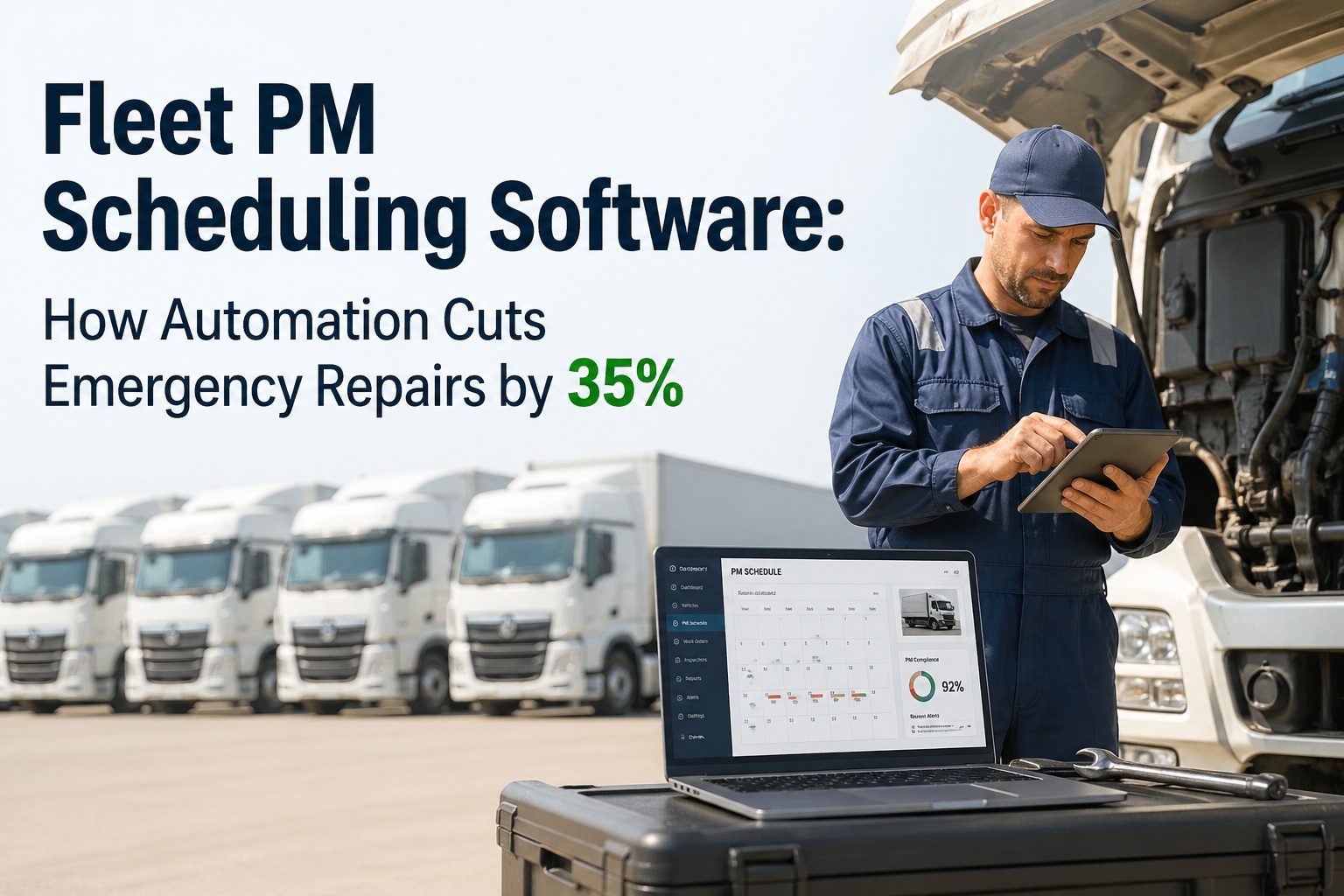
Preventive maintenance work orders generated automatically when mileage, engine hours, or calendar thresholds are reached. For heavy equipment: hours-based (250, 500, 1,000, 2,000 hr intervals). For trucks: mileage-based (every 10K-25K miles). Parts requirements calculated in advance from PM templates. Zero manual tracking, zero missed intervals.
OEM telematics systems (Cat Product Link, KOMTRAX, CareTrack, JDLink, Samsara, Geotab) broadcast diagnostic trouble codes and performance anomalies. A fault code triggers a work order with the DTC description, severity, and vehicle identification. AI-powered systems correlate fault patterns with historical failure data to predict urgency.
The most expensive source. Equipment has already failed. Emergency towing, field repair, rental replacement, and schedule disruption costs compound rapidly. Every breakdown work order should be analyzed: could this failure have been caught by inspection, PM, or telematics alert? If yes, the process failed — fix the process, not just the machine. Target: reduce breakdown-sourced work orders by 10% per quarter.
Step 2: Prioritization — Not All Work Orders Are Equal
Without systematic prioritization, urgent safety repairs get buried under routine PM tasks, and low-priority items consume technician time while critical defects wait. A priority matrix ensures the right work gets done first — every time.
Safety-critical defects: brake failures, steering issues, HV isolation warnings, structural cracks, fire hazards. Vehicle out of service until repaired. Push notification + SMS to shop supervisor immediately. Target response: under 2 hours. These feed directly into your CSA score — delay is not an option.
Defects affecting operation but not immediately dangerous: lighting failures, minor fluid leaks, inoperative gauges, HVAC issues. Vehicle may operate with limitations until repaired. Target: repair before next dispatch. Lighting defects are DOT "gateway violations" — they invite deeper inspections.
Wear items trending toward replacement: brake pads above minimum but wearing, tires above legal but nearing threshold, components with early degradation signs. Schedule for next planned downtime window. These are predictive maintenance opportunities — catching wear before it becomes failure.
Cosmetic issues, minor observations, items below action threshold but worth documenting for trend analysis. Log in the vehicle's history. Review at next scheduled service. No immediate action required but documentation ensures nothing is forgotten.
Step 3: Assignment — Right Tech, Right Parts, Right Time
Assignment is where most paper-based systems break down. The work order exists, but nobody knows who is doing it, whether parts are available, or when the vehicle will be ready. Digital assignment eliminates these gaps.
Match work orders to technicians by certification and skill set. Brake work goes to brake-certified techs. HV electrical goes to HV-trained techs. Engine work goes to engine specialists. Skill mismatch is a leading cause of low first-time fix rates (industry average: 65-75%, target: 90%+). Wrong tech = repeat visit = double the MTTR.
Before assignment, verify parts are in stock. If the brake chamber is not on the shelf, do not assign the work order — it will sit in "in progress" status while the tech waits. Check inventory, generate purchase request if needed, then assign when parts arrive. This single step eliminates the #1 cause of work-order-in-progress delays.
Distribute work orders across available technicians based on current queue depth, estimated repair time, and shift schedule. Overloaded techs produce lower quality work. Underloaded techs waste labor budget. Real-time workload dashboards prevent both extremes and ensure even distribution.
Tech receives work order on mobile device with: vehicle ID, location, defect description, photo evidence, priority level, parts status, and estimated repair time. No walking to the office. No reading the whiteboard. No waiting for a supervisor to hand out assignments. The work order arrives on the tech's phone the moment it is assigned.
Step 4: Execution — Capturing the Data That Matters
The repair itself is only half the value. The data captured during execution — labor time, parts consumed, work performed, additional issues found — is what builds your fleet intelligence over months and years.
Start/stop timer or manual entry per work order. Feeds wrench time KPI (how much of a tech's shift is actual repair vs waiting/walking/paperwork). Target: 60%+ wrench time. Low wrench time almost always points to process problems — parts delays, tool access, excessive documentation — not technician effort.
Every part used is linked to the work order and the vehicle. Auto-deducts from inventory. Feeds cost-per-vehicle, cost-per-work-order, and warranty tracking. Without parts linkage, your maintenance cost data is incomplete and fleet lifecycle decisions are guesswork. If a tech replaces a warranted part, the system flags it for claim recovery.
Notes, photos, measurements. "Replaced left front brake chamber — stroke was 2.25 inches (OOS limit: 2.0). Adjusted all positions to spec." This level of detail builds the repair history that informs future diagnostics and proves due diligence during audits and litigation.
During repair, the tech discovers a secondary problem. Best practice: spawn a new linked work order for the secondary issue — do not pile it into the original WO. Linked work orders maintain clean cost attribution and prevent scope creep that distorts completion time metrics.
Step 5: Closure — Completing the Compliance Chain
A work order is not complete when the repair is done. It is complete when the repair is documented, certified, costs are calculated, the vehicle is returned to service, and — for DVIR-sourced work orders — the FMCSA 3-signature chain is closed.
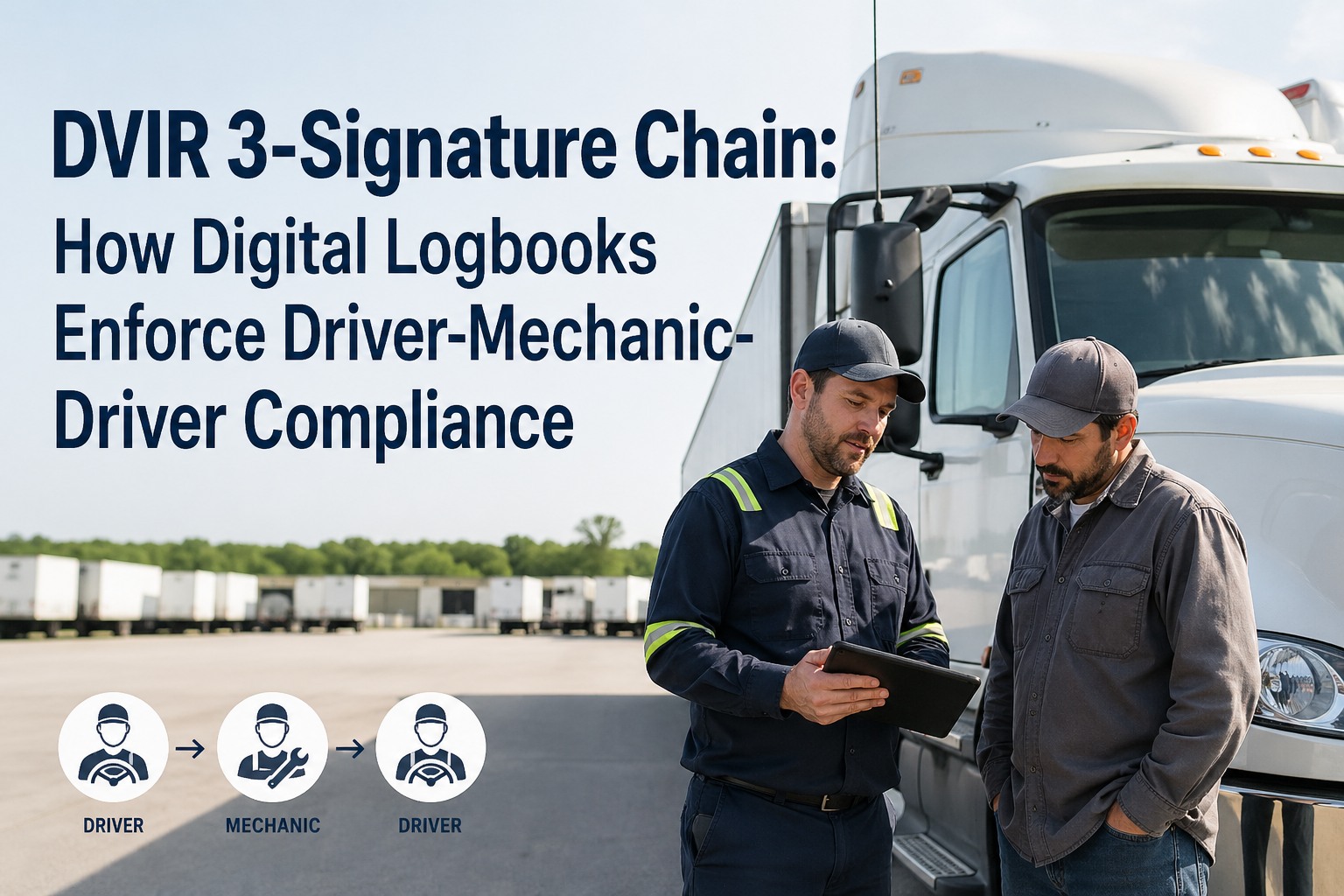
Technician certifies work performed with digital signature. For DVIR-sourced defects, this signature completes the FMCSA repair certification under 49 CFR 396.11(a)(3). One digital action satisfies both work order closure and DVIR compliance — without separate paperwork.
Total cost = labor hours x rate + parts consumed + any vendor/outsourced charges. This cost is attributed to the specific vehicle, building the cost-per-hour or cost-per-mile profile that drives keep-vs-replace decisions. Without accurate WO cost capture, your fleet financials are fiction.
Vehicle status changes from "out of service" or "in maintenance" to "available" immediately upon WO closure. Dispatch sees real-time availability. No phone calls asking "is truck 47 ready yet?" — the dashboard shows it the moment the WO closes.
Closed work order becomes permanent asset history. Searchable by vehicle, component, date, technician, cost. This archive is the raw material for trend analysis, lifecycle planning, warranty recovery, audit response, and litigation defense. Every closed WO makes your fleet data more valuable.
Step 6: KPIs — Measuring What Matters
Work order data is the richest source of fleet maintenance intelligence — if you track the right metrics. These six KPIs connect work order execution to fleet performance outcomes and financial results.
Every 10% shift toward planned reduces emergency costs. Reactive repairs cost 3-9x more than planned work. Track monthly and trend over quarters. The single most revealing metric of maintenance program maturity.
Measures the entire response chain: from defect discovery to vehicle returned to service. Long MTTR usually indicates parts availability problems or assignment delays — not slow technicians. World-class: 2-4 hours.
Only 28% of fleets achieve 95%+. Below 80% means the PM program is not working. Improving from 70% to 95% typically reduces breakdowns by 50%. Use the 10% rule: a PM must complete within 10% of its interval to count.
Low FTFR = inadequate diagnosis, wrong parts, or skill mismatch. Every comeback doubles the effective MTTR. Track by technician and repair type to identify training needs and systemic issues. Below 80% indicates a structural problem.
Growing backlog signals understaffing, parts shortages, or reactive emergencies displacing planned work. Track aging: work orders open 30+ days indicate systemic problems. Backlog is a leading indicator — rising backlog predicts future breakdowns.
Higher = more proactive. Measures what percentage of reactive work orders originate from driver inspections rather than breakdowns. If most reactive WOs come from breakdowns, your inspection process is not catching defects early enough.
HVI Work Order Management for Heavy Vehicle Fleets
HVI was built around the inspection-to-work-order pipeline. Defects flow directly to prioritized work orders with zero manual steps. Every work order connects to the inspection that created it, the parts consumed, the labor invested, and the vehicle it serves.
Driver reports defect in DVIR. Work order generates automatically with defect photo, severity, vehicle ID, and GPS location. Paper shops take 1-3 days for this handoff. HVI does it in under 60 seconds. That speed difference is now a direct CSA score factor under the 2026 Driver Observed category.
All open work orders sorted by severity, age, and vehicle criticality. Fleet managers see the complete maintenance picture at a glance. Filter by vehicle, technician, type, priority, or age. No work order is invisible. No critical repair is buried under routine tasks.
Techs view, update, and close work orders from their phone in the shop or field. Photo capture. Labor time tracking. Parts logging. Offline capable for remote locations. Repair certification flows back to the original DVIR, completing the FMCSA 3-signature chain with one action.
Labor + parts + vendor charges per work order. Aggregated to cost-per-hour, cost-per-mile, and total maintenance cost per vehicle. Compare identical assets: which trucks cost more? Rising cost-per-hour is a predictive signal for end-of-life. Budget vs actual tracking shows variances in real time.
Planned vs reactive ratio, MTTR, PM compliance, first-time fix rate, backlog aging, inspection-to-WO conversion — all calculated automatically from your work order data. No manual reporting. No spreadsheet calculations. The dashboard updates in real time as work orders move through the pipeline.
For every DVIR-sourced work order, HVI enforces the complete FMCSA 3-signature chain: driver reports defect → carrier/mechanic repairs and certifies → next driver confirms repair before operating. Every link is timestamped and digitally signed. The compliance chain is structurally impossible to break — not reliant on human memory or paper handoffs.
Frequently Asked Questions
The target is 80:20 (80% planned, 20% reactive). The industry average is 55:45. Every 10% shift toward planned reduces emergency costs because reactive repairs cost 3-9x more. Track this ratio monthly. If your fleet is below 60:40, the single highest-impact improvement is digitizing your inspection-to-work-order pipeline so defects become planned repairs before they become breakdowns. Book a demo to see how HVI shifts your heavy fleet from reactive to planned maintenance.
Safety-critical defects: under 2 hours from discovery to assigned work order. All other defects: same day. Paper-based shops average 1-3 days. Digital shops average 2-4 hours. Under the 2026 CSA overhaul, the "Driver Observed" Vehicle Maintenance category directly scores how quickly driver-reported defects are addressed. HVI generates work orders from inspection defects in under 60 seconds. Start your free trial of HVI's inspection-to-work-order pipeline for heavy vehicle fleets.
Start with five: planned vs reactive ratio (target 80:20), MTTR (target under 6 hours), PM on-time completion (target 95%+), first-time fix rate (target 90%+), and work order backlog aging (target under 2 weeks). These five KPIs give you the biggest operational insight for the effort invested. HVI calculates all of them automatically from your work order data — no manual reporting required. Book a demo to see HVI's automated KPI dashboard for heavy fleet maintenance.
The 2026 CSA overhaul split Vehicle Maintenance into two categories. The new "Driver Observed" category scores violations that drivers should have caught during walk-around inspections. This means your work order system's speed and completeness — how fast a driver-reported defect becomes an assigned, tracked, and completed repair — is now a direct, visible factor in your carrier safety profile. See how HVI's work order system protects your CSA score under the 2026 rules.
Yes — this is essential. Every part consumed should be logged against the specific work order and vehicle. This enables: accurate cost-per-vehicle calculations, automatic inventory deduction (preventing stockouts), warranty tracking (flagging warranted parts for claim recovery), and PM-driven parts forecasting. Without parts linkage, your maintenance cost data is incomplete and every fleet financial decision is compromised. Start your free trial of HVI's integrated work order and parts management for heavy fleets.
Yes. HVI supports tractors, trailers, reefers, straight trucks, buses, excavators, loaders, dozers, cranes, and specialty vehicles — all in one platform. Trucks use mileage-based PM triggers. Heavy equipment uses hours-based triggers. Each vehicle type gets the correct work order templates and inspection checklists. One system for your entire mixed fleet — no separate tools for separate vehicle types. Book a demo to see work order management across your entire heavy vehicle fleet.
Every Missed Work Order Is a Future Breakdown. Close the Gap Today.
Inspection defects become work orders in seconds. Parts are checked before assignment. Techs get mobile notifications with photos. Repairs are certified digitally. Costs flow to the right vehicle. KPIs calculate automatically. One platform connecting your entire heavy fleet maintenance operation.
No credit card • Trucks + heavy equipment in one platform • DVIR compliance chain built in • KPI dashboard included