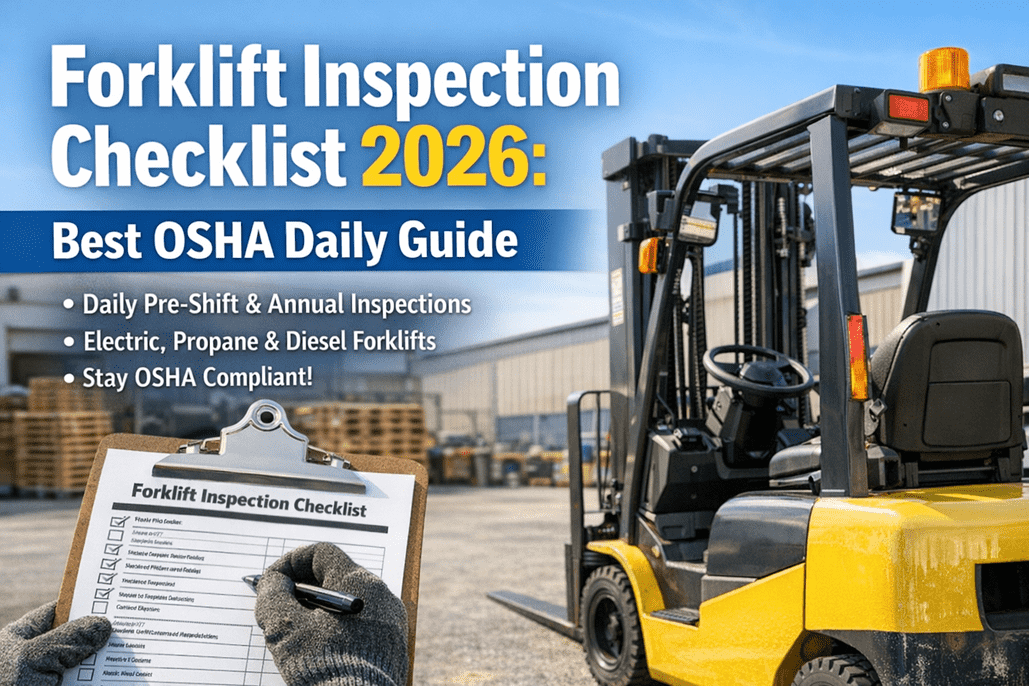
Powered industrial truck violations consistently rank among OSHA's top 10 most-cited standards — with over $15 million in forklift-related penalties in 2024 alone. OSHA 29 CFR 1910.178(q)(7) requires that forklifts be examined before being placed in service every shift, and forklifts used round-the-clock must be examined after each shift. Forklift accidents cause approximately 85 deaths and 34,900 serious injuries annually in the United States, and many of these could be prevented with proper pre-operation inspections. Whether you operate electric, propane, or diesel forklifts in warehouses, distribution centers, or manufacturing facilities, this guide gives you the complete OSHA-compliant inspection checklist — with power-type-specific checks, operational tests, and the documentation framework your compliance program needs. A thorough pre-shift inspection takes 5-10 minutes and prevents accidents that cost lives, OSHA fines up to $156,259 per willful violation, and equipment downtime. Book a demo to see HVI's forklift-specific digital checklists, or start your free trial.
Electric, Propane & Diesel Forklifts — Pre-Shift Visual Checks, Operational Tests & Compliance Documentation
Part 1: Pre-Start Visual Inspection (Key Off)
Begin with the forklift on level ground, key off, parking brake set. Walk around the entire machine. These checks apply to all forklift types — electric, propane, and diesel.
Part 2: Power-Type-Specific Checks (Key Off)
Each forklift type has unique inspection points. Complete the section that matches your forklift before starting the engine/motor.
Part 3: Operational Checks (Engine/Motor Running)
With the engine/motor running, test all operational systems before entering the work area. These checks apply to all forklift types.
Deploy Digital Forklift Checklists Across Your Facility
HVI provides pre-built forklift templates for electric, propane, and diesel units. Operators complete inspections in under 5 minutes on their phone. Defects auto-generate work orders. Compliance records are always audit-ready.
Out-of-Service Conditions (1910.178(q))
OSHA lists specific conditions that require immediate removal from service. If an operator encounters any of these during inspection or while driving, the forklift must be parked and reported.
Repairs must be made by authorized personnel only — 1910.178(q)(1). Operators should never attempt repairs unless trained and authorized to do so.
Frequently Asked Questions
Under 29 CFR 1910.178(q)(7), forklifts must be examined before being placed in service — meaning before each shift. Forklifts used on a round-the-clock basis must be examined after each shift. This is not a suggestion — it is a mandate. Failure to comply can result in citations ranging from $16,550 (serious) to $165,514 (willful). Powered industrial truck violations consistently rank in OSHA's top 10 most-cited standards.
No — OSHA does not prescribe a specific checklist format. The requirement is that forklifts be examined and that defective equipment be removed from service. However, using a standardized checklist (paper or digital) is the most reliable way to ensure nothing gets missed and to provide documentation of compliance. While OSHA does not specify record retention periods for daily inspections, best practice is to retain records for a minimum of 3 years.
Only operators who have been trained and evaluated in accordance with 29 CFR 1910.178(l) can operate and inspect forklifts. The operator performing the pre-shift inspection must understand what they are looking for and be authorized to remove equipment from service if defects are found. More detailed maintenance inspections should be performed by qualified maintenance technicians. Training must include truck-related topics, workplace-related topics, and practical evaluation.
The most frequently cited forklift violations include: inadequate operator training (1910.178(l)), failure to conduct daily inspections (1910.178(q)(7)), operating in unsafe conditions (1910.178(q)(1)), improper pedestrian safety measures, and failure to maintain equipment in safe condition. In 2024, forklift-related citations totaled over $15 million in penalties. Proper daily inspections documented with digital tools are the most effective defense against these citations.
A thorough pre-shift inspection — covering visual walk-around, power-type-specific checks, and operational tests — takes 5-10 minutes for experienced operators. New operators may need up to 15 minutes initially. With a digital checklist app, the process is faster because guided prompts ensure nothing is missed without requiring the operator to remember every item. Five minutes of inspection prevents accidents, OSHA fines, and equipment failures that cost far more in downtime.
Yes — each power type has unique inspection points. Electric forklifts require battery charge level, cable/connector condition, electrolyte level, and vent cap checks (with PPE for acid contact). Propane forklifts require LP tank mounting, pressure relief valve orientation, hose/connector condition, and leak detection. Diesel/gas forklifts require engine oil, coolant, fuel system, air filter, and exhaust checks. The walk-around, hydraulic, steering, brake, and safety device checks are the same across all types.
Digitize Forklift Inspections Across Your Facility
Pre-built templates for electric, propane, and diesel forklifts. Operators complete inspections in 5 minutes on their phone. Defects auto-generate work orders. Audit-ready compliance records from day one.
No credit card • No hardware • Setup in under 10 minutes • 29 CFR 1910.178 compliant