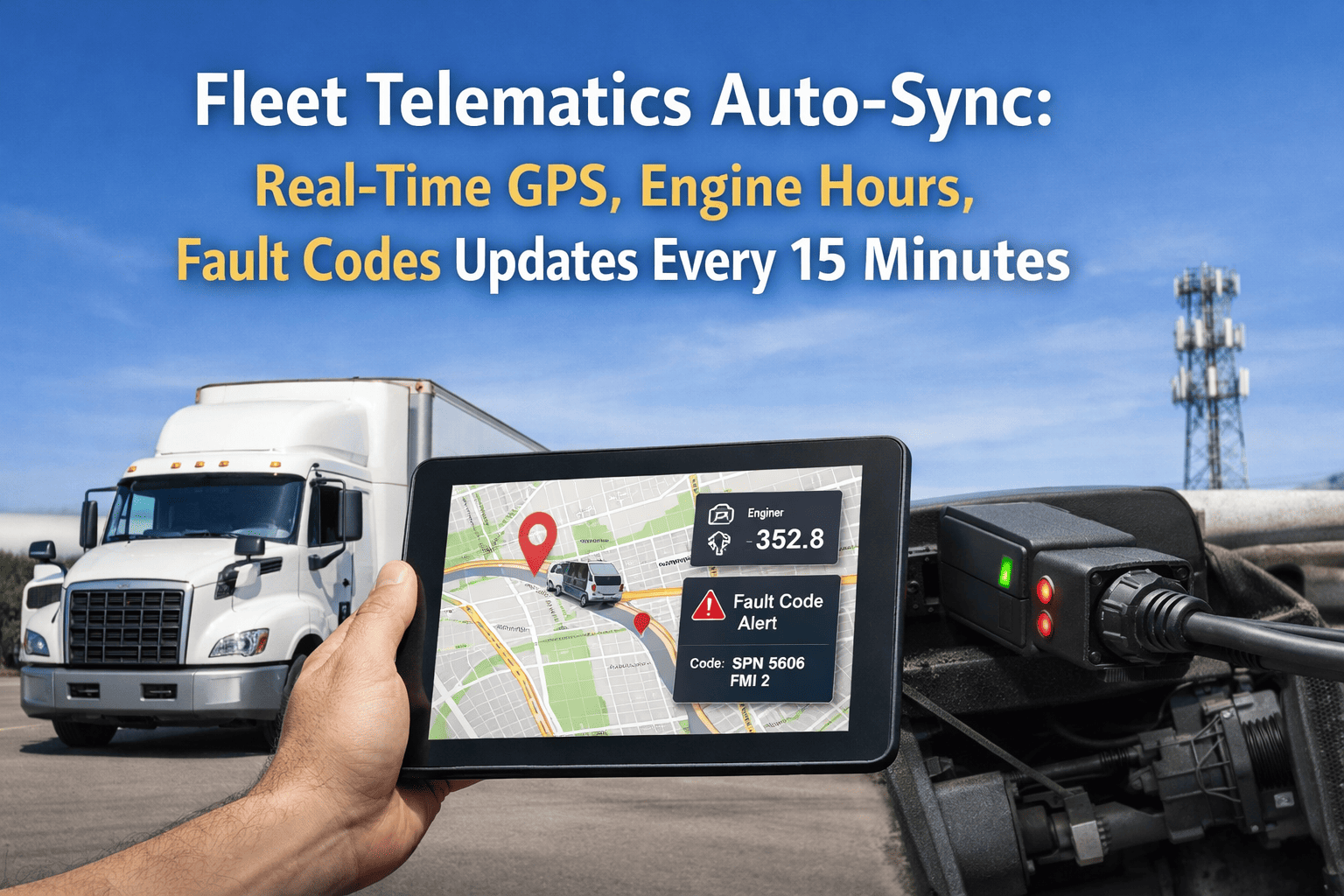
Every 15 minutes, HVI's fleet telematics auto-sync pulls live GPS position, engine hours, and fault codes from every vehicle in your fleet — without a single manual data entry. While your drivers are on the road, your dashboard is already updated: which vehicles are running hot, which engine fault codes just triggered, which units are approaching their next service interval. That is the difference between reactive fleet management and a fleet operation that stays ahead of problems before they become breakdowns. Start your free trial and connect your first vehicles today, or book a demo to see live telematics sync in action across your fleet.
What "auto-sync every 15 minutes" actually means for your fleet
Most fleet managers have experienced the frustration of looking at a dashboard and realising the data is hours old. A fault code triggered at 7am that no one actioned. A vehicle that has been idling for two hours but nobody knew. Engine hours that haven't synced since the last manual download. HVI's auto-sync closes that gap entirely — here is what updates every 15 minutes, automatically, with no driver action required.
Exact vehicle coordinates, route progress, current speed, and geofence status — updated continuously so your dispatch team always knows where every truck is.
Cumulative engine run time synced automatically to your maintenance schedule. HVI triggers service alerts the moment a vehicle hits its next PM interval — no manual calculations.
OBD-II and J1939 diagnostic trouble codes pulled directly from the ECU and pushed to your maintenance team with plain-English descriptions — not cryptic code numbers.
A composite health rating combining fault severity, service proximity, idle time, and inspection status — so managers see risk at a glance without reading raw data.
Real odometer readings and fuel level data synced directly — eliminating manual mileage entries and giving accurate fuel consumption tracking per vehicle, per route.
Excessive idling, hard braking, and speeding events tracked per driver and vehicle — giving fleet managers the data to coach drivers and reduce fuel waste.
The 15-minute sync advantage — what changes when data is always current
The gap between knowing about a problem and responding to it is where fleet costs are made or lost. Here is how HVI's 15-minute auto-sync compresses that gap across every data type that matters to your operations team.
| Data Point | Legacy / Manual | HVI Auto-Sync | Impact |
|---|---|---|---|
| Fault code detection | Next manual download (hours–days) | Within 15 minutes of trigger | Defect actioned same shift — not next week |
| Engine hours | Manual entry by driver or fleet admin | Auto-synced every 15 min from ECU | PM triggers on actual hours — not estimates |
| GPS location | Driver self-report or end-of-day log | Live position with 15-min refresh | Dispatch decisions based on real location |
| Idle time | Unknown until end-of-week report | Flagged same day, per vehicle | Coach drivers before fuel cost compounds |
| Service due alerts | Calendar-based or missed entirely | Triggered by actual engine hours & odometer | Never miss a service interval again |
| Fuel consumption | Fuel card receipts reconciled monthly | Per-vehicle, per-trip real-time tracking | Identify fuel waste and theft in real time |
How fault codes become work orders in under 15 minutes
The moment an engine fault code triggers on a vehicle in your fleet, a chain reaction starts inside HVI. Here is exactly what happens — from ECU signal to maintenance team action — with zero manual handoffs required.
A diagnostic trouble code (DTC) fires — anything from a minor sensor warning to a critical engine fault. The vehicle's OBD-II or J1939 system logs it immediately.
HVI's telematics hardware reads the fault code from the ECU and transmits it via cellular to the HVI cloud platform — included in the next 15-minute sync or triggered immediately for critical severity codes.
HVI converts the raw DTC into plain English, assigns a severity level (advisory / warning / critical), and cross-references the vehicle's maintenance history to determine urgency.
A maintenance work order is automatically generated with the fault code, plain-English description, vehicle ID, GPS location, and driver contact. Your team receives an instant alert and actions the job before the vehicle's next trip.
Real-time telematics ROI — what it adds up to
The financial case for 15-minute auto-sync telematics is not built on one big number — it is the accumulation of dozens of small wins, every single day, across every vehicle in your fleet.
The engine hours calculation that most fleets get wrong
| Fleet using calendar-based PM (every 90 days regardless of usage) | Over-services low-use trucks, misses high-use ones |
| Fleet using manual odometer entry (driver-reported, often estimated) | Avg. 340 km error per vehicle per quarter |
| Fleet using HVI engine hours auto-sync (direct ECU read every 15 min) | PM triggered on exact hours — every time |
| Result: PM cost difference per vehicle over 3 years | - $1,200–$1,800 saved per truck |
| 50-truck fleet, 3-year PM cost saving from accurate engine hours | $60,000–$90,000 |
Fault code severity — how HVI prioritises what needs action now
Not every fault code means pull the vehicle off the road. HVI's severity scoring system filters the noise and tells your maintenance team exactly what level of urgency each fault requires — so critical issues get immediate attention and advisory codes are tracked without creating false alarms.
Engine overtemperature, brake system faults, transmission failure codes, DPF critical regeneration failure. HVI triggers an immediate push alert to the dispatcher and maintenance team — vehicle should not complete its current run.
Elevated coolant temperature, EGR system faults, turbocharger performance degradation, ABS sensor faults. Vehicle can typically complete current shift but must be booked in for repair before next day's operation.
Oxygen sensor efficiency declining, minor exhaust system faults, evaporative emission codes, non-critical sensor calibration drift. Logged and tracked by HVI, addressed at the next scheduled PM — no emergency action required.
Frequently asked questions about HVI telematics auto-sync
Stop finding out about problems after they become breakdowns.
HVI's 15-minute auto-sync means your fleet's GPS, engine hours, and fault codes are always current — and your maintenance team is always one step ahead. Connect your vehicles today and see what real-time telematics intelligence looks like for your operation.
No credit card required · Works with existing telematics hardware · Fleet connected in under a day