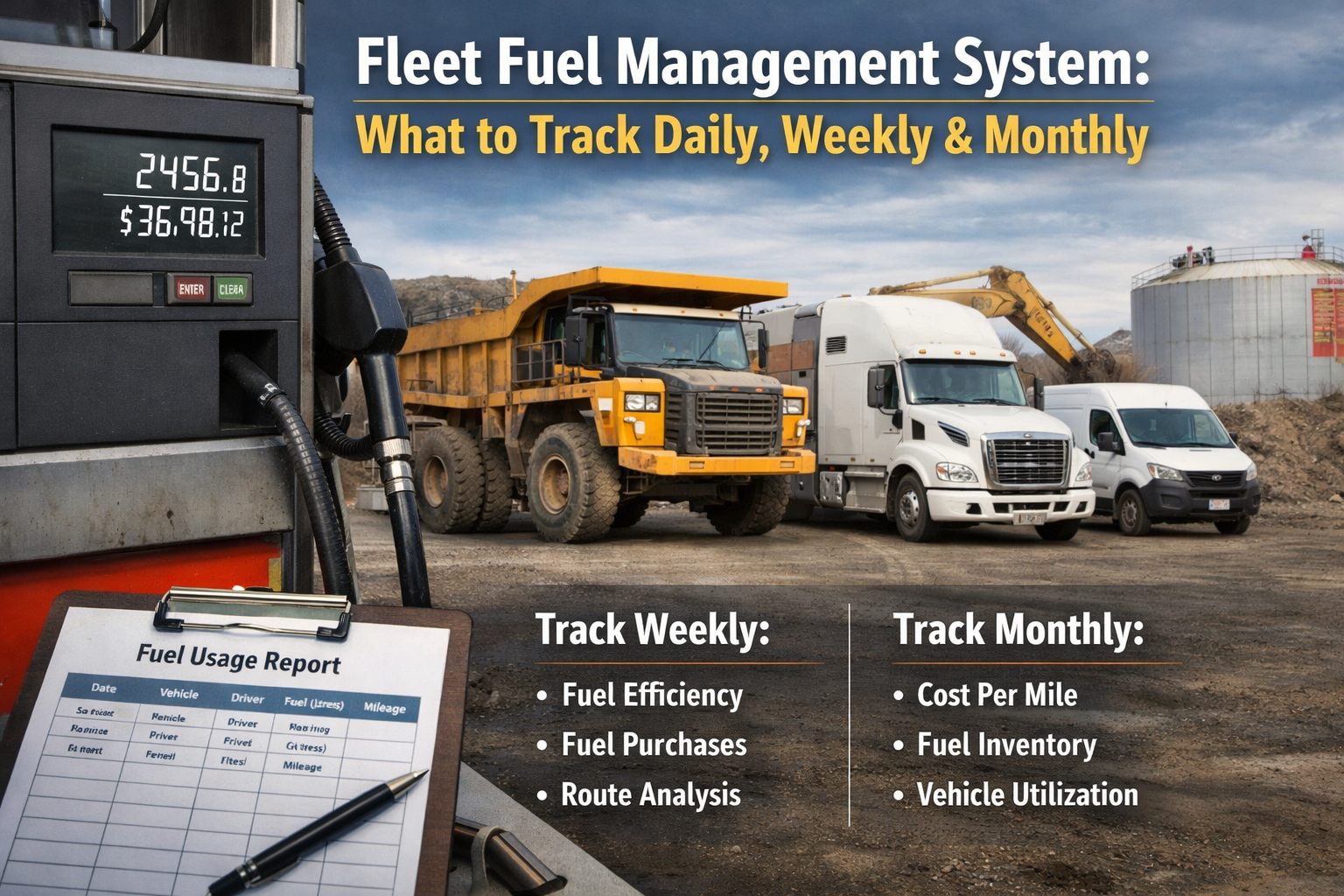
You're spending $87,000 monthly on fuel but can't explain why this month costs $12,000 more than last month. Without daily tracking, fuel waste is invisible. Fleet fuel management systems show exactly where money disappears—excessive idling, inefficient routes, aggressive driving, vehicle performance issues. Start tracking fuel metrics that actually reduce costs.
17%
Average Fuel Waste Without Daily Tracking
$8,700
Annual Waste Per Vehicle (Untracked Fuel)
12-18%
Fuel Savings With Systematic Tracking
90 Days
To Measurable Fuel Cost Reduction
Stop Guessing Where Fuel Money Goes
Track daily idle time, weekly route efficiency, and monthly performance trends with HVI's fuel management system.
Start Tracking
See Demo
Why Tracking Frequency Matters
- 30-day data lag - Problems continue entire month before detection
- Can't identify root causes - Too much data to pinpoint specific issues
- Slow response to waste - Thousands wasted before action taken
- Driver behavior unchecked - Bad habits become ingrained
Result: React to problems after thousands already wasted
- Real-time issue detection - Catch problems within 24 hours
- Pinpoint specific causes - Identify exact vehicle, driver, route issues
- Immediate intervention - Stop waste before it compounds
- Behavior correction - Coach drivers while issues are fresh
Result: Prevent waste before it accumulates
Daily Fuel Tracking Metrics
Daily Metric #1
Idle Time Per Vehicle
Track hours spent idling daily. Heavy vehicles burn 0.8-1.5 gallons per hour idling. Flag vehicles exceeding 30 minutes per 8-hour shift. Alert drivers immediately when idle limits exceeded.
Target:
Under 30 min idle per 8-hour shift
Daily Metric #2
Fuel Purchases & Anomalies
Monitor all fuel transactions daily. Catch unauthorized purchases, wrong fuel types, unusual quantities. Flag transactions outside normal parameters for immediate investigation.
Action:
Investigate anomalies within 24 hours
Daily Metric #3
Fuel-Up Volumes vs Tank Capacity
Compare fuel-up amounts to tank size. If driver adds 120 gallons to 100-gallon tank, you've got fraud or data errors. Catch fuel theft and reporting mistakes immediately.
Red Flag:
Fuel-up exceeds tank capacity by 10%+
Daily Metric #4
Critical Alerts & Exceptions
Review system-generated alerts for excessive idling, speeding, harsh braking events. Address critical fuel-wasting behaviors same day while incident is fresh in driver's mind.
Response:
Coach drivers on same day as incident
Weekly Fuel Tracking Metrics
Weekly Metric #1
MPG by Vehicle
Calculate miles per gallon for each vehicle weekly. Compare to baseline and fleet average. Flag 5%+ degradation indicating maintenance needs—tire pressure, air filters, alignment, engine issues.
Action Threshold:
5% MPG drop triggers inspection
Weekly Metric #2
Route Efficiency Analysis
Compare planned vs actual routes weekly. Identify drivers adding unnecessary miles, poor route choices, traffic inefficiencies. Calculate fuel cost of route deviations and optimize accordingly.
Optimization:
Focus on routes with highest deviation costs
Weekly Metric #3
Driver Behavior Scoring
Rank drivers by fuel efficiency metrics—MPG, idle time, harsh events, speed compliance. Publish scores weekly. Recognize top performers, coach bottom 20% on specific improvement areas.
Coaching:
Focus on bottom 20% drivers weekly
Weekly Metric #4
Fuel Theft & Fraud Detection
Review weekly patterns for fuel theft indicators—missing fuel between fill-ups, GPS location discrepancies at fuel-ups, driver-reported vs actual consumption gaps.
Investigation:
Flag 15%+ consumption discrepancies
Monthly Fuel Tracking Metrics
Monthly Metric #1
Fleet-Wide Fuel Cost Trends
Analyze total fuel spend month-over-month. Break down by cost per mile, cost per vehicle, cost per route. Identify trends—seasonal variations, efficiency improvements, emerging issues.
Benchmark:
Track cost per mile trending month-to-month
Monthly Metric #2
Vehicle Performance Benchmarking
Compare similar vehicles against each other monthly. Why does Truck #47 get 6.8 MPG while Truck #52 gets 5.9 MPG? Identify best performers and investigate underperformers systematically.
Analysis:
Investigate vehicles 10%+ below fleet average
Monthly Metric #3
Route Profitability Analysis
Calculate fuel cost per route monthly. Some routes may be unprofitable due to fuel consumption. Identify routes needing optimization, pricing adjustments, or elimination from service.
Decision:
Optimize or eliminate unprofitable routes
Monthly Metric #4
Improvement Program ROI
Measure results of fuel reduction initiatives monthly. Did idle reduction policy save projected amount? Did driver coaching improve MPG? Quantify ROI to justify continued investment.
ROI Tracking:
Compare actual vs projected savings monthly
Fuel Tracking Metrics Summary
| Frequency |
Key Metrics |
Action Threshold |
| Daily |
Idle time, fuel purchases, tank capacity checks, critical alerts |
Over 30 min idle, purchase anomalies, same-day coaching |
| Weekly |
MPG per vehicle, route efficiency, driver scores, theft detection |
5% MPG drop, high route deviation, bottom 20% drivers |
| Monthly |
Cost trends, vehicle benchmarking, route profitability, program ROI |
10% variance from target, unprofitable routes, ROI analysis |
Real Fleet Implementation Example
Baseline: $84K monthly fuel spend, no systematic tracking
Implemented daily idle monitoring, weekly MPG tracking, monthly trend analysis. Reduced idle time 58% first month. Identified 8 vehicles with maintenance-related MPG issues. Optimized 12 inefficient routes.
90-Day Result: $12K monthly savings (14% reduction)
Baseline: High idle hours, no driver accountability
Started daily idle alerts, weekly driver scorecards. Bottom 20% drivers coached on idle reduction. Implemented auto-shutoff policies. Top performers received monthly recognition.
90-Day Result: 1,100 idle hours eliminated, $47K savings
Baseline: Unknown route efficiency, inconsistent MPG
Weekly route analysis identified 23% unnecessary miles. Daily alerts caught fuel card fraud ($2,800 recovered). Monthly vehicle benchmarking found 14 vehicles needing maintenance.
90-Day Result: $18K monthly savings (11% reduction)
Critical Success Factor: Most fleets track fuel monthly then wonder why they can't reduce costs. Daily tracking catches problems within 24 hours—before hundreds of dollars waste. Weekly analysis identifies trends before they become expensive patterns. Monthly strategy ensures long-term optimization. The tracking frequency itself drives 60-70% of fuel savings.
Get a fuel tracking assessment showing what you should monitor.
Start Tracking What Actually Reduces Fuel Costs
HVI's fuel management system tracks daily idle, weekly MPG, and monthly trends automatically.
Start Tracking
See Demo
Frequently Asked Questions
Q
How much time does daily fuel tracking actually take?
15-20 minutes daily for automated systems. Review overnight idle alerts (2 min), check fuel purchase anomalies (3 min), address critical driver behavior issues (10 min). Weekly analysis adds 60-90 minutes. Monthly strategic review takes 2-3 hours. Total: ~1 hour weekly average. ROI is massive—$12K-$18K monthly savings for 50-vehicle fleet.
Q
What's the single most important fuel metric to track daily?
Idle time per vehicle. Heavy vehicles burn 0.8-1.5 gallons per hour idling—at 1,200 annual idle hours per vehicle, that's 960-1,800 wasted gallons ($3,360-$6,300). Daily idle tracking with immediate alerts delivers fastest ROI. Most fleets reduce idle 40-60% in first 30 days just by making it visible and addressing violations daily.
Q
Can we track fuel without expensive telematics systems?
Basic tracking is possible with fuel cards alone—you get purchase data and can calculate rough MPG. But you miss 70% of actionable insights: idle time, driver behavior, route efficiency, real-time MPG. Modern telematics costs $25-$45 per vehicle monthly—pays for itself if it saves just 3-4% fuel. For $1,000+ monthly fuel spend per vehicle, telematics ROI appears in 30-60 days.
Q
How quickly will we see fuel cost reduction?
Quick wins in 15-30 days—idle reduction shows immediate impact, addressing worst driver behaviors delivers fast savings. Full optimization takes 60-90 days as behavior changes solidify and route optimizations complete. Expect 5-8% reduction first month, 12-18% by month three. Most fleets recover telematics investment within 60 days from fuel savings alone.