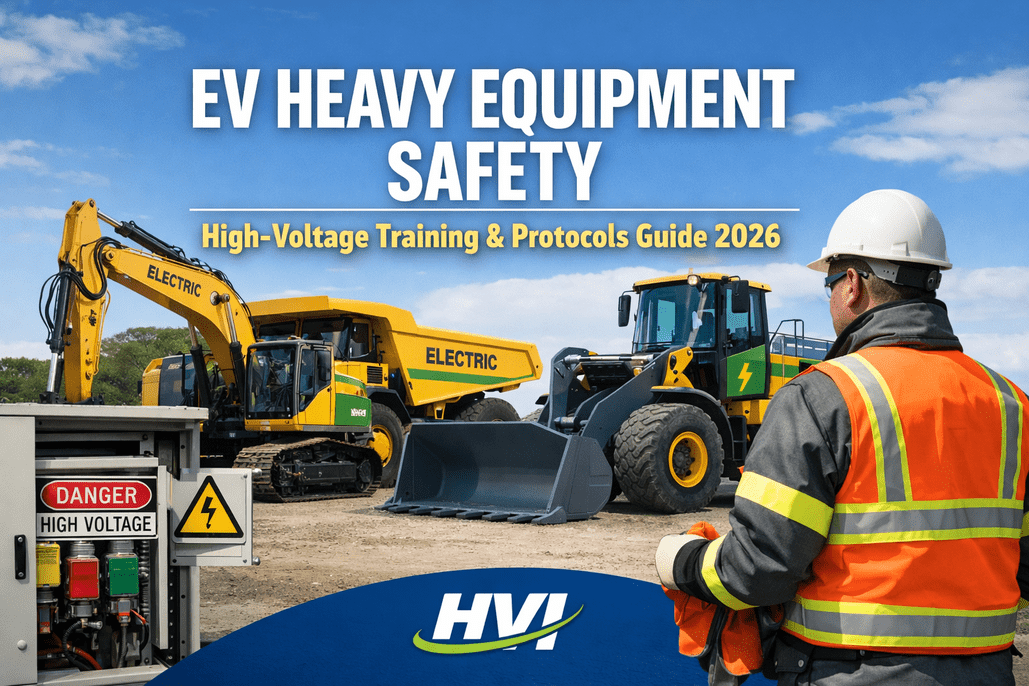
Electric heavy equipment introduces hazards that do not exist on diesel machines — and they can kill in ways that diesel equipment cannot. High-voltage battery packs operating at 400-800V DC deliver lethal shock on contact. Arc flash events reach 35,000°F and can cause fatal burns from several feet away. Thermal runaway in lithium-ion cells produces toxic gas, fire, and explosions that can reignite hours after initial suppression. These are not theoretical risks: over 2,070 workplace fatalities were caused by electrical contact in the US between 2011 and 2024, and construction workers account for 49% of all fatal electrical injuries despite being only 7% of the workforce. As electric excavators, trucks, loaders, and cranes enter fleets at scale — with the market projected to reach $29 billion by 2029 — every fleet needs a structured EV safety program before the first electric machine arrives. NFPA 70E sets the national standard for electrical safety in the workplace. OSHA's lockout/tagout standard (29 CFR 1910.147) and construction electrical standards (29 CFR 1926 Subpart K) apply directly. This guide covers high-voltage awareness training, lockout/tagout adapted for EV equipment, PPE requirements by role, emergency response for battery incidents, first responder protocols, and how to document EV safety compliance. Book a demo to see HVI's EV safety management features, or start your free trial.
HV Awareness Training, Lockout/Tagout, PPE by Role, Thermal Runaway Response, First Responder Protocols & Compliance Documentation
Why EV Safety Is Different from Diesel Equipment Safety
Diesel hazards are visible and intuitive — moving parts, hot surfaces, pressurized fluids. Electrical hazards are invisible. You cannot see, hear, or smell 600V DC waiting in a cable. A technician can touch an energized component and receive a lethal shock with zero warning. This fundamental difference is why EV safety requires a structured program, not just "be careful around the orange wires."
When you turn off a diesel engine, the hazardous energy stops. When you shut down an electric machine, the battery retains its full stored energy — potentially hundreds of kilowatt-hours. Disconnecting the HV system isolates the circuit but does not discharge the battery. Capacitors in inverters and motor controllers can retain lethal charge for minutes after isolation. Absence of voltage must be verified with a rated instrument — never assumed.
A damaged lithium-ion battery creates three simultaneous hazard categories: electrical (shock from stranded energy), thermal (self-heating reaching ignition temperatures), and chemical (toxic and flammable off-gassing including hydrogen fluoride). No single response protocol covers all three. EV safety training must address each hazard independently and in combination.
OSHA and NFPA 70E were written for fixed electrical installations — not mobile construction equipment with integrated battery packs. Fleet managers must adapt these frameworks to the unique context of EV heavy equipment: outdoor environments, dust, vibration, impact risk, and operators who are mechanics trained on diesel, not electrical engineers. The gap between existing standards and EV-specific needs is where accidents happen.
High-Voltage Awareness Training: 3-Tier Framework
Not everyone needs the same level of training. The industry best practice — aligned with NFPA 70E and OEM recommendations — uses a three-tiered structure based on exposure level and task requirements.
Who: All personnel who may be near EV equipment — operators, site workers, supervisors, dispatchers
Content: Identify HV components (orange cable coding), recognize HV warning labels, understand shock/arc flash/thermal runaway hazards, know what NOT to touch, emergency disconnect location, basic emergency response (evacuate, call 911, do not attempt rescue from energized source without proper equipment)
Duration: 2-4 hours initial, annual refresher
Outcome: Personnel can safely operate EV equipment and perform visual-only daily inspections without touching HV components
Who: Maintenance technicians who verify system shutdown and perform work on HV components in a de-energized, verified state
Content: OEM shutdown and isolation procedures, lockout/tagout for EV systems, absence-of-voltage verification using CAT III 1000V multimeter, PPE selection per NFPA 70E hazard risk category, safe approach distances, stored energy identification and discharge, documentation requirements
Duration: 8-16 hours initial, refresher every 3 years per NFPA 70E (or after equipment changes/incidents)
Outcome: Technician can safely de-energize, lock out, and perform maintenance on HV systems in a verified safe state
Who: Specialized electricians and advanced technicians who must work on or near energized HV components (diagnostics, testing, troubleshooting)
Content: All Level 2 content plus: energized work permits, arc flash hazard analysis, shock protection boundaries (limited/restricted/prohibited approach), live-working PPE (Category 2-4 arc-rated clothing), diagnostic procedures on energized systems, IEEE 1584 incident energy calculations
Duration: 24-40 hours initial, refresher every 3 years
Outcome: Qualified electrician can safely diagnose and test energized HV systems with proper PPE and procedures
Lockout/Tagout (LOTO) for Electric Heavy Equipment
OSHA 29 CFR 1910.147 and NFPA 70E Article 120 govern LOTO. For EV equipment, standard LOTO must be adapted to address multiple energy sources: HV battery, low-voltage auxiliary battery, capacitors, and pneumatic/hydraulic stored energy.
Review OEM documentation. EV equipment has at minimum: HV battery pack (400-800V), low-voltage auxiliary battery (12V/24V), capacitors in inverter/motor controller, hydraulic stored pressure, and pneumatic pressure (air brakes). Each source requires separate isolation. Use up-to-date diagrams — modifications may have added sources not on original drawings.
Inform operators, nearby workers, and supervision that the equipment is being locked out. Establish a safe work zone with barriers/signage — minimum 1 meter from the vehicle per industry practice. NFPA 70E requires involvement of every person who may be directly or indirectly exposed.
Follow OEM-specific shutdown procedure. Typically: (a) power down the machine via normal controls, (b) disconnect the low-voltage auxiliary battery and insulate terminal, (c) remove conductive personal items, don HV-rated PPE, (d) unlock and disconnect the HV service plug/disconnect, (e) wait manufacturer-specified time for capacitor discharge (typically 5-10 minutes).
Each authorized worker applies their own individual lock and tag to each energy isolation point. Use multi-lock hasps when multiple workers are involved. Locks must be durable, standardized, and identify the individual. Tags must include worker name, date, and reason for lockout. Keep vehicle key/fob secured and away from the machine.
Using a CAT III 1000V rated multimeter: (a) verify the meter is functioning correctly on a known live source, (b) test between all HV conductors phase-to-phase and phase-to-ground, (c) verify meter still functions correctly after testing. This "live-dead-live" verification is non-negotiable — it is the final confirmation that de-energization was successful. Never skip this step.
After verifying absence of HV voltage: release hydraulic pressure (lower all implements to ground), bleed pneumatic pressure (drain air tanks), and ground any conductors that could carry induced voltage. Only after all stored energy is released is the equipment in an electrically safe work condition per NFPA 70E Article 120.
PPE Requirements by Role
Emergency Response: Battery Thermal Runaway
Sizzling, popping, or hissing from battery area. Smoke or vapor from enclosure. Strong chemical or sweet odor. Sparks. Rapidly rising battery temperature on dashboard. Leaking or dripping fluid. Any of these = potential thermal runaway in progress.
Move all personnel to minimum 50-foot (15-meter) perimeter. Upwind if possible — thermal runaway produces toxic hydrogen fluoride gas. Do NOT attempt to suppress without SCBA and proper training. Do NOT attempt to disconnect HV system during active thermal event.
Call 911. Explicitly inform dispatch: "Lithium-ion battery thermal event on [equipment type] at [location]." This triggers different response protocols than a standard vehicle fire. Provide: equipment type, battery size if known, number of personnel in area, wind direction.
Contrary to common belief about electrical fires, water is the recommended agent for lithium-ion thermal runaway. The goal is cooling internal cell temperature to stop the chain reaction — not electrical suppression. Large volumes of water are needed (3,000+ gallons for vehicle-scale batteries). Standard ABC extinguishers are insufficient.
Lithium-ion batteries can reignite hours or even days after initial suppression. The thermal runaway chain reaction continues internally even when external flames are extinguished. Maintain monitoring for minimum 24 hours. Do not move the equipment until battery temperature stabilizes and is verified by a qualified EV technician.
First Responder Protocols for EV Equipment Incidents
Assume the HV system is live until confirmed otherwise. Identify the equipment type and locate the emergency disconnect (usually marked with a yellow/red label). Check for thermal runaway indicators before approaching. Establish a perimeter. Do not touch the vehicle until HV status is determined. Orange cables = high voltage.
If an operator is trapped and the HV system may be energized: use non-conductive rescue tools. Do NOT cut, pry, or drill into any part of the battery enclosure or orange-coded components. If the vehicle is in water, do not enter the water until the HV system is confirmed isolated. Follow OEM emergency response guide — each model has specific cut zone diagrams showing where it is safe to cut and where HV components run.
After an accident involving EV equipment: the battery may have sustained internal damage not visible externally. Internal damage can trigger delayed thermal runaway — hours or days later. The vehicle should be moved to an outdoor isolation zone (minimum 50 feet from buildings and other vehicles), monitored for 48-72 hours, and assessed by a qualified EV technician before any repair or transport decision.
EV Safety Compliance Documentation
Document: employee name, training level completed (1/2/3), date, trainer/provider, certificate number. NFPA 70E mandates retraining at minimum every 3 years — or after equipment changes or incidents. Retain records for employment duration plus 3 years.
Equipment-specific written LOTO procedures for each EV model in your fleet. Must include: all energy sources identified, isolation points, discharge steps, verification method, and PPE required. Generic procedures are not compliant — each model has different service plug locations and sequences.
Insulating glove testing every 6 months per ASTM D120. Pre-use visual inspection documented. Insulated tool inspection per ASTM F1505. Arc-rated clothing inspection for damage. All test records retained. Defective PPE must be immediately removed from service and replaced.
Any electrical shock event, arc flash exposure, thermal runaway incident, or near-miss must be documented: date, location, equipment, personnel involved, root cause analysis, corrective actions. OSHA recordable if injury occurs. Near-miss reporting is equally critical — it drives preventive improvements.
HVI EV Safety Management Features
Pre-built digital checklists with HV safety items: battery enclosure, orange cable condition, charging port, BMS warnings, thermal management — all with "DO NOT TOUCH" prompts for operators. Vehicle-ID auto-loads diesel or EV template.
Track each employee's HV training level (1/2/3), completion date, expiration date, and certification provider. Automated alerts when retraining is due (3-year NFPA 70E cycle). Ensure only Level 2+ personnel are assigned to HV maintenance tasks.
Track glove testing dates (6-month cycle), arc-rated clothing inspections, insulated tool certifications. Alerts before expiration. PPE assigned per employee with inspection history. Audit-ready documentation of your PPE program.
Store equipment-specific written LOTO procedures for each EV model. Link to vehicle records. Technicians access the correct procedure on their phone before starting work — no generic templates, no guessing at isolation points.
Digital incident reports with photo documentation, root cause categories, corrective action tracking, and management sign-off. Near-miss reports treated with the same urgency. Trend analysis identifies systemic safety gaps before they cause injuries.
If charging temperatures or BMS readings exceed thresholds, HVI generates pre-shift alerts before the next operator approaches the machine. Bridges the gap between daily inspections and real-time monitoring — catching thermal management issues before they become thermal events.
Training Resources & Certification Guide
The national standard for workplace electrical safety. Covers arc flash, shock protection, LOTO, and PPE requirements. Available through multiple providers (OSHA Training Institute, ClickSafety, National Safety Council). Required refresher every 3 years.
OSHA 10-hour (workers) and 30-hour (supervisors) construction training includes electrical safety fundamentals under Subpart K. Provides OSHA DOL card. Required for construction site access in many jurisdictions. Covers LOTO basics but not HV-specific EV content.
Cat, Volvo, Komatsu, JCB, Daimler, and other OEMs offer model-specific HV safety training through their dealer networks. Critical for Level 2+ technicians — covers model-specific service plug locations, LOTO sequences, diagnostic procedures, and emergency disconnect locations. Check with your dealer for availability.
ASE (Automotive Service Excellence) offers the xEV High-Voltage Electrical Safety Standards certification. While automotive-focused, the HV safety principles apply directly to heavy equipment. Covers PPE, approach boundaries, de-energization, and verification procedures. Recognized industry-wide.
Frequently Asked Questions
Yes — Level 1 HV Awareness training (2-4 hours). Operators must be able to identify HV components, understand what they must not touch, recognize thermal runaway signs, know the emergency disconnect location, and respond correctly to EV emergencies. They do NOT need Level 2 or 3 training unless they perform maintenance on HV systems. Annual refresher is recommended.
OSHA 29 CFR 1910.147 provides the general LOTO framework. EV-specific LOTO adds: multiple energy sources (HV battery, LV battery, capacitors, hydraulic, pneumatic), manufacturer-specific shutdown sequences, waiting periods for capacitor discharge, HV-rated PPE during isolation, and "live-dead-live" voltage verification. Generic LOTO procedures are insufficient — each EV model requires a specific written procedure.
The goal is cooling internal cell temperature to stop the chain reaction — not electrical suppression (which is the concern with water and electrical fires). Lithium-ion thermal runaway is a chemical exothermic reaction that continues regardless of oxygen availability. Only reducing cell temperature stops it. Large volumes of water (3,000+ gallons for vehicle-scale batteries) are required. ABC extinguishers and CO2 extinguishers are insufficient — they cannot cool the cells fast enough. Fire departments are trained on this protocol.
NFPA 70E mandates retraining at minimum every 3 years for Levels 2 and 3. Additionally, retraining is required after: equipment changes (new EV models added to fleet), incidents or near-misses, changes in work practices, or whenever an employee demonstrates inadequate knowledge. Level 1 awareness training should be refreshed annually — best practice, not regulatory minimum. Insulating gloves must be retested every 6 months regardless of training schedule.
Training records (employee, level, date, provider, expiration), written LOTO procedures per equipment model, PPE inspection/testing records (gloves every 6 months), incident/near-miss reports with root cause analysis, electrical safety program documentation, and arc flash hazard analysis for facilities where EV equipment is serviced. All records must be accessible during OSHA inspections. Digital platforms like HVI centralize this documentation with automated expiration tracking.
For standard mechanical systems (hydraulics, undercarriage, tracks, boom, brakes, cab) — yes, with no additional training beyond what they already have. For any work involving HV components (battery, HV cables, inverter, motor, charging system) — no, not until they complete Level 2 training at minimum and are equipped with proper HV-rated PPE. The transition path: start with Level 1 awareness for all technicians, then send 1-2 per shift through Level 2 OEM-specific training to create your in-house EV-qualified team.
Build Your EV Safety Program Before Your First Electric Machine Arrives
HVI tracks HV training levels, PPE compliance, LOTO procedures, incident reports, and EV-specific inspection checklists — all in one platform. Mixed fleet ready. NFPA 70E aligned. Audit documentation built-in.
No credit card • No hardware • Diesel + Electric fleets • NFPA 70E / OSHA aligned