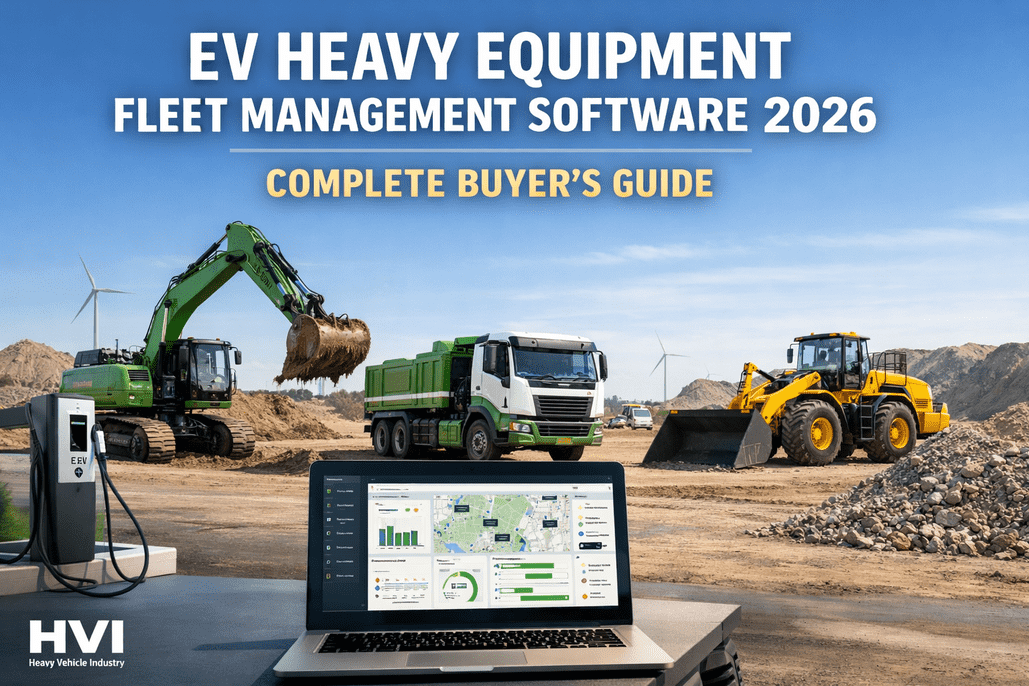
Electric heavy equipment is no longer experimental. Cat's 320E electric excavator, Volvo's EC230 Electric, Komatsu's PC210E, the Liebherr R 9150e mining shovel, and electric yard trucks from BYD and Kalmar are in commercial service today. The global EV fleet management software market reached $9.1 billion in 2025 and is projected to hit $32.25 billion by 2030 at a 22.7% CAGR. 64% of fleet professionals already operate some electric vehicles, and 87% plan electrification within five years. But here is the operational reality most vendors will not tell you: you cannot manage an electric heavy equipment fleet with software built for diesel machines. EV heavy equipment introduces entirely new inspection requirements (400-800V high-voltage systems, battery thermal management, regenerative braking calibration), different maintenance intervals (50% fewer moving parts but new critical systems), charging infrastructure management (depot scheduling, demand charge optimization, grid capacity planning), and battery lifecycle tracking that determines when a $150,000+ battery pack reaches end-of-life. Most fleets will run mixed diesel and electric equipment for the next decade — your software must handle both powertrains on one platform without forcing operators to switch between systems. This guide covers the unique challenges of EV heavy equipment fleet management, the must-have software features, mixed fleet strategies, battery lifecycle tracking, and how HVI handles the transition. Book a demo to see HVI's EV fleet capabilities, or start your free trial.
Electric excavators, loaders, and haul trucks need specialized fleet software. Battery lifecycle tracking, HV safety inspections, mixed diesel/EV management, charging infrastructure — all on one platform.
Unique EV Heavy Equipment Fleet Challenges
Electric heavy equipment operates at lethal voltages. Pre-shift inspections must verify HV interlock integrity, orange cable condition (SAE J1673), insulation resistance, and coolant levels in battery thermal management systems. Standard diesel checklists do not cover these items — and missing them is a safety-critical failure. Arc flash risk reaches 35,000°F.
A $150,000+ battery pack does not fail suddenly — it degrades over thousands of charge cycles. State of Health (SOH) drops from 100% to 70-80% over 3,000-5,000 cycles depending on temperature management, depth of discharge, and charging patterns. Your software must track SOH per machine over time and predict when replacement is needed — before the machine can no longer complete a shift.
Lithium-ion battery thermal runaway can reach 1,000°C+ and is extremely difficult to extinguish. Pre-shift thermal management checks are safety-critical: coolant levels, cooling fan operation, battery temperature within range, no swelling or discoloration. Your inspection template must include thermal-specific items that trigger immediate out-of-service if anomalies are detected.
EV heavy equipment has 50% fewer moving parts than diesel — no engine oil, no transmission fluid, no exhaust aftertreatment. But it introduces new critical maintenance: battery module balancing, inverter inspection, electric motor bearing lubrication, regenerative braking calibration, and charging connector wear. PM schedules must be rebuilt from scratch for electric powertrains.
Depot charging for heavy equipment consumes 200-600+ kWh per machine per charge. Without smart scheduling, demand charges can exceed the electricity cost itself. Your software must coordinate which machines charge when, manage grid capacity limits, support time-of-use rate optimization, and track charger availability — especially when multiple machines return from shift simultaneously.
No fleet will go 100% electric overnight. Most operations will run mixed diesel and electric equipment for the next decade. Your software must manage both powertrains on one platform: diesel PM schedules (oil, filters, exhaust) alongside EV PM schedules (battery, inverter, thermal) — without forcing operators to learn two different systems or maintain two separate databases.
Must-Have Software Features for Electric Heavy Equipment
Real-time State of Charge (SOC) and State of Health (SOH) tracking per machine. Historical degradation curves. Alerts when SOH drops below configurable thresholds (e.g., 80%). Replacement cost forecasting based on degradation rate. Integration with OEM BMS data where available.
Pre-shift checklists covering HV interlock verification, orange cable condition, battery thermal system, coolant levels, charging port condition, regenerative braking function, electric motor operation, and emergency disconnect accessibility. Not adapted diesel checklists — purpose-built for electric powertrains.
Track charger status, availability, and utilization. Smart scheduling to minimize demand charges. Time-of-use rate optimization. Multi-charger coordination when fleet returns from shift. Energy consumption per machine per charge cycle. Integration with OCPP-compliant charging hardware.
Battery temperature tracking with configurable alert thresholds. Cooling system inspection prompts in every pre-shift template. Thermal runaway risk assessment documentation. Emergency response protocol references. Integration with OEM thermal monitoring systems for real-time data.
Side-by-side total cost of ownership per machine: energy cost vs fuel cost, maintenance cost comparison, battery depreciation, charger infrastructure amortization. Per-hour operating cost for each powertrain type. Data-driven evidence for electrification expansion decisions.
PPE verification for HV-qualified technicians (Class 0 insulating gloves per ASTM D120). Lockout/tagout (LOTO) procedure documentation for HV systems. HV training certification tracking with expiry alerts. Arc flash hazard assessment records. Emergency shutdown procedure sign-off per machine.
Mixed Fleet (EV + Diesel) Management
Battery Lifecycle Tracking
Battery installed. Baseline capacity recorded. Charging patterns established. Initial degradation rate benchmarked over first 200 cycles. OEM warranty terms documented. Thermal management system verified.
Normal operating range. SOH tracked per charge cycle. Degradation rate monitored against OEM projections. Alerts if degradation accelerates beyond expected curve. Maintenance items: module balancing, coolant system service, contactor inspection.
Reduced range per charge. Machine may not complete full shift. Increased monitoring frequency. Replacement planning triggered. Budget forecasting for $150K+ battery pack. Second-life assessment (stationary energy storage potential).
Battery replacement required for continued heavy equipment use. Old pack assessed for second-life applications (BESS). New battery installed — lifecycle tracking resets. Historical data retained for fleet-wide degradation analysis and future procurement planning.
HVI EV Fleet Capabilities
Pre-built checklists for electric excavators (Cat 320E, Volvo EC230E, Komatsu PC210E), electric loaders, electric yard trucks, and electric haul trucks. Each template covers HV system checks, battery thermal management, regenerative braking, charging port condition, and emergency disconnect — items that do not exist on diesel checklists.
Per-machine battery health tracking over time. SOH degradation curve visualization. Configurable alerts at threshold levels (90%, 80%, 75%, 70%). Replacement cost forecasting. Charge cycle counting. Integration with OEM battery management system data where available via telematics API.
Diesel and electric equipment managed on the same dashboard. System auto-loads the correct inspection template based on equipment type and powertrain. Diesel machines get engine/fluid/exhaust checklists. Electric machines get battery/HV/thermal checklists. Operators never see the wrong checklist. Unified reporting across both powertrains.
HV technician certifications with expiry tracking (NFPA 70E 3-year retraining cycle). PPE compliance documentation (ASTM D120 glove testing 6-month cycle). LOTO procedure records per machine. Arc flash hazard assessments. Emergency response protocol acknowledgments. Only HV-certified personnel can be assigned to EV work orders.
Side-by-side cost-per-hour for each powertrain type. Energy cost vs fuel cost. Maintenance cost comparison over time. Battery depreciation factored in. Charger infrastructure amortized per machine. Data-driven evidence to support (or delay) further electrification investments based on your actual operational data.
EV inspections work offline — just like diesel inspections. Battery checks, HV system verification, photo capture, digital signatures — all without cell signal. Critical for construction sites and remote operations where electric equipment is increasingly deployed but connectivity remains limited.
Frequently Asked Questions
Yes — this is a core capability. HVI auto-loads the correct inspection template based on equipment type and powertrain. Diesel machines get engine, fluid, exhaust, and filter checklists. Electric machines get battery, HV system, thermal management, and regenerative braking checklists. Operators see only the checklist relevant to the machine they are inspecting. All data — diesel and electric — appears on one unified dashboard for fleet managers.
HVI tracks battery SOH per machine over time, logging charge cycles and capacity measurements. The dashboard visualizes degradation curves per machine. Configurable alerts trigger at threshold levels (e.g., when SOH drops below 80%). Replacement cost forecasting uses the degradation rate to estimate when the battery will reach end-of-life. Where OEM BMS data is available via telematics API, HVI can ingest real-time SOH data automatically.
HVI includes pre-built templates for Cat 320E Electric, Volvo EC230 Electric, Komatsu PC210E, JCB 220X Electric, Develon electric excavators, BYD electric yard trucks, Kalmar electric terminal tractors, and other electric heavy equipment. Custom templates can be created for any machine type. OEM telematics integration supports Cat Product Link, Volvo CareTrack, and Komatsu KOMTRAX for automatic data sync.
HVI tracks charging events per machine (energy consumed, charge duration, charger used) and integrates with OCPP-compliant charging hardware for real-time status. Charging data feeds into cost-per-hour calculations. For full depot charging optimization (smart scheduling, demand charge management, TOU rate optimization), HVI can integrate with dedicated charging management platforms or operate alongside them as the inspection and maintenance layer.
HVI maintains separate PM schedules per powertrain type. Diesel PM: 250/500/1,000 hour oil, filter, exhaust intervals. EV PM: battery module balancing, inverter inspection, electric motor bearing lubrication, coolant system service, regenerative braking calibration, charging connector inspection. The system knows which PM tier applies to which machine based on its powertrain type — no manual selection required.
HVI supports documentation for NFPA 70E (electrical safety), OSHA HV work requirements, SAE J1673 (HV cable standards), ASTM D120 (insulating glove testing), and OEM-specific HV safety protocols. HV technician certification tracking ensures only qualified personnel are assigned to EV maintenance. LOTO procedure documentation, arc flash assessments, and emergency response protocols are all tracked per machine and per technician.
HVI manages both diesel and EV heavy equipment on one platform. EV-specific inspections, battery lifecycle tracking, HV safety compliance, mixed fleet support. One dashboard. One system. Both powertrains.
No credit card • No hardware • Works offline • Diesel + EV on one platform