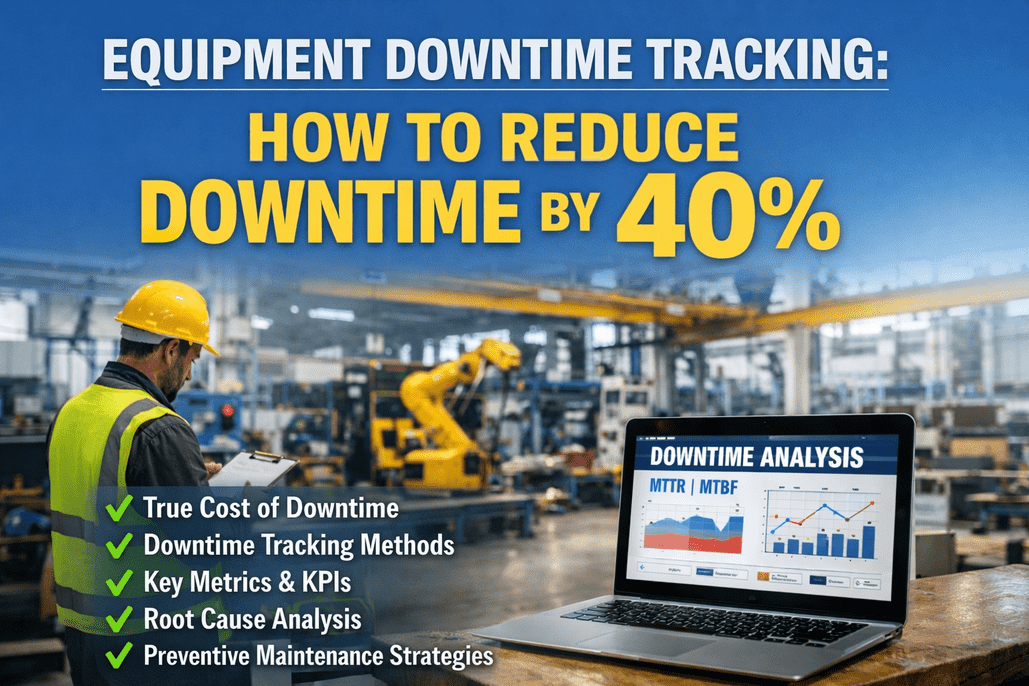
Unplanned downtime costs U.S. manufacturers and fleet operators an estimated $50 billion annually. The average facility faces 800 hours of unplanned equipment downtime per year — more than 15 hours every week of paid, non-productive time. Aberdeen Research pegs the average cost at $260,000 per hour, while ABB's Value of Reliability report found two-thirds of companies deal with unplanned downtime at least once per month at $125,000 per hour. Yet over 80% of companies cannot correctly calculate their true downtime costs, and 67% still rely on reactive maintenance. This guide covers the complete downtime reduction framework: cost calculation, tracking methods, KPI dashboards, root cause analysis, preventive strategies, and the CMMS software that ties it all together. Book a demo to see how HVI's equipment tracking and inspection platform helps fleets and facilities cut unplanned downtime by 40% or more.
From Reactive Firefighting to Predictive Control — The Complete Framework
1. The True Cost of Equipment Downtime
Most organizations dramatically underestimate downtime costs because they only count the obvious: repair parts and labor. The true cost is a cascade of direct, indirect, and hidden expenses that can be 5-10x the visible repair bill.
2. Downtime Tracking Methods
You can't reduce what you don't measure. The gap between perceived and actual downtime is typically 30-50% — most operations dramatically underestimate how much time equipment actually sits idle. Effective tracking starts with choosing the right method for your operation's maturity level.
Manual Logging
Operators record downtime start/stop times, equipment ID, and reason codes on paper or spreadsheets. Low cost, easy to start, but suffers from inconsistent recording, delayed entry, and subjective reason coding. Data quality degrades over time.
Digital Inspection Forms + CMMS
Mobile apps guide operators through standardized downtime capture: timestamps, photo evidence, categorized reason codes, and severity tags. Data feeds directly into a CMMS for trending and analysis. Eliminates paper lag and improves reason-code consistency.
IoT Sensors + Automated Detection
Machine-connected sensors automatically detect when equipment stops, starts, or operates outside parameters. Real-time dashboards show live status across all assets. Eliminates human reporting lag entirely — the system knows the machine is down before the operator logs it.
3. Key Downtime KPIs and Metrics
Tracking downtime without the right KPIs is like having a speedometer without a target speed. These six metrics form the core of any downtime management dashboard — each measures a different dimension of equipment reliability and maintenance effectiveness.
Measures equipment reliability. Higher = more reliable. Track per asset and per asset class to identify which equipment fails most frequently. A declining MTBF signals a machine approaching end-of-life or a maintenance gap.
Measures maintenance team effectiveness. Lower = faster recovery. High MTTR often indicates parts availability problems, skill gaps, or poor diagnostic capability rather than complex repairs.
The gold standard metric for manufacturing. World-class OEE is 85%+. Most plants operate at 60%. Every 1% improvement in OEE represents significant revenue recovery. Downtime directly erodes the Availability component.
Measures maintenance maturity. Reactive organizations show 60%+ unplanned. Best-in-class achieve <10% unplanned. This single metric reveals whether your maintenance program is proactive or firefighting.
The percentage of scheduled time that equipment is actually available to operate. For fleets, this is vehicle uptime — the percentage of days a vehicle is available for dispatch vs. in the shop.
Translates downtime into dollars. Essential for prioritizing which equipment to focus improvement efforts on. A $500/min asset gets attention before a $10/min asset — even if the cheaper one fails more often.
4. Root Cause Analysis for Downtime
Equipment failure accounts for 42% of all downtime incidents, but that's just the visible symptom. Behind every equipment failure is a chain of contributing causes. Root cause analysis digs past the symptom to find the systemic issue that, once fixed, prevents recurrence.
5. Preventive Strategies to Reduce Downtime by 40%
The 40% reduction target isn't aspirational — it's the documented average improvement when organizations shift from reactive to proactive maintenance. ABB found that predictive maintenance reduces spare parts needs by up to 40%. Real-time monitoring has reduced unplanned downtime by 25% alone. Combined with the strategies below, 40% total reduction is achievable within 12-18 months.
Shift to Preventive/Predictive Maintenance
Move from "fix when broken" to scheduled PM with condition-based triggers. Track the ratio of planned vs. unplanned work orders — target 80%+ planned. Use inspection data to identify equipment showing early warning signs before failure.
Implement Real-Time Equipment Monitoring
IoT sensors, telematics, or digital inspection apps that capture equipment condition data at every touchpoint. Real-time monitoring alone reduces unplanned downtime by 25% in documented studies. The key: data must trigger action, not just fill dashboards.
Standardize and Enforce Inspection Protocols
Guided digital inspections ensure every operator checks the same items, every time. Photo verification proves inspections actually happened. Defects auto-escalate to maintenance. Eliminates the "pencil-whipping" that lets early-warning signs go unreported.
Optimize Critical Spare Parts Inventory
Stock critical spares based on failure history and lead time — not guesswork. A $200 part sitting on a shelf costs far less than a $5,500/hour downtime event waiting 3 days for that part to arrive. Track MTTR by part availability to quantify the gap.
Invest in Operator Training
22% of equipment failures trace back to maintenance or operator errors. Train operators to recognize early warning signs (unusual sounds, vibrations, temperature changes) and report them immediately. Autonomous maintenance — operators performing basic care — extends mean time between failures.
6. CMMS Software for Downtime Tracking
A Computerized Maintenance Management System transforms downtime tracking from a manual, after-the-fact exercise into an automated, real-time intelligence platform. The right CMMS doesn't just record what happened — it predicts what's about to happen and triggers the preventive action to stop it.
Automated Downtime Capture
Timestamped logging with categorized reason codes — eliminates the reporting gap that hides true downtime from management visibility.
KPI Dashboards
Live MTBF, MTTR, OEE, and availability metrics by equipment, location, and time period. Pareto charts surface the 20% of assets causing 80% of downtime.
PM Scheduling & Compliance
Automated preventive maintenance scheduling based on time, meter readings, or condition triggers. Overdue PM alerts escalate to supervisors — no more missed services that lead to failures.
Work Order Management
Defects detected during inspections auto-generate work orders routed to the right technician. Track time-to-complete, parts used, and root cause for every repair.
Predictive Analytics
Trend analysis on inspection data, failure history, and condition readings to forecast which equipment will fail next — enabling intervention before breakdown.
Mobile Inspections
Drivers and operators capture equipment condition data via smartphone — photo evidence, readings, defect reports — feeding the CMMS in real time from the field.
7. Case Studies: Achieving 40% Downtime Reduction
The 40% reduction figure isn't theoretical — it's the documented outcome when organizations implement the strategies in this guide systematically. Here are three composite scenarios based on documented industry outcomes:
Regional Fleet: 85 Vehicles
Manufacturing Facility: 120 Assets
Mixed Fleet + Equipment: 200 Assets
Frequently Asked Questions
Start with what you do know: total annual revenue divided by total operating hours gives you a rough revenue-per-hour baseline. Add idle labor cost (technician/operator hourly rates during downtime), average repair cost per incident, and any documented penalty costs. Even a rough calculation is better than none — most companies that attempt the math discover their true downtime cost is 3-5x what they assumed. Track this quarterly and refine as you collect better data from your CMMS.
For fleet operations, best-in-class MTTR ranges from 2-4 hours for non-critical repairs and same-day for safety-critical defects. The industry average is closer to 8-12 hours when you include parts procurement time. Focus on reducing MTTR by improving parts availability (stock critical spares), technician diagnostic capability (training + manuals), and work order response time (automated escalation). A 50% MTTR improvement is achievable within 6 months of implementing a structured work order system.
Immediate wins (weeks 1-4): Standardized digital inspections catch defects that were previously unreported, preventing 2-3 breakdowns in the first month. Short-term (months 2-6): PM compliance improvements prevent the failures that were predictable but missed. Medium-term (months 6-18): Root cause analysis and trending data enable targeted capital investment in the equipment causing the most downtime. Most organizations see measurable improvement within 60 days and full 40% reduction within 12-18 months.
Uptime is the total time equipment is operational. Availability is uptime as a percentage of scheduled operating time. A vehicle that's operational 23 hours out of a 24-hour schedule has 95.8% availability. The same vehicle operational 23 hours but only scheduled for 16 hours has 100% availability (it exceeded its schedule). For fleet management, availability — not raw uptime — is the metric that matters because it measures whether vehicles are ready when dispatchers need them.
Absolutely — in many ways more than large fleets, because each vehicle represents a larger percentage of capacity. One vehicle down in a 20-truck fleet is 5% capacity loss; in a 200-truck fleet it's 0.5%. Small fleets typically see the fastest ROI from digital inspection and work order automation because the gap between current (usually paper/spreadsheet) and digital is so large. Book a demo to see a setup that works for operations as small as 10 assets.
Every Hour of Downtime Costs You $260,000 on Average.
How Many Hours Did You Lose Last Month?
HVI gives your team guided digital inspections, automatic defect-to-work-order escalation, PM compliance tracking, and downtime analytics — all in one platform purpose-built for fleets and heavy equipment. Most teams go live in under a week.
No commitment required • 30-minute walkthrough • See your downtime data in real time