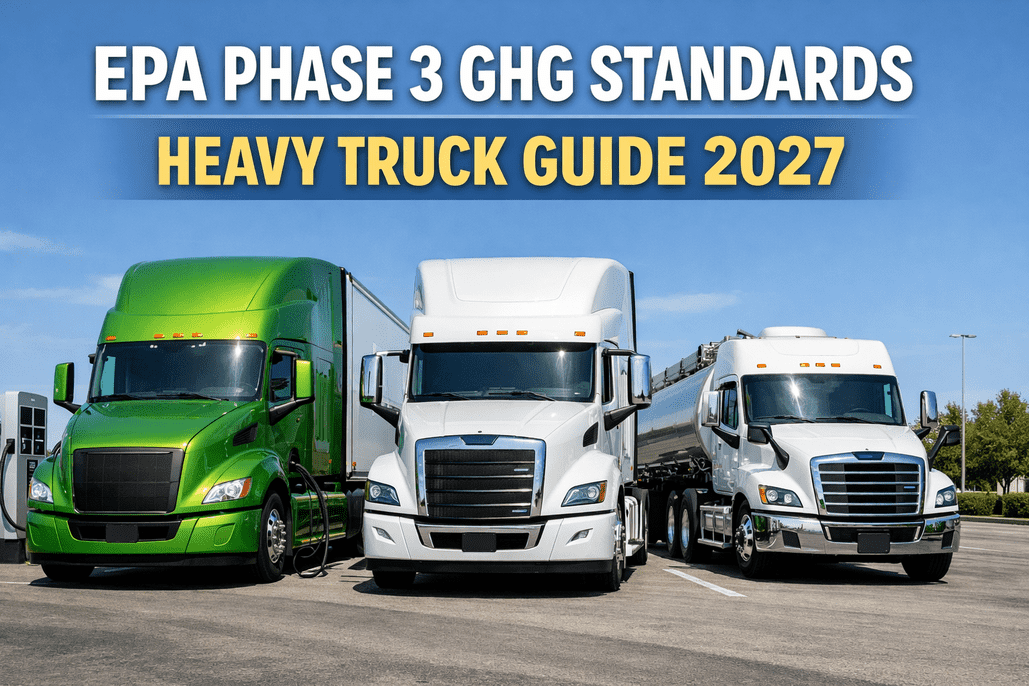
EPA's Phase 3 Greenhouse Gas standards for heavy-duty vehicles — finalized March 29, 2024 — set the most ambitious federal CO2 reduction targets ever imposed on commercial trucks and buses. The rule targets up to 60% CO2 emission reductions for vocational trucks and up to 40% for tractor trucks by model year 2032, with phase-in beginning MY 2027. It applies to every Class 2b-8 vehicle: delivery trucks, refuse haulers, transit buses, day cab tractors, sleeper cab tractors, and vocational vehicles over 14,000 lbs GVWR. Net benefits were projected at $180-$320 billion through 2055, with 1.8 billion metric tons of CO2 reduction. But the regulatory landscape shifted dramatically in 2025-2026. The Trump administration's EPA, under Administrator Lee Zeldin, announced formal reconsideration of Phase 3 GHG in March 2025 as part of what Zeldin called "the biggest deregulatory announcement in U.S. history." In February 2026, EPA finalized the repeal of the 2009 endangerment finding — the legal foundation for all federal GHG vehicle standards — effectively removing EPA's authority to enforce Phase 3. The American Trucking Associations called GHG3 "disastrous" and an "electric truck mandate that put the trucking industry on a path to economic ruin." Legal challenges from both sides are expected to continue for years. For fleet operators, the uncertainty is the operational challenge. Whether Phase 3 survives, is weakened, or is replaced, fleets that invested in emissions compliance, EV infrastructure, or mixed fleet management need to continue managing those assets. And the underlying technology trends — electrification, fuel efficiency improvements, and state-level regulations like California ACF that operate independently of federal rules — continue regardless of federal policy. This guide covers what Phase 3 GHG requires, the current regulatory status, which vehicles are affected, what changes for fleet operations, how to prepare regardless of the political outcome, and how HVI helps manage compliance across both diesel and electric heavy vehicles. Book a demo to see how HVI handles mixed fleet compliance, or start your free trial.
The most aggressive federal CO2 standards ever for heavy-duty vehicles — what it requires, current regulatory status under the Trump administration, which trucks are affected, and how to prepare your fleet.
What Phase 3 GHG Requires
Phase 3 builds on EPA's 2016 Phase 2 program and maintains a technology-neutral, flexible structure. It does not mandate the sale of zero-emission vehicles — but the stringency of CO2 targets effectively requires manufacturers to include ZEVs and advanced technologies in their production mix to meet fleet-average standards.
Delivery trucks, refuse haulers, public utility trucks, transit buses, shuttle buses, school buses. CO2 emission reductions of up to 60% by MY 2032 compared to Phase 2 MY 2027 levels. Standards phase in starting MY 2027 with progressively stricter targets through 2032.
Day cab tractors and sleeper cab tractors. CO2 emission reductions of up to 40% by MY 2032. Long-haul sleeper cabs have less stringent targets recognizing the energy demands of extended-range operation. Phase-in begins MY 2027.
New requirement: manufacturers must provide warranty coverage for batteries and electric powertrain components on ZEVs. Must install customer-facing battery state-of-health (SOH) monitors on plug-in hybrids and battery-electric vehicles. First federal battery health transparency mandate for heavy trucks.
Manufacturers can average, bank, and trade (ABT) emission credits across vehicle classes. Phase 3 provides transitional flexibility during MY 2027-2032 for credit transfers across averaging sets. Advanced technology credit multipliers for PHEVs, BEVs, and FCEVs continue through MY 2027 with guardrails.
Current Regulatory Status (March 2026)
The regulatory landscape for Phase 3 GHG has changed fundamentally since the rule was finalized. Here is the timeline of events:
Which Heavy Vehicles Are Affected
Commercial pickup trucks and vans over 8,500 lbs GVWR. Transit vans, work trucks, shuttle buses. MY 2027 standards revised from Phase 2 levels.
Delivery trucks, box trucks, small refuse haulers, school buses. Up to 60% CO2 reduction target for vocational vehicles by 2032.
Large delivery trucks, city transit buses, utility trucks, cement mixers, dump trucks. Vocational truck standards apply. Phase-in starting MY 2027.
Day cab tractors, sleeper cab tractors, refuse haulers, heavy vocational. Up to 40% CO2 reduction for tractors. Most challenging category for electrification — long-haul sleepers have less stringent targets.
What Phase 3 Changes for Fleet Operations
Whether Phase 3 survives in its current form or is replaced, the technology trends it accelerated are not reversing. OEMs have already invested billions in electric heavy trucks. Charging infrastructure is being built. State regulations continue independently. Here is what fleet operators should plan for:
MY 2027+ vehicles from major OEMs will incorporate advanced emissions technology regardless of federal rule status — manufacturers cannot un-engineer trucks already in development. Expect more diesel-electric hybrids, advanced aerodynamics, low-rolling-resistance tires, predictive cruise control, and battery-electric options across all classes. Your procurement team needs to evaluate both powertrain options.
Fleets that have already acquired ZEVs or plan to must manage diesel and electric vehicles side by side. Different inspection checklists (engine/fluid/exhaust vs battery/HV/thermal), different PM schedules, different technician certifications, different fueling/charging infrastructure. One platform must handle both — without forcing operators to learn two systems.
California ACF, ACT, and Section 177 states (17+ states representing 40% of the US truck market) operate under separate legal authority. Even if federal Phase 3 is fully repealed, fleets operating in these states must still comply with state-level ZEV requirements. Your compliance system must track both federal and state regulatory frameworks simultaneously.
Phase 3's requirement for customer-facing battery SOH monitors — the first federal mandate of its kind — signals the direction. Whether the federal rule stands or not, battery health tracking is becoming a fleet management necessity as electric heavy trucks enter service. Warranty claims, resale value, and operational planning all depend on SOH data.
Electric heavy vehicles require entirely different pre-trip inspection items: HV interlock integrity, orange cable condition (SAE J1673), battery thermal management, regenerative braking calibration. Standard diesel checklists miss safety-critical items on EVs. Your inspection platform must provide powertrain-specific templates that auto-load per vehicle.
Technicians working on electric heavy vehicles need HV qualification (NFPA 70E). Class 0 insulating gloves tested per ASTM D120 every 6 months. LOTO procedures for HV systems. Arc flash assessments. These requirements exist regardless of whether Phase 3 survives — they are OSHA safety requirements, not EPA emission rules.
How to Prepare — Regardless of Political Outcome
Whether your fleet stays 100% diesel, goes mixed, or adds EVs, digital inspection and maintenance tracking is the foundation. Paper cannot handle the documentation complexity of multiple powertrains, multiple regulatory frameworks, and compliance reporting for both federal and state requirements.
Even without federal mandates, state regulations and OEM production shifts mean electric heavy vehicles are entering fleets. Your fleet management platform must auto-load the correct inspection template per powertrain type. Diesel gets engine/fluid/exhaust checklists. Electric gets battery/HV/thermal checklists. One dashboard. One system.
California ACF, Oregon, Washington, New York, New Jersey, Massachusetts, and 12+ additional Section 177 states have their own fleet electrification requirements. If your trucks operate in any of these states, compliance is mandatory regardless of federal rule status. Track which vehicles are subject to which state regulations.
OSHA HV safety requirements (NFPA 70E, ASTM D120 glove testing, LOTO procedures) apply to any fleet with electric vehicles — independent of EPA rules. Technician certification tracking, PPE compliance documentation, and work order restrictions (only HV-certified techs assigned to EV work) should be implemented before EVs arrive.
How HVI Helps Navigate the Regulatory Uncertainty
Diesel and electric heavy vehicles on the same dashboard. Auto-loads correct template per powertrain. Diesel: engine, fluid, exhaust checklists. Electric: battery, HV, thermal, regen checklists. Unified reporting for both federal and state compliance.
Pre-built checklists for eCascadia, Volvo VNR Electric, Tesla Semi, Peterbilt 579EV, BYD yard tractors. HV system checks, battery thermal management, regen braking, charging port. Items diesel checklists do not include.
Per-vehicle battery health tracked over time. Degradation curves. Configurable SOH alerts. Replacement cost forecasting. Whether required by Phase 3 or by operational necessity, battery data is essential for any fleet with electric heavy trucks.
FMCSA DVIRs (49 CFR 396), OSHA equipment inspections (29 CFR 1926), California ACF/ACT, state-level Section 177 requirements — all managed on one platform. As regulations change, HVI templates update. Your fleet stays compliant regardless of which rules apply in which jurisdictions.
Side-by-side cost-per-hour by powertrain. Energy/fuel cost, maintenance cost, battery depreciation, infrastructure amortization. Data-driven evidence for your fleet transition decisions — proving what works and what does not based on your actual operational data.
Every feature works without internet. Inspections, work orders, PM schedules, photo capture — all offline. Critical for heavy vehicle operations in construction, freight yards, and remote locations where connectivity is limited.
Frequently Asked Questions
The rule was finalized in March 2024 and published in the Federal Register (89 FR 29440). However, the Trump administration's EPA repealed the 2009 endangerment finding in February 2026 — the legal basis for all federal GHG vehicle standards. EPA has also announced formal reconsideration of Phase 3. The rule's enforcement status is uncertain and subject to ongoing legal challenges from both environmental groups and industry. Practically, EPA indicated it plans to maintain 2026 standards for an additional 2 years while reconsidering.
Not directly. California's Advanced Clean Fleets (ACF) and Advanced Clean Trucks (ACT) regulations operate under Clean Air Act Section 177, which gives California separate authority to set vehicle emission standards. However, EPA has separately moved to revoke certain California heavy-duty truck waivers, which is subject to legal challenge. 17+ states follow California's standards under Section 177 — collectively representing approximately 40% of the US truck market. The state vs federal legal battle is expected to take years.
Yes — for three reasons. First, state-level regulations (California ACF, Section 177 states) continue regardless of federal policy. Second, OEMs have already invested billions in electric truck development — eCascadia, VNR Electric, Tesla Semi, and others are in production and will continue. Third, the operational economics (50% lower maintenance costs, lower energy costs per mile) make EVs viable for many duty cycles on TCO merit alone. The question is not whether electric heavy trucks are coming — it is when your fleet will encounter them.
Up to 60% CO2 emission reductions for vocational trucks and up to 40% for tractor trucks by model year 2032, compared to Phase 2 MY 2027 levels. The rule is technology-neutral — it does not mandate ZEV sales, but the stringency of targets effectively requires manufacturers to include ZEVs in their production mix. The phase-in begins MY 2027 and tightens progressively through MY 2032.
Phase 3 itself does not change inspection requirements — those are governed by FMCSA (49 CFR 396) and OSHA. But the vehicles entering your fleet as a result of emissions regulations are fundamentally different. Electric heavy trucks require different pre-trip inspection items (HV systems, battery thermal management, regen braking), different PM schedules (no oil/filters but battery/inverter/coolant service), and different technician qualifications (NFPA 70E HV certification). Your inspection platform must handle both powertrains.
Phase 3 includes the first federal requirement for manufacturers to install customer-facing battery state-of-health (SOH) monitors on plug-in hybrid and battery-electric heavy vehicles. This tracks battery degradation over time and communicates the vehicle's state of certified energy (SOCE). For fleet operators, SOH data is critical for replacement planning ($150K+ battery packs), warranty claims, and residual value assessment. HVI tracks SOH per vehicle over the equipment lifecycle.
Regardless of Phase 3's fate: digitize your inspection and maintenance documentation (paper fails under any compliance framework). If operating in California or Section 177 states, comply with state-level ZEV requirements. If you have or plan EVs, establish HV safety protocols (NFPA 70E, ASTM D120). Use a platform that handles both diesel and electric vehicles on one dashboard. Track TCO data to make evidence-based electrification decisions. HVI handles all of this from day one.
Yes — HVI supports FMCSA DVIR requirements (49 CFR 396.11/396.13), OSHA equipment inspections (29 CFR 1926), California ACF/ACT compliance documentation, MSHA mining requirements (30 CFR Part 56/57), and EPA-related vehicle documentation. Templates are customizable per regulatory framework and per vehicle type. As rules change — whether tightened or relaxed — HVI templates update. One platform manages every vehicle in your fleet regardless of which jurisdiction's rules apply. Book a demo to see multi-regulation compliance in action.
Federal rules may shift. State rules persist. Technology trends continue. HVI manages diesel and electric heavy vehicles on one platform — FMCSA, OSHA, California ACF, and MSHA compliance regardless of which regulations apply to your fleet today or tomorrow.
No credit card • No hardware • Diesel + EV on one platform • Multi-regulation compliant