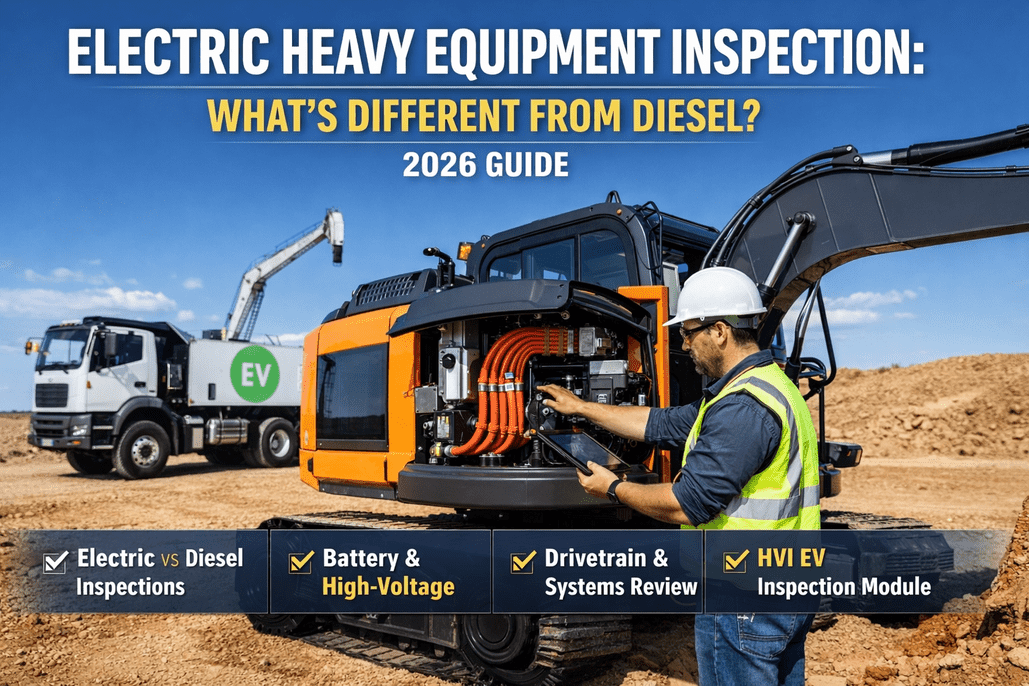
Electric excavators, cranes, loaders, and haul trucks are shipping from every major OEM in 2026 — Caterpillar, Volvo CE, Komatsu, JCB, Liebherr, SANY, John Deere. The electric construction equipment market hit $14.5 billion in 2024 and is projected to reach $29 billion by 2029. But the inspection protocols your team uses on diesel equipment do not fully apply to electric machines. Some inspection items disappear entirely (engine oil, coolant, DEF, exhaust aftertreatment, belt tension, fuel system). New inspection items appear that most operators have never encountered: high-voltage cable integrity, battery state-of-health, thermal management system, inverter condition, charging port, isolation monitoring. Get the high-voltage items wrong and the consequences are not a breakdown — they are electrocution. Operating voltages range from 400 to 1,000 volts on modern battery-electric heavy equipment. FMCSA has published specific training materials for inspecting high-voltage electric-drive commercial motor vehicles, and OSHA 1910.335 governs insulated tool requirements for work near energized conductors. Meanwhile, 60-70% of your inspection checklist stays exactly the same: hydraulics, undercarriage, tracks, buckets, structural integrity, cab safety, lights, brakes, tires — the working end of the machine does not change just because the power source did. This guide covers exactly what changes, what stays the same, the high-voltage safety protocols your team must follow, battery health monitoring, electric drivetrain inspection points, and how HVI supports mixed diesel/electric fleets with a single platform. Book a demo to see HVI's EV-specific inspection workflows, or start your free trial.
Electric Heavy Equipment Inspection: What Changes from Diesel?
Electric machines eliminate diesel maintenance items and introduce high-voltage, battery, and thermal management inspections. Here is exactly what your team needs to know.
What Stays the Same: 60-70% of Your Checklist
Electric changes the powertrain. It does not change the working end of the machine. Every mechanical inspection item that applies to a diesel excavator, crane, or loader applies identically to its electric version.
Hydraulic oil level and condition, cylinder rod seals, hose condition, pump operation, valve function. Most electric heavy equipment still uses hydraulic actuators (some manufacturers like Volvo are experimenting with electromechanical actuators, but hydraulics remain standard in 2026). Hydraulic oil and grease are still required — these do not disappear with electrification.
Track tension, roller condition, idler wear, sprocket teeth, track pad condition, track frame integrity. Undercarriage wear is driven by ground conditions and operating patterns, not powertrain type. The same inspection intervals and criteria apply.
Structural cracks, pin and bushing wear, bucket teeth and cutting edge condition, weld integrity. The working end of an electric excavator is mechanically identical to diesel. Same loads, same wear patterns, same inspection requirements.
Seatbelt condition, mirror adjustment, cab glass integrity, ROPS/FOPS certification, fire extinguisher, emergency exits. Operator protection requirements are powertrain-independent. OSHA standards apply identically.
Service brake function, parking brake hold, steering responsiveness. Note: electric machines use regenerative braking which reduces brake pad wear significantly — but the brake system still requires inspection. Reduced wear means longer pad life, not eliminated inspection.
Work lights, reverse alarm, travel alarm, beacon, camera systems. These are powered by the 12V/24V auxiliary system which exists on both diesel and electric equipment. Same inspection items, same criteria.
High-Voltage Safety Protocols
Battery-electric heavy equipment operates at 400-1,000 volts. Contact with energized high-voltage components is lethal. These are not guidelines — they are mandatory safety requirements governed by OSHA 1910.335, NFPA 70E, ASTM F1505, and OEM service manuals. FMCSA has published specific training modules for inspecting high-voltage electric-drive commercial motor vehicles.
High-voltage power must be disconnected and verified dead before any maintenance work on or near HV components. Use a CAT III 1000V or CAT IV 600V rated digital multimeter to verify zero voltage between HV cable ends and between HV cables and ground. Never rely on dashboard indicators alone. Follow OEM-specific isolation procedures for each machine model.
Class 0 or Class 00 insulating gloves (rated per ASTM D120) must be inspected before every use: check for cuts, splits, cracks, pinholes. Inflate gloves to detect air leaks using pneumatic pump or roll-up method. Insulated tools must meet ASTM F1505 and OSHA 1910.335(a)(2)(i). Face shield and arc-rated clothing per NFPA 70E for work near energized components.
A lighted red warning light indicating loss of high-voltage isolation is a serious safety hazard per FMCSA training standards. The machine must not operate until the isolation fault is diagnosed and cleared. This is not a "check it later" item — it is an immediate out-of-service condition. HVI flags this as a critical defect requiring immediate lockout.
Any fluid on top of or dripping from a high-voltage battery or HV component may be electrolyte and constitutes a potential safety hazard. Do not touch. Do not attempt to identify the fluid. Treat as hazardous until confirmed otherwise. FMCSA training specifically addresses this scenario. Report immediately and isolate the machine.
High-voltage cables are typically orange-sheathed for identification. Inspect for: damaged insulation, exposed conductors, chafing against frame or components, loose connections, melting or discoloration. Any damage to HV cable insulation is an immediate out-of-service condition. Cables are sealed and guarded by design — visible damage indicates a serious fault.
An insulated retrieval hook (rescue hook / hot stick) must be accessible whenever technicians work near HV systems. This non-conductive fiberglass pole allows rescue of personnel disabled by electrical shock without exposing the rescuer. All personnel working around HV equipment must know the location of the rescue hook and how to use it. Emergency procedures posted at service bay.
Battery Health Monitoring
The battery pack is the most expensive component on an electric machine — $15,000-$80,000+ depending on capacity. Battery state-of-health (SOH) directly determines machine capability, runtime, and resale value. Monitoring SOH is not optional — it is the EV equivalent of engine compression testing.
SOH indicates what percentage of original battery capacity remains. A new battery = 100% SOH. Most OEM warranties guarantee 70-80% SOH after a defined number of charge cycles or years. Track SOH at every major service interval. Declining SOH means declining runtime — plan for replacement when SOH drops below the operational threshold for your duty cycle. HVI logs SOH readings as part of PM records for trend analysis.
Record battery SOC at the start and end of each shift. Consistent SOC decline patterns across similar work reveal battery degradation before SOH metrics catch it. If Machine A and Machine B perform the same work but Machine A's SOC drops 15% faster, Machine A's battery is degrading. This pattern analysis requires structured digital records — exactly what HVI captures.
Lithium-ion batteries require active thermal management to maintain safe operating temperatures. Battery cooling systems use liquid coolant (yes, electric machines still have coolant — just not engine coolant). Inspect: coolant level, hose condition, radiator/heat exchanger cleanliness, pump operation, temperature sensor function. Overheating accelerates battery degradation and creates thermal runaway risk.
Batteries have a limited number of charge cycles (typically 2,000-5,000 full cycles depending on chemistry). Track total cycles alongside operating hours. A machine with low hours but high charge cycles (frequent partial charges) may have a battery aging faster than hours suggest. HVI tracks both hours and cycle count for accurate lifecycle planning.
Multi-cell battery packs require balanced voltage across all cells. Imbalanced cells reduce overall capacity and can indicate a failing cell module. OEM diagnostics report cell-level voltage data. During major service intervals, record cell balance data. A single weak cell can limit the entire pack — early detection prevents premature pack replacement.
Inspect charging port for: debris, corrosion, damaged pins, water intrusion, housing cracks. Inspect charging cables for: insulation damage, connector wear, strain relief integrity. A damaged charging port can cause arcing, incomplete charging, or fire. Include charging infrastructure condition in your inspection scope — the charger is part of the machine's operating system.
Electric Drivetrain Inspection Points
An electric drivetrain has approximately 20 moving parts vs 2,000+ in a diesel powertrain. Less to inspect — but the items that remain are critical, unfamiliar to most technicians, and carry high-voltage risks.
Visual inspection for: unusual noise (bearing wear), vibration, overheating (discoloration or smell), mounting bolt torque, cooling system connection. Electric motors are sealed units — if found not working, replace rather than repair (per Volvo CE recommendation). Motor bearing wear is detectable through vibration analysis before audible symptoms appear.
The inverter converts DC battery power to AC motor power. Visual inspection for: mounting security, cooling connections, warning lights, error codes. Sealed unit — do not open. Any fault codes from the inverter are immediate service items. Temperature monitoring through OEM diagnostics reveals developing faults before failure.
The AC-to-DC converter for plug-in charging. Inspect for: warning lights, error codes, housing integrity, connection security. Many electric machines can charge while operating from an external power supply — inspect both the onboard charger and any tethered power connections. Charging system faults can damage the battery pack if not detected.
Electric machines capture braking energy and return it to the battery. Inspect for: regen function (verify energy recovery on display during braking), abnormal behavior (jerking, inconsistent deceleration), regen fault codes. Regen significantly reduces conventional brake wear — but if regen fails, conventional brakes bear full load. Brake inspection intervals may need adjustment.
Electric machines still have a low-voltage auxiliary system for lights, controls, displays, and safety systems. This system is powered by a DC-DC converter from the HV battery. Inspect: auxiliary battery condition, DC-DC converter operation, low-voltage wiring. A failed DC-DC converter disables all auxiliary functions even with a fully charged HV battery.
The manual high-voltage disconnect allows safe isolation of the HV system for service. Inspect: disconnect handle condition, locking mechanism, indicator function, interlock operation. Verify the disconnect is accessible and clearly labeled. All operators must know its location for emergency use. This is the "kill switch" for the HV system.
HVI EV Heavy Equipment Module
HVI supports mixed diesel/electric fleets with a single platform. The same inspection workflow, the same work order system, the same compliance documentation — with EV-specific items added where they apply and diesel items removed where they do not.
Pre-built checklists that add battery SOH, HV cable inspection, thermal management, charging port, inverter, and isolation monitoring items. Diesel items (oil, DEF, exhaust, fuel system) automatically excluded. Fully customizable per OEM and model — Cat 320 Electric gets different items than Volvo EC230 Electric.
Track state-of-health and state-of-charge readings over time per machine. Visual trend charts show degradation rate. Compare identical machines: is one battery aging faster? Data supports warranty claims, replacement planning, and resale valuation. Battery trending requires structured digital records — not paper logs.
Any HV-related defect (isolation warning light, cable damage, fluid on HV components, charging fault) is automatically flagged as critical with immediate-action priority. These defects bypass normal work order queues and trigger instant notifications to safety managers. The machine is marked out-of-service until the HV defect is cleared.
Diesel and electric machines in a single view. Filter by powertrain type, battery health status, or inspection compliance. Fleet managers see both their Cat 320 Diesel and Cat 320 Electric in the same dashboard without switching tools. One platform for the entire fleet, regardless of powertrain mix.
Track maintenance cost per operating hour separately for diesel and electric versions of the same machine class. Compare: is your electric excavator actually cheaper to maintain? The data answers the question definitively — not with manufacturer marketing claims but with your actual fleet numbers.
Audit-ready inspection records that capture the correct items for each powertrain type. When OSHA asks for HV safety inspection documentation on your electric excavator, the records exist — complete with timestamps, photos, defect resolution chain, and technician signatures.
Frequently Asked Questions
Yes — for visual and external items (hydraulics, undercarriage, cab safety, lights, charging port exterior). Operators should never open HV battery enclosures, disconnect HV cables, or work near exposed HV conductors without proper training. Pre-shift inspection checklists should clearly separate "operator items" from "technician-only items." HVI templates enforce this separation automatically. Book a demo to see EV-specific operator vs technician checklists.
Yes. Most electric heavy equipment in 2026 still uses hydraulic actuators for boom, stick, bucket, and attachment operation. Hydraulic oil level, condition, and filter changes remain standard PM items. Grease points on pins, bushings, and slew rings are identical to diesel. The only fluids eliminated are engine oil, engine coolant, DEF, and fuel. Battery thermal management coolant is added. Start your free trial to track both fluid types.
At minimum, every major service interval (500-1,000 operating hours or per OEM recommendation). Many OEM telematics systems report SOH continuously — HVI can ingest this data automatically. For fleets comparing diesel and electric TCO, monthly SOH logging provides the trend data needed for accurate lifecycle cost analysis. See battery trending in a demo.
Stop the machine safely and immediately. A loss of high-voltage isolation means the HV system may be energizing the machine frame or other normally-safe surfaces. This is a serious safety hazard per FMCSA training standards. Do not attempt to diagnose. Mark out of service and call a qualified HV technician. HVI flags isolation warnings as immediate-action critical defects. Book a demo to see HV critical defect handling.
Yes — that is the core design. One platform, one login, one dashboard for diesel, electric, and hybrid machines. Each machine gets the correct inspection template for its powertrain type. Fleet managers compare maintenance costs, downtime, and compliance across powertrain types in a single view. No separate tools for separate powertrains. Start your free trial with your entire fleet.
Yes. Technicians working on or near HV components need training covering: AC motor function, Ohm's law, inverter operation, lithium-ion battery systems, HV isolation procedures, insulated tool use, and emergency rescue procedures. Volvo CE and other OEMs offer manufacturer-specific HV training. Track technician certifications and training expiration dates in HVI. See certification tracking in a demo.
Your Fleet Is Going Electric. Your Inspections Should Be Ready.
Diesel and electric machines in one platform. EV-specific inspection items. HV safety defect flagging. Battery SOH trending. Mixed-fleet cost comparison. HVI handles both powertrains from day one.
No credit card • Supports diesel + electric + hybrid • EV templates included • Full offline capability