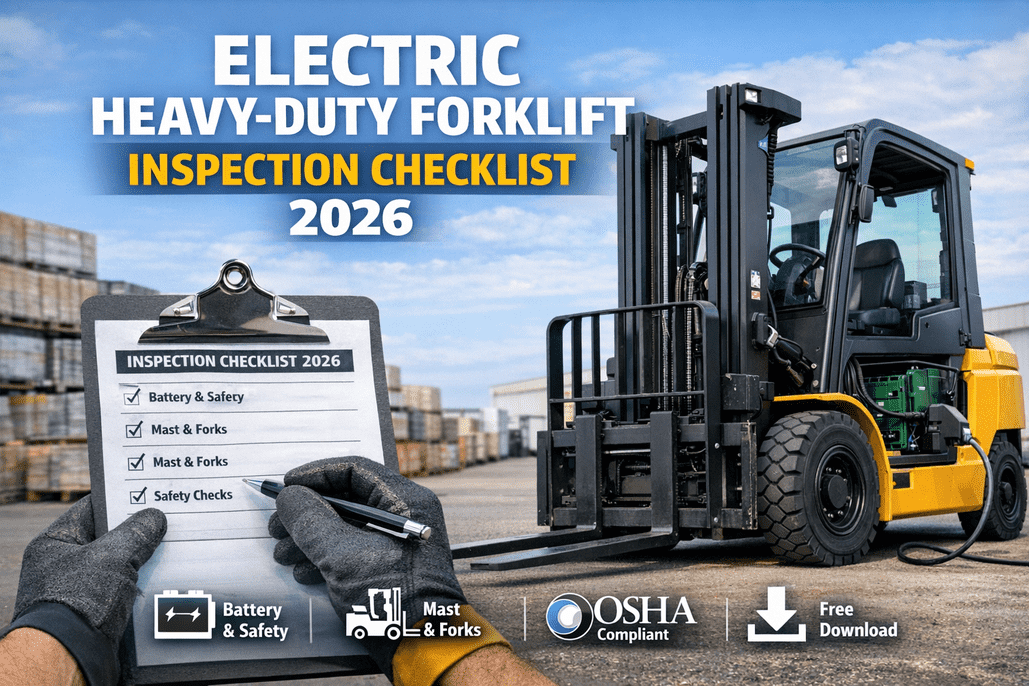
Electric heavy-duty forklifts — Class 1 (electric motor, rider, counterbalanced) and Class 2 (electric motor, narrow aisle) — require inspection protocols fundamentally different from internal combustion trucks. There's no engine oil to check, no exhaust system, no fuel tank. Instead, the critical systems are the high-voltage battery pack (48-80V, representing 30-40% of asset value), electric motor and controller, regenerative braking system, charging port and cables, and the thermal management system that keeps battery cells within safe operating temperature. OSHA 29 CFR 1910.178(q)(7) requires that all powered industrial trucks be examined before being placed in service — and when used round-the-clock, after each shift. OSHA's 2025 Lithium-Ion Battery Safety Fact Sheet adds specific guidance for Li-ion powered equipment. This checklist covers 62 inspection items across 8 systems organized into three phases: Power-Off Visual (key off, no energized systems), Power-On Systems Check (energized but stationary), and Operational Test (moving and lifting). Each item is tagged by battery chemistry where requirements differ between lead-acid and lithium-ion. Use this checklist digitally in the HVI app or download the PDF — either way, every defect auto-generates a work order with photos and severity routing to your maintenance team.
Three-Phase Inspection Flow
Electric forklift inspection follows a strict sequence: start with the machine powered off to safely inspect high-voltage components, then power on to verify systems and indicators, then operate to test drive and lift functions. Never skip to operational testing — energized component inspection with the machine running creates unnecessary HV exposure risk.
PHASE 1
Power-Off Visual
Key off. Main disconnect open. Safe to inspect HV-adjacent components visually.
PHASE 2
Power-On Systems
Key on. Verify all indicators, gauges, warning lights, and electronic safety systems before moving.
PHASE 3
Operational Test
Move slowly in open area. Test steering, brakes, lift, tilt, and all operational functions under load.
Complete Checklist: 62 Items / 8 Systems
1. Battery Pack & Power System12 items
P1ALLBattery compartment cover/lid — secure, undamaged, latches functional
P1ALLBattery cables and terminals — no corrosion, burns, fraying, or loose connections
P1ALLMain disconnect/emergency cutoff — accessible, functional, clearly labeled
P1LEAD-ACIDElectrolyte levels — check each cell. Top up with distilled water AFTER charging only. Never add acid.
P1LEAD-ACIDCell caps/vents — all present, not clogged. Hydrogen gas must vent freely during charging.
P1LEAD-ACIDBattery case — no cracks, leaks, bulging, or acid residue. Check tray for acid accumulation.
P1Li-IONBattery enclosure — sealed, no damage, no swelling or deformation of casing
P1Li-IONBMS indicator light — check status panel for fault codes, cell imbalance warnings, thermal alerts
P1Li-IONCooling system vents/fans — unobstructed, no debris blocking airflow to battery pack
P2ALLBattery charge indicator/SoC display — verify reading. SoC above 20% before operation. Below 20% = recharge before use.
P2ALLVoltage reading — within normal range for pack size (48V, 72V, 80V nominal). Significant deviation = investigate.
P2ALLBattery restraint/hold-down — secure. Battery must not shift during operation, cornering, or ramp travel.
2. Electric Motor & Controller7 items
P1ALLMotor housing — no damage, cracks, or excessive dust/debris accumulation blocking ventilation
P1ALLMotor cables/wiring — no chafing, exposed conductors, melted insulation, or burn marks
P1ALLController/inverter unit — secure mounting, no visible damage, ventilation openings clear
P2ALLMotor response — smooth acceleration from stop. No hesitation, surging, jerking, or unusual vibration
P2ALLUnusual sounds from motor — no grinding, whining, clicking, or high-pitched noise indicating bearing wear
P2ALLRegenerative braking engagement — verify regen activates when throttle released (felt as deceleration without brake pedal)
P3ALLMotor performance under load — no loss of power, overheating odor, or thermal warning during lift operations
3. Charging System & Port8 items
P1ALLCharging port/connector — no damage, corrosion, bent pins, melted plastic, or burn marks on contacts
P1ALLCharging cable — no cuts, kinks, exposed wiring, or damage to outer jacket. Proper strain relief at connections.
P1ALLCharging port cover/cap — present and functional. Protects port from debris and moisture when not charging.
P1LEAD-ACIDCharger interlock — verify forklift cannot be driven while connected to charger. Test: plug in, attempt to drive.
P1Li-IONCharger-to-BMS communication — verify charger status indicator shows proper handshake before charging begins
P1ALLCharging area safety — verify area has adequate ventilation (hydrogen gas for lead-acid), fire extinguisher present, no smoking signs posted
P1LEAD-ACIDEyewash station — within 25 feet of charging area (OSHA requirement for acid-battery charging stations)
P2ALLCharge completion indicator — verify last charge completed normally (no fault codes, no premature termination)
4. Mast, Forks & Hydraulics10 items
P1ALLForks — no cracks, bending, or excessive wear. Check heel, blade, and tip. Fork thickness within spec (10% wear = replacement).
P1ALLFork positioning latch/pin — functional and engaged. Forks must not slide freely on carriage.
P1ALLMast channels and rollers — no excessive wear, debris buildup, or visible damage. Mast chains lubricated.
P1ALLHydraulic cylinders — no leaks, scoring, or rod damage. Check lift, tilt, and side-shift cylinders.
P1ALLHydraulic hoses and fittings — no leaks, chafing, bulging, or cracked fittings. Check at connection points.
P1ALLHydraulic fluid level — check sight glass or dipstick. Top up with manufacturer-specified fluid only.
P3ALLLift function — raise and lower forks through full travel. Smooth operation, no jerking, stalling, or drift when stopped.
P3ALLTilt function — full forward and back tilt. Smooth, no binding or hesitation. Verify holds position when released.
P3ALLSide-shift (if equipped) — full travel both directions. Smooth operation, returns to center.
P3ALLLoad backrest extension — secure, not cracked or bent. Prevents load from falling back toward operator.
5. Brakes & Steering7 items
P2ALLService brake pedal — proper feel and travel. No sponginess, no sinking to floor. Firm engagement.
P2ALLParking brake — engages and holds on grade. Verify truck does not creep when parking brake set on slight incline.
P2ALLRegenerative braking — decelerates smoothly when throttle released. Inconsistent regen = motor or controller issue.
P3ALLBrake test — at slow speed, apply brakes firmly. Truck should stop straight without pulling to either side.
P3ALLSteering response — full lock left and right. Smooth, proportional, no dead spots, binding, or excessive play.
P3ALLPower steering operation — no unusual noise. Verify adequate assist — steering should not feel heavy or unresponsive.
P3ALLInching control (if equipped) — allows simultaneous drive and lift control at low speed. Smooth engagement.
6. Tires, Wheels & Chassis6 items
P1ALLTire condition — no chunks missing, excessive flat spots, exposed cords, or embedded debris. Check all tires including casters.
P1ALLTire inflation (pneumatic tires) — correct pressure per manufacturer spec. Uneven wear indicates alignment or overloading.
P1ALLWheel lug nuts — all present and tight. No cracks in wheel rim.
P1ALLChassis and frame — no cracks, welds breaking, structural damage, or excessive corrosion
P1ALLCounterweight — secure, mounting bolts present and tight. Counterweight shifting = catastrophic tip-over risk.
P1ALLFloor/ground under truck — check for fluid puddles (hydraulic oil, coolant, battery acid) indicating leaks
7. Safety Devices & Operator Controls8 items
P1ALLOverhead guard — no cracks, bending, missing hardware. Protects operator from falling objects.
P2ALLHorn — audible and functional. Test at power-on.
P2ALLLights — headlights, tail lights, warning strobes/beacons all functional. Critical for warehouse visibility.
P2ALLBackup alarm — sounds when reverse selected. Required in most facilities.
P2ALLSeat belt — functions, retracts, buckle clicks. Operator restraint is critical in tip-over situations.
P2ALLOperator presence sensing (dead-man switch / seat switch) — verify truck cannot move when operator leaves seat
P2ALLEmergency stop button — clearly marked red button. Test: press and verify complete power cutoff. Reset and verify restart.
P2ALLMirrors and camera system (if equipped) — clean, adjusted, functional. Rear-view camera display powers on with key.
8. Data Plate & Documentation4 items
P1ALLData plate — legible, attached. Shows capacity, weight, mast type, and attachment allowances. Capacity changes with attachments.
P1ALLLoad capacity chart (if posted) — legible, current, matches attached implements
P1ALLWarning labels — HV warning labels present on battery compartment and electrical panels. "Authorized Personnel Only" for HV service.
P1ALLOperator manual — on truck or readily accessible. Includes emergency procedures and contact information.
Complete this entire checklist digitally in the HVI app — with photo capture, defect severity, and auto-generated work orders.
Book a demo. Or
start free.
OSHA Requirements for Electric Forklift Inspection
Electric forklift inspection isn't optional — it's required by federal regulation. Understanding the specific requirements and their consequences prevents both accidents and citations.
29 CFR 1910.178(q)(7)
Daily inspection before placing in service. Round-the-clock operations: inspect after each shift. Defects reported immediately and corrected before operation.
29 CFR 1910.178(q)(1)
Any PIT not in safe operating condition removed from service. All repairs by authorized personnel only. Tag out-of-service equipment immediately.
29 CFR 1910.178(g)
Battery charging area: adequate ventilation, acid spill containment, no open flames/sparks, eyewash station within 25 feet (lead-acid), fire extinguisher accessible.
29 CFR 1910.178(l)
Only trained and evaluated operators may conduct inspections and operate forklifts. Training must cover truck-specific topics for the type(s) of PIT being operated.
Li-Ion Fact Sheet (2025)
OSHA's 2025 Lithium-Ion Battery Safety Fact Sheet: guidance on thermal runaway risks, proper charging procedures, ventilation requirements, and emergency response for Li-ion battery incidents.
Charging Area Safety: The Overlooked Inspection
The charging area is part of the inspection — not separate from it. OSHA 1910.178(g) requires specific safety provisions for battery charging stations. Lead-acid and lithium-ion stations have different requirements.
Lead-Acid Charging Area
Adequate ventilation — hydrogen gas produced during charging is explosive. Mechanical ventilation required in enclosed spaces.
Eyewash station — within 25 feet. Sulfuric acid splash risk during watering and connection.
Acid spill kit — neutralizing agent (baking soda), absorbent material, protective gloves, face shield.
No smoking / no open flame signs — prominently posted.
Charger matched to battery — voltage, amperage, and charging profile correct for battery type and capacity.
Battery handling equipment — hoist or roller stand for battery changes. Proper lifting technique enforced.
Lithium-Ion Charging Area
Fire suppression — Li-ion rated extinguisher (not water). Class D or dry chemical. Water exacerbates Li-ion thermal events.
Thermal monitoring — charging area temperature within manufacturer specifications. No charging in extreme heat (>40°C).
Charger-BMS compatibility — charger must communicate with Battery Management System. Incorrect charger can damage cells.
Opportunity charging station design — Li-ion supports brief top-ups without "memory effect." Station positioned for break-time charging.
Ventilation — less hydrogen risk than lead-acid, but thermal event can produce toxic fumes. Ensure adequate airflow.
No battery changes needed — Li-ion packs are fixed-mount. No hoist or battery handling equipment required (weight/ergonomic advantage).
Lead-Acid vs. Lithium-Ion: What Changes on the Checklist
Your fleet may include both battery chemistries — especially during a transition from lead-acid to lithium-ion. The inspection protocol must match the chemistry. HVI provides chemistry-specific templates so operators see only the items relevant to their machine.
Battery Maintenance
Weekly watering required (distilled water only, AFTER charging). Check each cell. Acid spill risk during maintenance.
Maintenance-free sealed pack. No watering. No acid handling. BMS manages cell balance automatically.
Visual Inspection Items
Electrolyte levels, cell caps, vent condition, acid residue, case cracks, terminal corrosion, tray contamination
Enclosure integrity (sealed), BMS indicator lights, cooling vent/fan condition, connector condition, no swelling
Charging Protocol
Full charge cycles only (no opportunity charging — causes "memory effect" and acid stratification). 8-hour charge typical. Cool-down period required before use.
Opportunity charging supported and encouraged. Brief top-ups during breaks extend battery life. No cool-down required. 1-3 hour fast charge available.
Charging Area Safety
Hydrogen gas ventilation mandatory. Eyewash within 25 ft. Acid spill kit. No open flame. Battery handling hoist for changes.
Li-ion rated fire suppression. Thermal monitoring. No acid risk. No battery changes (fixed mount). Simpler infrastructure.
Cycle Life
1,000-1,500 cycles typical. 5-year average lifespan with proper maintenance.
2,000-5,000+ cycles (LFP chemistry). 8-10+ year lifespan. Higher upfront cost offset by longevity.
HVI provides battery-chemistry-specific inspection templates — lead-acid items for lead-acid trucks, lithium-ion items for Li-ion trucks — on one platform.
Book a demo. Or
start free.
Lithium-Ion Rapidly Replacing Lead-Acid in New Purchases
Li-ion forklifts now dominate new purchases in warehousing and logistics. Benefits: no watering, no acid spills, opportunity charging, 2-3x cycle life, sealed maintenance-free packs. But they require different inspection items — BMS status, thermal management, sealed enclosure integrity — that lead-acid checklists don't cover.
OSHA 2025 Li-Ion Battery Safety Fact Sheet
OSHA published specific lithium-ion battery safety guidance in 2025, addressing thermal runaway risks, charging safety, and emergency response. Fleets operating Li-ion forklifts need updated inspection protocols and training that address these Li-ion-specific hazards.
Book a demo.
Digital Inspection Replacing Paper Checklists
Paper forklift checklists sit in binders — unreviewed, lost, and useless for trend analysis. Digital inspection via HVI captures every defect with photos, routes to maintenance, and tracks completion rates. Auditors can pull any inspection in seconds. Defect trends identify recurring issues before they cause accidents.
Heavy-Duty Electric Forklifts Growing (15,000+ lb capacity)
Electric forklifts now available in 15,000-36,000 lb capacities for heavy-duty applications — steel, lumber, container handling. These large-format Li-ion packs (80V, 500+ Ah) require more rigorous battery health monitoring than standard warehouse units. Inspection protocols must scale with pack size and duty cycle severity.
The Checklist Is the First Line of Defense
Every forklift accident that could have been prevented by a pre-shift inspection represents a failure of the inspection process — either the checklist didn't cover the item, the operator skipped it, or the defect was reported but not repaired. Digital inspection with HVI closes all three gaps: comprehensive checklists covering every electric-specific item, operator accountability through photo evidence and completion tracking, and automatic work order generation that ensures every defect reaches maintenance. 62 items, 8 systems, 3 phases — completed in under 10 minutes on a phone.
Digital Electric Forklift Inspection
Complete this 62-item checklist in the HVI app with photo capture, defect routing, and auto-generated work orders — or download the PDF for print use.
Frequently Asked Questions
Q: How often must electric forklifts be inspected?
OSHA 29 CFR 1910.178(q)(7) requires inspection before being placed in service — at least daily. For round-the-clock operations, inspect after each shift. Any defects must be reported immediately and corrected before the forklift is operated. Forklifts failing inspection must be tagged out of service.
Q: What's different about inspecting lithium-ion vs. lead-acid forklifts?
Lead-acid requires: electrolyte level checks, cell cap/vent inspection, acid leak detection, eyewash station verification, hydrogen ventilation. Lithium-ion requires: BMS indicator check, sealed enclosure integrity, cooling system vent inspection, thermal management verification. Li-ion eliminates watering and acid handling but adds electronic monitoring requirements.
Use HVI for chemistry-specific checklists.
Q: Who can perform forklift inspections?
Only operators trained and evaluated per OSHA 29 CFR 1910.178(l). Training must cover the specific type(s) of powered industrial truck being operated — including electric-specific topics like battery safety, charging procedures, and HV component awareness. Training must be refreshed every 3 years or when unsafe operation is observed.
Q: What are the penalties for non-compliance?
OSHA's maximum penalty for willful violations is $165,514 per violation (2025 rate, adjusted annually). Powered industrial truck violations consistently rank in OSHA's top 10 most-cited standards. Beyond fines: uninspected forklifts cause approximately 85 fatalities and 34,900 serious injuries annually in the U.S. (OSHA data).
Q: Can I use this checklist digitally instead of paper?
Yes — OSHA requires inspection records but does not mandate paper. Digital inspection through HVI provides better compliance: timestamped completions, photo evidence, operator digital signatures, automatic defect routing to maintenance, and instant retrieval for audits. Paper checklists sit in binders. Digital checklists drive action.
Q: How long should the inspection take?
A thorough 62-item electric forklift inspection takes 8-12 minutes with digital tools (HVI app guides the operator through each phase). Paper typically takes 12-15 minutes due to manual writing. The inspection should never be rushed — but guided digital checklists with pass/fail selection and photo capture are significantly faster than writing defect descriptions by hand.