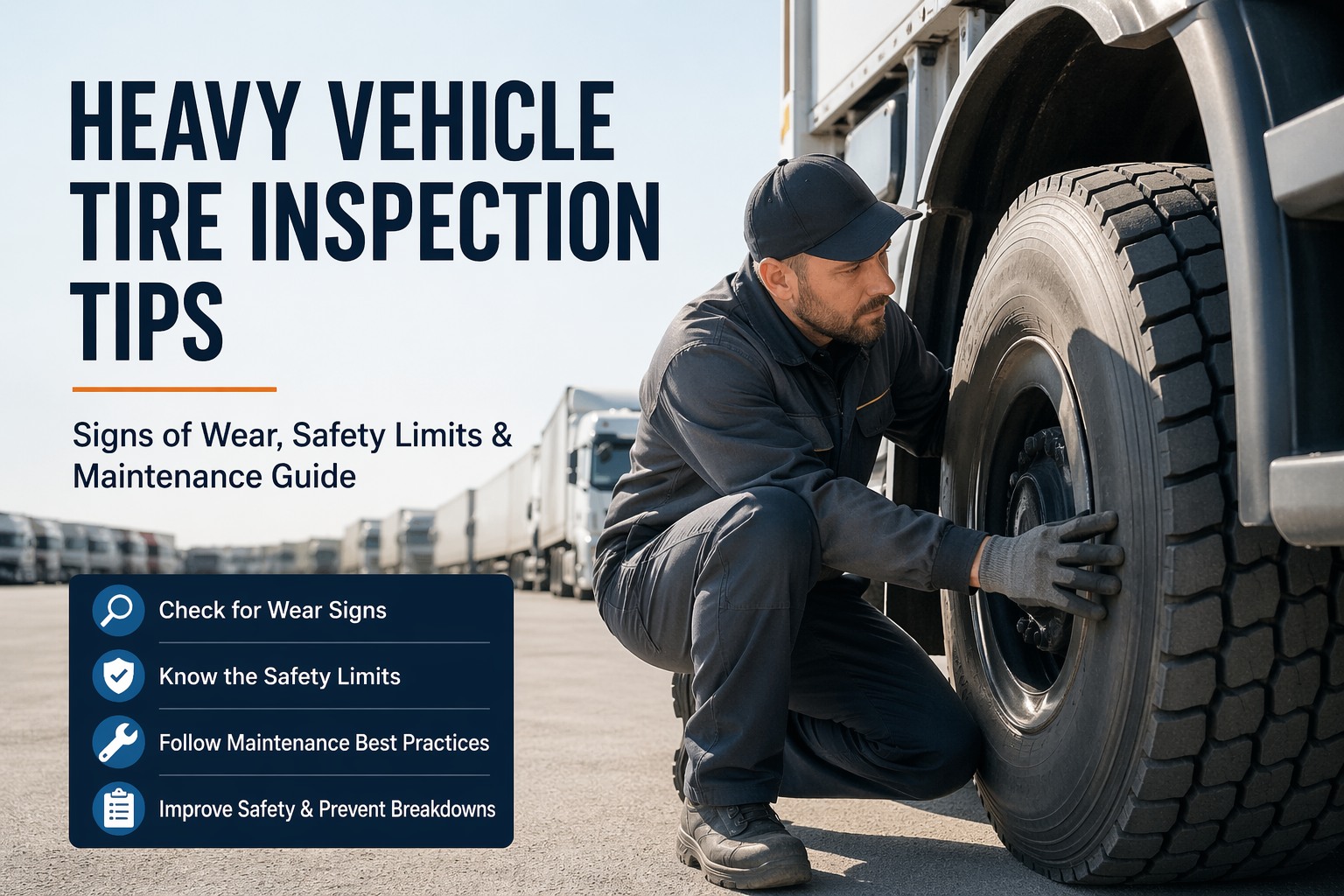
Tires are typically a fleet's third-largest expense behind labor and fuel, consuming 10-15% of total operating costs. Yet the difference between a 40,000-mile tire and a 60,000-mile tire often comes down to five fundamentals: consistent inflation, timely rotation, proper alignment, wheel balancing, and correct storage. Missing systematic rotation alone reduces tire lifespan by approximately 25%. A 10% drop in inflation costs 1% in fuel economy while accelerating wear. Improper alignment can shorten tire life by up to 12,000 miles per set. The math is not subtle — a 100-truck fleet spending $160,000 annually on tires can save $75,000-$100,000 through a structured maintenance program. This guide covers each discipline with specific intervals, measurable benchmarks, and the maintenance schedule your technicians can follow starting today. Start your free HVI trial to digitize tire inspections with tread-depth tracking and photo evidence, or book a demo to see fleet tire analytics.
Inflation, Rotation, Alignment, Balancing & Storage — Complete Maintenance Program
The 5 Pillars of Commercial Tire Maintenance
Proper inflation is the single most impactful thing you can do for tire life, fuel economy, and safety. The U.S. DOT reports that underinflated tires waste approximately 5 million gallons of fuel daily nationwide. Every 10 PSI below spec costs 15% tire life and 2% fuel economy. Yet a tire can be 20% underinflated and still look perfectly normal — visual checks are worthless.
100-truck fleet averaging 50,000 miles/year at 6 MPG, fuel at $3.50/gallon = $29,167 fuel per vehicle. 3% improvement from proper inflation = $875 saved per vehicle, $87,500 fleet-wide annually. Plus 17% tire life extension delays 68 tire purchases = $27,200 saved. Total inflation ROI: $114,700/year for a 100-truck fleet.
Different axle positions wear tires at different rates — steer tires scrub during turns, drive tires absorb torque, trailer tires endure lateral forces in curves. Rotation moves tires between positions so wear distributes evenly, extending the life of the complete set rather than replacing individual tires prematurely.
Missing rotation schedules reduces tire lifespan by approximately 25%. For a 100-truck fleet using 400 tires annually at $400 each ($160,000), that is $40,000/year in premature replacements from skipping rotation alone.
A misalignment of just 1/16 inch toe causes a tire to drag sideways 8 feet for every mile driven. That is relentless, invisible wear that silently destroys tire investments. Proper alignment keeps all axles tracking true, reducing rolling resistance and preventing feathering, one-sided edge wear, and thrust angle problems.
Improper alignment reduces tire life by up to 12,000 miles per set. It also increases rolling resistance, costing 1-2% in fuel economy. Low rolling resistance tires paired with proper alignment can cut fuel use by approximately 3% in real-world driving.
An out-of-balance wheel causes the tire to bounce at high speed, creating cupping — one of the most destructive and difficult-to-reverse wear patterns. Balancing distributes weight evenly so the tire rolls smoothly at all speeds.
If a driver says "it's starting to hum" — take it seriously. That is usually cupping or irregular wear becoming established. Catch it early and you can salvage the tire. Wait too long and the casing may not be retreadable.
Tires degrade even when not in use. Rubber compounds break down from UV exposure, ozone, and temperature cycling. Proper storage protects your tire and casing inventory from premature aging.
Retreadable casings are assets worth $50-$100+ each. Track casings from removal through inspection, retread, and return. Implement a casing policy: which brands to save, maximum age, damage criteria for scrap vs retread.
Tire Maintenance Schedule: Quick Reference
5 Costly Tire Maintenance Mistakes
A tire can be 20% underinflated and look perfectly normal. Every PSI check must use a calibrated gauge. "It looked fine" is never an acceptable inflation verification. Require actual PSI readings in digital pre-trip inspections.
Long-haul tires on city delivery trucks wear 15-20% faster. Mounting all-season tires where winter compounds are needed creates safety risk. Spec tires by route profile, load pattern, and climate — not by what is cheapest or in stock.
Rotation without diagnosis just moves the damage. Feathering, cupping, and edge wear all have root causes (alignment, suspension, inflation). Fix the cause first, then rotate. Otherwise the pattern returns — now on a different tire.
Every scrapped retreadable casing is $50-$100+ lost. Track casings from removal through retread. Establish which brands to save, maximum age, and damage criteria. A 100-truck fleet losing 50 retreadable casings annually wastes $5,000+ and forgoes thousands in retread savings.
Emergency tire service calls cost 3-4x more than scheduled maintenance. A commercial tire failure averages $1,500 per incident including service call, driver downtime, and schedule disruption. Five monthly breakdowns = $7,500/month. Reduce to three through proactive maintenance = $36,000/year saved.
HVI: Your Fleet's Digital Tire Program
HVI captures tread depth, pressure readings, and photo evidence during every inspection. Mileage-triggered rotation and alignment alerts ensure nothing slips. Wear pattern trends across vehicles expose systemic problems. Defect-to-work-order workflow means issues get fixed, not just documented. One platform for inspections, tire tracking, and maintenance management.
Frequently Asked Questions
Visual and tactile inspection at every pre-trip (daily). Gauge-measured pressure checks weekly at minimum. Full tread-depth measurement with three-point readings at every PM service interval. Wear pattern documentation with photos at every PM. Professional alignment checks every 80,000-100,000 miles or after impact events.
Inflation management — by a wide margin. Proper inflation affects tire life (17% extension), fuel economy (3% improvement), safety (blowout prevention), and wear pattern development. Every 10 PSI below spec costs 15% tire life and 2% fuel economy. It is also the easiest task to implement: a calibrated gauge and 60 seconds per tire.
Fleets implementing comprehensive tire management consistently reduce total tire costs by 25-40%. For a 100-truck fleet spending $160,000 annually on tires: inflation management saves $114,700 (fuel + tire life extension), rotation saves $40,000 (preventing 25% premature replacement), alignment saves $12,000-$20,000 (preventing 12,000-mile life reduction), and breakdown reduction saves $36,000. Combined potential: $150,000-$200,000+ annually.
Manual checking (quality gauge + driver discipline) works for fleets under 25 vehicles with structured pre-trip programs. TPMS becomes justified when fleet size exceeds 25 vehicles, when high-value loads create significant downtime costs, or when driver compliance with manual checks is inconsistent. Automated TPMS investment of ~$200/vehicle typically pays back in under 2 months through fuel savings and tire life extension.
Under 49 CFR 393.75: steer tires require minimum 4/32" tread depth, drive and trailer tires require 2/32". However, plan replacements earlier: city delivery in dry climates can safely run to 3/32", but long-haul highway trucks in wet regions should retire at 5/32" for safety. Exceeding safe limits increases blowout risk by 300% and creates significant liability exposure.
Driver behavior directly impacts tire wear: hard braking creates flat spots, aggressive cornering causes shoulder wear, curb strikes damage sidewalls, and jackrabbit starts accelerate drive tire wear. Smooth driving extends tire life 15-25%. Train drivers that tires expose their habits — and that telematics data links driving behavior to tire costs. Include tire awareness in pre-trip training and consider driver scorecards tied to tire performance.
Build Your Fleet Tire Program Today
Inflation checks, tread tracking, rotation alerts, wear pattern documentation, and defect-to-work-order workflow — all from one platform. HVI gives every driver and technician the tools to extend tire life 25% or more.
No credit card • No hardware • Setup in under 10 minutes