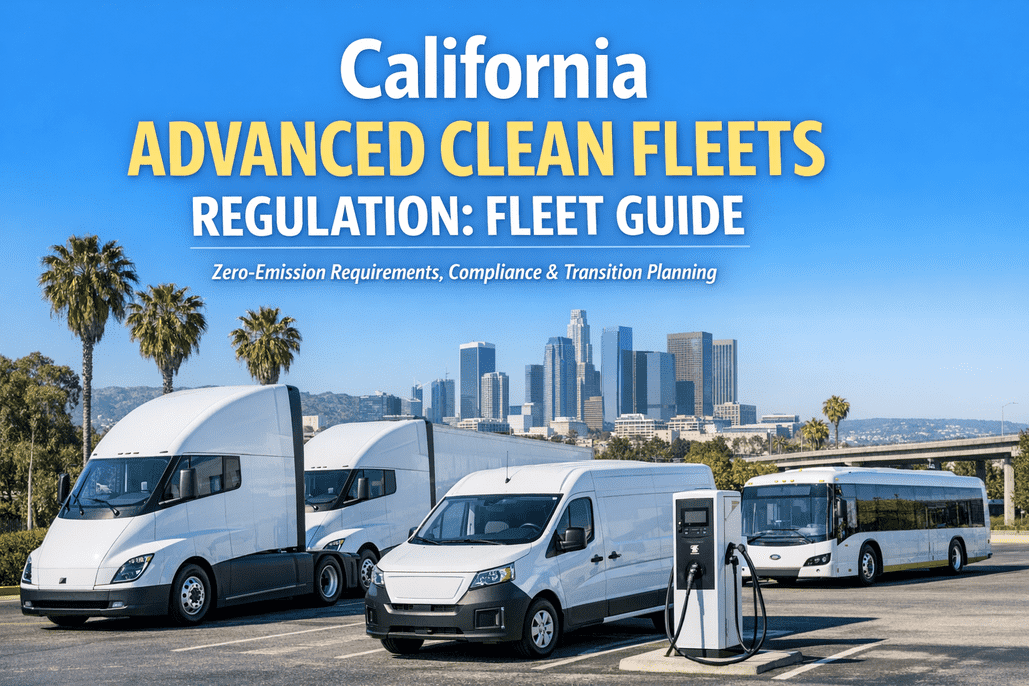
California's Advanced Clean Fleets (ACF) regulation is the most aggressive zero-emission vehicle mandate for medium- and heavy-duty fleets in the United States. Originally approved by CARB in April 2023, ACF required drayage fleets, high-priority private fleets, federal fleets, and state/local government agencies to phase in zero-emission vehicles starting January 1, 2024. However, significant changes occurred in October 2025: CARB voted to repeal ACF requirements for private and federal fleets after failing to secure a federal Clean Air Act waiver, and amended the regulation to provide expanded flexibility for public fleets. Despite these changes, ACF remains consequential — directly affecting state and local government fleets operating heavy vehicles in California, and setting the policy template other states are likely to adopt. For heavy vehicle fleet operators, the challenge is not just buying electric trucks — it is managing inspections, maintenance, and compliance across a mixed diesel/electric fleet during a transition that will last a decade or more. HVI handles both diesel and ZEV inspections in one system. Book a demo to see how HVI manages mixed diesel/ZEV fleets, or start your free trial.
ZEV requirements, compliance timeline, affected fleets, exemptions, and transition planning for heavy vehicle operators. What ACF means for inspections, maintenance, and fleet management.
What Is the Advanced Clean Fleets Regulation?
ACF is a CARB regulation requiring medium- and heavy-duty fleet operators in California to transition to zero-emission vehicles over the next two decades. It applies to vehicles with GVWR over 8,500 pounds, off-road yard tractors, and light-duty mail/package delivery vehicles. CARB estimates the regulation will result in roughly 1.7 million ZEVs on California roads by 2050, reduce emissions by nearly 25 million metric tons of CO2 between 2024 and 2041, and save $26.5 billion in statewide health benefits.
Critical 2025 update: In October 2025, CARB voted to repeal ACF requirements for private and federal fleets — including drayage truck requirements — after failing to secure a federal EPA waiver. The regulation now applies primarily to California state and local government fleets. However, CARB's ACT manufacturer sales mandate remains in effect, meaning ZEV trucks will increasingly dominate the market regardless of fleet purchase mandates.
Who Is Affected? (Post-2025 Amendments)
50% ZEV purchases required (extended 3 years). 100% ZEV purchases by 2030. Small fleets and low-population counties exempt until 2030. Public utility fleets have expanded exemptions. No ICE retirement requirement for existing vehicles.
Originally required 50+ vehicle or $50M+ revenue entities to purchase only ZEVs starting 2024. Repealed after CARB failed to secure federal EPA waiver. Private operators no longer mandated under ACF.
Originally required all new drayage registrations to be ZEV starting 2024, all drayage ZEV by 2035. Repealed alongside private fleet mandates. Port authorities may implement own programs independently.
Separate regulation requiring manufacturers to sell increasing ZEV percentages, reaching 100% by 2036. ZEV trucks will increasingly be the only new vehicles available — affecting every fleet regardless of ACF status.
Compliance Timeline
What This Means for Heavy Vehicle Fleets
Whether ACF directly mandates your fleet or not, the transition is happening. The ACT manufacturer sales mandate means ZEV trucks will increasingly dominate the new vehicle market. Every fleet operator needs to prepare for managing mixed diesel/electric fleets.
Electric heavy vehicles operate at 400-800V. Pre-shift inspections must include HV interlock verification, orange cable condition, battery thermal checks, regenerative braking, and charging port condition.
EVs have 50% fewer moving parts but introduce battery module balancing, inverter inspection, motor bearing lubrication, and regen braking calibration. PM schedules must be rebuilt for electric powertrains.
$150K+ battery packs degrade over 3,000-5,000 charge cycles. Software must track SOH per machine, predict replacement timing, and forecast capital expenditure.
Only HV-certified technicians can work on EVs. NFPA 70E 3-year retraining. ASTM D120 glove testing every 6 months. Fleet systems must track certs and prevent unqualified assignments.
Heavy equipment consumes 200-600+ kWh per charge. Smart scheduling prevents demand charge spikes. Fleet software must coordinate charging across multiple machines returning from shift.
Annual reports through TRUCRS until 2045. Records retained 5+ years. Document ZEV vs ICE counts, purchase dates, VINs, and compliance pathway. Digital systems make this manageable.
How HVI Helps You Navigate the Transition
Diesel and ZEV on the same dashboard. Auto-loads correct template per powertrain. Unified reporting across both.
Pre-built for eCascadia, VNR Electric, Tesla Semi, Cat 320E, Volvo EC230E. HV system, battery thermal, regen braking, emergency disconnect covered.
Per-machine health monitoring. Degradation curves. Threshold alerts. Replacement forecasting. OEM BMS integration.
NFPA 70E certs with 3-year retraining alerts. ASTM D120 glove testing reminders. Only HV-certified personnel assigned to ZEV work orders.
Side-by-side cost-per-hour for diesel vs ZEV. Energy vs fuel. Maintenance comparison. Data-driven electrification decisions.
Track ZEV vs ICE counts, purchase dates, VINs. Export for TRUCRS. 5+ year retention. Audit-ready documentation.
Key Exemptions
If ZEV configuration is not commercially available, fleets may purchase ICE. CARB maintains a streamlined exemption list.
1-year extension for charging infrastructure construction or electrical delays. Electrical extensions available through 2030.
Extension if ZEV ordered before deadline but delivery delayed due to manufacturer supply constraints.
Expanded exemptions for specialized utility vehicles. May purchase ICE when ZEVs do not meet operational needs.
Vehicles under 1,000 miles/year exempt. Odometer readings reported annually in TRUCRS.
Emergency vehicles exempt. Dedicated snow removal exempt. Intermittent snow removal exempt until 2030.
Frequently Asked Questions
No — as of October 2025, CARB repealed ACF requirements for private and federal fleets. However, the ACT manufacturer sales mandate requiring increasing ZEV sales reaching 100% by 2036 remains in effect.
50% ZEV purchases (extended 3 years). 100% ZEV purchases by 2030. Small fleets (10 or fewer) and low-population counties exempt until 2030. Near-ZEVs count as ZEVs until MY 2035.
Use a unified digital platform with powertrain-specific templates. HVI auto-loads the correct checklist per vehicle type. Diesel gets engine/fluid/exhaust. ZEV gets battery/HV/thermal. Both on one dashboard.
Annual compliance reports through TRUCRS from 2024 through 2045. Document fleet composition, vehicle purchases, VINs, and compliance pathway. Records retained 5+ years.
Multiple states have adopted ACT manufacturer sales mandate under Section 177 — Oregon, Washington, New York, New Jersey, Massachusetts. Fleet operators nationwide should prepare for increasing ZEV availability.
California HVIP offers vouchers up to $60,000+ per qualifying heavy-duty ZEV. Federal credits ended Sept 2025 but state programs remain. Business case increasingly stands on TCO merit — 50% lower maintenance, lower energy costs.
HVI manages both diesel and ZEV on one platform — powertrain-specific inspections, battery tracking, HV safety, and compliance documentation.
No credit card • No hardware • Diesel + ZEV on one platform