Electric Class 8 trucks are no longer pilot projects — Freightliner's eCascadia is the market leader in North American electric heavy-duty trucks, Volvo's VNR Electric is proving itself in regional and port drayage operations with a range up to 275 miles, Tesla Semi mass production is expected to ramp in 2026, and PACCAR brands Kenworth T680E and Peterbilt 579EV are entering fleets. The electric truck market is projected to reach $5.92 billion as deliveries accelerate. But here is the compliance reality that every fleet manager must understand: FMCSA regulations (49 CFR 396) apply equally to electric and diesel trucks. Pre-trip and post-trip DVIRs are still required. Annual periodic inspections under 396.17 are still required. Driver qualification files are still required. The truck being electric does not exempt it from a single FMCSA rule. What it does is add entirely new inspection items — high-voltage battery packs, regenerative braking systems, thermal management, charging ports — that do not exist on the diesel DVIR. And as of March 23, 2026, FMCSA's new eDVIR rule explicitly clarifies that electronic DVIRs are compliant, removing any remaining ambiguity for fleets moving to digital inspection platforms. This guide covers FMCSA compliance for EV trucks, the EV-specific DVIR items your drivers need to add, battery safety, maintenance interval differences, mixed fleet management, and how HVI handles it all in one platform. Book a demo to see HVI's EV truck inspection templates, or start your free trial.
FMCSA Rules, EV-Specific DVIR Items, Battery & HV Safety, Maintenance Intervals, Mixed Fleet Management & Digital Compliance
Electric Heavy Truck Models Entering Fleets in 2026
Class 8. 220-250 mile range. Market leader in North America — most widely deployed electric heavy-duty truck. Backed by Daimler Truck's extensive dealer and service network. Popular with large for-hire and regional fleets.
Class 8. Up to 275 miles range. Strong focus on regional hauling and port drayage. Robust safety features. Volvo's dealer network and CareTrack remote diagnostics support fleet operations.
Class 8. 300-500 mile range options. Tri-motor powertrain. 0-60 mph in ~20 seconds fully loaded (82,000 lbs GVWR). Mass production ramping 2026 from Nevada Gigafactory. Megacharger network planned.
Class 8. 150-250 mile range. PACCAR platform — familiar to existing Kenworth fleets. Regional and drayage focus. Growing dealer support for EV service.
Class 8. 150-250 mile range. PACCAR EV platform shared with Kenworth. Strong adoption among fleets already running Peterbilt diesel trucks.
Multiple models. Global EV leader making inroads in U.S. market. Competitive pricing backed by BYD's vertically integrated battery manufacturing.
FMCSA Compliance for EV Heavy Trucks
Electric trucks are subject to every FMCSA regulation that applies to diesel CMVs. The powertrain change does not create any exemption from 49 CFR Parts 390-399. Here is how existing rules apply — and where the EV twist appears.
EV-Specific DVIR Items for Electric Trucks
These items layer on top of the standard DVIR (brakes, tires, lights, coupling devices, horn, mirrors, wipers, emergency equipment). Every standard diesel DVIR item still applies — these are additions, not replacements.
Battery & High-Voltage System Inspection Deep Dive
Thermal runaway is an uncontrollable self-heating event in lithium-ion cells that can lead to fire, explosion, and toxic gas release. Warning signs: sizzling/popping sounds, smoke, strong chemical odor, sparks, rapidly rising battery temperature. If detected: evacuate immediately, establish 50-foot perimeter, contact fire department (inform them it is a lithium-ion event). Water is the correct suppression agent. Batteries can reignite hours later.
All high-voltage cables and connectors are orange per SAE J1673 and ISO 6722-2. Any orange component carries 400-800V DC — enough to cause fatal electrocution. During daily DVIR, drivers visually inspect orange cables for damage but must never touch, move, or disconnect them. Damaged orange cables = immediate out-of-service under FMCSA 396.7 until repaired by a qualified EV technician with proper PPE.
The BMS monitors cell voltages, temperatures, state of charge, and state of health. It controls contactors that connect/disconnect the HV battery from the drivetrain. BMS fault codes during pre-trip inspection = do not operate. Common faults: cell imbalance warnings, insulation resistance faults, temperature sensor errors. All require qualified EV technician diagnosis.
Every EV truck has an emergency high-voltage disconnect (service plug) — know its location before your first trip. This isolates the HV battery from all systems. In emergencies, activating this disconnect cuts power to the entire vehicle. Note: the battery still retains "stranded energy" even after disconnect — it is not zero voltage inside the pack. Never open battery enclosures without qualified training and PPE.
Regenerative Braking & EV-Specific Tire Wear Patterns
Regenerative braking captures kinetic energy during deceleration and returns it to the battery. This means mechanical brake pads and drums/rotors wear significantly slower than diesel trucks — sometimes lasting 2-3x longer. However, reduced use can cause brake components to corrode or seize from inactivity. Daily brake checks must verify both regen function AND mechanical brake condition. Regen supplements but legally cannot replace the mechanical brake system under 49 CFR 393.
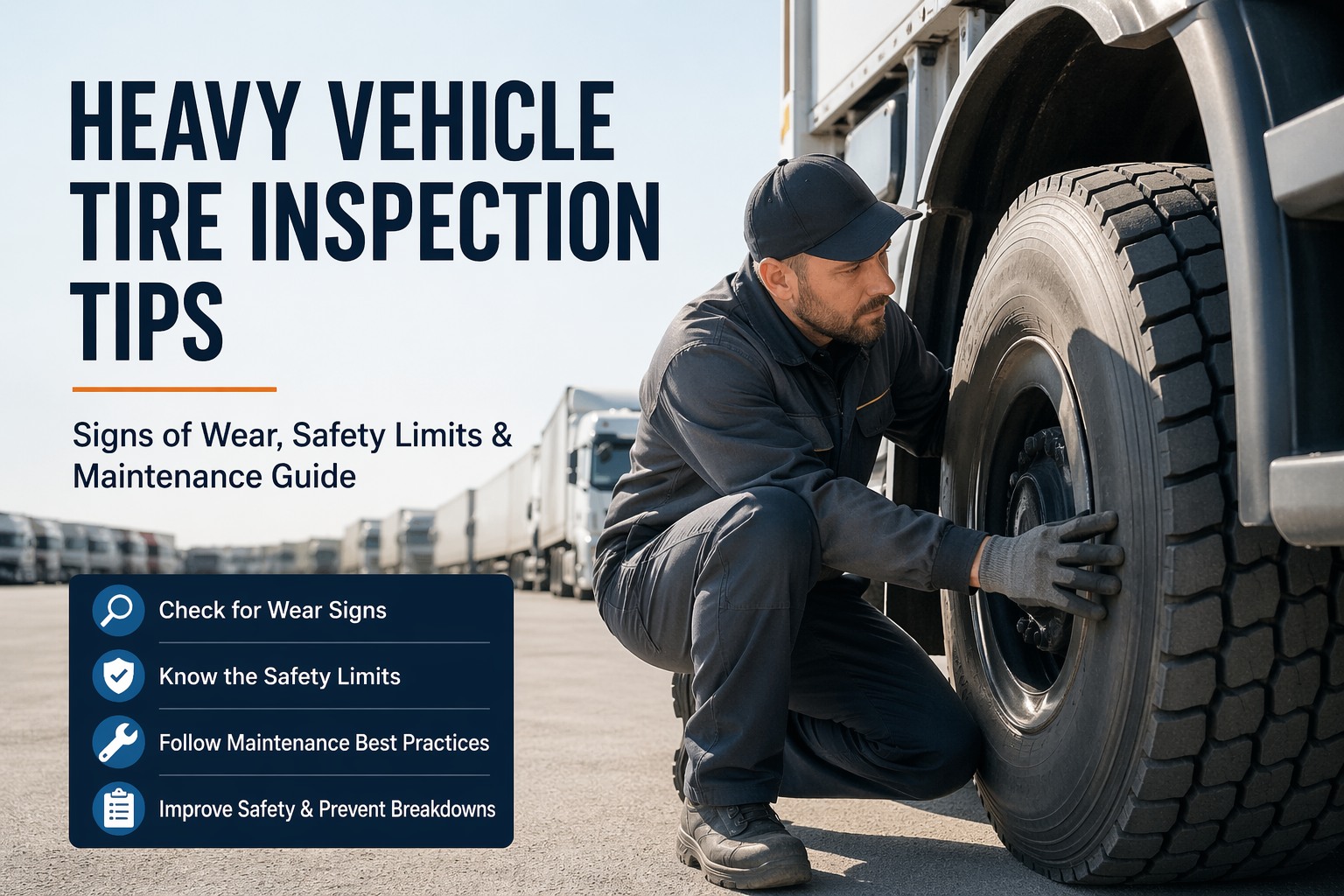
Electric trucks produce instant maximum torque from zero RPM — significantly higher launch forces than diesel engines. This accelerates front-drive axle tire wear, particularly center wear and feathering on drive tires. Electric trucks are also heavier than diesel equivalents (battery weight adds 3,000-5,000 lbs), increasing load on all tires. Inspect tires more frequently: watch for accelerated center wear on drive axles, and check tire pressure rigorously since additional weight makes under-inflation more damaging.
Electric Truck Maintenance Intervals vs Diesel
EV-Specific PPE & Safety Requirements
Standard CDL driver PPE: no additional PPE required for visual inspections. Key rule: do NOT touch any orange-coded cable, connector, or component. Do NOT open battery enclosures. Do NOT attempt to clean or repair charging port connectors. Visual inspection only — report any damage to maintenance. If you detect thermal runaway signs, evacuate immediately.
Class 0 or Class 00 rubber insulating gloves (rated 1,000V AC / 1,500V DC) with leather outer protectors. Arc-rated face shield and clothing per NFPA 70E. Insulated tools rated to 1,000V. CAT III 1000V multimeter. Non-contact infrared thermometer. Safety rescue hook. Remove all conductive personal items. Follow OEM lockout/tagout procedure. Verify absence of voltage before any work.
Mixed Fleet Management (EV + Diesel Trucks)
Most fleets will operate mixed diesel + electric for 5-10+ years during transition. Running separate inspection systems for each powertrain is operationally unsustainable. You need one system that handles both — with customizable DVIR templates that add EV-specific items for electric trucks while keeping standard templates for the rest of the fleet.
Electric trucks have fewer PM items (no oil, no transmission, no DPF) but add new ones (coolant service, HV inspection, battery health). Your PM scheduling system must handle both mileage-based diesel schedules AND charge-cycle/mileage-based EV schedules in one system.
Drivers moving between diesel and electric trucks need the correct checklist every time. A digital DVIR that auto-loads the correct template based on vehicle ID eliminates errors — the driver scans the truck and the correct template (diesel or EV) loads automatically with all required items.
One dashboard showing inspection compliance, defect rates, maintenance costs, and utilization across ALL trucks. Compare cost/mile by powertrain, defect rates diesel vs EV, uptime comparison — data that drives informed fleet transition decisions.
HVI EV Truck Fleet Capabilities
Pre-built templates for Tesla Semi, eCascadia, VNR Electric, T680E, 579EV, and BYD — each with EV-specific items layered on standard FMCSA items. Vehicle-ID auto-loads the correct template.
Track SOC, SOH, charge cycles, and thermal data per truck. Declining battery health triggers proactive maintenance. Integrates with OEM telematics (Volvo CareTrack, Daimler Detroit Connect, Tesla Fleet API).
Fully compliant with FMCSA's new eDVIR rule (FMCSA-2025-0115). Timestamped, geotagged, photo-verified digital records for both diesel and electric trucks.
Diesel and electric trucks in one view. Compare cost/mile, defect rates, and uptime between powertrains for data-informed fleet transition planning.
HV cable damage, charging port issues, regen faults — maintenance gets immediate notification with photos. Critical HV defects auto-tag the truck out of service per FMCSA 396.7.
Mileage-based diesel PM alongside charge-cycle/mileage-based EV schedules. Battery coolant service, HV annual inspection, brake checks — all tracked with correct intervals.
Frequently Asked Questions
Yes — 100%. FMCSA regulations (49 CFR 396.11, 396.13) apply equally to electric and diesel CMVs. Drivers must complete pre-trip and post-trip DVIRs, report defects, and carriers must repair safety-critical items before dispatch. The truck being electric does not exempt it from a single FMCSA requirement. Additionally, effective March 23, 2026, FMCSA's new eDVIR rule (FMCSA-2025-0115) explicitly confirms that electronic DVIRs are compliant.
Beyond all standard FMCSA DVIR items (brakes, tires, lights, coupling, horn, mirrors, wipers, emergency equipment), electric trucks need: battery enclosure visual check, HV cable condition (orange cables — visual only, no touching), charging port condition, BMS warning/fault codes, state of charge verification, regenerative braking function test, thermal management (coolant level, temperature), and electric motor area check. These items add approximately 2-3 minutes to a standard DVIR.
Only if the driver is relieved of all duty during charging. If the driver is waiting with the truck, monitoring the charge, or performing any other duty, charging time is on-duty not driving time. If the driver is in a sleeper berth at a charging stop with no responsibilities, that time can count toward rest requirements. The key: HOS rules track driver duty status, not vehicle status.
Electric trucks eliminate: engine oil changes (every 15-25K miles on diesel), transmission service (every 50-100K miles), DPF regeneration/replacement, DEF fluid, and EGR cleaning. Brake pads last 2-3x longer due to regen braking. New EV items include battery coolant service (50-100K miles) and annual HV inspection. Net result: approximately 50% lower total maintenance cost per mile.
For driving and daily DVIRs: basic EV orientation training covering what to check, what NOT to touch (orange HV cables), thermal runaway recognition, charging procedures, and emergency disconnect location. No special certification required. For any HV system work: trained and qualified EV technician with PPE per NFPA 70E. Drivers never open battery enclosures or touch HV components.
HVI auto-loads the correct DVIR template based on vehicle ID — diesel trucks get the standard template, electric trucks get standard plus EV-specific items. PM scheduling handles both interval types in one system. Reporting shows the entire fleet in one dashboard with powertrain comparison. No separate systems, no manual template selection.
Inspect Electric & Diesel Trucks — One FMCSA-Compliant Platform
Vehicle-ID auto-loads the correct DVIR template. EV-specific items layer on standard FMCSA requirements. Battery health, regen braking, charging port, and thermal system — all documented. eDVIR compliant effective March 23, 2026.
No credit card • No hardware • Tesla Semi, eCascadia, VNR Electric & more • FMCSA + eDVIR compliant