Every commercial motor vehicle must pass a comprehensive annual inspection at least once every 12 months — and documentation proving it must be on the vehicle at all times. Under 49 CFR 396.17, this is a federal requirement enforced through roadside inspections, compliance reviews, and DOT audits. Operating a vehicle with an expired or missing annual inspection generates approximately 133,000 citations per year — about 12,000 per month — with penalties including immediate out-of-service orders and fines up to $19,277. The annual inspection covers 15 major component categories defined in Appendix A, must be performed by a qualified inspector meeting 396.19 requirements, and generates a report retained for 14 months per 396.21. Yet fewer than 7% of carriers pass a DOT audit without a single violation, and the average penalty is $7,155 per violation. For heavy equipment fleets operating Class 6-8 trucks, trailers, and specialty vehicles, the Annual Vehicle Inspection Report (AVIR) is the single most important compliance document your fleet produces. This guide covers exactly what the report must contain, who qualifies to perform it, what they must inspect, how defects must be documented, and how HVI auto-generates compliant AVIRs across your entire fleet. Book a demo to see HVI's annual inspection management, or start your free trial.
Report Requirements, Qualified Inspector Standards, Appendix A Components, Defect Documentation & AVIR Automation
What an AVIR Must Include (§396.21)
The qualified inspector performing the inspection must prepare a report per 49 CFR 396.21 that contains every element below. Missing any single element can render the report non-compliant during an audit.
Qualified Inspector Requirements (§396.19)
The inspector must: (1) understand the inspection criteria in Part 393 and Appendix A and be able to identify defective components, and (2) have mastered the methods, procedures, tools, and equipment used when performing an inspection. This is not a general mechanic standard — it specifically requires Part 393 and Appendix A knowledge.
The inspector must have either: (a) successfully completed a Federal- or State-sponsored training program, or hold a State or Canadian Province qualifying certificate, or (b) have a combination of training and experience totaling at least 1 year. A January 2025 ATA exemption also allows TMC RP-based training programs (minimum 540 hours for new technicians).
Carriers must retain evidence of each inspector's qualifications for the entire period they perform annual inspections, plus one year after they stop. This means training certificates, program completion records, or documented experience — on file and producible on demand. Exception: documentation is not required for inspections performed under State periodic inspection programs.
The carrier can self-inspect (if it has qualified inspectors on staff), or use a third-party: commercial garage, fleet leasing company, truck stop, or similar commercial business — provided the business maintains appropriate facilities and employs qualified inspectors per §396.19. State inspection programs satisfying §396.23 also qualify.
Appendix A — Heavy Equipment Inspection Points
Appendix A to 49 CFR Part 396 defines 15 component categories that must be inspected. Each category has specific pass/fail criteria — if any item fails, the vehicle cannot be certified until corrected. Every tractor, trailer, and dolly is inspected separately.
Service brakes, parking brake, brake drums/rotors, brake hose, brake tubing, low-air pressure warning, air compressor, electric brakes, hydraulic brakes, vacuum system. Top failure: brake adjustment out of spec, lining below minimum.
Fifth wheels, pintle hooks, drawbars, saddle mounts, tow bars, safety devices. Check for cracks, loose mounting, worn components, and proper engagement.
Leaks, proper location relative to fuel system, secured and intact. No exhaust leaks likely to result in entry of exhaust gases into passenger or driver compartment.
Visible leaks, proper mounting, fuel cap present and functional. No dripping or seepage from tank, lines, or fittings.
Headlamps, tail lamps, stop lamps, turn signals, clearance/marker lamps, reflectors, identification lamps. All must be functional and of correct color.
Cargo securement devices functional. No shifting, spilling, or blowing conditions. Tailgate and end-gate latches operative.
Steering wheel free play within spec. Steering column secure. Power steering functional. All components — tie rods, drag links, pitman arm — without excessive wear or damage.
Spring assemblies, U-bolts, spring hangers, torque/radius rods, air bags. No cracked, broken, or missing leaves. Proper ride height.
No cracks, loose, or sagging frame members. Bolts and rivets secure. No damaged or missing cross members.
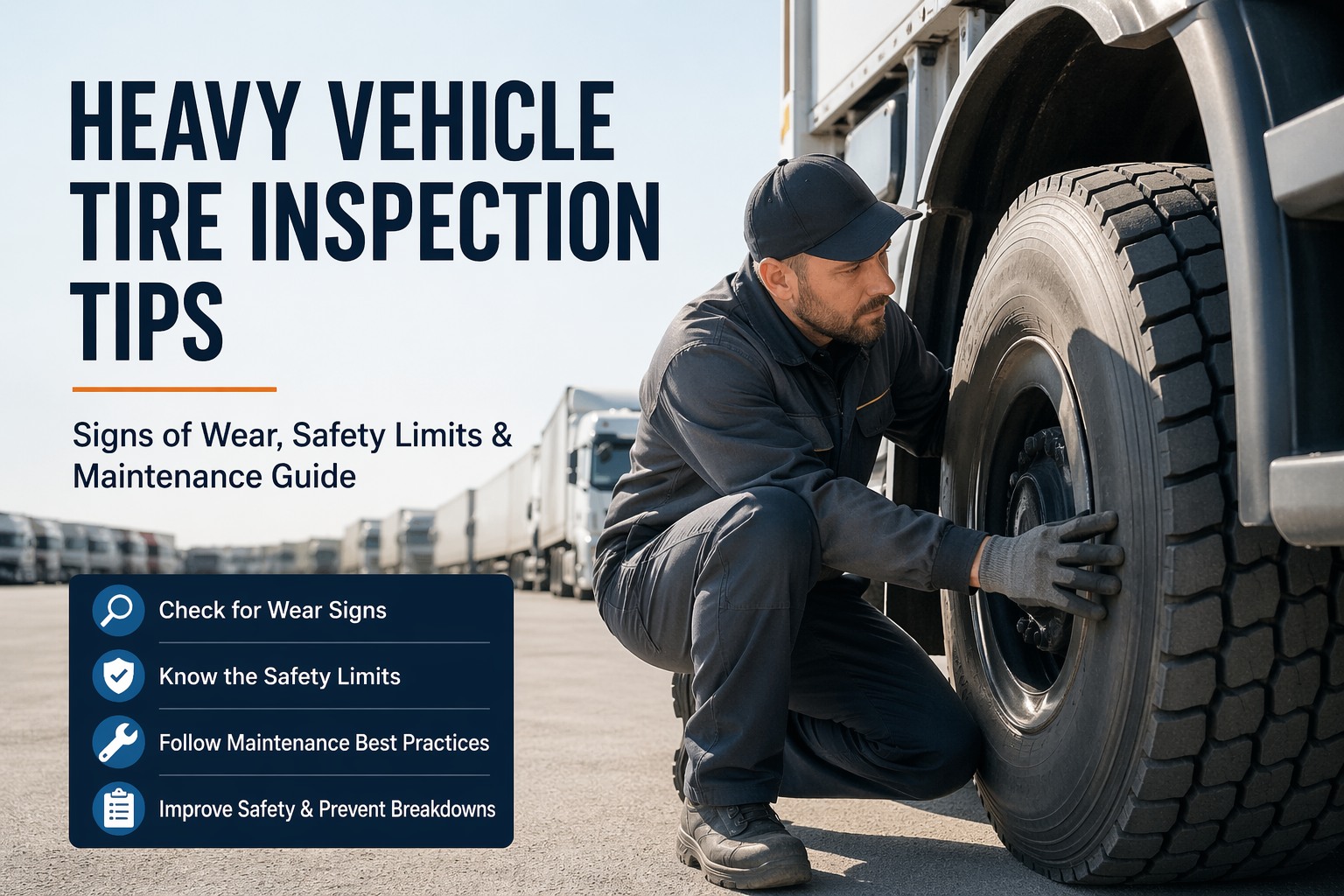
Tread depth (steer: 4/32", drive/trailer: 2/32"), sidewall condition, inflation, exposed cord, cuts, and flat spots. Proper size and load rating.
No cracks, broken or missing lugs/studs. Proper torque. No elongated bolt holes. Valve stems intact. Wheel bearing condition.
No cracks or discoloration in the area cleaned by wipers that obstruct driver's view. Wipers functional. Washer fluid operational.
All required windows present and in good condition. No cracks or damage that impair visibility or create injury hazard.
Horn must be functional and audible. Simple test but frequently overlooked.
Floor, doors, and structural members. No openings that would permit exhaust entry into occupied areas. Fenders and mud flaps intact.
Defect Documentation Standards
FMCSA requires defect descriptions with enough specificity to identify and correct the issue. "Brakes need work" fails. "Left front steer axle — brake lining worn to 3/32" (minimum 4/32"), requires replacement" passes. Every defect entry should include: component name, location (axle, side, position), specific condition observed, measurement if applicable, and pass/fail determination against Appendix A criteria.
While Appendix A does not mandate photos, photo evidence has become the audit standard. Photos of defects (with date/time metadata), measurements (brake stroke, tread depth), and corrective actions create unassailable documentation. Digital platforms that require photo capture for every failed item eliminate the "I wrote it down but you can't see what I saw" problem.
For any item that fails Appendix A criteria, the vehicle cannot be certified until the deficiency is corrected. The correction must be documented: what was done, who did it, when, and what parts were used. The AVIR should then be updated to reflect that all deficiencies were resolved. This defect→repair→certification chain is exactly what auditors verify.
The inspector certifies that the vehicle has passed an inspection complying with §396.17 — meaning every Appendix A component meets minimum standards. If any component fails and is not corrected before certification, the inspector cannot sign. Signing a report for a vehicle with uncorrected Appendix A deficiencies is a violation of both §396.17 and §396.21. The vehicle must be repaired first, then re-inspected and certified.
Annual Inspection Timeline & Compliance Calendar
Generate alerts for all vehicles approaching 12-month inspection deadline. Schedule inspector availability, shop bay time, and parts for known wear items. For large fleets, stagger inspections throughout the year — avoid end-of-year rush that leads to missed vehicles.
Review vehicle's DVIR history, maintenance records, and known deficiencies. Pre-order parts likely needed based on mileage and defect trends. Verify inspector qualifications are current. Confirm inspection equipment (brake stroke gauges, tread depth gauges, pressure gauges) is calibrated.
Complete all 15 Appendix A categories. Document every item — pass or fail. Photograph defects with measurements. Repair any deficiencies before signing certification. Apply decal/sticker to vehicle. File AVIR report per §396.21. Total time: 4-8 hours for comprehensive PM-C + DOT annual.
Store original/copy of AVIR report for 14 months minimum. Ensure copy is on/in vehicle for roadside access. Update fleet compliance dashboard — vehicle inspection status moves to "current." Track inspector qualifications retention (active + 1 year after).
HVI Auto-Generated AVIR Reports
HVI eliminates the documentation gaps that cause annual inspection violations by auto-generating compliant AVIR reports from the inspection data your inspectors enter — with every required §396.21 element pre-built into the template.
All 15 component categories with pass/fail gates for each item. Inspectors follow guided prompts — no categories get skipped, no items get missed. Required fields enforce completeness. Photo capture required for every failed item.
Upon inspection completion, HVI auto-generates a compliant AVIR containing every required element: inspector name, carrier, date, vehicle ID, all components inspected with results, defect descriptions, and certification. Export as PDF. No manual report assembly needed.
Automated alerts at 60, 30, and 7 days before each vehicle's annual inspection expires. Fleet dashboard shows green/yellow/red status for every vehicle. Never discover an expired inspection during a roadside stop or audit.
Track each inspector's credentials, training certificates, and qualification period. Alerts when qualifications approach expiration. Ensures every inspection is performed by a documented 396.19-qualified individual — the requirement auditors verify first.
When an inspector flags a failed component, HVI auto-generates a work order. Repair is documented with photos, parts, and technician. Vehicle cannot be certified until all deficiencies are resolved. The complete chain is audit-ready from day one.
AVIR reports stored digitally for the full 14-month retention period — accessible instantly during audits or roadside inspections. No filing cabinets, no lost reports, no "we had it somewhere." Produce any vehicle's annual inspection history in seconds.
Frequently Asked Questions
At least once every 12 months per vehicle — including every tractor, trailer, and dolly separately. The inspection must cover all 15 Appendix A component categories. Documentation must remain on the vehicle at all times. Operating a vehicle more than 12 months past its last inspection is an immediate OOS violation with fines up to $19,277.
Yes — provided the carrier employs a qualified inspector meeting §396.19 requirements and the state does not have an FMCSA-equivalent periodic inspection program (§396.23). The carrier can also contract a third-party: commercial garage, fleet leasing company, truck stop, or similar business with qualified inspectors and appropriate facilities. State inspection programs that meet Appendix A standards also satisfy the requirement.
Per §396.19, the inspector must: (1) understand Part 393 and Appendix A criteria and identify defective components, (2) have mastered inspection methods, procedures, tools, and equipment, and (3) have either completed a Federal/State training program or State/Canadian Province qualifying certificate, OR have a combination of training and experience totaling at least 1 year. Carriers must retain qualification evidence while the inspector is active and for one year afterward.
The original or a copy of the inspection report must be retained for 14 months from the inspection date per §396.21. The report must be stored where the vehicle is housed or maintained and be available for inspection upon demand by any authorized Federal, State, or local official. A copy or compliant decal must also be on the vehicle itself at all times.
The vehicle cannot be certified as passing until every Appendix A deficiency is corrected. The inspector documents the defect, the carrier repairs it, the repair is documented (what was done, who, when, parts used), and the inspector re-verifies the correction before signing the certification. Signing a report for a vehicle with uncorrected deficiencies violates both §396.17 and §396.21.
The annual inspection applies to all commercial motor vehicles (CMVs) as defined by FMCSA — vehicles with GVWR of 10,001 lbs or more, designed to transport 9+ passengers for compensation, 16+ passengers regardless of compensation, or hauling hazmat requiring placards. This includes Class 6-8 trucks, trailers, dollies, and any heavy equipment that operates on public roads and meets the CMV definition. Equipment that operates exclusively on private property or construction sites and never uses public roads may not be subject to FMCSA requirements, though OSHA standards would apply.
Never Miss an Annual Inspection Again
HVI tracks every vehicle's inspection deadline, auto-generates compliant §396.21 reports, verifies inspector qualifications, and creates the defect→repair→certification chain auditors demand. 60/30/7-day alerts prevent expired inspections. Audit-ready in seconds.
No credit card • No hardware • Setup in under 10 minutes • 49 CFR 396.17 / 396.21 compliant