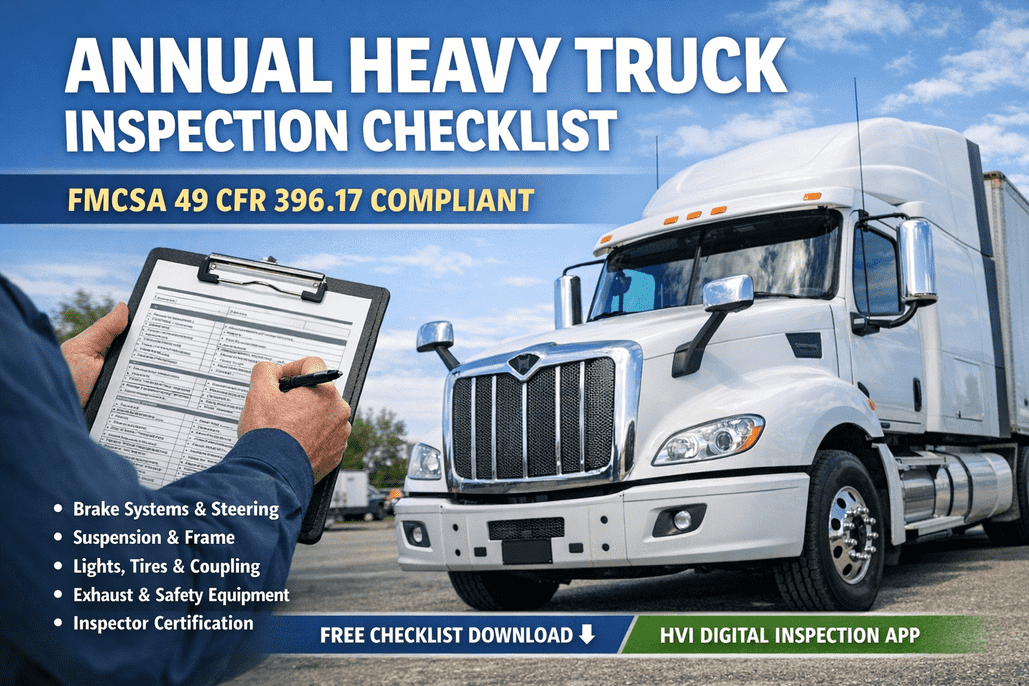
Annual Heavy Truck Inspection Checklist FMCSA 49 CFR 396.17 Compliant
This checklist covers every component required by 49 CFR 396 Appendix A: Minimum Periodic Inspection Standards for the annual DOT inspection of heavy-duty trucks and commercial vehicles. Every item has specific pass/fail criteria derived directly from federal regulations. The inspection must be performed by a qualified inspector per §396.19, documented per §396.21, and retained for 14 months. Approximately 133,000 vehicles are cited annually for operating without a current annual inspection — the second most common vehicle maintenance violation in the FMCSA CSA system. Use this checklist in the HVI app for guided digital inspections with photo capture, pass/fail gates, and auto-generated compliant AVIR reports — or download the PDF version for paper-based inspections. Book a demo to see HVI's annual inspection workflow, or start your free trial.
CHECKLIST • USA • 49 CFR 396.17 / APPENDIX A • 2026
Annual Heavy Truck Inspection Checklist
FMCSA 49 CFR 396.17 Compliant — All 15 Appendix A Categories — Pass/Fail Criteria — Measurement Specifications
Brake violations = #1 cause of OOS orders. 41% of all vehicle OOS at 2025 Roadcheck. Measure every brake on every axle.
Pushrod stroke within limits — Measure at 80-90 psi with brakes fully applied, engine off. Must not exceed manufacturer's readjustment limit per Appendix A tables. Most common single failure point.
Brake drums/rotors — No external cracks that open upon application (distinguish from hairline heat checks). No missing portions or sections in danger of separating.
Brake hose & tubing — No damage extending through outer reinforcement ply. No audible leaks. No chafing, kinks, or restriction. Connections secure.
Low air pressure warning — Must activate before air pressure drops below 60 psi (or 50% of governor cut-out for vehicles with higher settings).
Air compressor & governor — Compressor builds pressure. Governor cuts out at correct setting. Cut-in/cut-out spread within spec.
Air system leak-down — Max 3 psi drop/minute (single), 4 psi drop/minute (combination) with engine off, full system pressure, brakes released.
Parking brake — Must hold vehicle stationary when applied. Spring brake operation verified. Driveline parking brake (if equipped) functional.
ABS malfunction indicator — Lamp illuminates at key-on, then extinguishes. Sensor wiring intact. No active ABS fault codes.
Automatic brake adjusters — Functioning and maintaining proper adjustment. Manual adjustment not substituted for failed auto-adjusters.
No missing brakes — Every axle required to have brakes must have functioning brakes. No mismatch across steering axle (type, size, or air chamber).
2. Steering System Components
Steering wheel free play — Max 2" for manual, 2" for power steering with 20" wheel diameter. Measure with engine running (power steering).
Steering column — Securely mounted. No looseness or excessive play. Column securely attached to gear box.
Steering gear — Securely mounted to frame. No cracks in housing. Mounting bolts present and tight.
Pitman arm — Securely attached. No cracks. Locking device present and engaged.
Tie rods & drag links — No excessive wear in ball joints or sockets. No loose clamps. Threads not stripped. No bending or damage.
Power steering — No leaks. Fluid level adequate. Belt tension correct. Pump functioning. Hoses intact.
Steering stops — Present and functional. Prevent over-travel of steering linkage.
3. Suspension & Frame Integrity
Spring assemblies — No cracked, broken, or missing leaves in multi-leaf springs. No shifted leaves allowing contact with tire or frame. Main leaf intact.
U-bolts & spring hangers — U-bolts tight and not cracked or elongated. Spring hangers not cracked at mounting points. Bolts present and torqued.
Air suspension — Air bags not cracked, bulging, or leaking. Proper inflation. Height control valves functioning. Shock absorbers not leaking excessively or broken.
Torque/radius rods — Bushings not worn or deteriorated. Mounting hardware present and tight. No cracked or bent rods.
Frame rails — No cracks in rails, cross-members, or mounting brackets. No loose or missing rivets/bolts. No sagging, bending, or misalignment.
Frame fasteners — All fasteners present and effective. No cracks extending from mounting bolt holes. No weld cracks at stress points.
Tire/wheel clearance — No condition causing body or frame to contact tire or wheel assembly under any loading condition.
No exhaust leaks — No leaks forward of or directly below driver/sleeper compartment. Any leak likely to result in exhaust entry into occupied areas = fail.
Exhaust positioning — System not positioned where it could burn, char, or damage wiring, fuel supply, or any combustible part of the vehicle.
Mounting & clamps — Muffler and all exhaust components securely mounted. Clamps tight. No missing hangers or broken brackets.
DPF/aftertreatment — Diesel particulate filter intact, properly mounted, no visible damage. DEF system (if equipped) functional. No tampered emission controls.
5. Lighting & Electrical
Lighting defects = 14% of OOS violations. "Gateway violation" — inspectors who find bad lights look harder at everything else.
Headlamps — Both high and low beam operational. Properly aimed. Lenses not cracked or discolored.
Tail lamps, stop lamps, turn signals — All operational. Correct color (red tail/stop, amber/red turn). Visible from required distance.
Clearance & marker lamps — All operational and correct color. Front: amber. Rear: red. Side: amber (front half), red (rear half).
Identification lamps — Three-lamp cluster on cab and rear of vehicle operational (vehicles over 80" wide).
Reflectors & reflective tape — All required reflectors present and not cracked or missing. Conspicuity tape (trailer) intact and reflective.
License plate lamp — Operational. Illuminates plate from rear.
Wiring — No chafing, exposed conductors, or loose connections. No jury-rigged repairs. All connections properly insulated.
6. Tires, Wheels & Rims
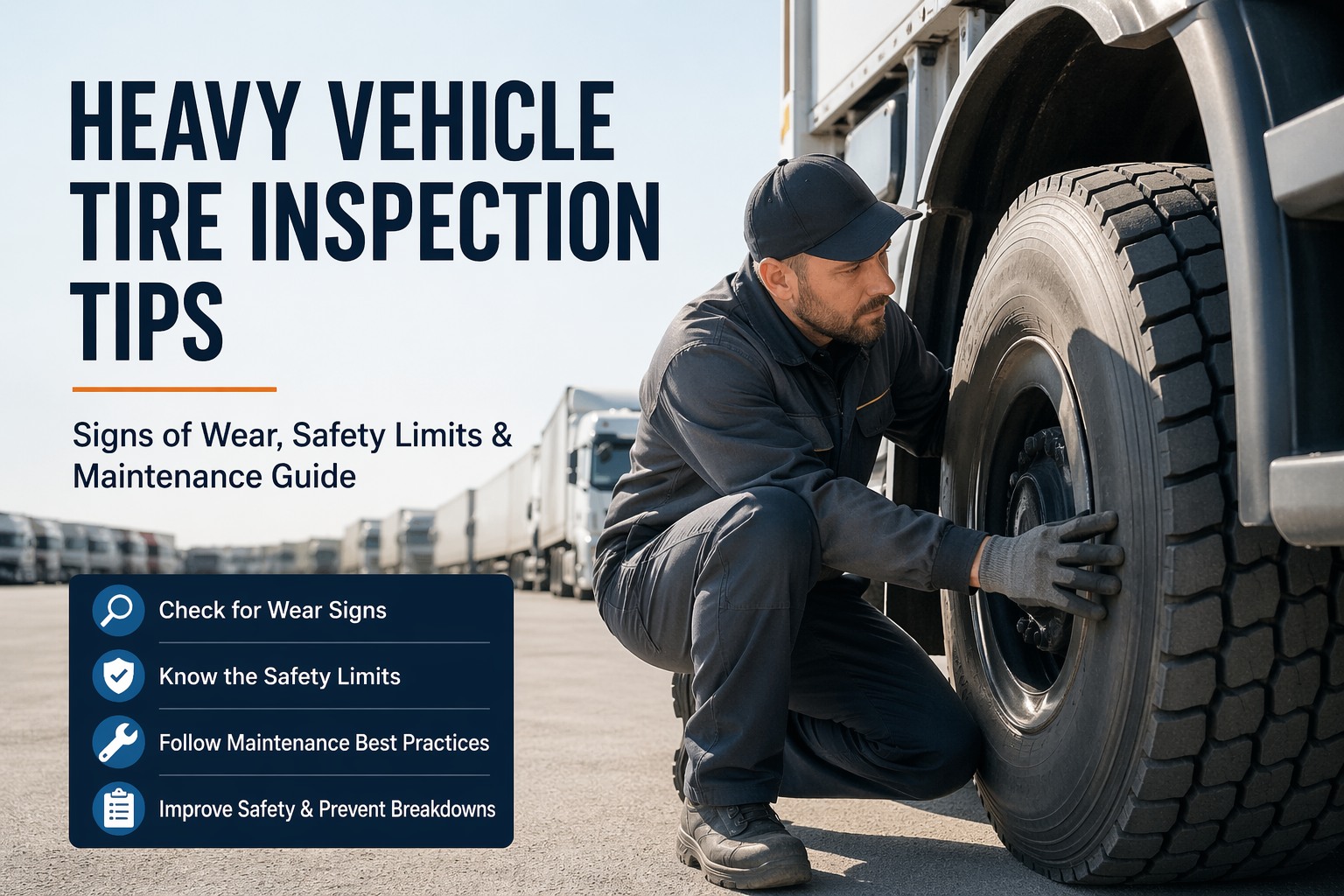
Tire defects = 21.4% of OOS violations. 2,899 tire-related OOS at 2025 Roadcheck. Measure — do not estimate.
Tread depth — Steer axle: minimum 4/32" in every major groove. All other axles: minimum 2/32". Measure at shallowest point with a gauge.
Tire condition — No exposed cord, belt, or ply material. No bulges, cuts extending into cord body. No flat or audibly leaking tires.
Inflation — All tires inflated to proper pressure. No tire below 50% of max inflation pressure stamped on sidewall (immediate OOS).
Tire matching — No mixing bias and radial tires on same axle. No tires labeled "Not for Highway Use" on steering axle. Proper load rating for position.
Wheel fasteners — All lug nuts present and properly torqued. No cracked, broken, or missing studs. No elongated bolt holes.
Rim condition — No cracked or broken rims. No welded repairs on aluminum wheels. Lock rings properly seated (if applicable).
Valve stems — Intact, not cracked or cut. Caps present. Not contacting brake components.
Wheel bearing condition — No excessive play. No overheating evidence (discoloration, leaking seals). Hub caps/covers intact.
7. Coupling Devices — Fifth Wheel & Pintle Hook
Fifth wheel — No cracks in fifth wheel plate (exception: approach ramp cracks and casting shrinkage cracks in ribs). Mounting bolts secure. Pivot bracket intact.
Locking mechanism — Parts not missing, broken, or deformed. Kingpin securely held when locked. Locking jaws fully closed around kingpin.
Pintle hook (if applicable) — No cracks. Latch functional and secure. Mounting hardware intact. Safety chains/devices present and functional.
Drawbar/tongue — No cracks, bends, or excessive wear. Eye properly shaped. Safety chains present and of adequate rating.
Slider pins — Fully engaged (for sliding fifth wheels). Release mechanism functional. No missing or broken locking pins.
Air/electrical connections — Glad-hands seal properly, no air leaks. Electrical connector (7-way) intact, all pins present. No corroded or damaged connections.
8. Windshield, Wipers & Glazing
Windshield condition — No cracks or discoloration in the area cleaned by wipers that obstruct driver's view. No damage affecting safe operation.
Wipers — Operational on all required speeds. Blades make proper contact and clear the windshield effectively. No streaking or skipping.
Washer fluid — System operational. Reservoir filled. Nozzles aimed properly.
Other glazing — All required windows present. No damage creating safety hazard or significantly impairing visibility through any required window.
9. Fuel System
No fuel leaks — No visible leaks from tank, cap, lines, or fittings. No dripping or seeping.
Fuel cap — Present and seals properly. Missing cap = vapor emission hazard.
Tank mounting — Tank securely mounted to frame. Straps tight. No cracks or damage to tank.
Fuel lines — No chafing against frame or moving parts. Proper routing away from exhaust. Secure at all connections.
10. Horn & Emergency Equipment
Horn — Functional and audible. Activates from driver's normal seating position.
Fire extinguisher — Present, properly mounted, accessible, charged (gauge in green), inspection tag current.
Warning devices — Three reflective triangles present and in good condition. Stored in accessible location.
11. Body & Cab
Floor condition — No openings that could permit exhaust entry into occupied areas of vehicle.
Doors — Open, close, and latch properly. No sharp edges or protrusions that could injure.
Fenders & mud flaps — Present and functional. Not dragging or broken. Adequate coverage per state requirements.
Seat belt — Present and functional for driver. Buckle latches securely. Webbing not frayed or damaged.
Inspector Certification & Documentation
Inspector Qualifications (§396.19)
Must understand Part 393 and Appendix A, identify defective components, and have mastered inspection methods/tools. Requires: Federal/State program completion, or State/Canadian Province certificate, or 1+ year combined training and experience. Qualification documentation retained while active + 1 year after.
Report Requirements (§396.21)
Must include: inspector name, motor carrier name, inspection date, vehicle ID (VIN/unit number), all components inspected with results, description of any defects, and inspector certification of accuracy and completeness. Original retained 14 months. Copy or compliant decal on vehicle at all times.
Defect Resolution
Vehicle cannot be certified until every Appendix A deficiency is corrected. Corrections must be documented: what was repaired, by whom, when, and parts used. Inspector re-verifies correction before signing certification. Signing for a vehicle with uncorrected defects violates §396.17 and §396.21.
HVI Digital Annual Inspection
All 15 Categories Pre-Loaded
Every Appendix A item with pass/fail gates, measurement fields (brake stroke, tread depth), and required photo capture for defects. Inspector follows guided prompts — nothing gets skipped.
Auto-Generated §396.21 AVIR
Compliant report generated automatically upon completion — inspector name, carrier, date, vehicle ID, all items, defects, and certification. Export as PDF. No manual assembly.
Defect → Repair → Certify
Failed items auto-generate work orders. Repair documented with photos and parts. Vehicle blocked from certification until all corrections verified. Complete audit trail.
Fleet-Wide Scheduling
90/60/30/7-day alerts before each vehicle's annual inspection expires. Stagger across the year automatically. Dashboard shows green/yellow/red for every vehicle.
Yes. Every segment of a combination vehicle is inspected separately. A tractor-trailer requires two inspections with two separate reports. Dollies in multi-trailer combinations also need their own inspection. Each unit has its own 12-month cycle that may be on different dates.
Yes, provided your inspector is qualified per §396.19: understands Part 393 and Appendix A, masters inspection methods and tools, and has documented training (Federal/State program or 1+ year experience). Retain qualification evidence while inspector is active + 1 year after. Third-party commercial garages and fleet leasing companies can also perform the inspection.
Pushrod stroke must be measured with engine off, reservoir pressure 80-90 psi, brakes fully applied. Must not exceed manufacturer's readjustment limit per Appendix A tables. Brake lining thickness: non-steering min 1/4" (air drum), steering min 1/4" (drum) or 1/8" (air disc). Air system leak-down: max 3 psi/min single, 4 psi/min combination.
Steer axle: minimum 4/32" in every major groove. All other axles (drive, trailer): minimum 2/32". Measure at the shallowest point with a calibrated gauge — visual estimates are insufficient. Any tire with exposed cord, belt, or ply material is an immediate fail regardless of tread depth. Tires below 50% of max inflation pressure stamped on sidewall are also immediate OOS.
14 months from inspection date per §396.21. Original or copy stored where vehicle is housed or maintained, available on demand. Copy or compliant decal/sticker must also be on the vehicle at all times — no proof at roadside = citation regardless of whether inspection was performed. Inspector qualifications retained while active + 1 year after separation.
Vehicle cannot be certified until every Appendix A deficiency is corrected. The repair must be documented (what, who, when, parts), and the inspector re-verifies the correction. Only then can the inspector sign the certification. Operating a vehicle with known uncorrected Appendix A defects is a violation of §396.7 (unsafe operations) with fines up to $19,277 per instance.
Digitize Your Annual Inspections — Pass Every Time
HVI's Appendix A templates with pass/fail gates, photo capture, measurement fields, and auto-generated §396.21 reports eliminate the documentation gaps that cause failures. 96% audit pass rate. 14-month digital retention.