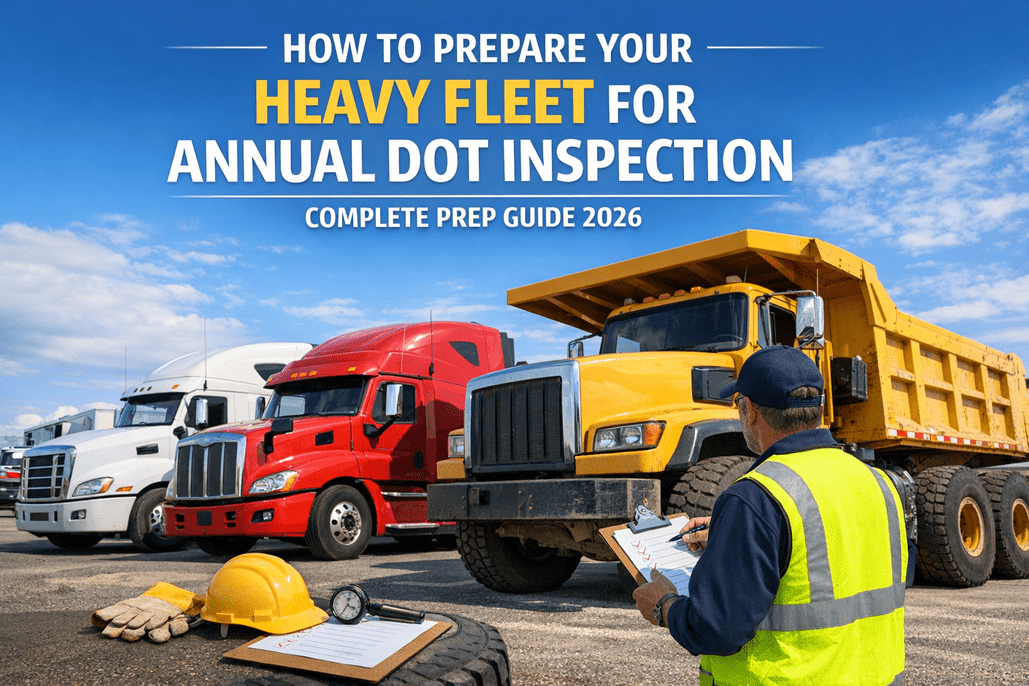
During the 2025 CVSA International Roadcheck, 18.1% of trucks inspected were placed out of service — 10,148 vehicles shut down in 72 hours. Brake violations accounted for 41% of all vehicle OOS findings. Tire issues caused 23%. Lighting defects added another 14%. Yet 81.6% of vehicles passed without any OOS violations, proving that the difference between passing and failing comes down to preparation — not luck. The annual DOT inspection (49 CFR 396.17) covering all Appendix A components is the most comprehensive compliance checkpoint your fleet faces. Operating a vehicle with an expired annual generates approximately 133,000 citations per year with fines up to $19,277. But the real cost of failing is not the fine — it is the machine sitting idle, the crew waiting, and the project falling behind schedule. Fleets that prepare systematically — starting 90 days before the inspection date — pass at rates exceeding 95%. Fleets that scramble the week before fail at 3-5x the rate. This guide gives you the complete 90-day preparation timeline, the 15 failure points that account for most OOS violations, system-specific prep guides for brakes/lighting/frame, and the documentation auditors verify first. Book a demo to see how HVI automates annual inspection scheduling, or start your free trial.
90-Day Prep Timeline, Top 15 Failure Points, System-Specific Guides, Documentation Checklist & Pass Rate Data
Why Prep Starts 90 Days Before — Not the Week Before
Brake drums, steering components, and suspension parts have 1-4 week lead times. If your 30-day pre-inspection review finds a worn kingpin or cracked spring, you need time to order, receive, and install the part before the inspection date. Last-week discovery = expedited shipping at 200% premium or a failed inspection.
A thorough annual inspection takes 4-8 hours per vehicle. For a 50-truck fleet, that is 200-400 shop hours. Trying to push all vehicles through in the final week creates bottlenecks, overtime costs, and rushed inspections that miss defects. Stagger vehicles across 90 days — 2-3 per week — and the workload is manageable.
A vehicle cannot be certified until every Appendix A deficiency is corrected. If your inspector finds 3 defects across 3 different systems, each repair must be completed, documented, and re-verified. This chain takes 1-5 days per vehicle depending on complexity. Build correction time into your schedule.
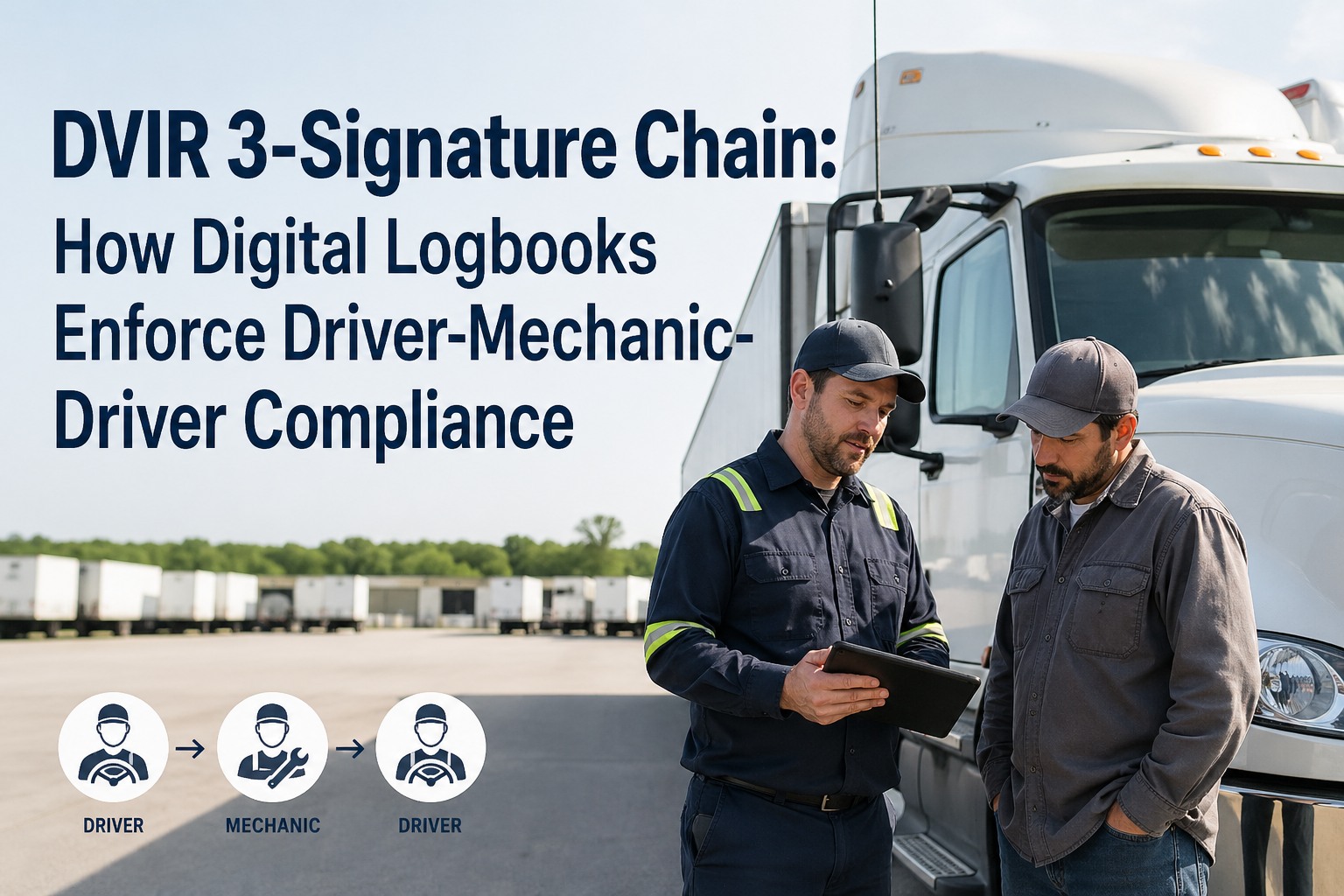
Auditors verify inspector qualifications (396.19), previous maintenance records (396.3), and DVIR history (396.11) alongside the annual report. If these records are scattered across paper files, spreadsheets, and email, assembling them takes time. Digital systems produce everything instantly — paper systems need weeks.
90-Day Pre-Inspection Maintenance Plan
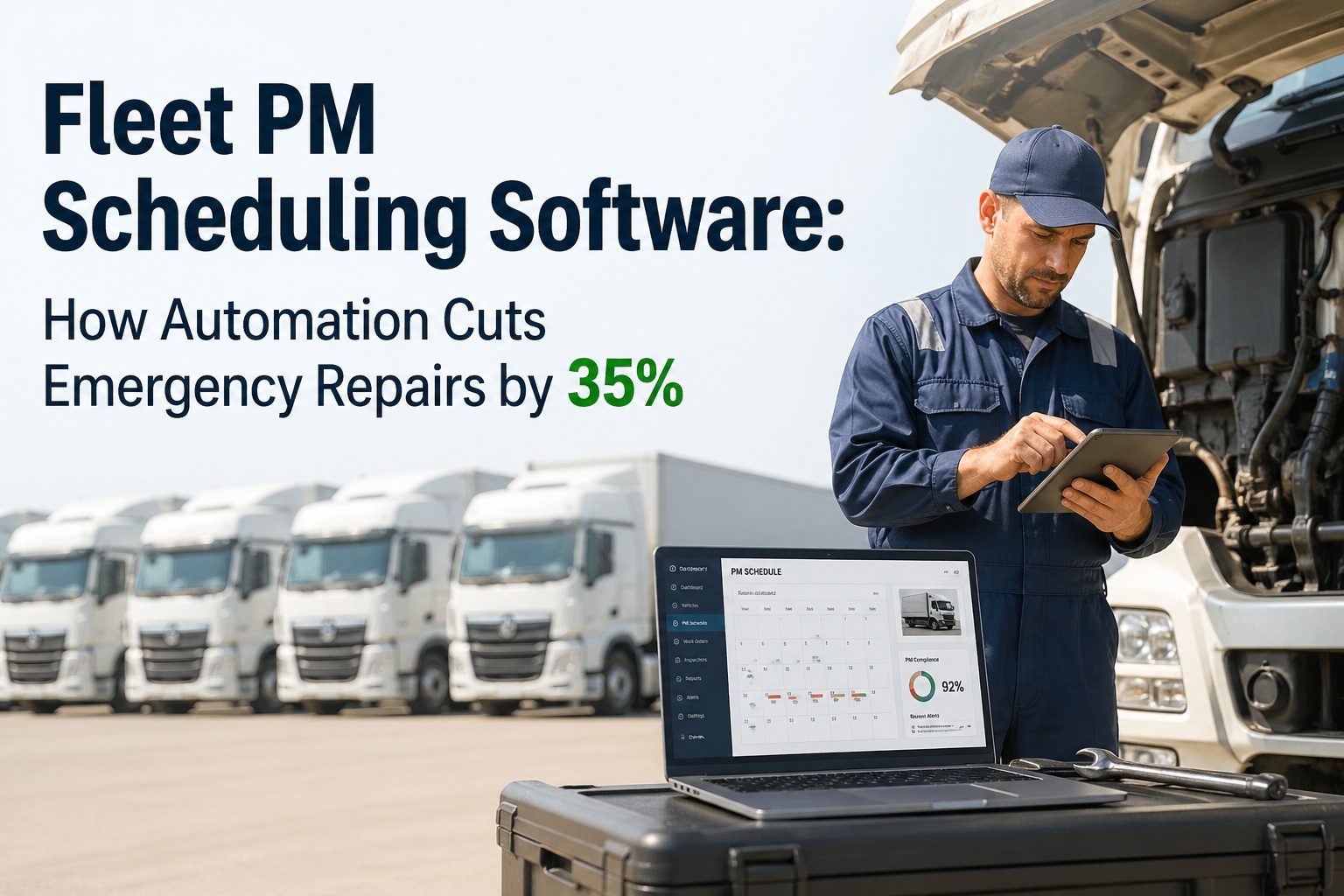
Generate list of all vehicles approaching 12-month inspection deadline within the next 90 days. Assign inspection dates — stagger 2-3 vehicles per week across the fleet. Verify all inspector qualifications are current (396.19). Review each vehicle's maintenance history and DVIR defect trends. Order any parts with long lead times based on known wear items.
Perform a preliminary walk-through of each vehicle against Appendix A categories. Focus on the "Big 3" failure areas: brakes (check adjustment, lining thickness, air system), tires (tread depth all positions, sidewall condition, inflation), and lighting (all lamps operational, correct color, reflectors intact). Document any defects found. Order correction parts immediately. Begin repairs on vehicles scheduled for inspection in weeks 5-8.
Detailed inspection of secondary failure areas: steering (free play, tie rod ends, drag links), suspension (spring condition, U-bolts, air bags), frame (cracks at stress points, cross members), exhaust (leaks near cab, secure mounting), coupling devices (fifth wheel, kingpin wear), and windshield/glazing. Complete all repairs from 60-day findings. Verify all correction documentation is linked to original defect reports.
Re-check all previously repaired items — especially brake adjustment, which drifts within days of service. Verify every light works (check again — bulbs burn out between services). Confirm documentation package: inspector credentials on file, vehicle maintenance history accessible, previous DVIRs available, repair records linked to defects. This is a verification pass, not a repair pass — everything should already be fixed.
Qualified inspector performs full Appendix A inspection. All 15 categories documented with pass/fail for each item. Any defects found are corrected before certification. Inspector signs certification per 396.21. Report filed — retained 14 months. Decal/sticker applied to vehicle. Copy of report placed on/in vehicle for roadside access. Update fleet compliance dashboard — vehicle status moves to "current."
Top 15 Annual DOT Inspection Failure Points
These 15 items account for the vast majority of annual inspection failures and roadside OOS violations. The 2025 CVSA Roadcheck data confirms the same patterns year after year — making them both the most common and most preventable defects.
Pushrod travel exceeds limit. Slack adjusters allowing drift. #1 OOS violation every year.
One-fifth or more of braking system inoperable. Automatic critical violation.
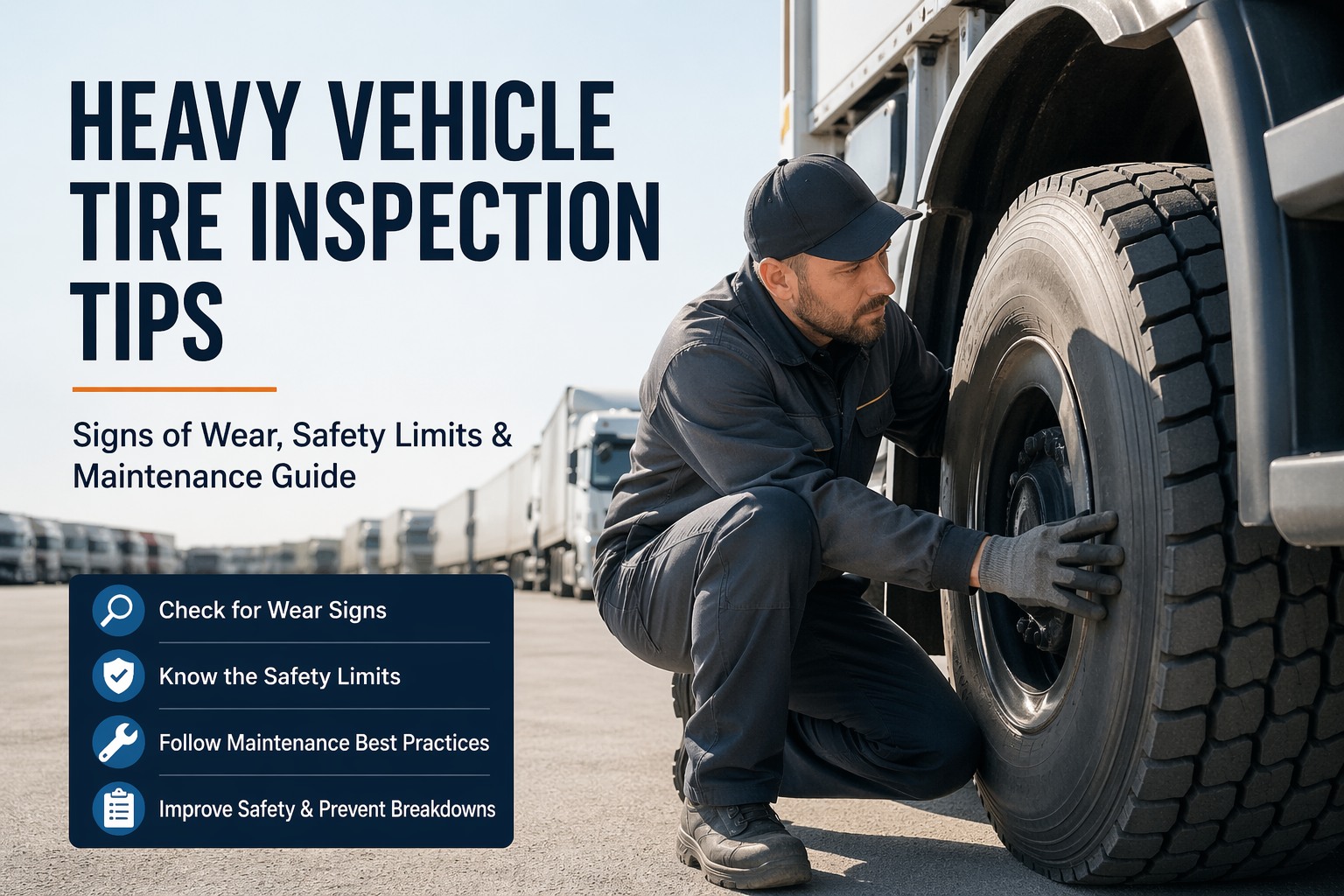
Below 4/32" steer, 2/32" drive. Exposed cord, sidewall damage, flat/underinflated.
Tail lamps, clearance markers, reflectors, turn signals. "Gateway violation" — triggers deeper inspection.
Chafed, cracked, or leaking air brake hoses. Restricted or kinked tubing. Common in undercarriage.
Audible air leaks exceeding allowable rate. Compressor not maintaining pressure. Low-pressure warning inop.
Cracked rim, missing studs/lugs, elongated bolt holes. 2025 Roadcheck focus: wheel ends account for ~25% of vehicle OOS.
Excessive free play in steering wheel. Worn tie rod ends, drag links, pitman arm. Ball joints with visible play.
Cracked or broken leaf springs. Missing U-bolts. Deflated air bags. Torque rod bushings worn.
Cracks at stress points (spring hangers, cross-member welds, fifth wheel mounts). Often missed without close inspection.
Exhaust system leak likely to cause entry of fumes into occupied areas. Loose or missing clamps.
Visible fuel leak from tank, lines, or fittings. Missing or defective fuel cap.
Not properly secured. Shifting, spilling, or blowing potential. 2026 Roadcheck announced vehicle focus area.
Fifth wheel mounting loose, platform cracked, locking jaws worn. Kingpin wear beyond spec.
Cracks or discoloration in wiper-cleared area. Wipers inoperative or leaving streaks that obstruct vision.
Brake System Prep for Annual Inspection
Measure pushrod travel on every brake chamber — steer, drive, and trailer axles. Compare against manufacturer limits (typically 1.5"-2" max depending on chamber size). Brakes drift out of adjustment within days of service, especially on older vehicles with worn automatic slack adjusters. Check the week before inspection, not just at last PM. This single item causes more OOS violations than any other.
Measure brake lining thickness at thinnest point. Minimum is typically 1/4" (check OEM spec). Replace if within 1/8" of minimum — do not cut it close for an annual inspection. Worn linings also indicate the need to inspect drums/rotors for scoring, heat checking, or being out-of-round.
Perform air loss rate test: with system fully charged and engine off, air pressure should not drop more than 3 psi in 1 minute (single vehicle) or 4 psi in 1 minute (combination). Check compressor cut-in/cut-out pressures. Verify low-pressure warning activates at 55-60 psi. Inspect all air hoses, fittings, and gladhands for damage and leaks.
With vehicle on level ground, apply parking brake and attempt to move in lowest gear. Vehicle should not move. Spring brakes must hold vehicle stationary. Test on loaded vehicle if possible — parking brake failures under load are more common and more dangerous.
Lighting & Electrical System Checks
Headlamps (high/low), tail lamps, stop lamps, turn signals (front/rear/side), clearance/marker lamps, identification lamps, license plate lamp, backup lamps. Every lamp must be functional and the correct color (amber front/side, red rear). A single inoperative clearance marker is a "gateway violation" that often triggers a full Level I inspection.
All required reflectors present and intact. Retroreflective tape (conspicuity markings) on trailers — alternating red/white, positioned per FMVSS 108. Missing or faded tape is a frequently cited violation because it is visible from a distance — inspectors spot it before they even approach the vehicle.
No exposed wiring. Connections secure and corrosion-free. Trailer plug making full contact — intermittent trailer lights are a common failure caused by worn 7-pin connectors. Replace connectors proactively if they show corrosion or loose pins.
Frame & Suspension Inspection Points
Check for cracks at high-stress points: spring hanger brackets, cross-member welds, fifth wheel mounting plates, and anywhere repairs/modifications have been made. Frame cracks propagate from vibration — a hairline crack at a PM can be a structural failure by annual. Use a flashlight and mirror for hidden areas. Any frame crack is an OOS condition.
Leaf springs: no cracked, broken, or missing leaves. Spring hangers and brackets secure with no elongated bolt holes. U-bolts tight. Air springs: no leaks, proper ride height, no contact with frame or axle components. Torque rods and radius rods: bushings intact, no visible play. Shock absorbers: no leaks, functional damping.
Wheel end components account for ~25% of Roadcheck OOS violations. Check for cracked rims, missing or loose lug nuts (torque to spec), elongated bolt holes, proper hub oil level, and wheel bearing condition (no excessive play when rocked). Inspect valve stems for damage. This area is a 2025-2026 CVSA enforcement priority.
Documentation Checklist for DOT Auditors
Current annual inspection report or compliant decal/sticker with: inspection date, inspector/carrier name and address, vehicle ID, certification statement. Must be accessible to any authorized official at roadside. No proof on vehicle = citation regardless of whether inspection was performed.
Original AVIR report per §396.21 — retained 14 months. Inspector qualification records per §396.19. Vehicle maintenance history per §396.3. Previous DVIRs with repair documentation per §396.11/396.13. All records must be "readily accessible" — producible on demand during an audit.
Evidence of each inspector's qualifications: training program completion certificate, state qualifying certificate, or documented training + experience totaling 1+ year. Retained while active and 1 year after they stop performing inspections. Auditors verify inspector credentials first — if the inspector isn't qualified, every inspection they performed is invalid.
For every defect found during the annual inspection: description of deficiency, repair performed, who performed it, date, parts used. The vehicle was not certified until all deficiencies were corrected. This chain of custody (defect → repair → re-verification → certification) must be documentable for every item.
Pass Rate Data: Prepared vs Unprepared Fleets
How HVI Automates Annual Inspection Prep Scheduling
Automated alerts at each milestone for every vehicle. Fleet dashboard shows which vehicles are due in each window. Never discover an expired inspection at roadside.
All 15 inspection categories with pass/fail gates. Required photo capture for failed items. Guided prompts ensure no category gets skipped. Inspector signs digitally.
Failed item auto-generates work order. Repair documented with photos/parts/technician. Vehicle cannot be certified until all items resolved. Complete audit trail.
Credentials on file, expiration alerts, training documentation linked. Auditors verify inspector qualifications first — HVI ensures they are always current.
Compliant AVIR report produced automatically upon inspection completion. PDF export. 14-month digital retention. Available on demand for audits — instantly.
Annual inspection prep pulls from daily DVIR defect history — known issues are pre-flagged before the inspector even starts. No surprises on inspection day.
Frequently Asked Questions
90 days minimum. At 90 days: identify vehicles due, schedule inspection dates, verify inspector credentials, and order long-lead parts. At 60 days: perform preliminary walk-through against Appendix A, focus on brakes/tires/lighting. At 30 days: deep-check secondary systems (steering, suspension, frame, exhaust). At 7 days: re-verify all repairs, confirm documentation. This timeline allows defect discovery, parts ordering, repair completion, and re-verification without rushing.
Brakes (41% of all OOS violations — adjustment out of spec, worn linings, air system leaks, defective components), tires (23% — insufficient tread, underinflation, sidewall damage, exposed cord), and lighting (14% — inoperative clearance markers, tail lamps, reflectors). These three categories alone account for 78% of all vehicle OOS violations at the 2025 CVSA Roadcheck. They are the most common failures and the most preventable.
No — every Appendix A component must meet minimum standards before the inspector can sign the certification per §396.17 and §396.21. If a defect is found, the vehicle must be repaired and re-verified before certification. The inspector cannot sign for a vehicle with uncorrected deficiencies. This is why pre-inspection prep matters — finding and fixing defects before inspection day avoids delays and ensures first-pass certification.
Immediate out-of-service order — the vehicle cannot operate until inspected and certified. Citation with fines up to $19,277 per instance. The violation goes on your CSA record with a severity weight of 2 under the 2026 scoring system. Approximately 133,000 annual inspection citations are issued per year — about 12,000 per month. One carrier was ordered to cease all operations and fined $25,000+ for operating uninspected vehicles.
Yes — every commercial motor vehicle, including each segment of a combination vehicle, must have its own annual inspection. The tractor, each trailer, and each dolly is inspected separately with its own AVIR report. A 50-truck fleet pulling 80 trailers has 130 separate inspection deadlines to track. This is where digital scheduling with automated alerts prevents expiration — manually tracking 130 dates on a spreadsheet virtually guarantees missed deadlines.
The 2026 Roadcheck is scheduled for May 12-14. Focus areas have not yet been officially announced as of early 2026, but cargo securement has been identified as the 2026 vehicle focus area. Additional 2026 CVSA events include Operation Safe Driver Week (expected July 2026), Brake Safety Week (expected August 2026), and an unannounced Brake Safety Day with no advance notice. Fleets should be Level I-ready at all times — not just during announced enforcement events.
Pass Every Annual Inspection — First Time, Every Time
HVI automates the 90-day countdown, provides Appendix A digital templates with pass/fail gates, tracks inspector qualifications, routes defects to repair, and generates compliant §396.21 reports. 96% audit pass rate. 500+ fleet operators.
No credit card • No hardware • Setup in under 10 minutes • 49 CFR 396.17 compliant