Every commercial motor vehicle operating in interstate commerce must pass an annual DOT inspection—yet nearly 12,000 trucks per month are cited for operating without valid proof of this required inspection. Under 49 CFR §396.17, this periodic inspection is the second most common vehicle maintenance violation in the entire FMCSA CSA system, costing fleets 12 CSA points per occurrence and putting carriers at risk for audits, fines, and out-of-service orders. This guide explains everything fleet managers and owner-operators need to know about annual DOT inspections: what's required, which vehicles need them, the complete inspection checklist, common failure items, and how digital recordkeeping can keep your fleet compliant year-round. Sign up for HVI to streamline your inspection compliance, or book a demo to see how digital inspections work.
What Is an Annual DOT Inspection?
An annual DOT inspection—also called a periodic inspection—is a federally mandated safety inspection required for all commercial motor vehicles (CMVs) at least once every 12 months. Governed by 49 CFR §396.17, this inspection ensures vehicles meet the Minimum Periodic Inspection Standards outlined in Appendix A/G of the Federal Motor Carrier Safety Regulations.
Annual DOT Inspection (49 CFR §396.17)
A comprehensive examination of a commercial motor vehicle's safety-critical systems performed by a qualified inspector to verify the vehicle meets federal safety standards. The inspection must be completed at least once every 12 months, and documentation must be retained for 14 months.
Key Facts About Annual DOT Inspections
Required at least once every 12 months for each CMV
49 CFR §396.17 (Periodic Inspection)
Must be performed by a qualified inspector per §396.19
Reports must be kept for 14 months from inspection date
Sticker/decal or report copy must be kept on vehicle
Typically takes 30-90 minutes depending on vehicle type
Who Can Perform Annual DOT Inspections?
Under 49 CFR §396.19, a qualified inspector must meet specific requirements:
Vehicles That Require Annual DOT Inspections
Not every vehicle on the road requires an annual DOT inspection—but most commercial vehicles do. Understanding which vehicles fall under this requirement helps you stay compliant and avoid the 12 CSA points per violation that come with operating without proof of inspection.
Vehicles That MUST Have Annual Inspections
- Commercial motor vehicles with GVWR/GCWR over 10,001 lbs
- Vehicles designed to transport 16+ passengers (including driver)
- Vehicles designed to transport 9-15 passengers for compensation
- Vehicles transporting hazardous materials requiring placards
- All trailers and semitrailers in combination vehicles
- Converter dollies used in combination vehicles
- Intermodal equipment interchanged to motor carriers
Vehicles That May Be Exempt
- Vehicles with GVWR under 10,001 lbs (unless hauling hazmat or passengers)
- Vehicles used exclusively in intrastate commerce (check state requirements)
- Farm vehicles operating within 150 air miles of farm
- Certain government-owned vehicles operated by government employees
- Recreational vehicles not used for commercial purposes
Note: Exemptions vary by state. Many states have additional inspection requirements regardless of federal exemptions.
Combination Vehicles: Each Unit Requires Inspection
For combination vehicles (e.g., tractor-semitrailer-full trailer), each segment must be inspected separately. A typical 5-axle tractor-trailer combination requires TWO annual inspections: one for the tractor and one for the trailer. If you use converter dollies, those need inspection too.
States with FMCSA-Approved Inspection Programs
Vehicles inspected under these state programs satisfy federal annual inspection requirements:
Also accepted: All 10 Canadian Provinces, Yukon Territory, and Mexico's NOM 68 program. Note: Arkansas and Oklahoma no longer have FMCSA-approved programs.
Managing annual inspections across a mixed fleet can be complex. Sign up for HVI to track inspection due dates, store documentation digitally, and receive automated alerts before inspections expire—or schedule a demo to see how it works for your fleet.
Annual DOT Inspection Checklist
The annual DOT inspection covers all safety-critical systems defined in 49 CFR Part 393 and Appendix A/G. Unlike daily pre-trip inspections, annual inspections require functional testing, measurements, and detailed documentation by a qualified inspector. Here's the complete checklist:
Brake System
24.4% of OOS violations- Brake adjustment (pushrod travel)
- Brake linings/pads thickness
- Brake drums/rotors condition
- Brake chambers and pushrods
- Automatic slack adjusters operation
- Air compressor operation
- Air pressure buildup rate
- Air leakage rate (static/applied)
- Low air pressure warning device
- Air hoses and tubing condition
- Glad hands and connections
- Parking brake operation
- Emergency/breakaway braking
- Trailer air supply valve
Steering System
- Steering wheel free play (max 30° for CMVs)
- Steering column security
- Power steering fluid level and leaks
- Steering gear box condition
- Pitman arm and drag link
- Tie rod ends and ball joints
- Kingpins and bushings
- Steering arm and knuckle
Suspension System
- Spring leaves and spring assembly
- U-bolts, spring hangers, and shackles
- Shock absorbers
- Air suspension bags and lines
- Torque arms and radius rods
- Axle alignment and positioning
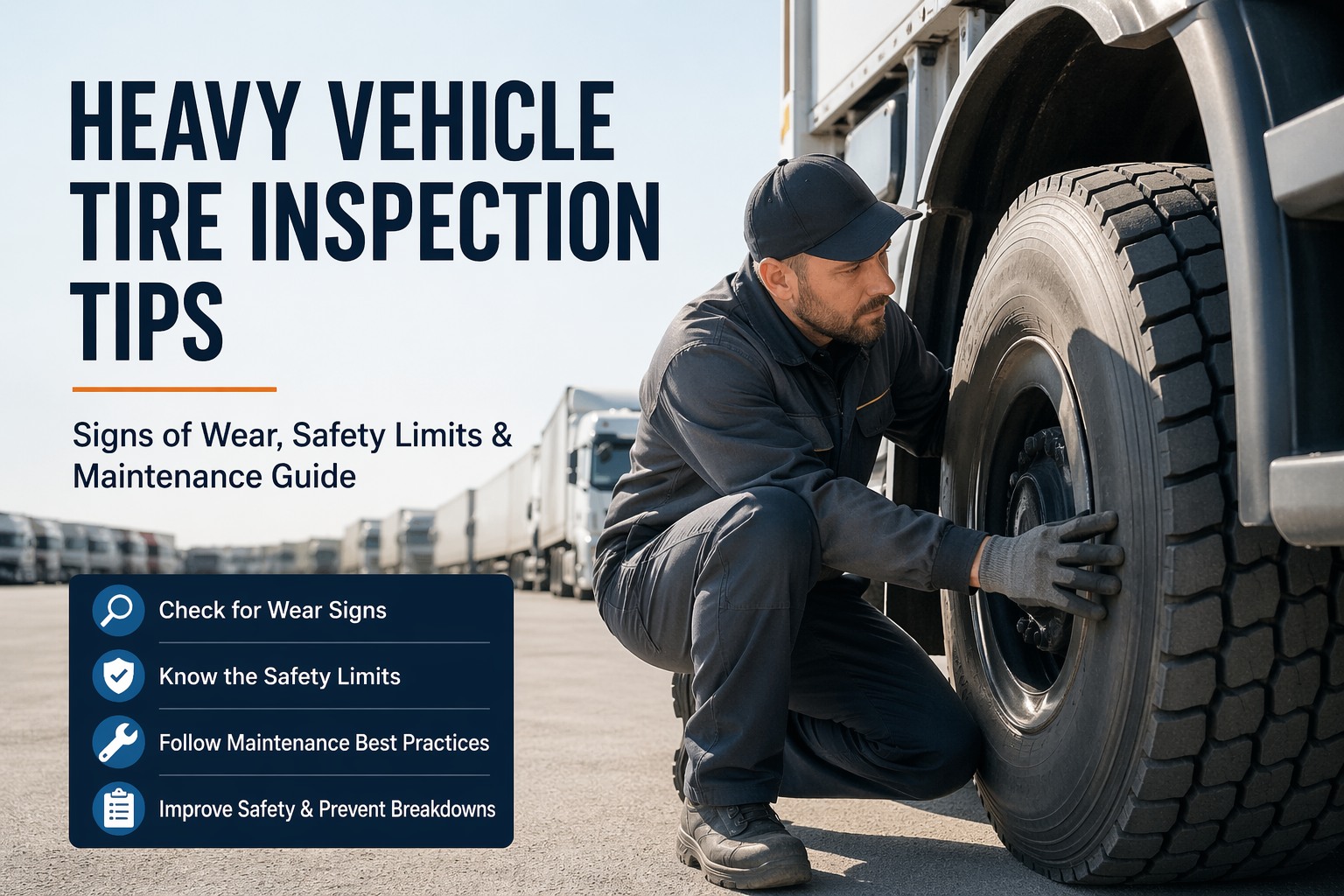
Tires & Wheels
23.4% of OOS violations- Tread depth (4/32" steer, 2/32" drive/trailer)
- Tire condition (cuts, bulges, tread separation)
- Tire inflation pressure
- Tire size and load rating
- Matching tires on dual assemblies
- No "Not for Highway Use" tires
- Wheel and rim condition
- Lug nuts torque and condition
- Hub oil/grease leaks
- Wheel bearing condition
- Valve stems and caps
Lighting & Electrical
#1 violation category- Headlights (high/low beam)
- Taillights and brake lights
- Turn signals (front, side, rear)
- Hazard warning lights
- Clearance and marker lamps
- Side marker lights
- License plate light
- Reflectors and retroreflective tape
- Backup lights (if equipped)
- Wiring and connections
Coupling Devices
- Fifth wheel mounting and condition
- Fifth wheel locking mechanism
- Kingpin condition
- Pintle hooks and drawbars
- Safety chains/cables
- Slider mechanism (if equipped)
- Air and electrical connections
Fuel System
- Fuel tank mounting and condition
- Fuel tank caps
- Fuel lines and connections
- No fuel leaks
Exhaust System
- Exhaust system leaks
- Exhaust discharge location
- Exhaust system mounting
- No exhaust entering cab
Frame & Body
- Frame rails and crossmembers
- Frame cracks or damage
- Body mounting
- Floor condition
- Doors and latches
Windshield & Glass
- Windshield condition (no cracks in wiper area)
- Windshield wipers operation
- Washer fluid system
- Mirrors condition and mounting
- Defroster operation
Emergency Equipment
- Fire extinguisher (charged, secured, accessible)
- Three reflective warning triangles
- Spare fuses (if equipped with fuse-type circuits)
This comprehensive checklist can be overwhelming to track manually. Get started with HVI's digital inspection platform to access pre-built annual inspection templates that guide inspectors through every required item, or book a consultation to customize templates for your fleet.
Common Failure Items
Understanding which components fail most frequently helps you prioritize maintenance and pre-inspection checks. Based on CVSA roadside inspection data and annual inspection trends, these are the areas that cause the most failures:
Top Failure Categories (2025 Data)
Brake System Failures
Brakes consistently top the failure list—and for good reason. A single brake defect can result in catastrophic stopping distance increases.
- Brake adjustment out of spec – Pushrod travel exceeds limits (99.9% OOS rate at roadside)
- Air leaks – Pressure loss exceeds 2 psi/min (single) or 3 psi/min (combination)
- Worn linings/pads – Below minimum thickness specifications
- Cracked drums/rotors – Heat cracks extending to mounting surface
- Inoperative automatic slack adjusters – Not maintaining proper adjustment
- Chafed/kinked air hoses – Restricted airflow or potential rupture risk
Tire & Wheel Failures
Tires are your only contact with the road—and tire failures can be catastrophic. Nearly 1 in 4 OOS violations involve tire issues.
- Insufficient tread depth – Below 4/32" (steer) or 2/32" (drive/trailer)
- Flat tire or audible air leak – 97.8% OOS rate
- Tread/sidewall separation – 94.4% OOS rate
- Exposed cord or belt material – Immediate failure
- Mismatched dual tires – Different sizes or tread patterns
- Loose or missing lug nuts – Immediate safety hazard
- Hub oil/grease leaks – Indicates bearing or seal failure
Lighting & Electrical Failures
"Inoperable Required Lamp" is the #1 most common vehicle maintenance violation in the CSA system. Lighting issues are easy to fix but frequently overlooked.
- Inoperative brake lights – 49.9% OOS rate
- Inoperative turn signals – Front, side, or rear
- Missing/inoperative marker lamps – Clearance and side markers
- Missing/damaged reflectors – Required reflective material
- Defective headlights – Burned out or improperly aimed
- Corroded wiring connections – Intermittent operation
The Cost of Annual Inspection Violations
Don't let common failures catch you off guard. Sign up for HVI to implement digital pre-trip inspections that catch brake, tire, and lighting issues before they become expensive violations, or schedule a demo to see how real-time defect tracking works.
Digital Recordkeeping & Compliance
Annual DOT inspection compliance isn't just about passing the inspection—it's about maintaining proper documentation that proves compliance during audits, roadside inspections, and compliance reviews. Digital recordkeeping transforms how fleets manage this critical compliance requirement.
Required Record Retention Periods
Why Digital Recordkeeping Outperforms Paper
Paper-Based Systems
- Files stored in multiple locations
- Difficult to search and retrieve
- Lost or damaged documents
- Manual tracking of due dates
- Hours to prepare for audits
- No visibility across fleet
- Illegible handwriting issues
- Easy to lose inspection proof
Digital Systems
- Centralized cloud storage
- Instant search and retrieval
- Secure backup and redundancy
- Automated expiration alerts
- One-click audit reports
- Real-time fleet-wide visibility
- Clear, standardized data entry
- Digital proof always accessible
Essential Digital Compliance Features
Receive alerts 30, 60, and 90 days before annual inspections expire. Never miss an inspection deadline.
Store inspection reports, sticker photos, and inspector qualifications in secure cloud storage with instant access.
Connect daily pre-trip/post-trip inspections with annual compliance for complete maintenance visibility.
Automatically generate work orders from inspection defects to ensure issues are addressed before annual inspection.
Generate compliance reports instantly showing inspection history, due dates, and documentation status.
Drivers can access inspection proof on their mobile device—no need to keep paper copies in the cab.
The Audit Reality
FMCSA data shows that fewer than 6% of carriers pass DOT audits without a single violation. The remaining 94%+ average 6 violations per audit. Proper documentation is the difference between a clean audit and costly fines.
Frequently Asked Questions
Stay Compliant Year-Round
Annual DOT inspections are just one piece of the compliance puzzle. When combined with consistent daily pre-trip inspections, proper maintenance documentation, and automated tracking systems, you can keep your fleet compliant, reduce violations, and pass audits with confidence.
No credit card required • DOT-compliant templates included • Setup in under 10 minutes