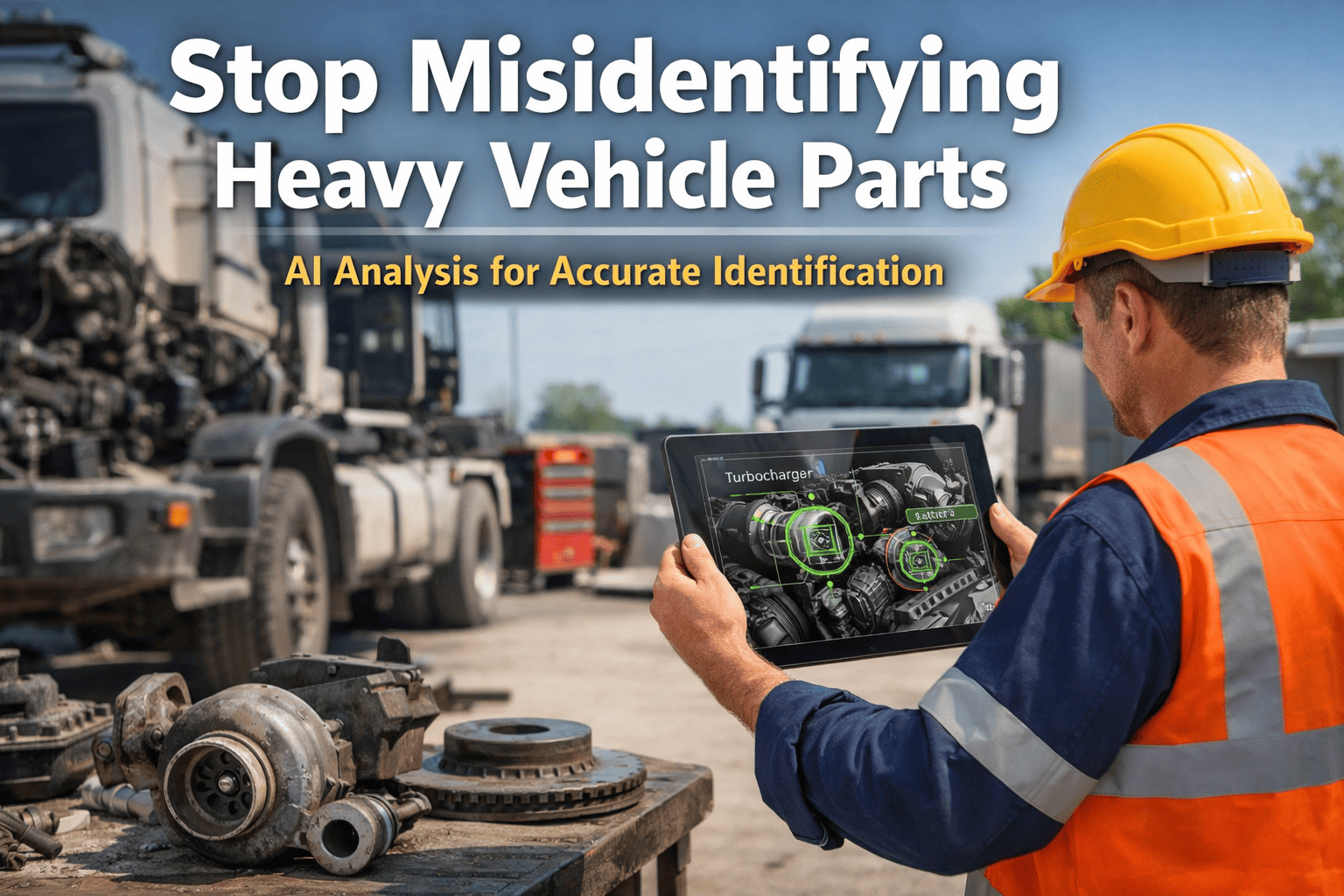
A technician orders a turbo actuator for a Freightliner Cascadia. The part arrives, looks almost identical — but it is built for a different engine series. Two days of downtime, a $1,200 restocking fee, and a driver sitting idle while the correct part ships overnight. This scenario costs commercial fleets billions annually in wasted labor, wrong parts, repeat repairs, and unnecessary downtime. AI-powered parts analysis now eliminates this guesswork — identifying components across 163+ vehicle parts with 95-99% accuracy from a single photo. Sign up for HVI to bring AI parts recognition to your fleet, or book a demo to see it in action.
The Hidden Cost of Misidentifying Parts
Parts misidentification is not just an inconvenience — it is a silent profit killer that compounds across every vehicle in your fleet. When the wrong component gets ordered, installed, or diagnosed, the damage ripples through your entire operation. Here is what misidentification actually costs.
Technician visually identifies a component, orders based on experience or catalog guesswork. Wrong model, wrong generation, wrong spec. Restocking fees range from $50 to $1,500+ for heavy vehicle components.
The truck sits idle waiting for the correct part. Average unplanned downtime costs fleets $1,900+ per incident when factoring lost productivity, driver pay, towing, and customer delays.
Wrong part gets installed, fails prematurely, vehicle returns to the shop. Industry data shows repeat repair rates above 3% signal systemic identification problems — costing 2-3× the original repair.
An incompatible brake component or wrong-spec air line installed on a Class 8 truck creates liability exposure. FMCSA violations for improper repairs average $7,155 per case — and auditors check repair documentation.
How AI Identifies Vehicle Parts With Precision
AI parts analysis uses computer vision — deep learning models trained on millions of annotated vehicle images — to recognize, classify, and assess components with a level of consistency that human inspection cannot match. Here is the technology pipeline that makes it work.
Driver or technician photographs the component using a smartphone. The guided app shows exactly what angle and distance to use — no specialized camera needed.
AI identifies what is in the photo — bumper, brake drum, alternator, hose fitting — and maps it against a database of 163+ vehicle components. The system understands vehicle structure and part relationships.
The AI scans for visual anomalies — areas where texture, color, wear pattern, or surface condition deviates from what a healthy component looks like. Damage candidates are flagged instantly.
Each anomaly is classified by type (crack, corrosion, wear, leak, misalignment) and severity (minor, moderate, critical). The correct part name, condition, and recommended action are documented — no guesswork required.
Trained on 30+ million real-world vehicle images, the AI recognizes dents, scratches, cracks, corrosion, tire wear, fluid leaks, and component misalignment — including micro-damages that experienced technicians consistently miss during visual inspection.
Where AI Outperforms Human Identification
Human expertise matters — but it has built-in limitations that no amount of training fully solves. AI parts analysis fills the gaps where human judgment falls short, creating a combination that is stronger than either approach alone.
Real Impact: From Inspection to Work Order in Seconds
The real power of AI parts identification is not just recognizing components — it is what happens next. When AI correctly identifies a part and its condition, the entire repair workflow accelerates.
Part identified, condition assessed, severity rated — in under 60 seconds.
Defect photo, part name, vehicle ID, and repair recommendation — work order created instantly.
Inventory checked against correct part spec. No wrong orders. No restocking fees. No guesswork.
Technician logs fix with photos. Full audit trail — from defect detection to repair completion.
Early, accurate identification turns expensive failures into routine fixes
5 minutes vs 45 — with better accuracy and zero paperwork
Correct parts identified and replaced before failure occurs
First prevented breakdown often covers the entire system cost
5 Parts Categories Where AI Prevents the Most Mistakes
Not all parts are equally prone to misidentification. These five categories account for the majority of wrong-part errors in fleet maintenance — and they are exactly where AI delivers the highest value.
Brake System Components
Brake pads, drums, chambers, and slack adjusters vary significantly across axle positions, manufacturers, and model years — yet look deceptively similar. AI cross-references the exact vehicle and position to ensure the correct specification every time, preventing the most dangerous misidentification errors.
Tires and Wheel Assemblies
Tread depth, load rating, speed rating, and tire size must match exactly. AI photo analysis estimates tread depth, detects mismatched sets across axles, and identifies wear patterns that indicate incorrect tire specifications — flagging issues before they become DOT violations.
Hydraulic Hoses and Fittings
On heavy equipment, hydraulic hoses and fittings come in hundreds of nearly identical sizes and pressure ratings. A wrong fitting on an excavator's boom circuit can cause catastrophic failure. AI identifies hose condition and fitting type from photos, reducing ordering errors.
Electrical and Lighting Components
Wiring harnesses, connectors, bulb types, and control modules vary by model and build date. Entering the wrong vehicle details leads to incorrect parts orders — AI auto-identifies the vehicle and matches components to the exact build specification using VIN-linked recognition.
Engine Filters and Fluid Components
Oil filters, fuel filters, air filters, and coolant components have dozens of variations that cross-reference differently across supplier catalogs. AI photo analysis confirms the installed part type and flags incompatible replacements before they are ordered.
Frequently Asked Questions
Right Part. Right Vehicle. Every Time.
AI parts analysis eliminates the guesswork that costs your fleet thousands in wrong orders, repeat repairs, and preventable downtime. HVI puts 95-99% identification accuracy in your technicians' hands — using the smartphones they already carry.
No credit card required · No hardware needed · Setup in under 10 minutes