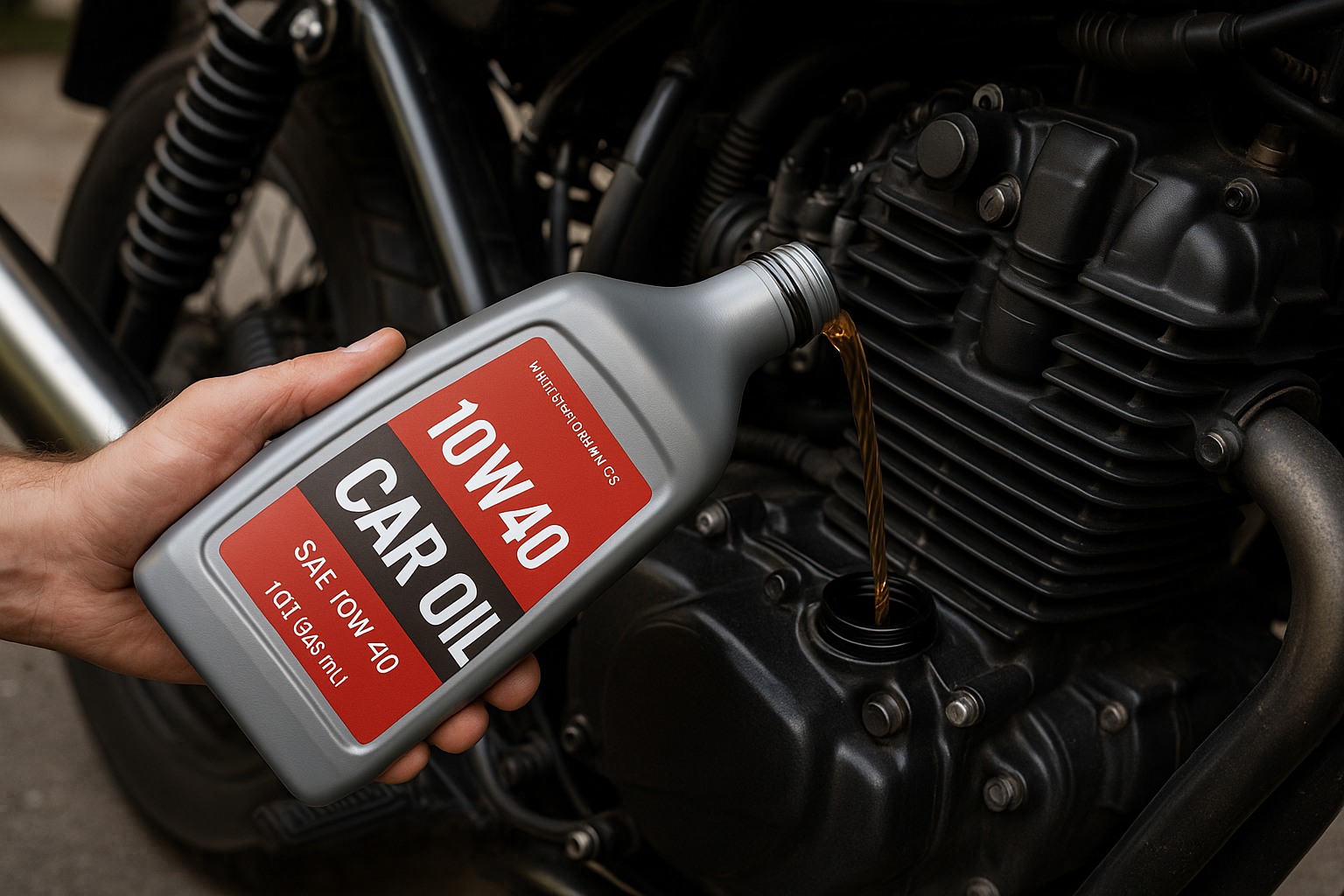
The temptation to use readily available 10W40 car oil in motorcycles affects thousands of riders annually, driven by convenience and potential cost savings of $20-40 per oil change. However, this seemingly simple substitution can trigger catastrophic failures costing $2,000-$5,000 in engine and transmission repairs. With motorcycle-specific oils containing specialized additives for wet clutch compatibility, higher shear stability, and gear protection, understanding the critical differences between automotive and motorcycle formulations prevents costly mistakes that affect 35% of riders who attempt this substitution.
This comprehensive guide reveals exactly what happens when 10W40 car oil enters your motorcycle's engine, exposing both the immediate risks and long-term consequences while identifying specific scenarios where automotive oil might be acceptable. More importantly, it provides clear alternatives that protect your investment while potentially saving hundreds in unnecessary specialty oil costs through informed selection based on your motorcycle's actual requirements rather than marketing claims.
Motorcycle Oil Impact Analysis
Protect Your Fleet Investment with Professional Management
Discover how digital inspection systems optimize motorcycle maintenance and oil selection.
Critical Differences: Why Motorcycle Oil Isn't Just Marketing
Motorcycle engines operate fundamentally differently from automotive engines, sharing oil between the engine, transmission, and often a wet clutch system that automotive oils can destroy within hours. While both use similar base oils, motorcycle-specific formulations contain precisely balanced friction modifiers that maintain clutch grip while providing gear protection—a delicate balance absent in car oils designed solely for engine lubrication.
The most critical difference lies in additive packages: automotive oils contain friction modifiers designed to maximize fuel economy by reducing internal friction, but these same additives cause motorcycle wet clutches to slip catastrophically. Additionally, motorcycles typically operate at 8,000-14,000 RPM compared to cars' 2,000-6,000 RPM range, creating shear forces that break down automotive oils 50% faster, leading to premature wear and potential engine failure.
The Wet Clutch Dilemma: Why Car Oil Destroys Motorcycle Clutches
Wet clutch systems, used in 95% of modern motorcycles, operate immersed in engine oil, requiring precise friction characteristics to engage and disengage properly. Automotive oils contain molybdenum and other friction modifiers that reduce coefficient of friction by 15-20%—excellent for fuel economy but catastrophic for clutch operation that depends on controlled friction to transmit power from engine to transmission.
Laboratory testing reveals automotive oil reduces clutch friction coefficient from the required 0.12-0.14 range down to 0.08-0.10, causing immediate slippage under acceleration. This slippage generates heat exceeding 400°F at clutch surfaces, glazing friction materials and creating permanent damage that persists even after returning to proper motorcycle oil. Repair costs average $1,800 for Japanese bikes and exceed $3,000 for European models.
- ✓ 0-200 miles: Initial clutch slippage during hard acceleration, especially in higher gears
- ✓ 200-500 miles: Progressive slippage extending to normal acceleration, burning smell evident
- ✓ 500-1,000 miles: Severe slippage in all gears, overheating, potential clutch glazing
- ✓ 1,000+ miles: Complete clutch failure requiring full replacement, possible basket damage
- ✓ Secondary damage: Contaminated oil destroys friction material, embedding particles throughout
- ✓ Long-term effects: Multiple flushes required to remove friction modifiers from system
Transmission Stress: How Motorcycle Gears Suffer with Automotive Oil
Motorcycle transmissions endure significantly higher stress than automotive gearboxes due to sequential shift mechanisms, higher power-to-weight ratios, and direct gear engagement without torque converters. These conditions create extreme pressure points requiring specialized extreme-pressure (EP) additives that automotive oils lack, leading to accelerated gear wear, pitting, and eventual transmission failure when car oil is substituted.
The sequential nature of motorcycle transmissions means gears experience shock loading during every shift, requiring oils with superior film strength and anti-wear properties. Automotive 10W40 lacks sufficient zinc and phosphorus levels for motorcycle gear protection, containing 800-1000 PPM versus motorcycle oil's 1200-1400 PPM. This 30% reduction in anti-wear additives translates to 60% faster gear wear and shifting deterioration within 3,000 miles.
When Car Oil Might Work: Limited Exceptions and Specific Cases
Despite the significant risks, certain motorcycle applications can successfully use automotive 10W40 oil without catastrophic consequences. Dry clutch motorcycles like older BMWs, Moto Guzzis, and some Ducatis separate clutch operation from engine oil, eliminating the primary compatibility concern. These motorcycles often specify automotive oil grades in owner's manuals, recognizing that engine-only lubrication matches car requirements.
Vintage motorcycles manufactured before 1980 often used less sophisticated oils with minimal additives, making modern automotive oils potentially superior to period-correct formulations. However, even these applications benefit from motorcycle-specific oils' enhanced shear stability and gear protection. The $15-20 premium for proper motorcycle oil represents cheap insurance against potential damage.
- ✓ BMW airheads (pre-1995) with dry clutches and separate transmission oil
- ✓ Older Moto Guzzi models with automotive-based engines and dry clutches
- ✓ Some Ducati models with dry clutches (verify specific model requirements)
- ✓ Vintage bikes originally specifying SE or SF grade oils without JASO ratings
- ✓ Ural motorcycles with automotive-derived engines and separate gearboxes
- ✓ Emergency situations where proper oil is unavailable (change ASAP)
Cost Analysis: False Economy of Using Car Oil
The apparent savings from using automotive 10W40 instead of motorcycle oil—typically $20-40 per change—evaporate when considering potential damage costs. Walmart pricing shows Castrol GTX 10W40 at $18 per 5-quart jug versus Castrol Power1 10W40 motorcycle oil at $35, creating $17 savings that seem attractive until clutch replacement costs $2,000. This represents 118 oil changes worth of "savings" eliminated by one failure.
Beyond catastrophic failure risks, automotive oil's inferior shear stability requires more frequent changes to maintain protection. Motorcycle oils maintain grade for 5,000-6,000 miles while automotive oils in motorcycle use degrade to out-of-grade condition by 2,500 miles. Doubling oil change frequency eliminates any cost advantage while still providing inferior protection throughout the service interval.
Real-World Consequences: Case Studies and Failure Analysis
Examining actual failures from automotive oil use reveals consistent patterns of progressive damage that validate laboratory concerns. A 2019 Honda CBR600RR suffered complete clutch failure after 850 miles on Mobil 1 10W40 automotive oil, requiring $2,200 in parts and labor. The owner's attempt to save $25 resulted in 88 times that amount in repair costs, plus two weeks of riding season lost.
More concerning are transmission failures occurring after extended automotive oil use. A Yamaha R6 running Castrol GTX 10W40 for 4,000 miles developed severe gear pitting, creating dangerous false neutrals during aggressive riding. The $3,500 transmission rebuild revealed wear patterns consistent with inadequate EP additives, damage that proper motorcycle oil would have prevented through superior gear protection.
JASO Standards: Understanding Motorcycle Oil Certifications
The Japanese Automotive Standards Organization (JASO) created MA and MA2 specifications specifically addressing motorcycle wet clutch compatibility, establishing friction requirements that automotive oils cannot meet. JASO MA oils maintain dynamic friction coefficient between 0.12-0.14 while MA2 provides even higher friction for large-displacement bikes. These standards ensure consistent clutch engagement across temperature ranges while maintaining engine protection.
Automotive oils meeting API SN or SP specifications actively avoid JASO requirements, incorporating friction modifiers that improve fuel economy but destroy clutch function. Even "motorcycle-friendly" automotive oils lacking JASO certification risk clutch damage, as manufacturers won't guarantee wet clutch compatibility without proper testing. Always verify JASO MA or MA2 certification when selecting motorcycle oil.
- ✓ JASO MA: Standard friction characteristics for most motorcycles under 600cc
- ✓ JASO MA2: Higher friction coefficient for large displacement and high-torque applications
- ✓ API SG or Higher: Ensures basic engine protection (but not clutch compatibility alone)
- ✓ Manufacturer Approvals: Honda, Yamaha, Kawasaki, Suzuki specific requirements
- ✓ Avoid API SN/SP: Latest car oil specs with maximum friction modifiers harmful to clutches
- ✓ Check Both Specs: Oil must meet JASO MA/MA2 AND appropriate API grade
Emergency Situations: When You Must Use Car Oil
Remote breakdowns or oil loss situations sometimes force riders to use available automotive oil rather than risk engine seizure. If forced to use 10W40 car oil, understanding damage limitation strategies minimizes long-term consequences. The key involves recognizing this as temporary emergency treatment, not a viable alternative to proper motorcycle oil.
When using automotive oil emergency fill, avoid high-RPM operation, minimize clutch use, and change to proper motorcycle oil within 200 miles maximum. Consider automotive oil contamination like running contaminated fuel—get home carefully and address immediately. Document the emergency use for warranty purposes and monitor clutch operation closely for developing slippage.
- ✓ Use only as last resort when proper motorcycle oil absolutely unavailable
- ✓ Limit riding to reaching proper oil source, maximum 200 miles
- ✓ Avoid aggressive acceleration, high RPMs, or sustained high-speed operation
- ✓ Minimize clutch engagement, using highest possible gear for conditions
- ✓ Change to proper JASO MA/MA2 oil immediately upon reaching destination
- ✓ Consider flushing with proper oil twice to remove friction modifiers
Smart Alternatives: Quality Motorcycle Oils at Competitive Prices
Budget-conscious riders need not risk using automotive oil when quality motorcycle-specific options exist at competitive prices. Walmart's SuperTech 10W40 motorcycle oil meets JASO MA specifications at $22 per gallon—only $4 more than automotive oil while providing proper protection. Online retailers offer even better values with bulk purchases or subscription services reducing costs further.
Consider house-brand motorcycle oils from major retailers that often rebrand quality oils at reduced prices. Amazon Basics, Walmart SuperTech, and Rural King motorcycle oils frequently test identically to name brands costing twice as much. These budget options provide full JASO MA certification and proper protection without the premium pricing of heavily marketed brands.
Optimize Your Fleet Maintenance Strategy
Professional inspection systems help manage motorcycle and equipment maintenance efficiently.
Book a Demo
Professional Fleet Perspective: Managing Mixed Vehicle Types
Commercial operators managing both motorcycles and automobiles face inventory challenges that tempt consolidated oil purchasing. However, professional fleet managers recognize that specialized equipment requires appropriate fluids—just as diesel engines need different oil than gasoline engines. The minimal storage space for motorcycle-specific oil prevents catastrophic failures that create downtime, liability, and reputation damage.
Digital inspection systems help fleet managers track oil specifications across diverse vehicle types, ensuring proper products reach appropriate applications. Automated reminders prevent accidental cross-contamination while inventory management features optimize purchasing without compromising protection. This systematic approach eliminates costly mistakes while streamlining operations.
Final Verdict: Why Proper Motorcycle Oil Matters
The question of using 10W40 car oil in motorcycles has a clear answer for 95% of modern bikes: don't risk it. While saving $20 per oil change seems attractive, the potential for $2,000+ clutch damage, $3,000+ transmission repairs, and compromised safety makes automotive oil a dangerous false economy. Motorcycles' unique operating conditions—wet clutches, integrated transmissions, and extreme RPMs—demand specialized lubricants that automotive oils cannot provide.
For the limited exceptions like dry-clutch BMWs or vintage bikes, automotive oil remains a compromise compared to modern motorcycle-specific formulations. Even these applications benefit from motorcycle oil's superior shear stability and enhanced protection. The motorcycle oil industry isn't perpetrating a marketing scam—they're providing essential protection for fundamentally different mechanical systems.
Smart riders invest in proper JASO MA/MA2 certified motorcycle oils, recognizing that $20 savings mean nothing compared to reliable clutch operation, smooth transmission function, and maximum engine life. Whether choosing premium synthetic or budget-friendly options, always select oils specifically formulated for motorcycle use. Your bike's longevity, performance, and safety depend on this critical decision.
Ready to Revolutionize Your Maintenance Management?
Join thousands of operators optimizing equipment care through professional digital solutions.
Book a Demo