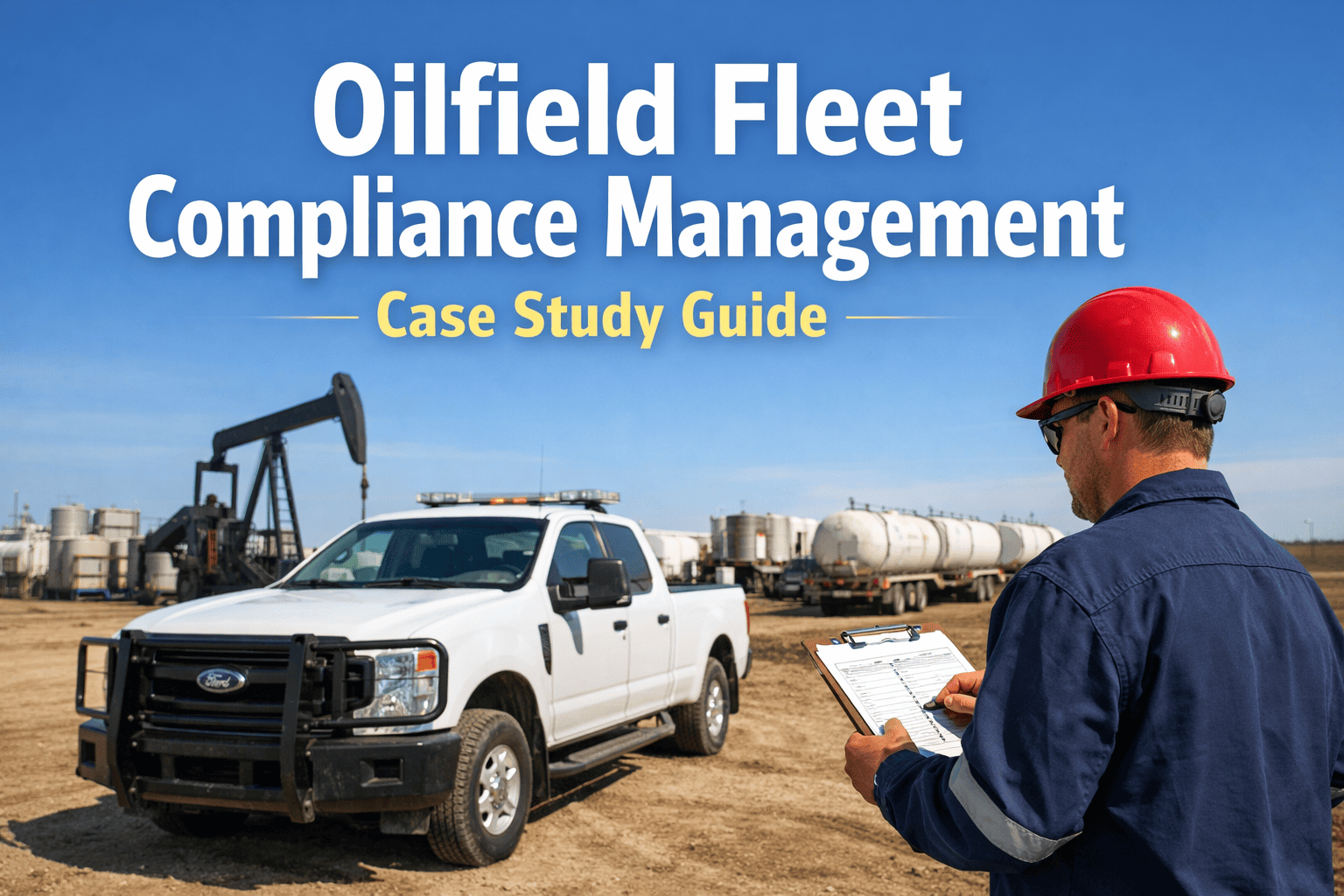
In the oil and gas industry, a non-compliant vehicle is not just a regulatory problem — it is a contract-ending, operation-halting, fine-generating liability. With DOT and OSHA enforcement tightening year over year, oilfield services companies operating fleets across remote Permian Basin lease roads, pipeline corridors, and unmapped wellhead routes face a compliance burden that paper-based systems and disconnected tools simply cannot manage. The companies building competitive advantages in this environment are not working harder on compliance — they are working smarter with digital systems purpose-built for the field.
100% DOT Compliance, Zero Violations: How an Oilfield Services Company Eliminated $200K in Fine Risk Across 120 Vehicles
Company Overview
A mid-sized oilfield services company operating across West Texas and southeastern New Mexico, providing pressure pumping, wireline, and fluid transport services to upstream operators in the Permian Basin. Their fleet of 120 commercial vehicles — including frac trucks, tanker transports, pickup crew cabs, and specialty equipment carriers — operated across remote lease roads with limited connectivity and 24/7 dispatch schedules. Annual maintenance and compliance expenditures exceeded $1.9 million. With ISNetworld and Veriforce audit requirements from major operators, plus FMCSA oversight, the cost of a single compliance gap extended far beyond the fine itself — it meant losing access to job sites. Fleet managers looking to close these gaps can start a free HVI account today.
The Stakes in Oilfield Fleet Compliance
The Challenge
Managing compliance for 120 vehicles spread across remote oilfield locations is fundamentally different from managing an urban delivery fleet. Vehicles are dispatched before sunrise to wellheads without cellular coverage. Drivers hold CDLs across multiple states. Hazmat endorsements, medical certificates, and annual inspection records expire on different dates for every vehicle and every driver. And when an operator auditor shows up — they expect every document, for every asset, immediately. Book a demo to see how HVI solves this for oilfield operations exactly like this one.
Vehicles operating on lease roads with no cellular coverage meant inspection reports were completed on paper — or not at all. Non-compliant vehicles were dispatched without real-time visibility into their status.
120 drivers × multi-state CDLs × hazmat endorsements × annual MVR checks × medical certificates = thousands of expiration dates managed manually in spreadsheets. A single missed renewal triggered operator audit failures.
Annual vehicle inspections, pre/post-trip DVIRs, and defect resolution records were stored in paper files at multiple depot locations. Cross-referencing them during a roadside check or audit took hours the company did not have.
ISNetworld and Veriforce audits from Permian Basin operators required current documentation on every vehicle and driver. Paper-based systems produced verification delays and a 23% document error rate on first submission.
With no system pushing expiration warnings, compliance managers discovered expired registrations, medical cards, and hazmat endorsements reactively — often after a vehicle had already been dispatched out of compliance.
Caliche roads, extreme heat, and heavy load cycles degraded vehicles faster than standard maintenance intervals could track. Brake, tire, and suspension failures on remote routes created both safety and compliance crises simultaneously.
- 23% document error rate on first submission to ISNetworld and Veriforce operator audits
- Expired medical certificates discovered post-dispatch on an average of 4 vehicles per month
- Annual vehicle inspection records missing or incomplete for 18% of fleet at any given time
- Zero automated alerts for CDL endorsement, hazmat cert, or registration expiration
- Paper DVIR completion rate at 61% — 39% of pre-trip inspections going undocumented
- Estimated $200,000 in potential DOT fine exposure from accumulated compliance gaps
- Compliance audit preparation consuming 180+ hours quarterly across three depot locations
- No centralized view of fleet compliance status — status checked vehicle-by-vehicle manually
The Solution: HVI Compliance Management for Oilfield Operations
The company deployed HeavyVehicleInspection.com's compliance management platform across all 120 vehicles and their full driver roster. Three capabilities anchored the transformation: digital inspections built for remote field conditions, automated DQ file management with expiration alerting, and a real-time compliance dashboard that gave management instant visibility across every asset.
Digital Inspections for Remote Locations
Mobile-first DVIR and DOT inspection workflows that function offline — completing and syncing when connectivity returns. Oilfield-specific checklists covering brakes, tires, hazmat placarding, and load securement. No more paper, no more missing records.
DQ File Automation
Centralized driver qualification file management with automated expiration alerts for CDL renewals, hazmat endorsements, medical certificates, annual MVR checks, and drug/alcohol testing records. Every driver. Every document. Always current.
Real-Time Compliance Dashboard
Live fleet compliance status across all 120 vehicles and drivers — filterable by location, vehicle type, expiration date, and violation risk. Operator audit packages generated in minutes, not days. Management visibility at all times, from any device.
Full HVI Platform Deployment Included:
- Offline-capable mobile inspection app for remote lease road and wellhead operations
- Oilfield-specific DVIR checklists: brakes, tires, hazmat placard, load securement, lighting
- Automated DOT expiration alerts: registrations, annual inspections, medical cards, HOS logs
- Centralized DQ file vault: CDL records, MVR history, drug/alcohol test results, training certs
- Real-time compliance status dashboard — green/yellow/red risk scoring per vehicle and driver
- ISNetworld and Veriforce audit package generation from a single export function
- Defect tracking and resolution workflow from field report through shop closure
- FMCSA Clearinghouse query integration for pre-employment and annual CDL driver checks
- Multi-depot visibility: compliance status across all three Texas locations in one view
- Automated compliance reporting for management and operator clients on scheduled intervals
The Compliance Transformation: By the Numbers
| Compliance Metric | Before HVI | After HVI | Change |
|---|---|---|---|
| DOT Violation Rate | Multiple per quarter | Zero (12 months) | -100% |
| DVIR Completion Rate | 61% | 99.2% | +62.6% |
| DQ File Error Rate | 23% | 0.4% | -98.3% |
| Expired Documents Dispatched | ~4 vehicles/month | 0 vehicles/month | -100% |
| Audit Prep Time | 180 hrs/quarter | 14 hrs/quarter | -92.2% |
| Operator Audit First-Pass Rate | 77% | 100% | +29.9% |
What 100% Compliance Actually Saved
DOT Compliance Rate
Violations in 12 Months
Fine Exposure Eliminated
Faster Audit Preparation
DQ File Compliance
$0 in driver-related DOT violations
Previously: ~$42,000 annual exposure from missing or expired driver qualification records
Vehicle Inspection Records
100% inspection documentation coverage
Previously: 18% of fleet had incomplete annual inspection records — each a potential $16K violation
Expiration Alerting
Zero expired documents dispatched
Previously: 4 vehicles per month dispatched with expired medical cards, registrations, or endorsements
Operator Audit Performance
100% first-pass rate on ISNetworld & Veriforce
Previously: 77% first-pass rate — failed audits risked removal from approved contractor lists
- 100% DOT compliance rate sustained across all 120 vehicles for the full 12-month period
- Zero roadside DOT violations — from multiple per quarter to a clean record in year one
- $200,000 in potential fine exposure eliminated through proactive compliance management
- DVIR completion rate lifted from 61% to 99.2% with mobile offline-capable inspection app
- DQ file error rate on operator audits reduced from 23% to 0.4% with automated management
- Quarterly audit preparation reduced from 180 hours to 14 hours — saving 664 staff hours annually
- Zero vehicles dispatched with expired medical certificates, CDL endorsements, or registrations
- ISNetworld and Veriforce first-pass audit rate reached 100% — up from 77% pre-deployment
- Defect-to-resolution cycle time reduced by 67% with digital tracking from field to shop
- Compliance management team headcount held flat despite 18% growth in fleet size during the period
"In oilfield services, your compliance record is your reputation. One failed ISNetworld audit and you're off a major operator's approved list — potentially losing millions in annual contract revenue. HVI gave us something we never had before: a real-time view of our entire compliance posture across all 120 vehicles and every driver file. We went from dreading audits to walking into them with confidence. Twelve months in, zero DOT violations, 100% first-pass audit rate. That's not just peace of mind — that's a competitive advantage."
— VP of HSE & Fleet Operations, Oilfield Services Company, Permian BasinStop Managing Compliance Risk. Start Eliminating It.
Oilfield fleet compliance is not a back-office function — it is a frontline competitive requirement. Every expired document, every missed DVIR, every undocumented defect is a fine, an out-of-service order, or a lost operator contract waiting to happen. HVI's compliance management platform was built for the specific demands of oil and gas fleet operations: remote locations, harsh conditions, multi-state CDL complexity, and operator audit requirements from ISNetworld and Veriforce. Whether you're running 30 vehicles or 300, the platform scales to your operation from day one. Create your free account today or speak with the HVI oilfield team to build your compliance roadmap.
Your Next DOT Audit Is Either a Risk or a Win — You Decide
Digital inspections, automated DQ file management, and real-time compliance dashboards built specifically for oilfield fleet operations.
Get Started Free Book a Demo