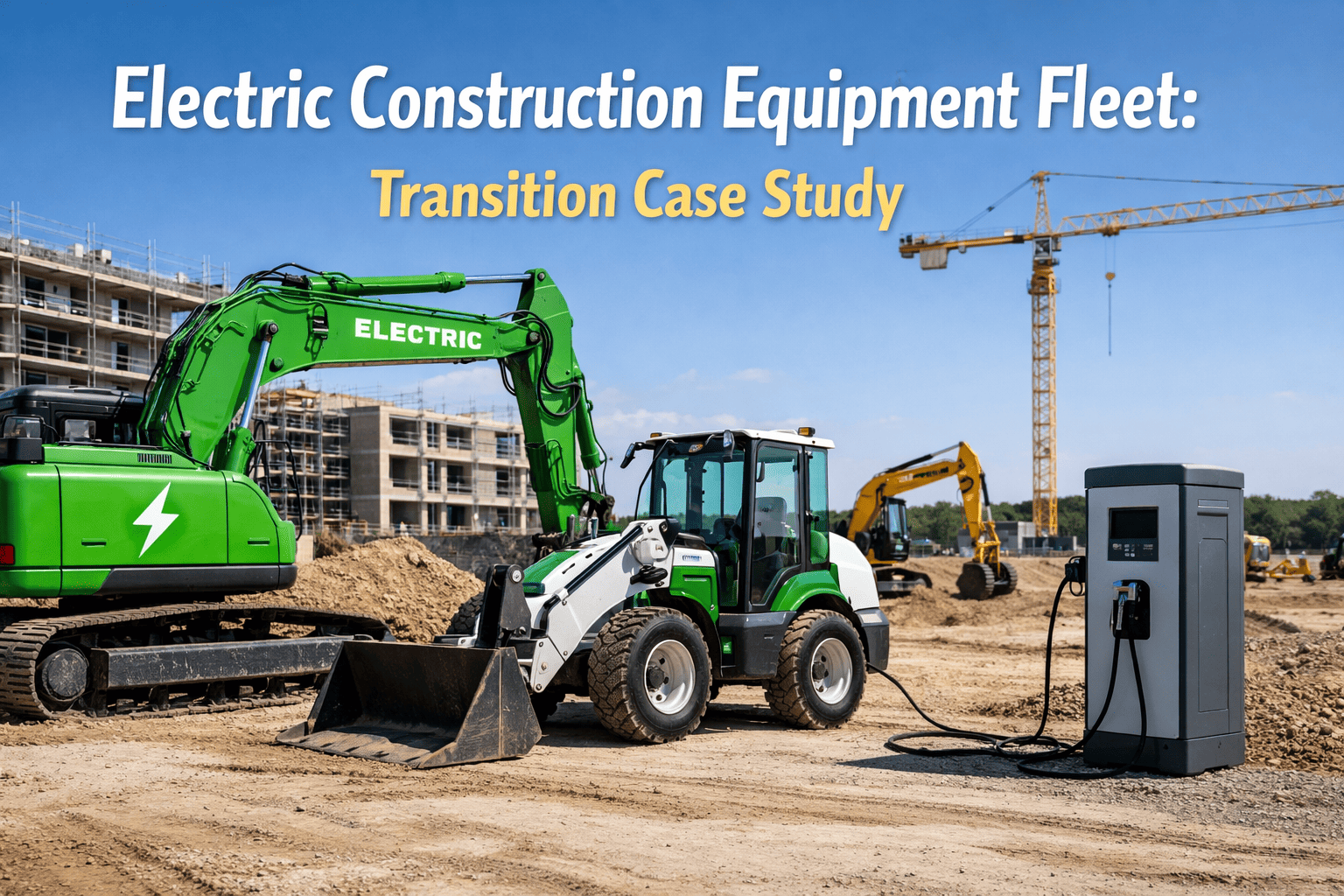
Construction contractors are facing a convergence of pressures that diesel-only fleets are no longer equipped to handle. Urban noise ordinances blocking night work. Emission zone restrictions locking equipment out of dense-city projects. Sustainability scorecards from general contractors and municipal clients demanding zero-emission machinery on-site. And the relentless climb in diesel costs eating into already compressed project margins. The contractors winning urban construction contracts in 2025 and beyond are the ones who began their transition to electric equipment before it became mandatory — and crucially, the ones who built the fleet management infrastructure to run both ICE and EV assets seamlessly in one operation.
From 0% to 30% Electric: How an Urban Contractor Cut Fuel Costs 40%, Slashed Maintenance 60%, and Ended Every Noise Complaint — In One Year
Company Overview
A commercial construction contractor specializing in urban infrastructure, building foundation work, and municipal civil projects across a major metropolitan region. Operating a mixed fleet of 60 machines — excavators, compact track loaders, skid steers, wheel loaders, and compactors — the company was facing growing pressure on three simultaneous fronts: a major client's sustainability mandate requiring zero-emission equipment on all public projects by 2026, a city-level noise ordinance restricting diesel machinery after 6 PM in residential zones, and diesel fuel costs rising 22% year-over-year. The decision to transition 30% of their fleet to electric was not just about sustainability — it was a contract-access strategy. Contractors evaluating a similar transition can start a free HVI account and explore the platform today.
The Three Forces Driving Every Urban Contractor Toward Electric
Sustainability Mandates
The C40 Clean Construction Declaration calls for zero-emission machinery on municipal projects from 2025, with zero-emission construction sites city-wide by 2030. Public clients are now awarding contracts based on fleet emission profiles — not just price.
Urban Noise Restrictions
Cities across North America now enforce decibel limits at construction sites — particularly in residential and mixed-use zones. Diesel equipment frequently exceeds these limits after hours, locking contractors out of high-value evening and night-shift work windows.
Rising Diesel Costs
Diesel prices increased 22% year-over-year for this contractor's operating region, with ongoing fuel cost volatility adding unpredictability to project budgeting. A 20-tonne electric excavator saves over $12,000 per year in fuel costs alone versus its diesel equivalent.
The Challenge: Running a Mixed ICE/EV Fleet Without Two Separate Systems
The electric transition decision was straightforward. The operational challenge was not. Electrifying 18 machines across an active 60-unit fleet meant introducing fundamentally different maintenance requirements, battery health monitoring needs, and inspection protocols — while keeping 42 diesel machines running at full project capacity. Most fleet management tools are built for one or the other. Managing both meant choosing between operational fragmentation or building the right platform. Book a demo to see how HVI handles this for mixed construction fleets.
42 ICE Machines
Diesel engines, fluid maintenance, DPF systems, emissions compliance, fuel management
18 Electric Machines
Battery health, charge cycles, thermal management, HV safety, charge scheduling
Without unified management, a mixed fleet multiplies admin burden and creates dangerous maintenance blind spots
Electric excavators and compact loaders have no equivalent of an oil change indicator. Battery state-of-health degradation is invisible without dedicated monitoring — and a machine dispatched with insufficient charge range creates the same project disruption as a diesel breakdown. The contractor had no way to track battery health trends across 18 EV units.
Diesel-era inspection checklists missed the critical EV safety items: high-voltage system integrity, battery thermal management, charging port condition, and HV cable checks. Generic checklists applied to electric equipment created both safety gaps and compliance exposure under OSHA's evolving EV equipment standards.
Without integrated charge scheduling, EV equipment was dispatched to projects without confirmed charge levels — creating range shortfalls mid-shift. Evening charging windows conflicted with project timelines requiring equipment on site through overnight hours. Dispatchers coordinated charge schedules via text message.
Management had approved the electric transition based on projected fuel and maintenance savings. Without real-time cost-per-machine analytics comparing ICE and EV units on the same jobs, there was no way to verify the investment was delivering its modelled return — or identify which project types were the best fit for EV deployment.
The Solution: HVI Mixed-Fleet Management for ICE + Electric Operations
The contractor deployed HeavyVehicleInspection.com's unified fleet management platform across all 60 machines. Every ICE and EV asset operated inside a single system with vehicle-type-specific workflows — eliminating the parallel-operations problem and giving management a live view of the entire fleet's health, compliance, and cost performance.
Battery Health Dashboard
Real-time state-of-health monitoring across all 18 EV units. Degradation trends per machine with charge-range validation before dispatch. Predictive alerts when battery capacity approaches thresholds that affect project viability.
EV-Specific Inspection Checklists
Separate OSHA-aligned inspection templates for electric equipment — covering HV safety, battery thermal management, charging port integrity, and HV cable condition alongside standard structural and undercarriage checks.
Unified Mixed-Fleet Dashboard
All 60 machines — ICE and EV — on one live screen. Filter by vehicle type, project assignment, maintenance status, and charge level. Live TCO analytics comparing cost-per-hour for diesel vs. electric units on equivalent jobs.
Full HVI Platform Capabilities Deployed Across the Mixed Fleet:
- Unified dashboard: all 60 ICE and EV assets on one screen with vehicle-type-specific status indicators
- Battery state-of-health monitoring for all 18 EV units with charge range validation before project dispatch
- Automated charge scheduling integrated with project dispatch — conflicts flagged 24 hours in advance
- Separate EV inspection templates covering HV safety, thermal management, and charging port integrity
- Predictive battery alerts at 90%, 80%, and 70% state-of-health thresholds per machine
- Live ICE vs. EV cost-per-hour analytics to validate TCO projections and optimize project assignment
- EV-specific PM scheduling: charge cycle tracking, thermal system checks, and HV safety protocol intervals
- Mobile offline-capable inspection app — functional at active urban construction sites without stable connectivity
- Noise restriction compliance tracking: EV machines flagged as available for restricted evening and night shifts
- Emission-zone compliance reporting: EV asset deployment documented for sustainability mandate reporting
EV vs. ICE: The Real Numbers After 12 Months on the Same Projects
Per-machine annual cost comparison based on 12 months of live HVI cost tracking across the mixed fleet. Urban project assignment, equivalent duty cycles and working hours applied.
Results After 12 Months of Mixed-Fleet Operation
Twelve months after deploying HVI across both ICE and EV assets, the contractor had validated every financial projection behind the electric transition — and exceeded them. The platform made the mixed fleet feel like one unified operation rather than two competing systems. Contractors ready to explore their own EV transition can book a personalized demo to see the platform in action.
Fleet Electrified
EV Fuel Cost Reduction
Lower EV Maintenance
Noise Complaints
Battery Health Performance
98.4% average state-of-health across all 18 EV units at 12 months
Predictive monitoring prevented every potential charge-related dispatch failure — zero range shortfalls on active projects
Noise Restriction Compliance
Zero noise ordinance violations across all urban project sites
EV assets enabled evening and weekend shift windows previously unavailable to diesel equipment — expanding billable project hours
EV Inspection Compliance
44% → 98.8% completion rate on EV-specific pre-use inspections
HV safety checks, battery thermal inspection, and charging port condition documented for every shift across all electric units
Sustainability Mandate Compliance
100% compliance with client zero-emission requirements
Automated emission-zone deployment reporting — EV asset hours documented and exported for sustainability mandate submissions in under 5 minutes
- 30% of fleet (18 of 60 machines) successfully electrified with seamless mixed-fleet operation in one platform
- 40% reduction in fuel costs on EV units — $11,200 average annual saving per electric machine vs. diesel equivalent
- 60% lower maintenance costs on EV units — fewer moving parts, no fluid management, reduced wear cycles
- Zero noise ordinance complaints across all urban project sites for the full 12-month period
- EV units enabled evening and weekend project windows worth an estimated $120,000 in additional billable hours
- Battery state-of-health maintained above 98% across all 18 EV units at the 12-month mark
- EV-specific pre-use inspection completion lifted from 44% to 98.8% with dedicated digital checklists
- Zero charge-related project disruptions — charge scheduling integrated with dispatch eliminated range shortfalls
- 100% sustainability mandate compliance — EV deployment documented automatically for all client reporting requirements
- Mixed-fleet TCO analytics confirmed the electric investment delivers payback within the modeled 6–8 year window
"We didn't electrify because it was fashionable. We electrified because our biggest client told us our equipment needed to be zero-emission on public projects by 2026, our city told us diesel machines couldn't work after 6 PM in half our project zones, and diesel costs were eating our margins. What we didn't expect was how difficult it would be to manage both fleet types without the right system. HVI gave us one platform for everything — ICE inspection, EV battery monitoring, charge scheduling, and the TCO data to prove to management that the transition was working exactly as projected. Twelve months in, the numbers are better than the model. We're extending the electric programme to 50% of the fleet."
— VP of Operations, Urban Construction Contractor, Northeast U.S.The Transition Is Happening. The Question Is Whether Your Fleet Management Is Ready.
The electric construction equipment market is growing at 23.3% annually — from $16.3 billion in 2025 toward $106.9 billion by 2034. Urban noise restrictions, zero-emission project mandates, and diesel TCO economics are converging to make this transition not a choice but a timeline. The contractors building competitive advantage right now are those who have the fleet management infrastructure to run mixed ICE/EV operations without doubling their administrative overhead. HVI provides the battery health monitoring, EV-specific inspection workflows, charge coordination, and live TCO analytics that make a mixed fleet feel like one unified operation. Whether you're electrifying 5 machines or 50, the platform is built to scale with every phase of your transition. Create your free account today or speak with the HVI electrification team to map your transition roadmap.
Manage Your ICE and Electric Fleet in One Platform — From Day One of the Transition
Battery health monitoring, EV-specific inspection checklists, charge scheduling, and live ICE vs. EV cost analytics — built for contractors operating at every stage of electrification.
Get Started Free Book a Demo