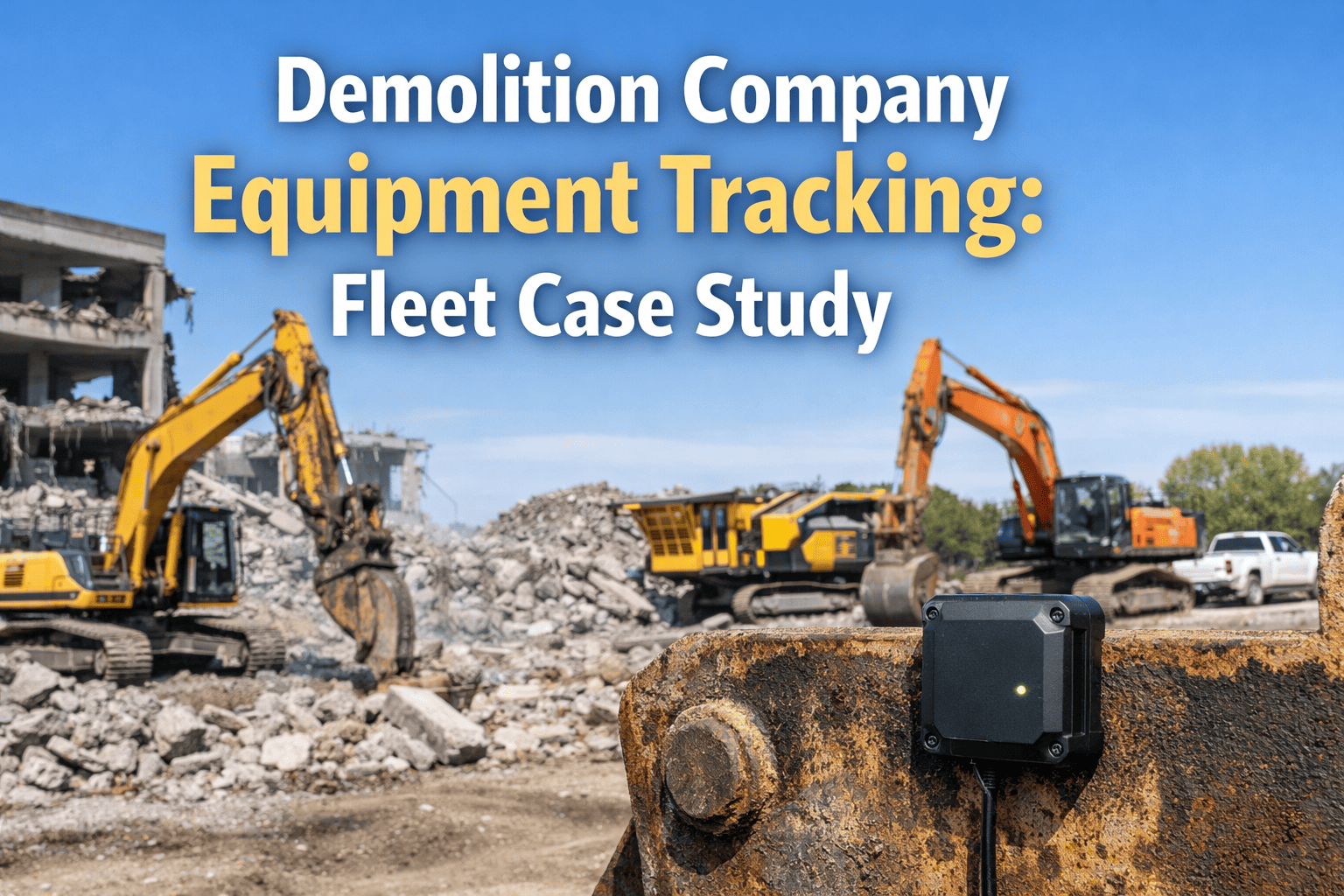
Demolition is the most asset-intensive, high-wear segment of construction. Excavators fitted with hydraulic breakers, concrete crushers, pulverizers, and grapples cycle through punishment daily that would sideline standard construction equipment in weeks. Assets move constantly between active demolition sites, staging yards, and maintenance bays — often without any formal tracking. And when 50-plus pieces of heavy equipment are spread across 8 simultaneous sites in an urban or industrial corridor, the question is not whether something will go missing or miss a service interval. The question is how many things will go unnoticed until they become a crisis.
Zero Lost Equipment, 50% Fewer Emergency Repairs, Complete History on Every Asset — How One Demolition Company Finally Got Control of Its Fleet
Company Overview
A commercial and industrial demolition contractor operating across the Mid-South United States, taking on structural demolition, selective interior strip-outs, industrial plant teardowns, and environmental abatement projects. Their asset fleet of 50-plus items — spanning high-reach excavators, demolition attachments, track skid steers, hydraulic breakers, concrete crushers, grapples, compactors, and support vehicles — operated simultaneously across up to 8 active demolition sites. With each site representing a distinct project contract, a different superintendent, and a separate equipment pool, the company had no centralized visibility into where assets were, what condition they were in, or when service was last performed. Demolition operators managing similar fleet complexity can start a free HVI account today.
The Industry Reality: Untracked Equipment Is Expensive Equipment
The Fleet: 50+ Assets, 8 Sites, Zero Centralized Visibility
The Challenge
Demolition equipment operates in the harshest conditions in the construction industry. Hydraulic breakers cycle thousands of blows per shift. Crushers and pulverizers are under near-constant mechanical stress. High-reach excavators work at structural edge conditions where hydraulic system integrity is safety-critical. Under these conditions, missed service intervals are not administrative oversights — they are direct pathways to catastrophic equipment failure. And in an operation where no one knew where assets were at any given time, missed intervals were the rule, not the exception. Book a demo to see how HVI solves this for demolition fleets specifically.
Assets Moved Without Tracking
Equipment was routinely transferred between demolition sites by crew superintendents without notifying the central fleet office. Attachments — breakers, grapples, pulverizers — moved most frequently and were the hardest to locate when needed.
Service Intervals Missed on High-Wear Equipment
Hydraulic breakers require tool paste and bushing checks every shift. Crushers need tooth inspections every 50 hours. Without automated interval tracking, these checks were performed by operator memory — inconsistently at best, never at worst.
No Mobile Inspection Capability
Pre-use equipment inspections on demolition sites — which often lack office facilities, stable connectivity, and level ground — were done on paper forms that were frequently incomplete, illegible, or never submitted to the central fleet record.
No Maintenance History at Asset Sale or Transfer
Without centralized maintenance records, assets sold or transferred between projects had no verifiable service history. Buyers discounted prices for undocumented condition, and insurance claims on damaged equipment faced documentation gaps that delayed settlement.
- 3–4 assets per month classified as "location unknown" — requiring multi-site coordinator search calls
- 9 emergency hydraulic breaker and attachment failures in the prior year due to missed service intervals
- Pre-use inspection completion rate of 31% across all 8 demolition sites
- Zero centralized maintenance history — each site superintendent maintained separate paper records
- 15–20% resale value discount on equipment disposals with no documented service records
- Insurance claim settlement delays of 3–6 weeks due to missing condition documentation
- No condition-based maintenance triggering — all service scheduled by calendar date only, not operational hours
- Attachment inventory reconciliation required 2+ days at the end of each project contract
The Solution: HVI Asset Tracking & Condition-Based Maintenance
The demolition company deployed HeavyVehicleInspection.com's asset management platform across all 50-plus machines and attachments. Three capabilities transformed the operation: real-time asset tracking with site assignment visibility, condition-based and engine-hour PM triggers for high-wear demolition equipment, and mobile inspection workflows that worked on active demolition sites with or without connectivity.
Asset Tracking & Site Assignment
Every asset — from high-reach excavators to individual hydraulic breaker attachments — registered in a centralized digital inventory with current site assignment, last known location, and assignment history. Transfers logged digitally by superintendents at point of move.
Condition-Based PM Scheduling
Engine-hour and operational-cycle triggers for demolition-specific service intervals. Hydraulic breaker tool paste and bushing checks set to shift frequency. Crusher tooth inspections at 50-hour intervals. Excavator hydraulic system checks tied to actual operating hours — not calendar.
Mobile Inspections for Active Demolition Sites
Offline-capable mobile inspection workflows for pre-use checks on all equipment types — designed for demolition site conditions with mandatory photo documentation, GPS timestamping, and auto-sync when connectivity is restored. Inspection data flows directly into each asset's maintenance history.
Full HVI Platform Deployment for Demolition Fleet Operations:
- Centralized digital asset registry for all 50+ machines and attachments — site assignment tracked in real time
- Superintendent-level transfer logging: asset moves recorded at point of transfer, not discovered after the fact
- Engine-hour and operational cycle PM triggers for hydraulic breakers, crushers, pulverizers, and excavators
- Demolition-specific inspection checklists per equipment type: breaker, crusher, grapple, high-reach excavator
- Offline mobile inspection app — field-operational at demolition sites with no stable connectivity
- Photo-documented condition evidence attached to every inspection record and work order
- Complete maintenance history vault per asset — available for resale documentation, insurance claims, and audits
- Defect-to-work-order automation: field finding generates work order in under 60 seconds
- Attachment tracking module: hydraulic breakers, grapples, and crusher attachments tracked independently
- Cross-site asset inventory dashboard: all 8 sites, all assets, current status on one screen
Before vs. After: Demolition Fleet Visibility Transformed
Results Across One Full Operating Year
Twelve months after full platform deployment, the demolition company had achieved what most operators consider impossible without adding headcount: complete visibility into 50+ assets across 8 simultaneous sites, with maintenance history on every piece of equipment and emergency failures cut in half. Demolition contractors ready to build the same foundation can book a personalized demo today.
Lost Assets (Full Year)
Fewer Emergency Repairs
Inspection Completion
Asset History Coverage
Asset Visibility
3–4 lost assets/month → Zero
Digital site assignment and transfer logging eliminated location searches entirely — every asset locatable in under 30 seconds
Emergency Repair Reduction
9 failures/year → 4 failures/year
Condition-based PM triggers for hydraulic breakers and crushers cut emergency failure events by 56% — each prevented failure saved $8,000–$25,000
Asset Resale Value Recovery
Full documented value achieved
Complete maintenance history eliminated the 15–20% resale discount previously accepted on undocumented equipment — recovering tens of thousands in disposal revenue
- Zero assets classified as "location unknown" across all 8 demolition sites for the full 12-month period
- Emergency equipment failures reduced from 9 to 4 per year — a 56% reduction in critical breakdown events
- Pre-use inspection completion rate lifted from 31% to 96.4% with offline mobile inspection workflows
- Complete maintenance history record established for all 50+ assets — every machine, every attachment
- Equipment resale documentation improved — full service records eliminated forced value discounts at disposal
- Insurance claim documentation available same-day — eliminating 3–6 week settlement delays
- Attachment inventory reconciliation moved from 2-day end-of-project process to real-time always-current status
- Condition-based PM replaced calendar-only scheduling — hydraulic breakers and crushers serviced at actual need
- Work order response time for field defects reduced from 2.8 days to under 4 hours with auto-generation
- Fleet management team maintained full visibility across 50+ assets with zero additional administrative headcount
"In demolition, you're running equipment hard every day across sites that would destroy it if you're not paying close attention. Before HVI, we were losing track of attachments every week and finding out about equipment failures when machines went down in the field — sometimes mid-demolition on a structural collapse. We knew we had a problem, we just didn't have a system. Now we know exactly where every breaker, every crusher, every grapple is at any moment. Our inspection rate went from something embarrassing to nearly perfect. And we haven't had a single asset go 'missing' in over a year. For demolition contractors, that's not a small thing — that's how you protect a $4 million equipment fleet."
— Director of Fleet & Equipment, Commercial Demolition Contractor, Mid-South U.S.Your Equipment Fleet Is Too Valuable to Manage on Spreadsheets and Phone Calls
Demolition is demanding in ways that most fleet management platforms are not designed for. Attachments move between sites hourly. Hydraulic breakers need service every shift. High-reach excavators operate at the edge of structural safety where maintenance history is not optional. HVI's asset tracking and condition-based maintenance platform was built for exactly this level of operational complexity — giving demolition fleet managers real-time visibility into every asset, automated PM triggers matched to actual equipment wear, and complete maintenance documentation that protects both operational readiness and resale value. Whether your fleet is 20 assets or 200, the platform scales to every site you operate. Create your free account today or speak with the HVI demolition team to see the platform in action.
Know Where Every Asset Is. Never Miss a Service Interval Again.
Real-time asset tracking, condition-based PM scheduling, and mobile inspection workflows purpose-built for demolition fleet operations across multiple active sites.
Get Started Free Book a Demo