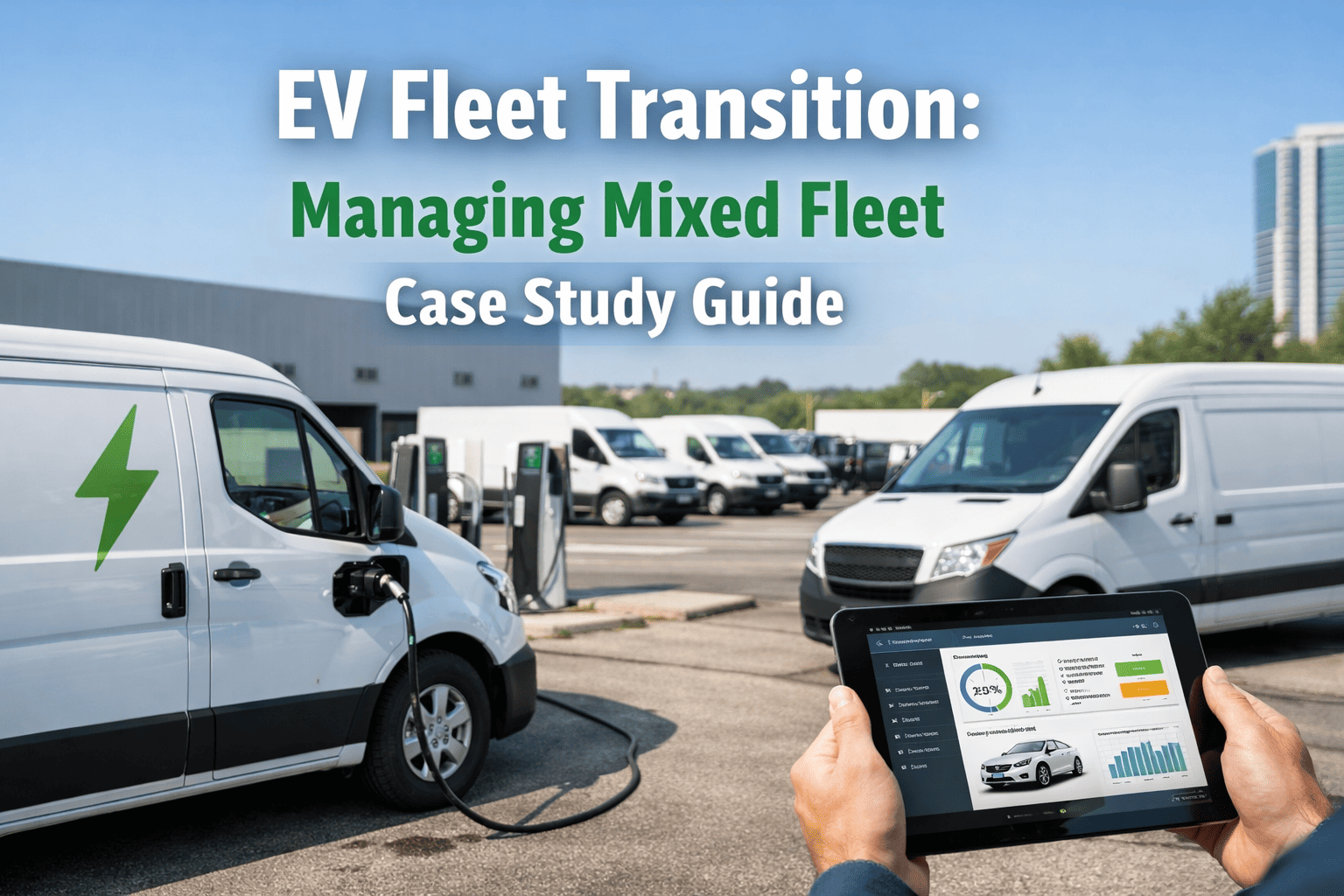
Managing a fleet through an EV transition is one of the most operationally complex challenges in modern logistics. When electric vehicles enter a traditionally ICE-powered operation, maintenance workflows diverge, compliance requirements multiply, and charging coordination becomes a daily puzzle. The companies that succeed are those that unify both vehicle types inside a single intelligent platform — eliminating the operational blind spots that derail mixed-fleet operations before they even begin.
How HVI Unified a 200-Vehicle Mixed Fleet and Achieved Zero Range Failures
Client Overview
A regional delivery company operating across three states with a 200-vehicle fleet of delivery vans and light commercial trucks. The company committed to transitioning 40% of its fleet — 80 vehicles — to electric as part of a sustainability and cost-reduction initiative. Running annual maintenance expenditures of $1.68 million across multiple depots, the operation required a smarter approach to managing two fundamentally different vehicle types under one roof. With delivery SLAs tightly monitored and customer expectations at an all-time high, even a single range-related failure carried significant reputational and financial cost. Operators looking to achieve a similar transition can get started with a free HVI account today.
The Challenge
Transitioning 80 vehicles to electric while keeping 120 diesel trucks running on schedule created a dual-maintenance problem that existing systems were never designed to solve. Technicians were using diesel-era checklists on EVs, battery health was invisible, and charging coordination happened manually every morning. The operational cracks appeared fast.
- No EV-specific inspection checklists — diesel templates applied to electric vehicles creating compliance gaps
- 14 range-related delivery incidents in the first quarter of EV deployment
- Battery health invisible — no degradation tracking or predictive capacity alerts
- Charging coordination done manually, consuming 3+ hours of dispatcher time daily
- Separate tools for ICE and EV maintenance creating duplicated admin work
- Technicians untrained on HV safety protocols and battery diagnostics
- No cost-per-mile comparison between vehicle types to guide future procurement
- State-specific EV compliance requirements not reflected in any existing workflow
- Reactive maintenance approach on battery issues — problems found at dispatch, not before
- Monthly reporting required manual reconciliation across two unconnected systems
The Turning Point
The EV maintenance gap
Battery thermal checks, HV safety protocols, and charging port inspections have zero overlap with diesel servicing — yet most fleets have no separate workflow for them.
The data blind spot
Without battery state-of-health trending, fleet managers cannot predict range capacity for next-day routes — making every EV dispatch a calculated guess.
The compliance risk
DOT and state-level EV inspection requirements differ significantly from ICE standards. Applying old checklists to new vehicles creates audit exposure across every operating state.
The Solution
The fleet partnered with HeavyVehicleInspection.com to deploy a unified mixed-fleet management platform that handled both ICE and EV assets inside one system. Rather than maintaining parallel operations, every vehicle — diesel or electric — was managed through a single dashboard with vehicle-type-specific workflows. Teams interested in seeing the platform in action can book a personalized demo here.
Battery, HV safety & charging port inspection templates built to EV standards
State-of-health trending with predictive alerts before capacity drops affect routes
Unified visibility — all 200 vehicles, ICE and EV, in one live operations view
HVI Platform Capabilities Deployed:
- Custom EV inspection checklists covering battery health, thermal management, and HV safety
- Real-time battery state-of-health tracking with route range validation at dispatch
- Automated charging schedule coordination integrated with daily dispatch planning
- Unified mixed-fleet dashboard filtering by vehicle type, depot, and compliance status
- State-specific EV compliance templates auto-applied based on vehicle registration
- Predictive maintenance alerts for battery degradation before field failures occur
- Live ICE vs EV cost-per-mile analytics to guide future fleet procurement decisions
- Technician work orders built around EV drivetrain components and parts categories
- Automated compliance documentation reducing monthly reporting from 22 hours to under 5
- Mobile-first inspection workflows for field technicians at remote depot locations
Before vs. After: Mixed Fleet Operations
Financial Performance: EV vs ICE Maintenance Cost
Annual per-vehicle maintenance figures based on 12-month post-implementation fleet operation data across 200 vehicles
Results After 12 Months
Within one year of deploying HVI's mixed-fleet platform, the operation had achieved complete EV integration without disrupting delivery performance. The transition that management feared would create parallel operations had instead become a competitive advantage. Fleet operators facing a similar transition can schedule a consultation to explore a tailored implementation timeline.
Lower EV Maintenance vs ICE
Range Failures (Full Year)
Faster Compliance Reporting
Battery Issues Resolved Proactively
EV Maintenance Cost
$5,200 → $3,360 / vehicle
35% reduction per EV annually
Range Incident Elimination
14 incidents → 0 incidents
100% delivery failure prevention
Compliance Reporting Time
22 hrs → 4.8 hrs / month
78% admin time reduction
- Zero range-related delivery failures achieved across all 12 months of operation
- 80 EV vehicles fully integrated into existing maintenance and compliance workflows
- Battery state-of-health tracked across 100% of electric fleet in real time
- Charging schedule conflicts reduced from 9 per week to fewer than 1
- Technician EV inspection completion rate increased from 61% to 98%
- Cost-per-mile analytics enabled data-driven procurement decisions for year two
- Maintenance cost per EV reduced by 60% compared to equivalent ICE vehicles
- State-specific EV compliance coverage across all 3 operating states automated
- Monthly reporting consolidated from two systems into one, saving 17+ hours
- Fleet management team headcount held flat despite 40% fleet expansion to EV
"We were worried the EV transition would mean running two separate operations — one for diesel, one for electric. HVI eliminated that entirely. From day one, our technicians worked inside a single system that understood both vehicle types. The battery health tracking alone saved us from what would have been multiple costly delivery failures. We ended the year with zero range incidents and a clear picture of exactly why EVs are our future."
— VP of Fleet Operations, Regional Delivery Company (Southwest U.S.)Start Your EV Transition the Right Way
Don't let mixed-fleet complexity hold back your electrification goals. Join delivery and logistics operators across America who are using HeavyVehicleInspection.com to manage ICE and EV assets in one unified platform — with battery health tracking, EV-specific inspection workflows, and real-time cost analytics built in from day one. Whether your fleet is 5% electric or 50%, HVI scales to every stage of your transition. Create your free account today or speak with our fleet specialists to build a custom implementation plan.
Manage Your Mixed Fleet With Confidence
EV-specific checklists, battery health tracking, and unified ICE + EV operations — all in one platform built for fleets in transition.
Get Started Free Book a Demo