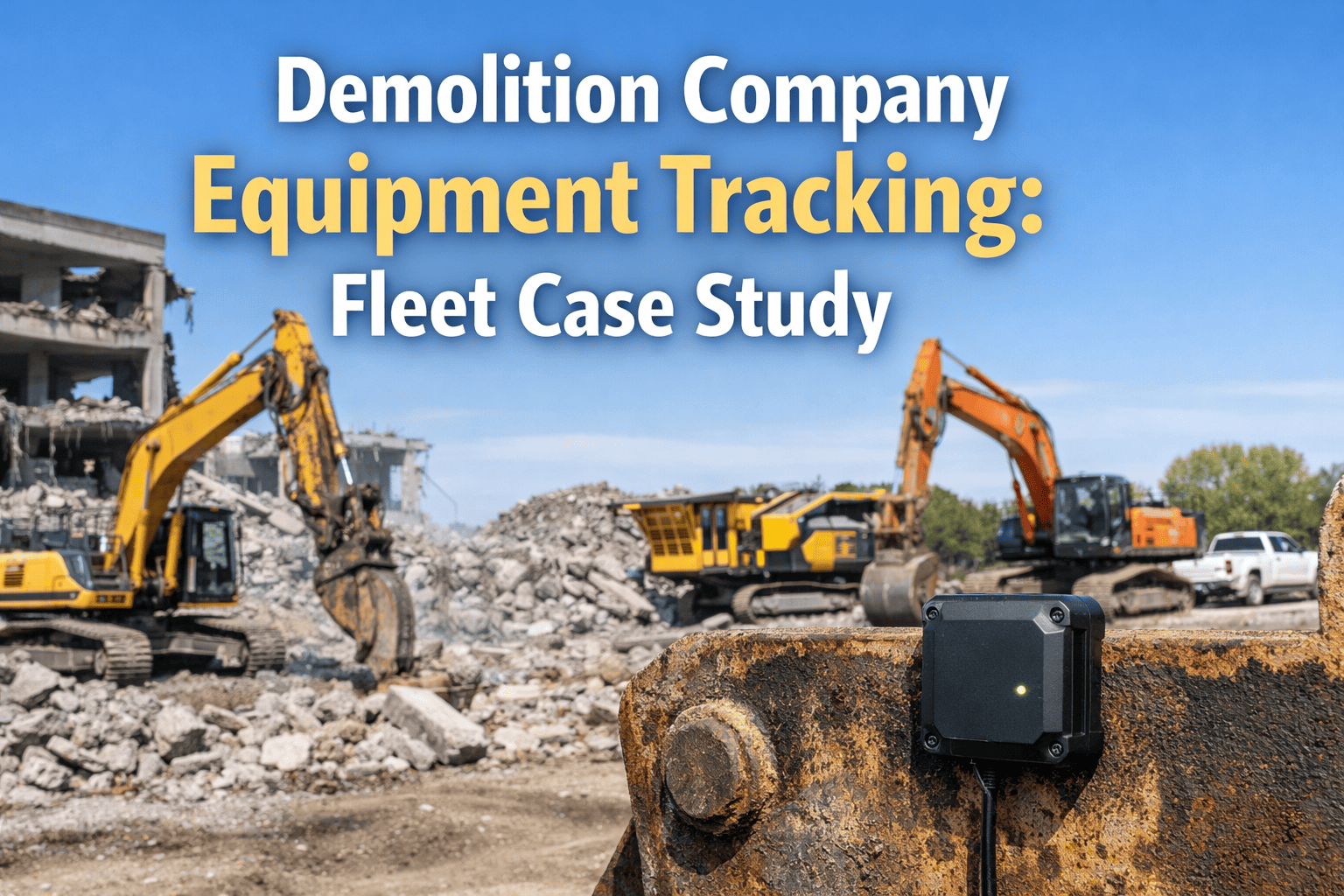
A mid-size commercial construction company operating 85 pieces of heavy equipment across 12 active job sites had no reliable way to answer the most basic operational question: where is each machine right now, and is it being used? Equipment requests were managed through phone calls between project managers and a central dispatcher working from a whiteboard. When a site needed an excavator, the dispatcher called other sites to ask if one was available — a process that took 45 minutes on average and regularly failed because site foremen underreported idle equipment to keep a buffer for their own projects. The result: 40% average idle time across the fleet, $1.2M spent annually on rental equipment to cover perceived shortages that were actually allocation failures, 6 machines discovered sitting unused for over 90 days during an end-of-year audit, and PM schedules based on calendar dates rather than engine hours — meaning some machines were over-maintained while others ran past critical service intervals. After deploying a fleet management platform with real-time GPS tracking, engine-hour-based utilization dashboards, automated PM scheduling tied to actual usage, and digital inspections linked to maintenance workflows, the company increased equipment utilization by 35%, saved $500,000 annually in eliminated rentals and optimized maintenance, retired 10 redundant units worth $1.8M in recovered capital, and improved PM compliance from 58% to 94%. Construction fleet managers, equipment directors, and project operations leaders will find a detailed framework for turning equipment visibility into utilization gains — with specific data on how tracking, scheduling, and inspection alignment eliminated the waste hiding across 12 job sites.
Construction Fleet Boosts Equipment Utilization 35% — Saving $500K and Eliminating 10 Redundant Units
Fleet Profile & Utilization Challenges
This commercial construction company specialized in site development, earthwork, and infrastructure — projects that require heavy iron on tight timelines. The fleet had grown through acquisition over 8 years, adding machines project by project without a centralized tracking system to show what was owned, where it was, or how much it was being used. Every project manager treated "their" equipment as dedicated inventory, creating 12 isolated pools of machines that couldn't be rebalanced across sites without phone calls, politics, and delays. Schedule a consultation to assess whether your construction fleet has hidden utilization capacity, or start your free trial to see real-time equipment tracking in action.
Equipment Composition by Class
Utilization Heat Map: Pre-Implementation (Engine Hours / Available Hours)
The Hidden Costs of Poor Equipment Visibility
Without real-time tracking, every decision about equipment allocation was based on phone calls, memory, and gut feeling. The fleet wasn't short on equipment — it was short on visibility. The result was a fleet that owned enough machines to serve all 12 sites but rented additional equipment because no one could see what was already available. Understanding how inspections feed into equipment management was part of closing this visibility gap.
Annual Cost of Invisible Equipment
Equipment rented to cover "shortages" that were actually idle machines on other sites. 34 rental invoices reviewed post-audit found that owned equipment of the same class was sitting idle within 15 miles during 78% of rental periods.
Calendar-based PM meant machines running 200 hours/year received the same service intervals as machines running 1,800 hours/year. 23 units were serviced 2-3x more often than their actual usage required.
Conversely, 11 high-hour machines ran past critical service intervals because PM was calendar-based and the calendar hadn't caught up to actual usage. These units generated 61% of all unplanned breakdown events.
Average time to locate and redeploy equipment between sites: 45 minutes of phone calls + 1-2 days transport scheduling. 14 documented project delays in 12 months traced directly to equipment availability failures.
Nearly $22,000 per machine per year — wasted not because the equipment was broken, but because nobody could see where it was or how much it was being used.
Can You See Every Machine in Your Fleet Right Now?
If locating idle equipment requires phone calls instead of a dashboard, you're paying for visibility you don't have. See how real-time tracking eliminates the waste.
The Solution: Tracking, Utilization Dashboards & Inspection-Driven PM
The company deployed a fleet management platform across all 85 units in 6 weeks, starting with GPS tracking and engine-hour data collection in weeks 1-2, adding utilization dashboards and reallocation workflows in weeks 3-4, and connecting digital inspections to PM scheduling in weeks 5-6. The implementation prioritized showing value fast — within 2 weeks, project managers could see every machine on a live map with real-time engine status. Schedule a demo to see construction fleet tracking and utilization dashboards.
GPS Tracking & Engine-Hour Data Collection
Telematics devices installed on all 85 units. AEMP 2.0 integration for mixed OEM fleet (Cat, Deere, Volvo). Live map showing real-time location, engine on/off status, and idle vs. working state for every machine across all 12 sites. Within 48 hours of going live, the operations director identified 8 machines that hadn't moved in over 30 days.
Utilization Dashboards & Reallocation Workflows
Engine-hour data transformed into utilization percentages by machine, class, and site. Automated alerts when any unit drops below 30% utilization for 7+ consecutive days. Digital reallocation request system replaced phone calls — a project manager could request a machine class, and the system showed available units by proximity and utilization status. Average reallocation time dropped from 45 minutes + 1-2 day transport delay to 8 minutes + same-day transport.
Digital Inspections & Engine-Hour-Based PM
Paper inspection forms replaced with vehicle-class-specific digital checklists. Inspection defects auto-routed to maintenance queue. PM schedules converted from calendar-based to engine-hour-based — so a dozer running 40 hours/week gets serviced twice as often as one running 20 hours/week, based on actual wear rather than arbitrary dates. Inspection data fed directly into PM scheduling for condition-based service adjustments.
Results: Utilization, Savings & Fleet Optimization
The fleet went from operating blind to operating from a single dashboard that showed every machine's location, status, utilization trend, and maintenance condition. The financial impact was immediate and compounding — rental spend dropped in month 1, redundant units were identified by month 3, and the PM program reached 94% compliance by month 6.
12-Month Impact: Full Metrics
| Metric | Before | After (12 months) | Impact |
|---|---|---|---|
| Average fleet utilization | 47% | 63% | +35% |
| Annual rental spend | $1,200,000 | $410,000 | -66% |
| Fleet size (owned) | 85 units | 75 units | -12% (rightsized) |
| PM on-time compliance | 58% | 94% | +36 pts |
| Unplanned breakdowns / month | 9.4 | 3.7 | -61% |
| Equipment reallocation time | 45 min + 1-2 day delay | 8 min + same day | -82% |
| Inspection completion rate | 41% | 92% | +51 pts |
| Project delays (equipment-related) | 14 / year | 2 / year | -86% |
Year 1 ROI: Construction Fleet Management Platform
How HVI Powers Construction Fleet Equipment Management
The visibility gap this fleet experienced — idle machines invisible to dispatchers, PM running on calendars instead of engine hours, inspections disconnected from maintenance, and rental spend replacing allocation intelligence — is exactly what HVI's construction fleet platform eliminates.
Real-Time Equipment Tracking
See every excavator, loader, dozer, and haul truck on a live map with engine status, location history, and geofence alerts. Mixed OEM fleets unified through AEMP 2.0 integration — Cat, Deere, Volvo, Komatsu, and more in a single view.
Utilization Dashboards by Site, Class & Unit
Engine-hour-based utilization percentage for every machine, every site, every equipment class. Automated low-utilization alerts when units drop below configurable thresholds. Identify reallocation opportunities and dormant assets before they cost you rental dollars.
Engine-Hour-Based PM Scheduling
Replace calendar dates with engine-hour triggers for every PM interval. A dozer running 40 hours/week gets serviced on a different schedule than one running 15 hours/week — based on actual wear, not arbitrary dates. Stop over-maintaining idle machines and under-maintaining busy ones.
Equipment-Class Digital Inspections
Vehicle-class-specific inspection templates for excavators, loaders, dozers, haul trucks, graders, compactors, and specialty equipment. Photo documentation, GPS verification, and defect-to-maintenance auto-routing. Every inspection feeds PM intelligence.
Fleet Rightsizing Analytics
Utilization trend reports identify which machines earn their ownership cost and which should be sold, re-leased, or retired. This fleet used 12 months of data to identify and sell 10 redundant units — recovering $1.8M in capital that was previously invisible.
Multi-Site Dispatch & Reallocation
Digital equipment requests replace phone calls. The system shows available units by class, proximity, and utilization status. Project managers see what's available in minutes instead of spending an hour on calls — and equipment moves the same day instead of waiting for dispatcher coordination.
Stop Renting Equipment You Already Own
See every machine. Know what's idle. Move it where it's needed. Turn equipment visibility into utilization gains that eliminate rentals and recover capital.
Free 14-day trial. No credit card required.