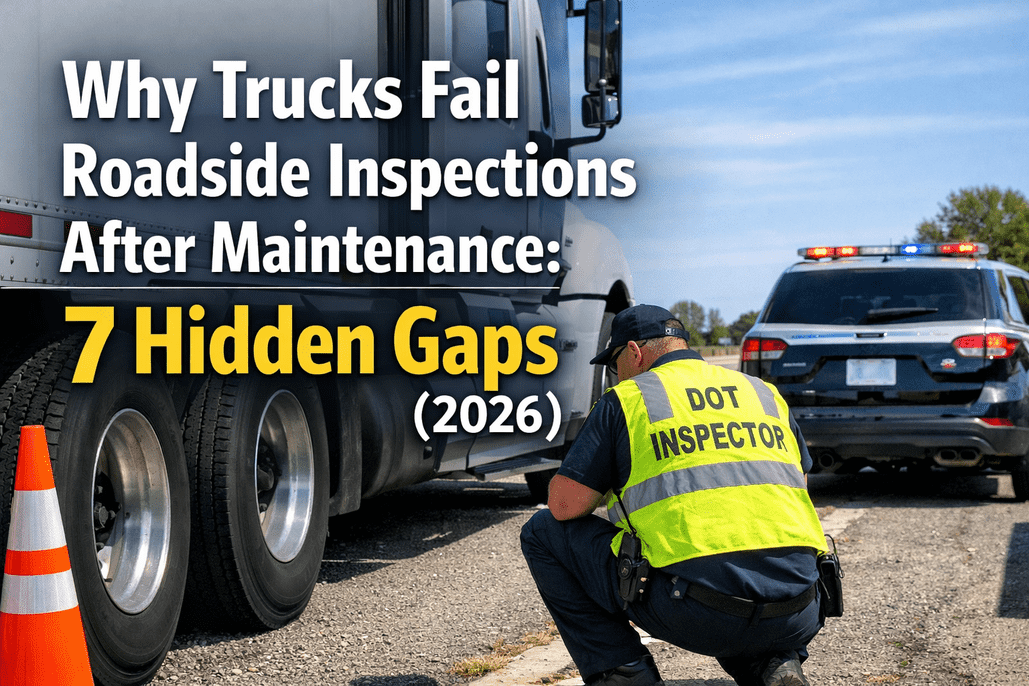
Your mechanic just finished a full PM service. New filters, fresh oil, brake inspection complete. The truck rolls out — and 200 miles later, a DOT inspector places it out of service. This isn't a rare scenario. During the 2025 CVSA International Roadcheck, 18.1% of trucks inspected were shut down on the spot — 10,148 vehicles in 72 hours. The majority of those trucks had recent maintenance records on file. The problem isn't that fleets skip maintenance. It's that preventive maintenance creates its own blind spots — gaps between what mechanics service and what inspectors actually check, defects that develop after the truck leaves the shop, and documentation failures that make good maintenance invisible to auditors. This guide exposes the 7 hidden gaps responsible for the majority of post-maintenance roadside failures — and the pre-dispatch inspection protocol that closes every one of them. Sign up for HVI to add the inspection layer that catches what maintenance misses, or book a demo to see how fleets are eliminating these gaps.
7 Hidden Gaps That Turn Good PM Into Roadside Shutdowns
The Post-Maintenance Failure Paradox
Here's the uncomfortable truth FMCSA data reveals: fleets with active PM programs still fail roadside inspections at alarming rates. The 2025 CVSA Brake Safety Week — a targeted enforcement initiative the industry knows about months in advance — still found 15.1% of inspected trucks with brake violations severe enough for immediate shutdown. That's one in seven trucks, during a week when every fleet should be at peak readiness.
The paradox isn't hard to explain once you understand how maintenance and inspections differ:
Mechanics follow PM checklists based on mileage or calendar intervals. They replace parts that are due, service fluids, and address known wear items. The work happens in a controlled shop environment.
Brakes drift out of adjustment within days of service. Vibration loosens connections. Lights burn out. Tires pick up road damage. New parts fail early ("infant mortality"). Documentation gets lost or incomplete.
DOT inspectors don't care when your last PM was. They measure what's happening right now — brake adjustment, tire tread, light function, fluid leaks. Current condition is the only standard.
7 Hidden Gaps Mechanics Miss
These seven gaps explain why trucks with active maintenance programs still fail roadside inspections. Each gap includes the FMCSA violation data, the mechanical explanation, and the specific inspection step that closes it:
Brake Adjustment Drift After Service
The Gap: Mechanics adjust brakes during PM. Within days to weeks, automatic slack adjusters allow pushrod travel to drift back out of spec — especially on older vehicles, on routes with heavy braking, or when auto-adjusters are worn. The truck passed the shop inspection but fails the roadside check 2,000 miles later.
Why PM Misses It: PM intervals are typically 15,000-25,000 miles. Brake adjustment can drift outside limits within 3,000-5,000 miles of heavy use. The truck operates in an unknown state for weeks between services.
Infant Mortality: New Part Failures After Service
The Gap: Reliability research from NASA, the U.S. Navy, and United Airlines shows that 68% of component failures follow "Pattern F" — highest failure rate immediately after installation, then dropping to a constant random rate. Every PM service that replaces parts restarts this high-risk period.
Why PM Misses It: Mechanics install quality parts correctly. But manufacturing defects, installation stress, improper torque, and break-in failures are invisible at the time of service. They reveal themselves in the first 500-2,000 miles — long after the truck leaves the shop.
Tire Condition Changes Between Services
The Gap: Tires are checked during PM and measured at adequate tread depth. But road hazards, gradual underinflation, objects lodged between duals, and sidewall cuts happen daily. A tire that was at 5/32" during PM can be at 2/32" — the OOS threshold — within weeks of heavy running.
Why PM Misses It: Tire condition changes faster than PM intervals. Slow leaks lose 1-2 psi per day — over 3 weeks between services, that's 30-40 psi lost. A tire at 110 psi during PM can be at 50 psi (OOS territory below 55 psi on a 110 max rating) by the next inspection.
Lighting Failures: The Fastest-Changing Defect
The Gap: Every light on the truck was working when it left the shop. Bulbs burn out unpredictably. Vibration loosens connections. Corrosion develops at terminals. Water intrusion shorts circuits. A single burned-out brake light can happen on any trip between any two PM services.
Why PM Misses It: Light bulb failure is statistically random — no correlation to age or mileage. A bulb can fail the day after a PM service just as easily as the day before. PM checks lights once; the truck runs 500+ hours before the next check.
Vibration-Induced Loosening and Leaks
The Gap: Highway vibration — especially on rough routes — gradually loosens connections, fastenings, and seals that were secure during PM. Air brake fittings, exhaust clamps, fuel line connections, and wheel lug nuts all experience vibrational fatigue. A perfectly torqued connection at mile 0 can be loose by mile 5,000.
Why PM Misses It: Mechanics torque to spec at service time. Vibration-induced loosening is a progressive, invisible process that accelerates based on road conditions the shop can't predict. The truck is always one pothole away from a new leak.
Documentation Gaps That Void Good Maintenance
The Gap: The truck was properly maintained, but the records don't prove it. Missing DVIR signatures, incomplete repair certifications, no proof of annual inspection, illegible paper records, or the mechanic forgot to update the maintenance log. Auditors can't give credit for work they can't verify.
Why PM Misses It: Mechanics are skilled at wrenching, not paperwork. Paper-based systems make it easy to forget signatures, lose forms, or skip documentation steps. When the auditor asks for 3 months of DVIRs and you can't produce them within 48 hours, the maintenance work becomes invisible.
The "Someone Else's Problem" Gap
The Gap: Driver A finishes a shift and notices a minor defect but doesn't report it — the truck is "someone else's problem" tomorrow. Driver B picks up the truck, assumes the previous driver would have reported any issues, and skips a thorough pre-trip. The defect compounds over multiple shifts until it reaches OOS severity.
Why PM Misses It: PM services the vehicle. But between services, the human chain of daily inspections and defect reporting is where information gets lost. Verbal handoffs, assumed inspections, and "pencil-whipped" DVIRs create accountability gaps no PM schedule can fill.
Real Failure Scenarios and Fixes
These scenarios are composites drawn from FMCSA enforcement data and common fleet experiences. Each illustrates how a specific gap leads to a roadside shutdown — and the inspection step that would have prevented it:
Fleet truck received full brake service at 45,000-mile PM. All slack adjusters reset, new brake shoes installed on drive axle. At mile 48,200, DOT inspector finds 3 of 10 brakes beyond pushrod travel limits — triggering the 20% defective brake rule. Truck placed OOS.
Gap #1 (Brake Adjustment Drift) + Gap #2 (Infant Mortality). New brake shoes have a break-in period where material transfers and adjustment changes rapidly. Automatic adjusters on 2 positions had worn internal components that allowed drift. The PM checklist said "adjust brakes" — it didn't say "verify auto-adjuster internal condition."
Daily pushrod travel check for the first 500 miles after brake service (takes 2 minutes total). If any brake shows rapid re-drift, flag the auto-adjuster for replacement — don't just re-adjust. Post-PM inspection note in digital DVIR system to trigger heightened monitoring.
Trailer tires checked at PM — all at 6/32" tread depth with proper inflation. Three weeks later at a scale, inspector finds one steer tire at 3/32" (minimum is 4/32" for steer axle) and a drive tire at 40 psi on a 110 psi max sidewall (OOS below 55 psi). Truck placed OOS for both violations.
Gap #3 (Tire Condition Changes). The steer tire had an alignment issue causing accelerated inner-edge wear — invisible from a quick walk-around but obvious with a gauge. The drive tire had a slow valve stem leak losing 2 psi/day. After 21 days: 42 psi lost. Neither condition existed at PM time.
Weekly tread depth measurement with a gauge (not visual). Daily tire pressure check with calibrated gauge — catches slow leaks within 24 hours instead of 21 days. Photo documentation of tire condition in digital DVIR creates a visual timeline that reveals accelerated wear patterns early.
Fleet receives focused audit notice. Auditor requests 3 months of DVIRs, maintenance records, and annual inspection documentation. The maintenance was performed — but 40% of DVIRs have missing driver signatures, 2 vehicles have no repair certification after DVIR-reported defects, and 1 annual inspection record can't be located. Audit results: 4 violations, $22,000 in proposed penalties.
Gap #6 (Documentation Gaps). Paper DVIRs were filled out but not all were signed. A defect reported by a driver was fixed by the shop but the repair certification was never completed on paper. The annual inspection was performed but the paper record was misfiled. Good maintenance, invisible proof.
Digital DVIR platform with required fields — the system won't accept a submission without driver signature, vehicle ID, and condition certification. Defects auto-generate work orders; repair certifications are required before the vehicle can be dispatched. All records stored searchable, exportable, and audit-ready with HVI.
Pre-Dispatch Inspection Protocol
This 6-step protocol bridges the gap between your PM program and roadside inspection standards. Implement it as a mandatory pre-dispatch checkpoint — especially in the 7 days following any PM service:
Check pushrod travel on every brake chamber. Listen for air leaks with brakes applied. Verify low-air warning activates. Confirm parking brake holds. If any brake shows marginal adjustment, do not dispatch — re-adjust or investigate auto-adjuster condition.
Gauge-check pressure on every tire (not thump test). Measure tread depth at shallowest point. Inspect inner and outer sidewalls for cuts, bulges, or cord exposure. Clear debris from between duals. Check valve stems for damage.
Activate all lights: headlights (high/low), turn signals, hazard flashers, clearance/markers. Have someone press brakes while you check rears. Walk every side of the vehicle. Replace any inoperative lamp before dispatch.
Check under the vehicle for any new puddles, drips, or wet spots. Verify oil, coolant, and power steering levels. Check fuel tank caps and lines. Any active leak is a potential violation — fix before dispatch.
Cross-check every component touched during PM: verify new parts are secure, fluids are at proper level, no tools or rags left behind, all connections tight. Pay extra attention to replaced components — this is when infant mortality failures surface.
Complete digital DVIR with photo verification at each checkpoint. Certify vehicle condition. Submit — the system timestamps, GPS-tags, and stores the record automatically. If defects are found, the system generates a work order and prevents dispatch until repair is certified.
Frequently Asked Questions
PM addresses known wear items on a schedule, but many defects develop between services. Brake adjustment drifts within days, new parts can fail early (68% of failures follow "infant mortality" patterns), tires lose pressure gradually, lights burn out randomly, and vibration loosens connections. PM is periodic; vehicle condition is continuous. Daily inspections bridge this gap.
In heavy-braking applications (mountainous routes, urban stop-and-go, heavy loads), brake adjustment can drift outside allowable limits within 3,000-5,000 miles — as little as one to two weeks of operation. Worn automatic slack adjusters accelerate this drift. The only way to catch it is regular pushrod travel checks between PM intervals.
Over 60% of vehicle out-of-service violations involve brakes, tires, or lights — all items a thorough daily pre-trip inspection catches. When you add fluid leaks, loose components, and safety equipment checks, a comprehensive pre-trip addresses virtually every vehicle-side OOS category. The remaining driver-side OOS violations (HOS, CDL, medical cards) are documentation issues that digital compliance systems handle.
Yes. The first 7 days and 500-2,000 miles after any PM service are the highest-risk period for new part failures (infant mortality pattern). Implement a "post-PM heightened inspection" protocol: daily checks on all replaced components, watching for new leaks, listening for unusual sounds, and verifying secure mounting. With HVI, you can add post-PM inspection templates that automatically trigger for vehicles recently serviced.
Auditors can only credit maintenance they can verify with documentation. Missing DVIR signatures, incomplete repair certifications, and unlocatable annual inspection records make performed maintenance invisible. In 2025, 94% of audited carriers received at least one violation — most were documentation failures, not mechanical failures. Digital platforms that require complete fields and auto-store records eliminate this gap entirely.
Close the Gaps Your PM Program Can't
Preventive maintenance is essential — but it only covers scheduled wear items on a periodic basis. The 7 gaps in this guide explain why 18.1% of trucks still fail roadside inspections despite active PM programs. The fix isn't more maintenance — it's adding a daily condition-monitoring layer through systematic, documented inspections that catch what changes between services.
Bridge the Gap Between Maintenance and Compliance
HVI adds the daily inspection layer that catches brake drift, tire degradation, lighting failures, and documentation gaps — turning every driver into a condition monitor and every defect into an instant work order.
No credit card required • No hardware needed • Operational in under 10 minutes