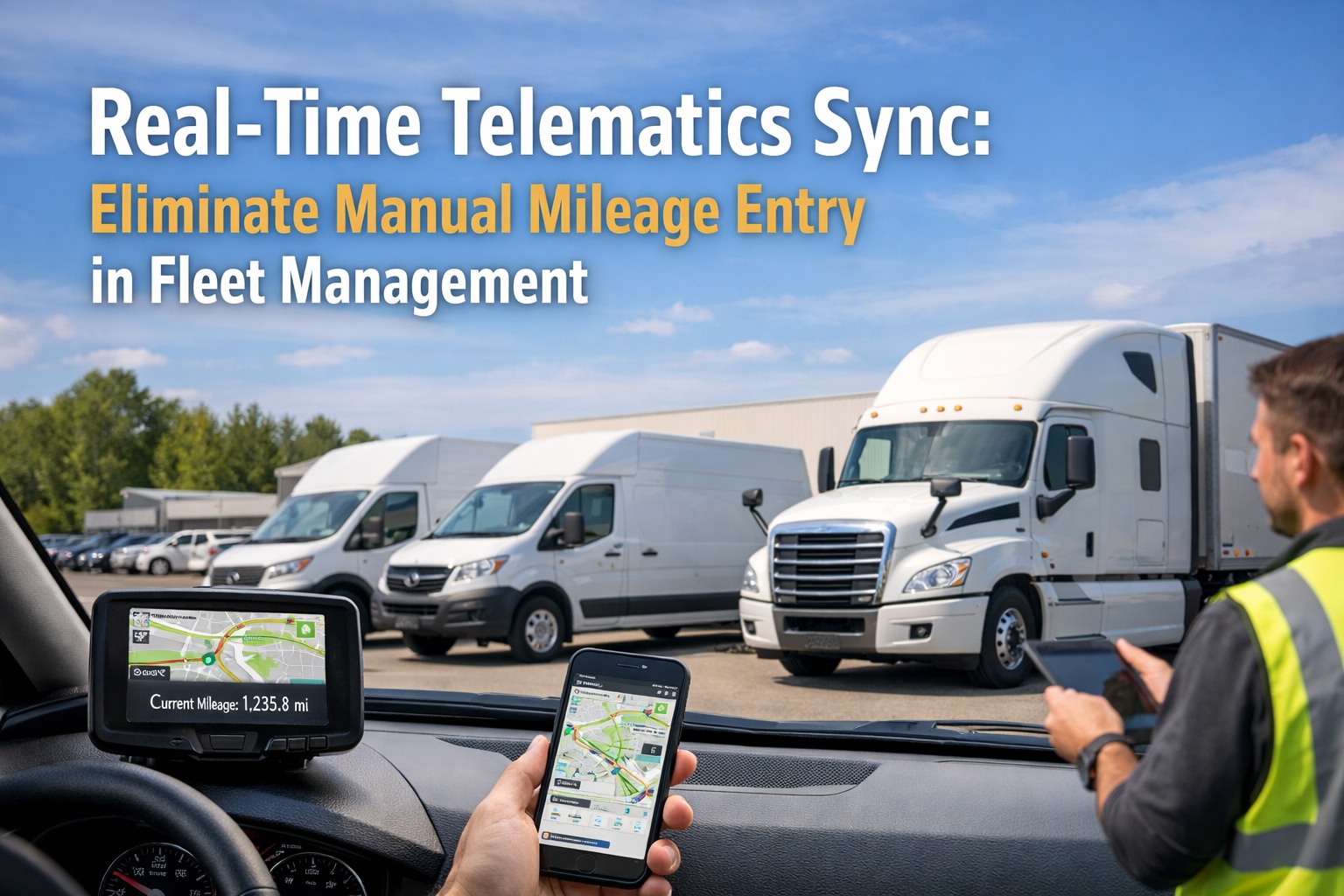
Manual mileage entry is one of the most quietly damaging habits in fleet operations. Drivers estimate. Technicians guess. Managers reconcile spreadsheets at the end of the week hoping the numbers roughly match reality. The result is PM schedules that fire too early or too late, fuel reports that cannot be trusted, compliance records built on approximations, and maintenance decisions made with data that is hours or days out of date. HVI's Auto Telematics Sync eliminates this entirely — engine hours, odometer readings, GPS position, and fault codes sync automatically from your vehicles every 15 minutes, directly into your fleet management dashboard and PM schedules, with zero manual input required. What gets measured in real time gets managed in real time. Start your free HVI trial today and connect your telematics data before your next shift, or book a 30-minute demo to see real-time telematics sync in action across a live fleet.
The manual mileage entry problem — what it actually costs
Most fleet managers accept manual data entry as a fact of life. They should not. The downstream costs of inaccurate, delayed, or missing odometer and engine hour data are significant — and every one of them disappears when telematics sync replaces manual entry.
PM intervals fire at the wrong time
When drivers report estimated odometer readings, PM triggers are based on numbers that can be 200–500km off actual. High-use vehicles get serviced late — increasing wear and breakdown risk. Low-use vehicles get serviced too early — wasting labour and parts spend on components that did not need replacing yet.
$3,200
avg breakdown cost from missed PM
Fuel consumption reports are unreliable
Fuel efficiency calculations depend on accurate mileage data. When odometer entries are estimated, litres-per-100km figures can be off by 10–18% — masking real efficiency problems and making it impossible to identify underperforming vehicles before fuel costs compound.
18%
avg fuel reporting error with manual entry
Compliance records contain unverifiable data
FMCSA auditors can challenge inspection and maintenance records where mileage data appears inconsistent or manually estimated. A telematics-verified odometer reading is factual and tamper-proof. A driver-written figure is a declaration that can be disputed — creating compliance risk that a vehicle with perfect maintenance history should not carry.
$16,000
avg FMCSA civil penalty for compliance violations
Manager time wasted on data reconciliation
Collecting, verifying, and reconciling manually entered odometer data across a fleet of 50+ vehicles takes 4–6 hours per week — time spent checking if numbers make sense rather than managing maintenance. With auto-sync, this administrative task disappears entirely.
6 hrs
weekly reconciliation time eliminated per fleet manager
15 min
Sync frequency — HVI updates engine hours, odometer, GPS, and fault codes every 15 minutes
Zero
Manual mileage entries required — every data point comes directly from the vehicle ECU
$22,000
Estimated annual value of eliminated data errors and recovered manager time for a 50-truck fleet
Still relying on drivers to report odometer readings and reconciling mileage data every week?
Schedule a free 30-minute telematics review — we will audit your current data entry workflow and show exactly how real-time telematics sync eliminates every manual step for your specific fleet setup and vehicle types.
What HVI auto-syncs every 15 minutes
HVI's telematics sync does not just pull odometer readings. Every 15 minutes, six categories of vehicle data are automatically captured, verified, and fed directly into your fleet management workflows — no driver action, no admin input, no data gaps.
Odometer Reading
Verified ECU odometer — not driver-reported. Accurate to within the last 15 minutes of actual distance driven. Feeds directly into PM interval calculations.
Feeds: PM triggers, fuel reports, cost-per-km
Engine Hours
Cumulative engine run time direct from ECU — critical for heavy vehicles that accumulate wear through idle time rather than distance. The most accurate PM trigger for off-road and high-idle fleets.
Feeds: PM triggers, engine wear tracking, utilisation
GPS Position
Live vehicle location with movement status. Confirms which vehicles are active, idle, or stationary — enabling accurate daily utilisation tracking and geofence-based depot check-in confirmation.
Feeds: Depot check-in, utilisation reports, driver tracking
Fault Codes (DTC)
J1939 and OBD-II diagnostic trouble codes are captured the moment they fire — instantly visible on the fleet dashboard and optionally triggering a maintenance work order before the driver even notices a warning light.
Feeds: Fault alerts, AI parts lookup, maintenance work orders
Battery and Voltage
Battery state and charging system voltage — flagging deteriorating batteries before they cause no-start events that ground a vehicle unexpectedly and require roadside recovery calls.
Feeds: Predictive alerts, pre-trip inspection check items
Idle Time & Engine State
Tracks engine state — running, idling, or off — giving accurate separation of idle hours from productive running hours. Critical for fleets with anti-idling policies and accurate fuel cost attribution per vehicle.
Feeds: Idle reports, fuel attribution, driver behaviour scores
Telematics Data Is Tamper-Proof Compliance Evidence: Unlike manually entered odometer readings, ECU-sourced telematics data cannot be altered retroactively — it carries a hardware timestamp and GPS correlation that makes it legally robust. HVI stores the full telematics history for every vehicle, providing an unbroken, verifiable data trail for FMCSA audits, insurance claims, and fleet performance disputes.
Sign up free and start building your verified telematics record today.
How auto-sync transforms your PM accuracy
The most immediate operational impact of real-time telematics sync is the transformation of your preventive maintenance schedule from calendar-based guesswork to usage-based precision. Here is what that looks like in practice.
High-use vehicle doing 1,400 km/week
Driver reports 1,200 km — PM delayed by 3 days, running 600 km past interval before service
ECU data triggers PM alert at exactly the right interval — vehicle booked at 10,000 km
Low-use vehicle doing 400 km/week
Calendar PM fires at 90 days regardless — vehicle serviced with 2,200 km on current interval instead of the required 5,000 km — wasted service cost
PM holds until actual odometer triggers — service happens at the right interval, not at a calendar date
Fault code fires mid-route
Driver may not report until end of shift — or may ignore the light entirely — maintenance team unaware until the vehicle returns
DTC visible on dashboard within 15 minutes — work order created and technician notified before vehicle returns to depot
Vehicle transferred between sites
Previous site's mileage records must be manually transferred — often delayed or incomplete
Continuous ECU data follows the vehicle — PM schedule continues seamlessly from last reading regardless of site
Ready to see how accurate your PM schedule could be with real odometer and engine hour data instead of driver estimates?
Sign up free and connect your first vehicles — HVI's telematics sync works with all major fleet telematics providers. Most fleets have live data flowing within 24 hours of account setup, with no hardware changes required.
Telematics sync vs. manual data entry — full comparison
| Capability |
Manual Entry / Paper Logs |
HVI Auto Telematics Sync |
| Odometer accuracy |
Driver estimate — can be 200–500 km off |
ECU verified — accurate to last 15-minute sync |
| Data availability |
End of shift or next morning — hours old |
Real-time — 15-minute maximum lag |
| Fault code visibility |
Driver-reported only — often delayed or missed |
Instant — captured at ECU, visible on dashboard immediately |
| PM trigger accuracy |
Based on estimated data — can fire 500+ km late |
Triggers at exact actual interval — every time |
| Fuel reporting accuracy |
Up to 18% error — masks real efficiency problems |
Accurate to actual km driven — reliable efficiency data |
| Compliance defensibility |
Driver declaration — challengeable in audit |
Hardware-sourced, tamper-proof, GPS-correlated |
| Admin time required |
4–6 hrs/week data collection and reconciliation |
Zero — data enters system automatically |
| Manager data reconciliation time eliminated (6 hrs/wk × 50 wks × $50/hr) |
- $15,000/yr |
| PM accuracy improvement — 2 fewer late-triggered breakdowns × $3,200 avg |
- $6,400/yr |
| Over-servicing eliminated — 8 early calendar PM services avoided × $280 avg |
- $2,240/yr |
| Fuel reporting accuracy improved — 2% fuel cost saving via better efficiency visibility |
- $4,800/yr |
| Total estimated annual value — 50-truck fleet |
$28,440+/yr |
Frequently asked questions about HVI telematics sync
QWhich telematics providers does HVI integrate with?
HVI integrates with all major fleet telematics providers including Samsara, Verizon Connect, Geotab, Fleet Complete, Teletrac Navman, Trimble, Mix Telematics, and others via standard API connections. If your current telematics provider supports data export via API or FTP, HVI can typically connect within 24 hours. For fleets without existing telematics, HVI also supports OBD-II and J1939 data via plug-in telematics devices that work with any vehicle.
Sign up free and check compatibility with your current telematics provider on the HVI integrations page.
QWhat happens if a vehicle loses connectivity — is data lost?
No data is lost during connectivity gaps. HVI's telematics devices and connected units store all ECU readings locally during periods without cellular or GPS coverage. When connectivity is restored, all buffered data is uploaded in sequence, filling any gaps in the timeline automatically. The HVI dashboard clearly shows the last sync timestamp for each vehicle, so managers can identify vehicles that have been out of coverage and assess their current data freshness at a glance.
QCan we still allow manual odometer entry for vehicles without telematics?
Yes. HVI supports mixed fleets — vehicles with telematics use auto-sync data, while vehicles without telematics can continue using manual driver-reported odometer entry via the HVI mobile app. The system clearly distinguishes between verified ECU data and manual entries in reporting, so managers always know which figures are hardware-sourced and which are driver-reported. This allows a phased telematics rollout without disrupting the maintenance workflow for vehicles not yet connected.
Book a demo to see how mixed-fleet data management works in practice.
QDoes telematics sync require any new hardware to be installed in vehicles?
If your vehicles already have a fleet telematics system installed, no new hardware is required — HVI connects to your existing system via API. For vehicles without telematics, HVI supports a range of plug-in OBD-II and J1939 adapters that require no installation beyond plugging into the vehicle's diagnostic port — a process that takes under 60 seconds per vehicle. These devices are compatible with all Class 6, 7, and 8 heavy vehicles built after 2000 that have a J1939 port, which covers the vast majority of active commercial fleets.
QHow does HVI handle telematics data for vehicles that are leased or under warranty?
HVI reads telematics data in a read-only capacity — the sync does not write to the vehicle's ECU or make any changes to manufacturer warranty systems. For leased vehicles, HVI's data access is through the same standard diagnostic port that roadside assistance and dealer technicians use, which does not affect lease terms or warranty coverage. Always confirm with your lease provider that telematics data access is permitted under your specific agreement, as policies vary by lessor.
Real-time data in. Manual mileage entry out. Forever.
HVI's Auto Telematics Sync replaces estimated odometer figures with verified ECU data — so your PM schedules fire on time, your fuel reports are accurate, your compliance records are defensible, and your management team spends zero hours a week reconciling numbers that should never need human hands to collect. Start free today and have your first vehicles syncing before your next shift.
No credit card required · Works with your existing telematics · Live data within 24 hours