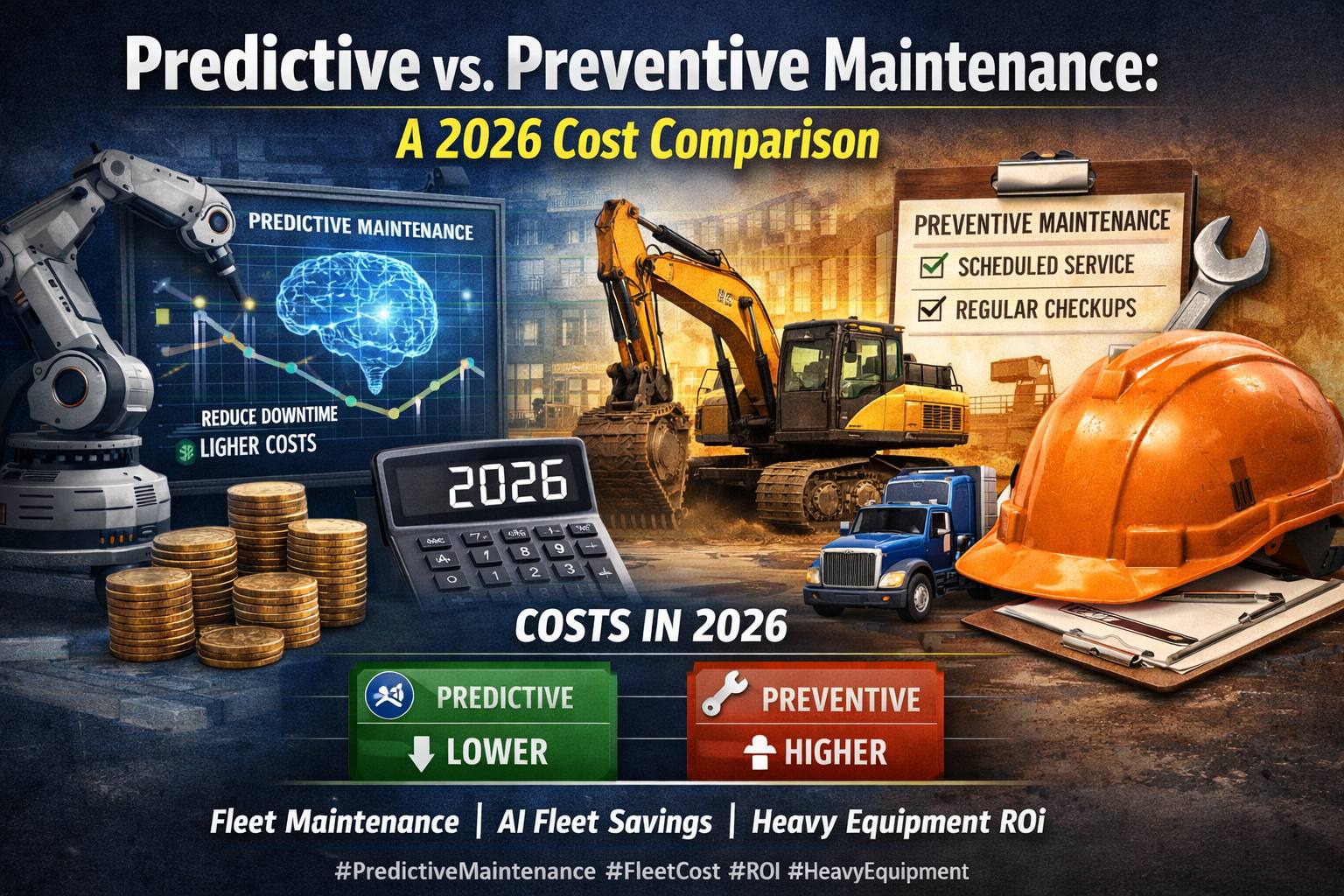
A construction fleet managing 45 heavy equipment assets switched from preventive to predictive maintenance in 2024. The results after 18 months: 34% reduction in maintenance costs ($287,000 saved annually), 62% fewer unplanned breakdowns, and 28% longer equipment lifespan. Their previous preventive maintenance program ran equipment through scheduled services regardless of actual condition—replacing parts with 40% useful life remaining and missing early failure indicators that caused costly breakdowns. Predictive maintenance changed everything by monitoring actual equipment condition and predicting failures before they occurred. As we enter 2026, the cost gap between these approaches has widened dramatically,making the strategic choice clear for fleet operators managing tight margins.
2026 Maintenance Economics
Critical cost metrics shaping fleet maintenance strategies
$127K
avg annual cost
Per heavy equipment unit using traditional preventive maintenance programs
$84K
predictive cost
Average annual maintenance cost per unit with AI-powered predictive systems
34%
cost reduction
Average savings when switching from preventive to predictive maintenance
18 mo
ROI timeline
Average payback period for predictive maintenance system implementation
Preventive maintenance follows fixed schedules—change oil every 250 hours, replace filters every 500 hours, regardless of actual condition. Predictive maintenance monitors real-time equipment health and predicts optimal service timing. The 2026 cost difference stems from predictive's ability to eliminate unnecessary service, catch problems early, and optimize parts inventory. Understanding these cost structures determines whether fleets thrive or struggle in today's competitive environment.
Preventive vs. Predictive Maintenance: Core Differences
The fundamental distinction between preventive and predictive maintenance determines both operational approach and cost structure for heavy equipment fleets.
Preventive vs. Predictive: Key Differentiators
Understanding the strategic and operational differences
Factor
Preventive Maintenance
Predictive Maintenance
Service Timing
Fixed calendar/hour intervals regardless of condition
Condition-based timing using real-time equipment data
Technology Required
Basic tracking (spreadsheets, simple CMMS)
IoT sensors, AI analytics, cloud platforms
Initial Investment
Low ($5K-15K setup)
Moderate ($25K-75K including sensors/software)
Annual Cost per Unit
$127,000 average
$84,000 average (34% lower)
Unplanned Downtime
12-18% of operating time
4-7% of operating time (62% reduction)
Parts Waste
30-40% of parts replaced prematurely
5-10% parts waste (80% reduction)
Failure Detection
Reactive—failures discovered during breakdowns
Proactive—identifies issues 2-8 weeks before failure
Best For
Small fleets (under 10 units), simple equipment
Medium-large fleets (10+ units), high-value assets
The cost advantage of predictive maintenance grows with fleet size and equipment complexity. A 50-unit fleet saves approximately $2.15 million annually switching from preventive to predictive—enough to fund system implementation multiple times over. Start your free trial to see predictive maintenance ROI calculations for your specific fleet.
Calculate Your Predictive Maintenance ROI
See exactly how much your fleet can save by switching to predictive maintenance. Get personalized cost analysis and implementation roadmap. No credit card required.
Detailed Cost Breakdown: 2026 Analysis
Understanding where costs accumulate in each maintenance approach reveals optimization opportunities and quantifies the predictive advantage.
Annual Maintenance Cost Structure per Equipment Unit
Comprehensive breakdown of direct and indirect costs
Preventive Maintenance
$127,000/year
Scheduled Service Labor
$28,000
Fixed interval services at 90 hrs/year @ $155/hr
Parts & Consumables
$34,000
Filters, fluids, belts replaced per schedule (40% premature)
Unplanned Breakdown Repairs
$31,000
Emergency repairs from missed early warning signs
Downtime Cost
$26,000
Lost productivity: 240 hrs/year @ $108/hr
Inventory Carrying Cost
$8,000
Holding 30% more parts for unpredictable failures
Predictive Maintenance
$84,000/year
Condition-Based Service Labor
$22,000
Optimized timing: 68 hrs/year @ $155/hr (24% reduction)
Parts & Consumables
$21,000
Replaced only when needed based on condition (38% reduction)
Planned Component Replacement
$19,000
Scheduled replacements before failure based on predictions
Downtime Cost
$10,000
Minimal unplanned: 92 hrs/year @ $108/hr (62% reduction)
Technology & Sensors
$7,000
IoT sensors, platform subscription, data analytics
Inventory Carrying Cost
$5,000
Predictable failures enable 38% inventory reduction
Annual Savings per Unit:
$43,000
(34% cost reduction)
ROI Timeline: Predictive Maintenance Implementation
Predictive maintenance requires upfront investment in sensors and software. Understanding the payback timeline helps fleet operators plan implementation and measure success.
24-Month Predictive Maintenance ROI
Implementation costs vs. cumulative savings for 25-unit fleet
Month 0-3: Implementation
Initial Investment:
$125,000
IoT sensors (25 units × $1,800): $45,000
Predictive platform license (3-year): $48,000
Installation & integration: $22,000
Staff training: $10,000
Cumulative: -$125,000
Month 4-6: Initial Results
Quarterly Savings:
$215,000
Reduced unplanned downtime: $125,000
Optimized parts usage: $52,000
Fewer emergency repairs: $38,000
Cumulative: +$90,000
Month 7-12: System Maturity
6-Month Savings:
$510,000
AI model accuracy improves; failure predictions 85%+ accurate
Full fleet transition complete; maximum cost reduction achieved
Inventory optimization: 35% reduction in parts carrying costs
Cumulative: +$600,000
Month 13-24: Full Returns
12-Month Savings:
$1,075,000
Sustained 34% cost reduction year-over-year
Extended equipment lifespan adds asset value
Improved fleet reliability enables business growth
Cumulative: +$1,675,000
Breakeven Point:
4.3 months
Per-Unit Savings:
$43K/year
The investment payback accelerates with fleet size. Smaller fleets (10-15 units) see 12-18 month ROI; larger fleets (50+ units) achieve payback in 3-6 months. Schedule a consultation to calculate exact ROI for your fleet size and equipment mix.
See Predictive Maintenance in Action
Get a personalized demo showing how predictive maintenance cuts your fleet costs by 34%. See real-time equipment monitoring, failure predictions, and ROI dashboards.
When to Choose Each Approach
Strategic selection between preventive and predictive maintenance depends on fleet characteristics, operational requirements, and financial considerations.
Maintenance Strategy Selection Guide
Matching approach to fleet characteristics
✓
Small fleet size: Under 10 equipment units where predictive investment doesn't justify savings
✓
Simple equipment: Basic machines without complex systems or high failure consequences
✓
Low utilization: Equipment operates intermittently or seasonally (under 500 hrs/year)
✓
Limited budget: Cannot fund upfront predictive technology investment
✓
Predictable failures: Equipment has well-established service intervals with consistent wear patterns
✓
Medium-large fleet: 10+ units where savings justify technology investment
✓
High-value assets: Equipment worth $150K+ where downtime costs are substantial
✓
Heavy utilization: Equipment operates continuously or near-continuously (1,500+ hrs/year)
✓
Critical operations: Downtime causes significant revenue loss or contractual penalties
✓
Variable conditions: Operating environments vary significantly, making fixed schedules inefficient
✓
Growth trajectory: Fleet expanding where scalable predictive systems provide long-term advantage
Implementation Roadmap
Transitioning from preventive to predictive maintenance requires systematic planning to maximize ROI and minimize operational disruption.
90-Day Predictive Maintenance Launch
Proven implementation framework for fleet operators
1
Days 1-15: Assessment & Planning
Audit current preventive maintenance costs and identify improvement opportunities
Calculate baseline metrics: downtime hours, parts spend, labor costs per unit
Select pilot equipment (3-5 high-value or high-utilization units)
Choose predictive platform with IoT integration and AI analytics
2
Days 16-45: Pilot Deployment
Install IoT sensors on pilot equipment (vibration, temperature, pressure, fuel, hours)
Configure predictive platform with equipment specifications and baseline data
Train maintenance team on platform usage and alert interpretation
Begin data collection and AI model training period
3
Days 46-60: Validation & Refinement
Monitor pilot results: compare predicted vs. actual failures
Adjust alert thresholds and prediction models based on early data
Document quick wins and cost savings from pilot group
Develop full fleet rollout plan based on pilot learnings
4
Days 61-90: Fleet-Wide Rollout
Deploy sensors across remaining fleet in phases
Transition from calendar-based to condition-based service scheduling
Implement predictive alerts for technicians and fleet managers
Establish monthly ROI tracking and reporting process
Frequently Asked Questions
Why Fleet Operators Choose Predictive Maintenance
✓
34% Cost Reduction: Cut annual maintenance spend from $127K to $84K per unit
✓
62% Less Downtime: Reduce unplanned equipment failures and lost productivity
✓
4-6 Month Payback: Recover technology investment rapidly through savings
✓
Real-Time Visibility: Monitor equipment health 24/7 from any device
✓
AI-Powered Predictions: Get 2-8 week advance warning before failures occur
✓
Free Trial Available: Test predictive maintenance with no commitment required
What's the actual cost difference between predictive and preventive maintenance?
In 2026, preventive maintenance averages $127,000 per heavy equipment unit annually, while predictive maintenance costs $84,000—a 34% reduction ($43,000 savings per unit per year). The difference comes from eliminating premature parts replacement (38% reduction), reducing unplanned downtime (62% reduction), and optimizing service timing. For a 25-unit fleet, this translates to $1.075 million in annual savings. The cost gap widens with equipment complexity and utilization hours.
How long until predictive maintenance pays for itself?
Average ROI timeline is 4-6 months for medium fleets (10-25 units) and 3-4 months for larger fleets (25+ units). Initial investment includes IoT sensors ($1,800/unit), platform subscription ($1,920/unit for 3 years), installation ($900/unit), and training ($400/technician). A 25-unit fleet investing $125,000 typically breaks even in month 4 through reduced downtime, optimized parts usage, and fewer emergency repairs. Year one net savings average $950,000.
Can small fleets benefit from predictive maintenance?
Fleets with 10-15 units can benefit if equipment is high-value (over $150K each) or heavily utilized (1,500+ hours/year). Smaller fleets see 12-18 month ROI versus 3-6 months for larger operations. The decision threshold: if annual maintenance costs exceed $80K per unit and downtime causes significant revenue loss, predictive maintenance delivers positive ROI even for smaller fleets. Fleets under 10 units typically achieve better economics with optimized preventive maintenance.
What technology is required for predictive maintenance?
Essential components: IoT sensors monitoring vibration, temperature, pressure, fuel consumption, and operating hours; cloud-based predictive platform with AI/machine learning analytics; mobile/web interface for technicians and managers; integration with existing CMMS or fleet management systems. Modern platforms offer plug-and-play sensor installation (no custom wiring) and pre-trained AI models specific to equipment types. Total technology cost averages $2,700/unit for hardware plus $1,920/unit for 3-year software subscription.
Start a free trial to test predictive technology with your equipment.
How accurate are predictive maintenance failure predictions?
Modern AI-powered systems achieve 85-92% prediction accuracy after 3-6 months of data collection. Systems provide 2-8 week advance warning for major component failures (engines, transmissions, hydraulics) and 1-4 week warning for minor issues. Accuracy improves over time as AI models learn specific equipment patterns. False positives (predicting failures that don't occur) average under 8%; false negatives (missing actual failures) average under 6%. This accuracy enables confident scheduling of planned repairs during convenient downtime rather than reactive emergency service.