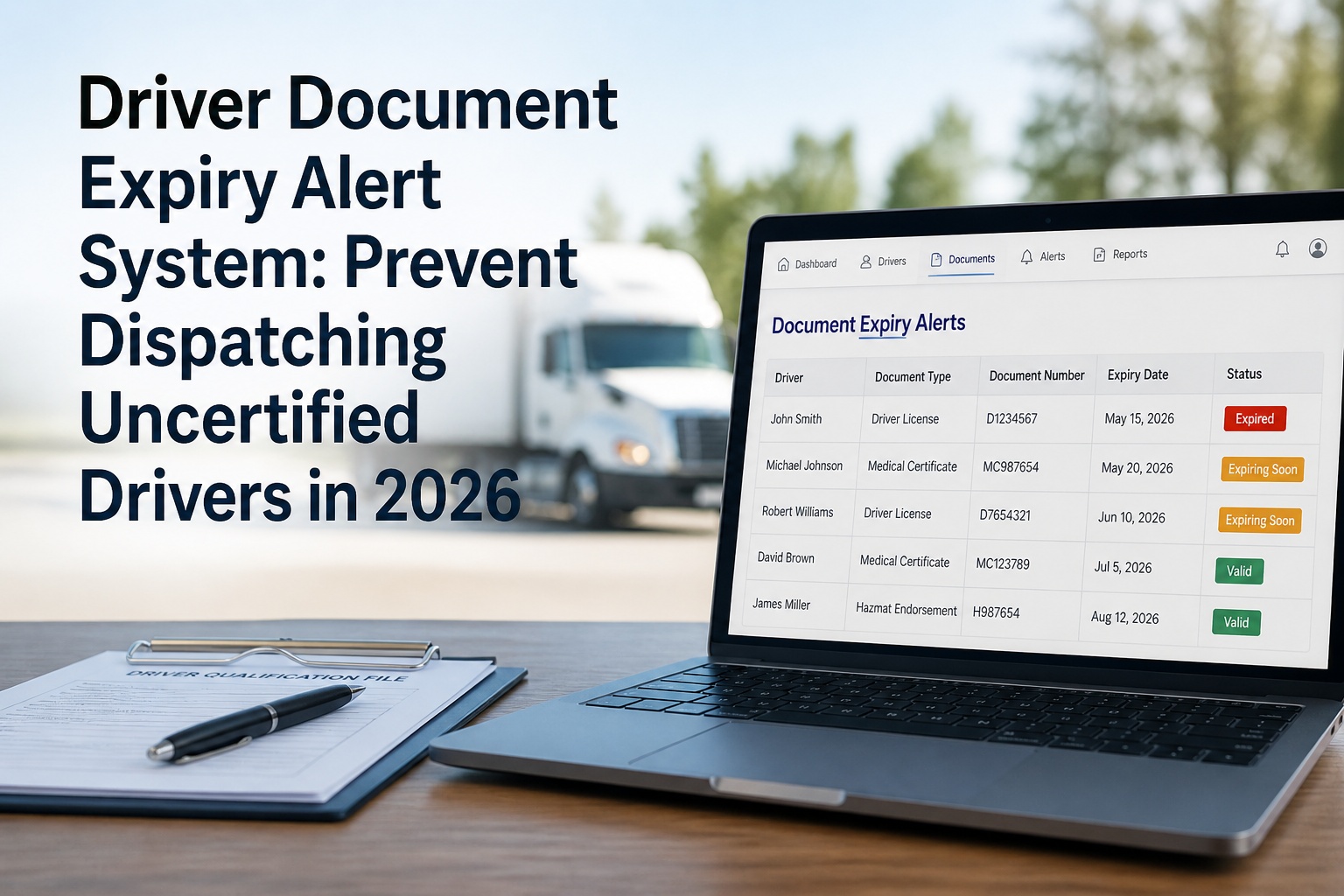
Every dispatcher's worst-case scenario starts the same way: a driver pulls into a roadside inspection, hands over a medical certificate that expired three weeks ago, and the truck is placed out of service before lunch. The freight is stranded. The driver's CDL faces downgrade proceedings (Texas in 10 days, New York in 15, federal ceiling at 60). The carrier absorbs an $11,000+ fine on the medical certificate alone, plus CSA score damage that drives insurance premiums up 10-30% at next renewal. None of it had to happen. Every expired document gives 90 days of warning if anyone is tracking expiration dates — and the fleets that consistently pass FMCSA compliance reviews (only 7% pass without violations) all have one thing in common: an automated driver document expiry alert system that catches every renewal date before it lapses. That's exactly what HVI's driver qualification module delivers — automated 90/60/30-day expiration alerts, digital document storage, MVR-based medical certificate verification (now mandatory after January 10, 2026), and dispatch-blocking when any required document expires. This article explains why driver document tracking is the single most preventable compliance failure in 2026, the specific documents HVI tracks for every driver, the 90/60/30 alert architecture that prevents the dispatch-with-expired-credentials scenario, and the integrations that make HVI's system more reliable than any spreadsheet or paper file. Start your free HVI trial to digitize your driver document tracking, or book a 30-minute demo to see the alert workflow live.
HVI tracks every CDL, medical certificate, MVR review, Clearinghouse query, hazmat endorsement, and training cert across your entire driver roster — with 90/60/30-day automated alerts and dispatch-blocking on expiration. Stop discovering expired documents at roadside.
Why driver document tracking is the #1 preventable compliance failure
Every FMCSA enforcement statistic from 2025-2026 points to the same conclusion: document expiry violations are the most preventable, most expensive, and most consequential mistakes in fleet compliance. HVI's tracking system exists specifically to eliminate them.
Every document HVI tracks for every driver
A complete driver qualification file under 49 CFR Part 391 contains 13-18 documents per driver, each with its own renewal cycle. Tracking them across a roster of 50, 100, or 500 drivers manually is the work that causes the gaps. HVI tracks every document below automatically — with the right alert cadence for each renewal cycle.
The single most cited document in DOT enforcement. Standard 24-month validity, but examiners can shorten to 12 months, 6 months, or 90 days for specific conditions. HVI tracks the actual examiner-assigned expiration per driver — not a uniform 24-month assumption.
Renewal cycles vary by issuing state. HVI tracks not just expiration but also class match (A/B/C), endorsements (H, N, P, S, T, X), and restrictions (intrastate-only, no-air-brake, etc.) — and flags when a driver's assigned vehicle exceeds their CDL class.
Carriers must pull and review an MVR for every CDL driver at least once every 12 months. HVI automates the annual MVR pull, stores the report, flags any new violations, and resets the 12-month clock automatically.
Annual Clearinghouse limited query is required for every CDL driver. HVI tracks the query schedule, alerts when due, and flags any return-to-duty findings that require action before the driver can be dispatched.
Driver-signed list of moving violations from the past 12 months, compared against the MVR for discrepancies. HVI prompts the driver via mobile app for completion and stores the signed certification with timestamp.
Hazmat endorsement requires TSA security threat assessment every 5 years. HVI tracks both the CDL endorsement and the TSA clearance separately, with longer alert windows because TSA processing can take 30-60 days.
Transportation Worker Identification Credential required for drivers entering secure port and maritime facilities. HVI tracks expiration with longer alert windows due to TSA processing delays.
FMCSA's 2026 enforcement focus on non-domiciled CDLs requires tracking work authorization and visa expiration alongside the CDL itself. HVI flags non-domiciled drivers and tracks both documents with paired alerts.
The HVI 90/60/30 alert architecture — never miss a renewal
HVI uses the industry-standard tiered alert structure that separates informational reminders from operational urgency. Every document tracked produces alerts at four severity levels — escalating channels and recipients as the expiration approaches.
Email reminder to driver and compliance manager. Renewal scheduling window opens. No operational impact.
Escalated reminder to driver, compliance manager, and direct supervisor. Mobile push notification to driver. Renewal must be in scheduled state.
SMS alert to driver, manager, and dispatch lead. Daily reminders begin. Renewal appointment must be booked or dispatch may be impacted.
Driver automatically flagged as non-dispatchable in the system. Dispatch board blocks vehicle assignment. Manager notification with required action steps.
The January 10, 2026 medical certificate change — and how HVI handles it
The most important driver document compliance change in 2026 is the expiration of the paper Medical Examiner's Certificate waiver for CDL drivers on January 10, 2026. After that date, MVR is the sole verification method for CDL medical certification — paper certificates are no longer accepted as primary proof. Most fleets are unprepared for this shift. HVI was built for it.
How HVI's expiry alert system actually works — end to end
From new-hire onboarding through ongoing compliance monitoring, HVI runs the complete document lifecycle for every driver in your roster. Here's the workflow that replaces 18 hours of weekly compliance paperwork with a 28-minute automated process.
Drivers photograph new credentials directly from the HVI mobile app. OCR extracts issue and expiration dates automatically. Compliance manager confirms or corrects in seconds — no manual data entry.
HVI auto-generates the 90/60/30/expiration alert sequence for every document based on its actual expiration date — including shorter cycles for medical certificates issued for 90 days, 6 months, or 12 months.
For CDL drivers, HVI automatically pulls MVR 14 days after each medical exam to verify NRII transmission, then again before expiration. No manual MVR scheduling. State-aware logic for the 5 non-compliant states.
HVI's compliance status syncs to the dispatch board in real time. Drivers with expired or expiring documents show with color-coded indicators (green/yellow/red). Dispatchers cannot assign expired drivers to vehicles.
When auditors arrive, HVI exports the complete driver qualification file for any selected driver in under 2 minutes. Document inventory checklist shows which requirements are satisfied. One-click PDF export replaces filing-cabinet retrieval.
Frequently asked questions — driver document expiry tracking
Stop discovering expired documents at roadside.
HVI tracks every CDL, medical certificate, MVR review, Clearinghouse query, hazmat endorsement, TWIC card, and training cert across your entire driver roster — with 90/60/30-day alerts, MVR auto-pulls, dispatch-board integration, and dispatch-blocking on expiration. The 13-18 documents per driver that paper systems lose track of, HVI tracks structurally. The $11,000+ medical-certificate violation that catches most fleets becomes effectively impossible.
No credit card required · Driver document tracking live in minutes · Audit-ready export by default