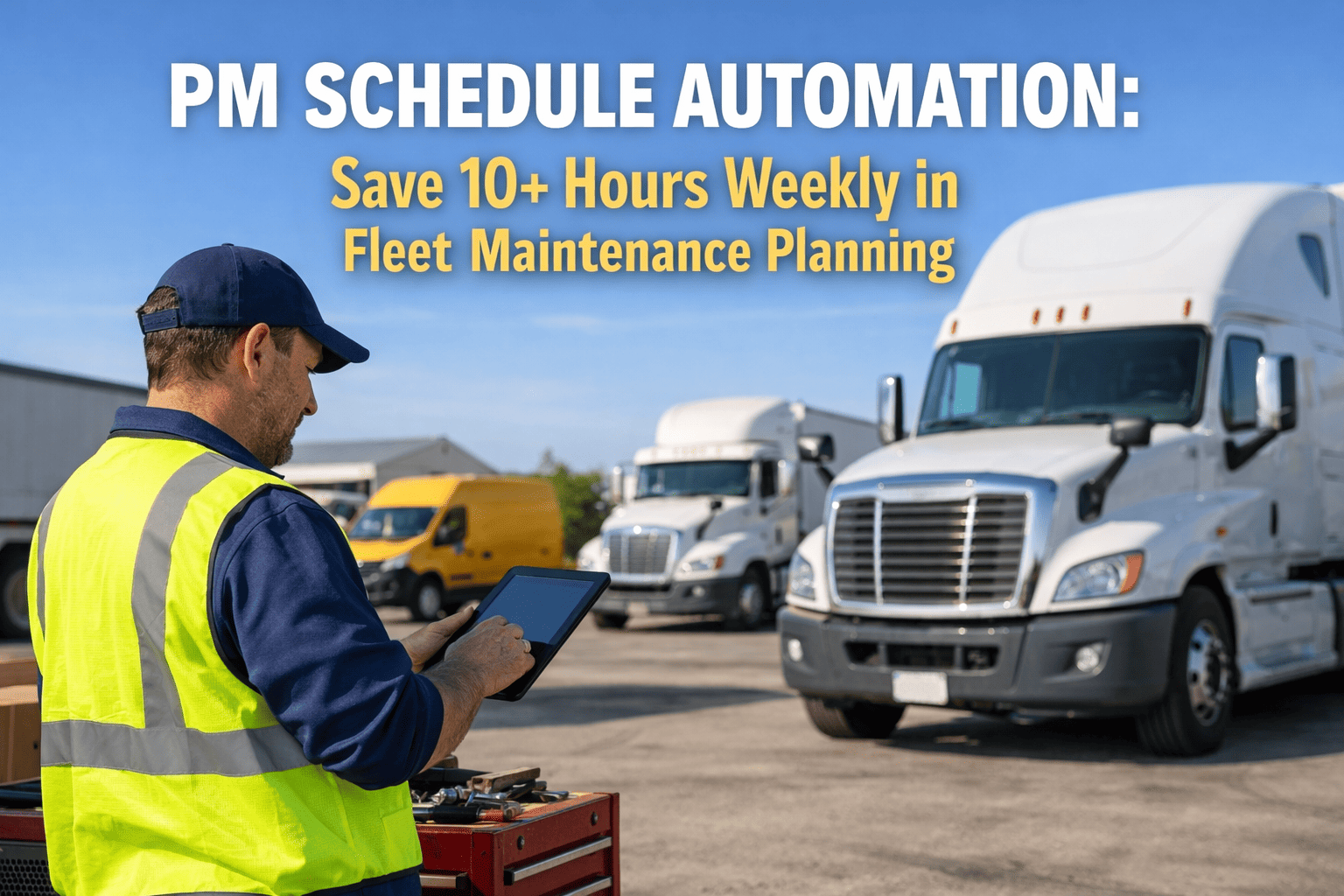
Most fleet maintenance managers spend 10–15 hours every week on tasks that should not require human attention at all — manually checking when each vehicle is due for an oil change, rebuilding PM schedules after a vehicle comes back late from a job, cross-referencing service histories to figure out which trucks need what next. This is not maintenance management. It is data entry. HVI's PM Schedule Automation replaces the entire manual planning cycle: engine hours and odometer data sync from your vehicles every 15 minutes, maintenance intervals trigger automatically when thresholds are hit, and work orders are created and assigned without anyone touching a spreadsheet. The result is 10+ hours of planning time recovered every single week — time your team reinvests in actually fixing vehicles, not scheduling them. Start your free HVI trial and have automated PM schedules running across your fleet today, or book a 30-minute demo to see PM automation in action on a live fleet.
Where the 10 hours a week actually go
Before automation, maintenance planning is a patchwork of spreadsheets, paper logs, calendar reminders, and institutional memory. Here is where fleet managers lose time — and why each task is far harder than it looks.
Manually reviewing each vehicle's last service date, current odometer, and engine hours to decide what is due next — done for every truck, every week.
When a vehicle comes in late or misses a service window, cascading updates to related intervals must be recalculated manually — tyres, brakes, filters all shift together.
Creating individual maintenance work orders, assigning them to technicians, and chasing completion confirmations — one by one, for every scheduled service event.
Recording completed services into vehicle history files — often across multiple formats — so records stay current for audits and insurance documentation.
Identifying vehicles that have exceeded their PM interval, locating them in the schedule, notifying drivers, and ensuring the service happens before a breakdown or compliance violation.
10+ hours every week that HVI's PM automation eliminates entirely. That is 500+ hours per year returned to your maintenance team.
How HVI PM automation works — from interval to completed work order
HVI's PM Schedule Automation connects your vehicles' real usage data — engine hours, odometer, fault codes — directly to your maintenance plan. No manual triggers, no spreadsheet updates, no missed intervals. Here is the complete automated chain.
Engine hours, odometer, and fault codes feed directly from your vehicles via telematics — no manual entry, accurate to within minutes of actual usage.
When a vehicle reaches its configured interval (e.g. every 10,000km or 250 engine hours), HVI fires the PM trigger instantly — no waiting for someone to notice.
A detailed work order is created automatically — vehicle ID, service type, current engine hours, odometer, last service reference, and priority level all pre-populated.
The work order routes to the designated technician with a push notification. The vehicle is flagged on the fleet dashboard as service-due. No phone calls, no chasing.
When the technician closes the work order, HVI resets the PM interval counter, updates the service history, and logs the compliance record — next trigger set automatically.
What you can automate — HVI PM interval types
HVI supports four trigger methods for PM automation — letting you match your maintenance program exactly to each vehicle type's real-world usage pattern. Most fleets use a combination of all four.
The most accurate trigger for heavy equipment and trucks that operate at varied speeds — measures actual engine run time rather than distance travelled, catching high-idle vehicles that rack up wear without mileage.
The standard trigger for highway and urban delivery fleets where distance driven is the primary wear indicator. HVI syncs real odometer readings from the ECU — no manual entry, no driver-estimated figures.
For time-sensitive services that deteriorate regardless of usage — brake fluid changes, coolant flushes, annual roadworthy checks, tyre age inspections. HVI calendar triggers fire automatically on the set date.
When a specific fault code fires from the ECU, HVI triggers a targeted maintenance response automatically — no waiting for the next scheduled service. Critical for catching developing faults before they cascade into failures.
Manual PM planning vs. HVI automation — full comparison
| Capability | Manual / Spreadsheet | HVI PM Automation |
|---|---|---|
| PM trigger accuracy | Calendar estimates — misses high-use vehicles | Triggered by actual ECU engine hours & odometer |
| Schedule maintenance time | 10+ hours of manual planning every week | Near-zero — system plans itself |
| Overdue service detection | Discovered by chance or complaint | Flagged on dashboard 30 days before due |
| Work order creation | Manual — written and assigned one by one | Auto-generated with full vehicle context |
| Service history update | Manual entry after completion — often delayed | Auto-updated on work order close |
| Multi-vehicle visibility | Separate spreadsheet or file per vehicle | Single dashboard — every vehicle, live status |
| Compliance documentation | Manual filing — gaps common | Auto-recorded, searchable, audit-ready |
Real impact: 50-truck fleet, manual vs. automated PM
| Manager planning time saved (10 hrs/wk × 50 weeks × $50/hr) | - $25,000/yr |
| Unplanned breakdowns avoided — 23% reduction × 15 events × $3,200 avg | - $11,000/yr |
| Over-servicing eliminated (calendar PM replaced by usage-based triggers) | - $9,400/yr |
| Compliance documentation cost avoided (audit prep, missing record penalties) | - $6,200/yr |
| Total estimated annual value — 50-truck fleet | $51,600+/yr |
Frequently asked questions about HVI PM automation
Stop spending 10 hours a week on maintenance schedules that can run themselves.
HVI's PM Schedule Automation turns your maintenance program into a self-managing system — usage-triggered, automatically documented, and compliant from day one. Start free today and have automated PM schedules running across your fleet before your next service interval fires.
No credit card required · PM schedules live same day · All vehicle types supported