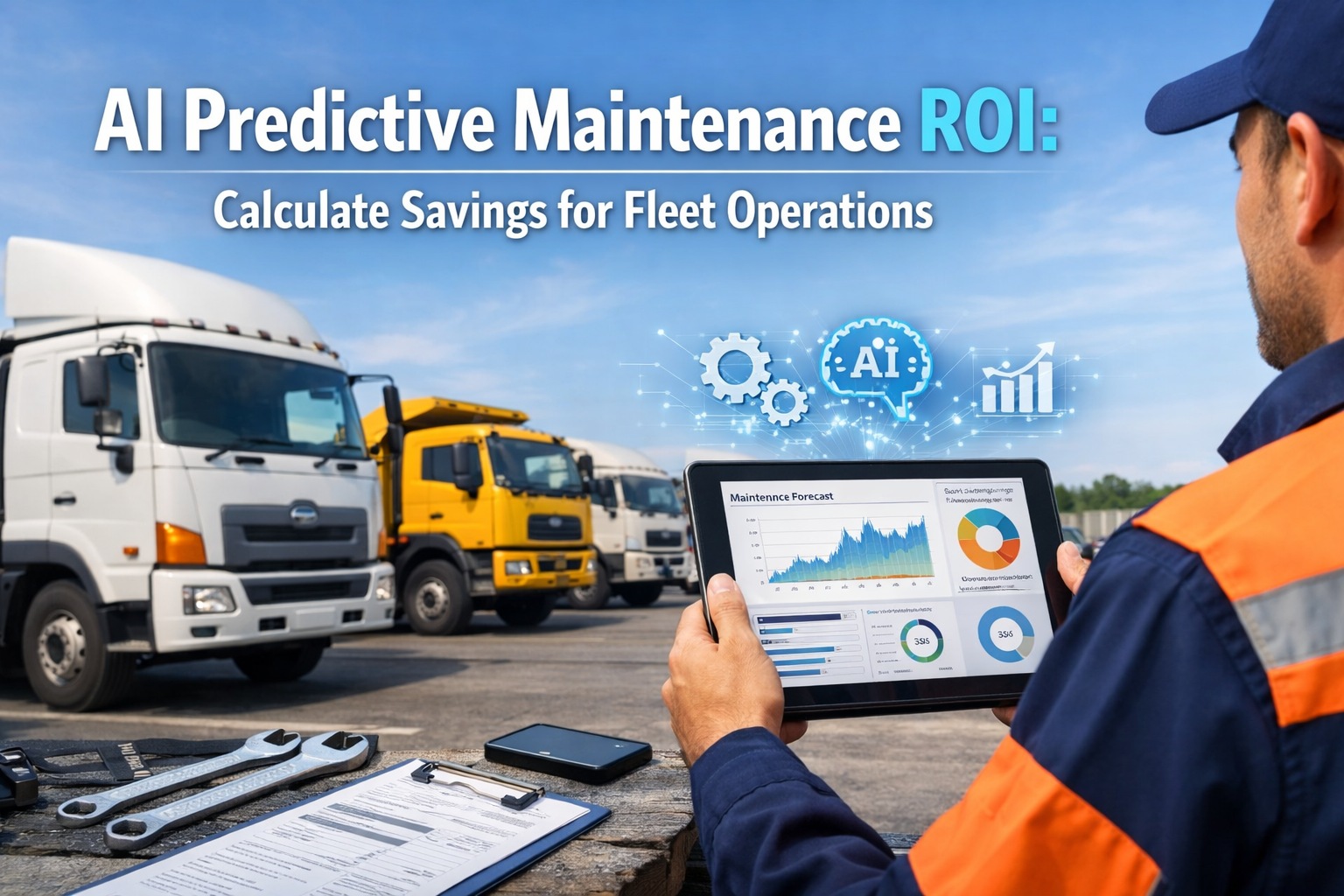
Every unplanned breakdown on a commercial fleet costs an average of $1,900 when you add direct repairs, lost productivity, driver downtime, and emergency towing together. Multiply that across a 50-vehicle fleet where unplanned maintenance consumes 11% of annual operating hours, and you are looking at six figures of avoidable cost every single year. The ROI case for AI predictive maintenance is not a projection anymore — it is a calculated number backed by documented deployments. Industry data consistently shows 200–500% annual returns, 10:1 to 30:1 ROI ratios within 12–18 months, and typical payback periods between 44 days and 6 months. A 35-vehicle construction fleet cut annual maintenance spend from $620K to $410K in the first year alone. A 250-vehicle logistics operation saved $1.8M combining 30% maintenance cost reduction with 45% downtime decrease. This guide shows you exactly where AI predictive maintenance savings come from, how to calculate the ROI for your specific fleet, and what realistic numbers to expect in your first 12 months. Start your free HVI trial and activate AI predictive maintenance with full ROI tracking today, or book a 30-minute ROI session where we'll model the numbers against your actual fleet data.
Where the savings actually come from — the 5 cost streams
Most ROI discussions talk about "maintenance savings" as if it were a single bucket. In reality, AI predictive maintenance delivers returns through five distinct, measurable cost streams — each with its own documented benchmark.
01
Unplanned breakdown reduction
35–45%
The largest single savings driver. AI catches 75% of failures 2–4 weeks before breakdown — letting repairs happen at shop rates instead of roadside emergency premiums (which run 3–5x higher).
~$760 direct + $1,140 indirect saved per prevented event
02
Maintenance cost optimization
25–35%
AI replaces parts based on actual condition rather than calendar intervals — eliminating both unnecessary work orders on healthy vehicles and late interventions on at-risk ones.
25–35% total maintenance spend reduction across the fleet
03
Downtime hours recovered
30–50%
Planned repairs fit into scheduled downtime windows; emergency breakdowns don't. Fleets running mature AI programs see 30–50% fewer unplanned downtime hours annually.
Revenue recovered from vehicles kept on the road
04
Asset lifespan extension
20–40%
Condition-based care extends component and full-vehicle life. Defers major capital replacements and improves trade-in residual values at end of useful life.
20–40% longer component lifespan across engine, transmission, brakes
05
Parts inventory optimization
18–30%
AI demand forecasting reduces emergency procurement premiums and cuts safety stock requirements — freeing working capital currently tied up in overstocked spare parts.
18–30% reduction in spare parts holding costs
These aren't projections — they're benchmark ranges from real fleet deployments.
Book a free HVI ROI session and we'll model the exact numbers against your current maintenance spend.
The real cost of reactive maintenance — what you're paying right now
Before calculating AI ROI, fleet managers need to quantify what reactive maintenance actually costs today. These are the 2026 benchmarks for a typical 50-vehicle commercial fleet.
Direct breakdown repair costs
18 breakdowns/yr × $760 avg direct repair
$13,680
Lost productivity & driver downtime
18 breakdowns × $1,140 avg indirect cost
$20,520
Emergency towing & roadside service
12 emergency tows × $850 avg
$10,200
Reactive repair premium (3–5x planned)
$60K planned × 2x premium on reactive portion
$72,000
Over-replacement of healthy parts
Calendar-based PM without condition check
$18,400
Excess parts inventory holding
26% excess stock × $55K inventory value
$14,300
Revenue lost during unplanned downtime
11% of operational hours × avg revenue/hr
$245,000
Total annual exposure to reactive maintenance
Addressable by AI predictive maintenance
$394,100
Fleet-size ROI benchmarks — what to expect year one
ROI scales with fleet size and current reactive maintenance intensity. Here are conservative year-one benchmarks across three fleet size bands, based on published deployment data.
10–25 vehicles
Small fleet
$75K–$150K
Year-one savings
3–5 months
Typical payback
150–250%
Year-one ROI
Smaller fleets see fastest relative impact per vehicle — a single prevented major failure can recover the annual platform cost several times over. Documented: a 35-vehicle construction fleet cut maintenance spend from $620K to $410K in year one.
Most common deployment
25–100 vehicles
Mid-size fleet
$200K–$500K
Year-one savings
2–4 months
Typical payback
250–400%
Year-one ROI
The sweet spot for AI predictive maintenance ROI. Enough fleet volume for strong ML model training, high enough maintenance spend for measurable savings, and operationally simple enough to deploy in weeks.
100+ vehicles
Large fleet
$500K–$2M+
Year-one savings
1–3 months
Typical payback
400–500%+
Year-one ROI
Largest absolute savings thanks to compound fleet-wide pattern detection. Documented: a 250-vehicle logistics operation achieved $1.8M annual savings combining 30% maintenance reduction with 45% downtime decrease.
The 7-step ROI calculation — build your own number
Use this simple step-by-step to calculate your fleet's AI predictive maintenance ROI before signing any vendor contract. Every number comes from data you already have or can pull from your existing CMMS.
01
Count last year's unplanned breakdowns
Pull breakdown event logs from your CMMS, telematics, or work order system. Count every event where a vehicle failed outside scheduled maintenance — including roadside, shop emergency repairs, and tow events.
Input: Total unplanned breakdown events in last 12 months
02
Multiply by $1,900 full-cost average
Industry average per unplanned breakdown: $760 direct + $1,140 indirect (productivity, driver time, towing, rental). This gives your baseline unplanned breakdown cost.
Breakdowns × $1,900 = Annual breakdown cost (A)
03
Pull your total annual maintenance spend
Include parts, labor, outside shop work, tire replacement, fluid changes, and emergency repairs. This is your total reactive + preventive maintenance budget.
Input: Total maintenance spend in last 12 months (B)
04
Apply the 40% prevention rate to A
AI predictive maintenance prevents approximately 40% of unplanned breakdowns on average (range: 35–45%). This is your breakdown-avoidance savings.
A × 0.40 = Breakdown-avoidance savings (C)
05
Apply the 25% optimization rate to B
AI reduces overall maintenance spend by 25–35% through condition-based service, eliminating unnecessary calendar PMs, and reducing reactive premiums. Use 25% for a conservative estimate.
B × 0.25 = Maintenance optimization savings (D)
06
Subtract the annual AI platform cost
Typical mid-tier AI platform pricing: $25/vehicle/month = $300/vehicle/year. For 50 vehicles, that is $15,000 annual platform cost.
Vehicles × $300 = Annual platform cost (E)
07
Calculate your net ROI
Net savings = C + D – E. ROI percentage = ((C + D – E) / E) × 100. Any result above 150% year-one ROI is a strong business case; most fleets land between 200% and 500%.
Net ROI % = ((C + D − E) / E) × 100
A · Baseline breakdown cost (18 events × $1,900)
$34,200
B · Annual maintenance spend
$400,000
C · Breakdown-avoidance savings (A × 40%)
$13,680
D · Maintenance optimization savings (B × 25%)
$100,000
E · Annual HVI platform cost (50 vehicles × $300)
−$15,000
Net year-one savings
$98,680
Year-one ROI percentage
658%
Want this calculation done against your actual numbers?
Start your free HVI trial — the platform models projected ROI from your first connected vehicles within 48 hours.
The payback timeline — when returns actually show up
Fleets don't wait 12 months to see AI predictive maintenance returns. Here is the realistic timeline of when each savings stream becomes measurable on the P&L.
Day 0
Connection & calibration
HVI connects to existing telematics. First baseline risk alerts within 72 hours. Fleet-wide pattern models active from day one using industry training data.
Platform spend: $1,250/month (50 vehicles)
Days 14–30
First prevented failures
AI flags first component risks on actual fleet vehicles. Most fleets prevent their first breakdown within 30 days — typically recovering the full first year platform cost.
First $5K–$15K avoided cost event
Days 30–90
Payback achieved
Full fleet-specific baselines complete. Prediction accuracy reaches 90%+. Cumulative prevented events exceed annual platform cost — fleets hit ROI break-even.
Break-even · 100% platform cost recovered
Months 4–9
Compound savings emerge
Maintenance cost optimization shows on budget reports. Parts inventory normalization reduces holding costs. Downtime recovery boosts fleet revenue.
2x–4x ROI on platform spend
Year 1+
Full program ROI
All five savings streams active. Fleet-specific AI model at peak accuracy. Asset lifespan extension begins deferring capital replacements. Year-two ROI typically 30–40% higher than year one.
200–500% annual ROI documented
Real prevented failures — what a single AI catch saves you
ROI calculations are strongest when you can point to actual prevented breakdowns. Here are documented examples of how much one AI catch saves across different component categories — giving you concrete evidence to anchor your business case.
Transmission rebuild prevented
AI signal: bearing wear + fluid temp deviation, flagged 28 days early
Avoided: $18,000
Preventive repair: $2,400
Net savings on one catch: $15,600
Engine overheat failure prevented
AI signal: coolant temp trending 12°F above baseline, flagged 19 days early
Avoided: $12,500
Preventive repair: $850
Net savings on one catch: $11,650
Brake system failure prevented
AI signal: pad wear rate 40% above baseline + deceleration anomalies
Avoided: $8,200
Preventive repair: $1,100
Net savings on one catch: $7,100
Alternator failure prevented
AI signal: voltage instability + charging cycle deviation, flagged 22 days early
Avoided: $4,800
Preventive repair: $650
Net savings on one catch: $4,150
Turbocharger failure prevented
AI signal: boost pressure variance + exhaust temp spike, flagged 31 days early
Avoided: $9,600
Preventive repair: $1,350
Net savings on one catch: $8,250
Wheel bearing seizure prevented
AI signal: vibration pattern + temperature rise, flagged 14 days early
Avoided: $6,400
Preventive repair: $520
Net savings on one catch: $5,880
Reality check: Across the six prevented failures above, total net savings equal $52,630 — more than 3 years of HVI platform cost for a 50-vehicle fleet. A single fleet catching just 6 major component failures in year one covers the entire platform investment several times over.
Frequently asked questions — AI predictive maintenance ROI
QHow quickly will we see positive ROI after deploying HVI?
Most fleets hit ROI break-even within 3–6 months, with many reaching full platform-cost recovery in the first quarter. The first prevented breakdown usually covers several months of platform cost alone — and AI typically flags its first actionable risk within 30 days of connection. Industry benchmark across commercial fleet deployments is a 44-day average payback period. For high-utilization or higher-maintenance-spend fleets, that window compresses further.
Start a free HVI trial and see your first baseline risk alerts within 72 hours.
QWhat's a realistic ROI range for year one?
Documented year-one ROI for AI predictive maintenance deployments falls between 150% and 500%, with the typical range being 200–400%. A 35-vehicle construction fleet cut maintenance spend from $620K to $410K in year one ($210K saved, roughly 14x the platform cost). A 250-vehicle logistics operation achieved $1.8M in annual savings. McKinsey research documents 10:1 to 30:1 ROI ratios within 12–18 months for well-implemented programs. Smaller fleets typically see higher percentage ROI; larger fleets see higher absolute dollar savings.
QWhat's the minimum fleet size to justify AI predictive maintenance?
The math works starting at 10 vehicles and becomes compelling at 25+. At 10 vehicles and $25/vehicle/month mid-tier pricing, platform cost is $3,000/year — easily justified by preventing a single major breakdown. For fleets under 10 vehicles, most AI platforms offer free tiers to prove value before paying. At 50+ vehicles, the platform cost typically returns 10–20x in documented annual savings. Fleet size below 10 can still benefit, but ROI math becomes less automatic and depends more on individual vehicle utilization and maintenance intensity.
Book a demo to model your specific fleet size.
QDo we need new hardware to generate the ROI numbers above?
No. Over 90% of commercial vehicles manufactured in 2026 ship with factory-installed telematics, and HVI integrates with major providers (Geotab, Samsara, Verizon Connect, Motive, OEM telematics) via standard APIs. For older vehicles without telematics, a $50–$150 OBD-II dongle per vehicle provides the necessary data connectivity. The ROI numbers in this guide assume standard hardware integration — no rip-and-replace required. Any vendor demanding their own hardware to deliver AI predictive maintenance is selling infrastructure lock-in, not software ROI.
QHow does ROI change between year one and year two?
Year-two ROI typically runs 30–40% higher than year one for three reasons: (1) AI models have accumulated 12+ months of fleet-specific failure history and reach peak prediction accuracy; (2) asset lifespan extension benefits begin materializing as components run longer before replacement; (3) parts inventory normalization frees working capital as safety-stock calibration matures. Many fleets that start at 250% ROI in year one reach 350–400% by year two without changing platform cost at all. The AI improves with every mile, every repair, and every sensor reading.
Stop losing money to breakdowns you could have predicted.
HVI's AI predictive maintenance platform connects to your existing telematics, starts producing failure predictions within 72 hours, and delivers documented 200–500% year-one ROI across commercial fleets. The breakdown you prevent next month pays for the platform for a year. Every month you wait, you are paying the reactive maintenance tax instead.
No credit card required · Full ROI model with your own data · First predictions within 72 hours