Heavy truck inspection compliance in 2026 runs on three parallel tracks that every fleet manager has to track simultaneously: daily driver inspections under 49 CFR § 392.7 and DVIRs under § 396.11, a mandatory annual periodic inspection every 12 months under § 396.17, and random roadside CVSA inspections that can happen any day, any hour, anywhere on the route. Miss a step on any one of them and the consequences escalate quickly — fines up to $19,277 per out-of-service violation, 12 CSA points per annual inspection failure, immediate driver disqualification at the roadside, and audit cascades that only 7% of carriers survive without at least one violation. 2026 brought significant rule changes on top of this baseline: the FMCSA Safety Measurement System overhaul went into full effect in February, Vehicle Maintenance BASICs split into "standard" and "Driver Observed" categories, CVSA's annual Roadcheck is targeting cargo securement and ELD tampering, and FMCSA officially finalized electronic DVIR compliance — removing any remaining ambiguity about digital inspection tools. This guide breaks down every heavy truck inspection requirement that applies in 2026, what's changed, and how to build a compliance program that actually passes audits. Book a 30-minute demo to see how HVI handles every inspection type in one unified workflow.
The 3 inspection types every heavy truck fleet must pass
Heavy truck inspection compliance is not a single check — it is three separate regulated inspection processes, each with its own regulation, frequency, and documentation requirement. A fleet passing annual inspections but failing DVIRs is non-compliant. So is one passing DVIRs but missing the periodic. Here are the three inspection pillars.
Driver walk-around at start of each workday, defect reporting in written/electronic form at day-end. Covers brakes, lights, tires, coupling, wheels/rims, steering, mirrors, horn, windshield wipers, emergency equipment.
Full periodic inspection once every 12 months performed by a qualified inspector against Appendix G standards. Decal or report must be on the vehicle at all times of operation. Roadside Level I does NOT satisfy this.
Random or targeted inspection conducted by CVSA-certified enforcement officer. Six levels (I–VI) covering driver, vehicle, hazmat, and cargo. Approximately 4 million conducted annually across North America.
Which vehicles need annual DOT inspection in 2026
Not every vehicle on the road falls under the annual inspection mandate. Here's the exact GVWR and use-case threshold matrix that determines applicability.
The 6 CVSA roadside inspection levels
Every roadside inspection in North America is classified into one of six CVSA levels. Understanding the scope of each helps drivers know what to expect and helps fleet managers build inspection-ready processes.
Most thorough inspection. Full driver credentials review + walk-around + under-vehicle inspection of brakes, suspension, exhaust, frame. Takes 45–60 minutes.
Driver credentials + walk-around of visible vehicle components. No under-vehicle component check. Takes 20–30 minutes. Most common level.
Driver documents only — CDL, medical certificate, HOS logs, drug/alcohol records. No vehicle component check. Common during HOS enforcement campaigns.
One-time studies or targeted enforcement — Brake Safety Day, emissions checks, specific component studies. Usually advertised in advance.
Full vehicle inspection performed without driver present — typically at carrier facility, shop, or inspection terminal. Passing vehicles can receive CVSA decal.
Required for vehicles transporting transuranic waste or highway-route-controlled quantities of radioactive material. Most rigorous of all levels.
What changed in 2026 — the regulatory updates fleets must know
Heavy truck inspection compliance did not stand still in 2026. Here are the five changes that directly affect how fleets document, report, and score inspections this year.
The FMCSA Safety Measurement System overhaul took full effect February 2026. Past violations age out of your score after 12 months — half the prior window — accelerating how quickly a compliant fleet's score recovers from past issues.
Out-of-service violations receive a severity weight of 2; all other violations get weight of 1. The old 1–10 granular scale is retired. Over 2,000 individual violation codes consolidated into ~100 groups, with multiple violations in the same group counted as a single infraction.
Violations a driver should reasonably catch during walk-around (lights, tires, coupling, visible leaks) now score in a separate "Vehicle Maintenance: Driver Observed" BASIC. Pre-trip inspection quality is now a direct CSA score factor.
FMCSA officially finalized electronic DVIR creation, maintenance, and signature — removing any remaining paper-based ambiguity. Digital inspection apps are now unambiguously compliant under 49 CFR § 390.32. Spare fuse and liquid-burning flare requirements also removed from required emergency equipment.
The 72-hour annual International Roadcheck shifts focus to cargo securement on the vehicle side and ELD tampering on the driver side — alongside comprehensive Level I inspections. Expect heightened enforcement on tie-down counts, working load limits, and ELD data integrity.
The heavy truck inspection checklist — every component on the list
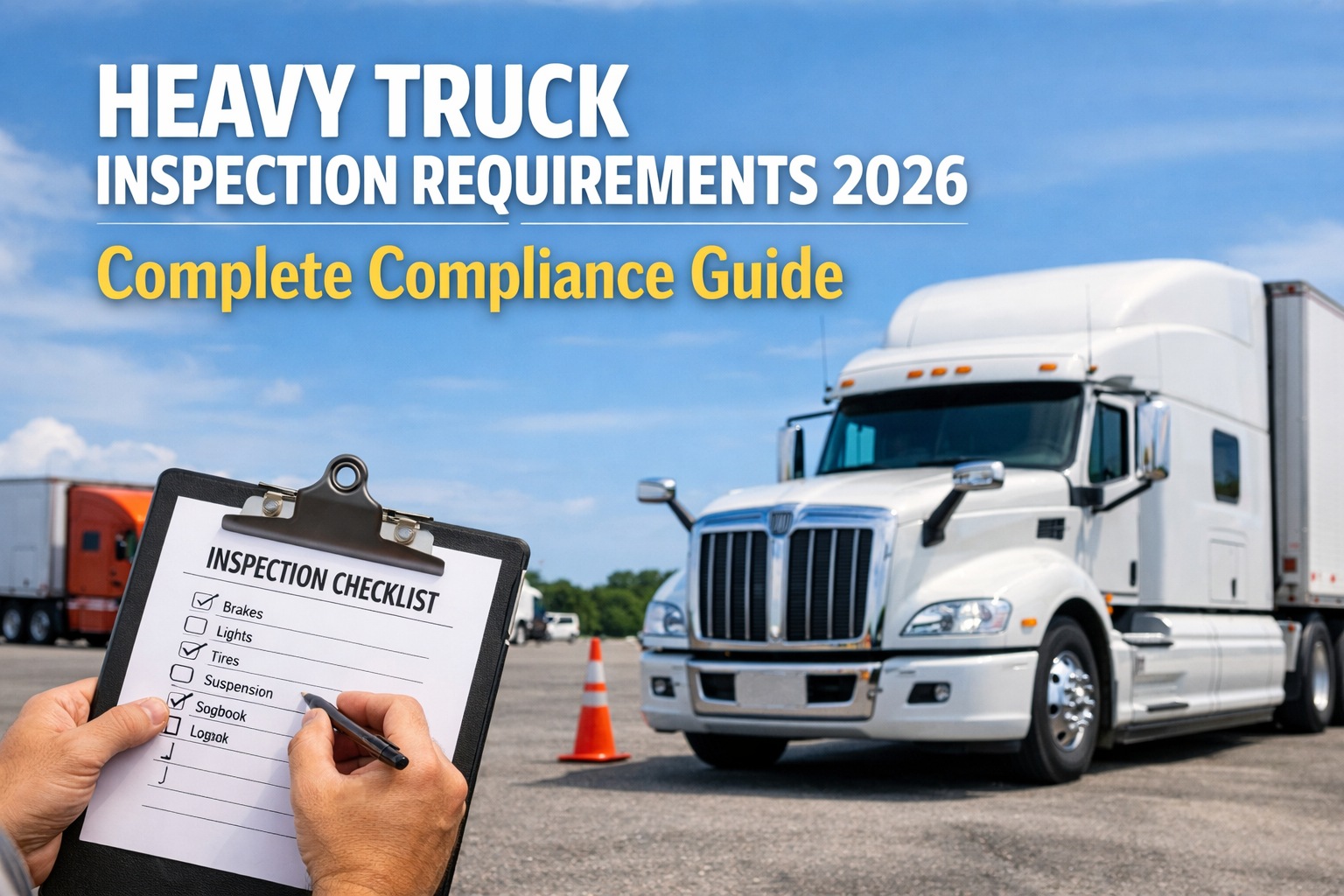
Whether the inspection is pre-trip, annual, or CVSA Level I, the same component categories get evaluated. Here is the complete checklist every heavy truck inspection covers.
- Service brake adjustment and stroke
- Air lines, chambers, and valves
- Air system leak test under 100 PSI
- Parking brake holding test
- ABS warning lamp function
- Trailer brake hand valve operation
- Steer tire tread depth (4/32" minimum)
- Drive/trailer tread depth (2/32" minimum)
- Sidewall condition, no exposed cord or belt
- Wheel lug nut torque & all present
- Rim cracks, bends, or fatigue damage
- Proper load rating vs vehicle GVWR
- Headlights, turn signals, brake lamps
- Clearance and marker lamps (all positions)
- Reflectors and reflective tape
- Trailer tail, stop, and turn lamps
- ABS warning function
- Battery condition & mounting
- Steering wheel lash (max 10° for most)
- Steering linkage & kingpin condition
- Leaf spring assembly integrity
- Shock absorbers & bushings
- Air bag suspension leaks
- U-bolts and center pins secure
- Fifth wheel mounting & cracks
- Kingpin and locking jaws
- Glad hands & air line connections
- Electrical pigtail condition
- Pintle hooks & safety chains
- Lower coupler bolt torque
- Frame cracks, bends, or sagging
- Cross-member integrity
- Exhaust leaks (post-DPF inspection point)
- Fuel tank mounting & strap condition
- DEF system status & tank integrity
- Cab mounts & body attachment
- Windshield cracks and wiper function
- All mirrors present and adjusted
- Horn, defroster, and heater operation
- Seat belts functional for all positions
- Fire extinguisher (working, charged)
- Emergency reflective triangles (3 required)
- Minimum tie-down count per load type
- Working load limits sufficient for cargo weight
- Tie-down anchor point integrity
- Edge protectors on load-rated straps
- Load blocking and bracing secure
- No leaking, spilling, blowing, or falling risk
Penalties & consequences — what violations actually cost
Frequently asked questions — heavy truck inspection 2026
Run every heavy truck inspection requirement on one platform.
HVI handles every inspection type a 2026 heavy truck fleet is required to perform — digital pre-trip and post-trip DVIRs under § 392.7 and § 396.11, annual periodic inspections under § 396.17, CVSA-ready documentation for any roadside level, and automated tracking of every expiration and every defect-to-repair cycle. No paper binders. No missed expirations. No audits that require 48 hours of filing cabinet excavation to answer a single FMCSA request.
No credit card required · Full compliance workflow live in days · All three inspection types in one platform