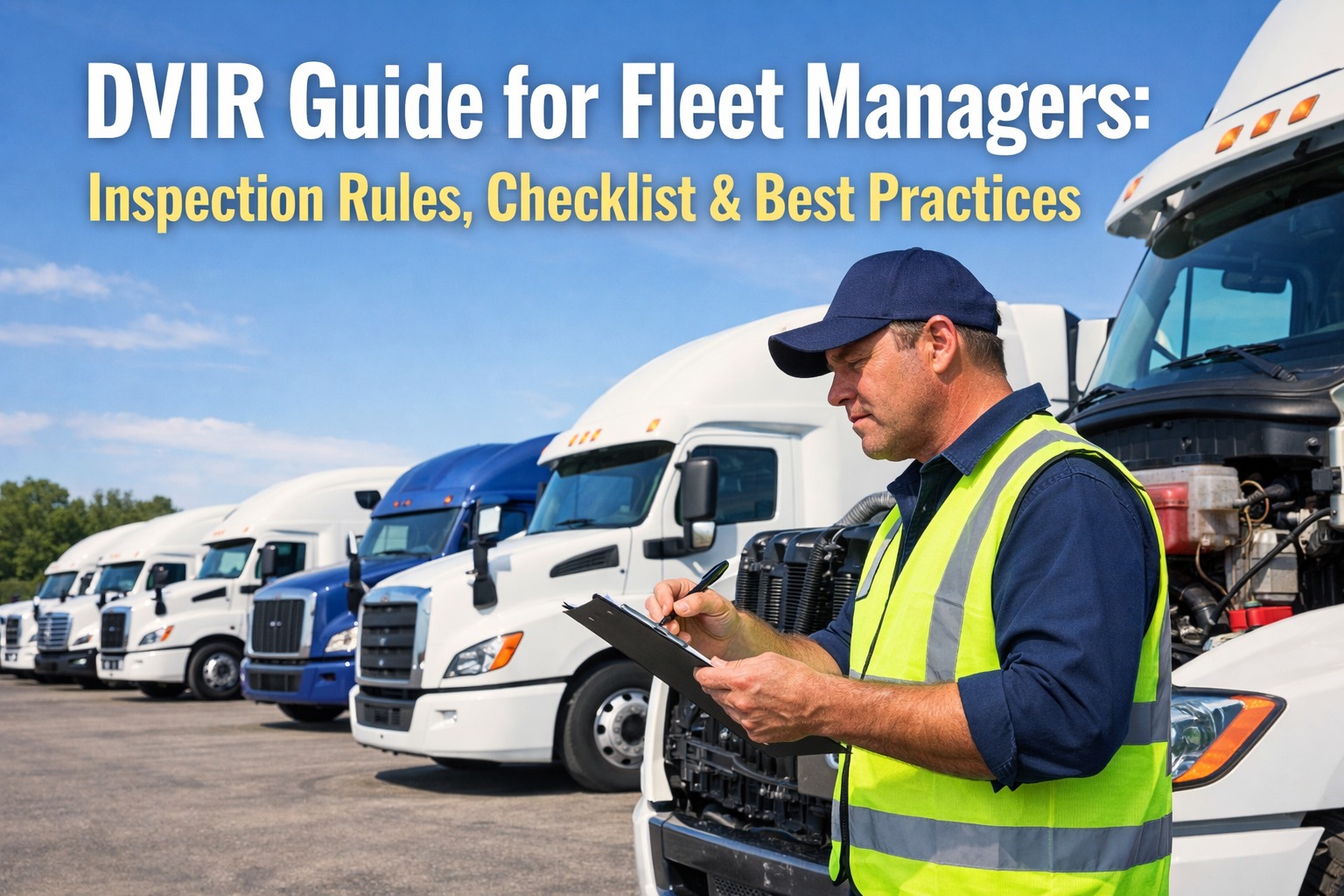
A Driver Vehicle Inspection Report (DVIR) is a federally mandated document under 49 CFR § 396.11 that records any safety defects or deficiencies found on a commercial motor vehicle at the end of a driver's workday.For fleet managers, the DVIR is more than a driver form — it is the backbone of your compliance program, the document auditors examine in 89% of compliance reviews, and the chain of custody that protects your operation when a defect turns into a lawsuit. On February 19, 2026, FMCSA published the final rule (Docket FMCSA-2025-0115, effective March 23, 2026) explicitly authorizing electronic DVIRs — removing any remaining ambiguity about digital inspection authority and making 2026 the cleanest regulatory moment in a decade to professionalize your DVIR program. Only 7% of motor carriers pass a focused compliance review without a single DVIR violation; the remaining 93% accumulate fines that range from $1,270 per day up to $19,277 per occurrence, compound into CSA score penalties, drive 10–30% insurance premium hikes, and cost contracts with shippers who screen CSA scores before award. This guide is written specifically for fleet managers: what you need to build, monitor, and defend a DVIR program that keeps your fleet in the 7%. Start your free HVI trial to run your DVIR program on a platform built for fleet managers, or book a 30-minute demo to see the full fleet-wide compliance dashboard.
The fleet manager's 4-pillar DVIR compliance program
Running a DVIR program is not the same as completing a DVIR. Fleet managers are responsible for four compliance pillars that together determine whether your fleet passes audits, survives litigation, and keeps CSA scores under intervention thresholds.
Written DVIR policy, onboarding training for every driver, refresher training annually, documented sign-off that each driver understands the policy. This is the first document auditors ask for.
Real-time visibility into whether DVIRs are actually being completed per shift, which drivers are rubber-stamping, which vehicles never report defects. Paper systems make this impossible.
Ensuring every defect flows into a work order, every repair gets certified on the original DVIR, and no vehicle dispatches without the three-signature chain complete. Broken chains are the #1 audit finding.
Retention of original DVIR + repair cert + driver review cert for minimum 90 days. In 2026, offsite audits have increased 400% with as little as 48 hours notice to produce digital records.
The 2026 DVIR penalty schedule every fleet manager must know
FMCSA updated civil penalty amounts in December 2024 for enforcement throughout 2025-2026. A single audit of a 50-truck fleet with systemic DVIR failures can easily produce $63,500+ in fines from one visit. Here is the current schedule every fleet manager should post above their desk.
Per-day penalty for any workday a DVIR should have been filed but wasn't. Compounds rapidly across drivers and dates during audits.
Marking components "OK" without actual inspection, or backdating reports. Often discovered via driver interviews during audits.
Sending a vehicle out before repair certification is complete. One of the most damaging violations in litigation exposure.
Operating a vehicle after an inspector placed it out-of-service without repair verification. The single highest-value individual violation.
Typical premium hike at renewal for carriers whose Vehicle Maintenance BASIC crosses intervention thresholds — often driven by DVIR gaps.
Share of FMCSA compliance reviews that include DVIR documentation examination. DVIR audit prep is not optional — it is near-certain.
Which vehicles and drivers fall under DVIR rules?
Applying a blanket DVIR policy across all vehicles without understanding the regulatory distinctions is one of the most common compliance mistakes. Here is the exact applicability matrix for 2026.
Paper DVIR vs digital DVIR — the fleet manager's cost comparison
The FMCSA March 23, 2026 eDVIR final rule settles the regulatory question: electronic DVIRs are explicitly authorized in § 396.11 and § 396.13. The operational question — paper vs digital — was settled years ago by every fleet that ran the numbers. Here is what the comparison looks like on a 50-vehicle fleet.
How to evaluate DVIR software — the fleet manager's scorecard
With the eDVIR final rule now in effect, the DVIR software market has matured with dozens of options. Here are the 8 capabilities that separate real compliance platforms from features-masquerading-as-compliance. Use this scorecard when evaluating any DVIR vendor.
Platform enforces § 396.11 and § 396.13 chain of custody: driver report, mechanic certification, next-driver acknowledgment. Any skipped signature blocks dispatch.
All three signatures captured with timestamps per § 390.32, with identity verification built in. Not just a digital form — legally defensible signatures.
Guided walk-around covering all § 396.11(a)(1) categories: brakes, parking brake, steering, lighting, tires, horn, wipers, mirrors, coupling, wheels/rims, emergency equipment.
Camera integration for defect documentation. Geotagged and timestamped photos prove inspection occurred and establish defect severity for insurance and litigation.
When a driver reports a defect, system auto-creates a work order and routes it to the right technician with photo, severity, and vehicle details — zero re-entry required.
Real-time visibility showing which drivers completed DVIRs this shift, which vehicles never report defects (rubber-stamp indicator), and where the three-signature chain broke.
Automatic retention that exceeds the 90-day federal minimum. Instant audit retrieval by date range, vehicle, or driver — the 48-hour audit response window becomes trivial.
Vehicle Maintenance and Driver Observed BASIC visibility tied to DVIR program outcomes. Lets fleet managers connect inspection quality to CSA scores in real time.
Frequently asked questions — DVIR for fleet managers
Build a DVIR program that passes audits and protects your fleet.
HVI was purpose-built for fleet managers running DVIR programs at scale. Every feature — enforced three-signature chain, 11-component guided checklists, fleet-wide dashboards, maintenance work order integration, CSA score tracking, and indefinite audit-ready retention — is designed to keep your fleet in the 7% that passes compliance reviews clean.
No credit card required · Fleet-wide dashboard live in minutes · Every must-have capability built-in