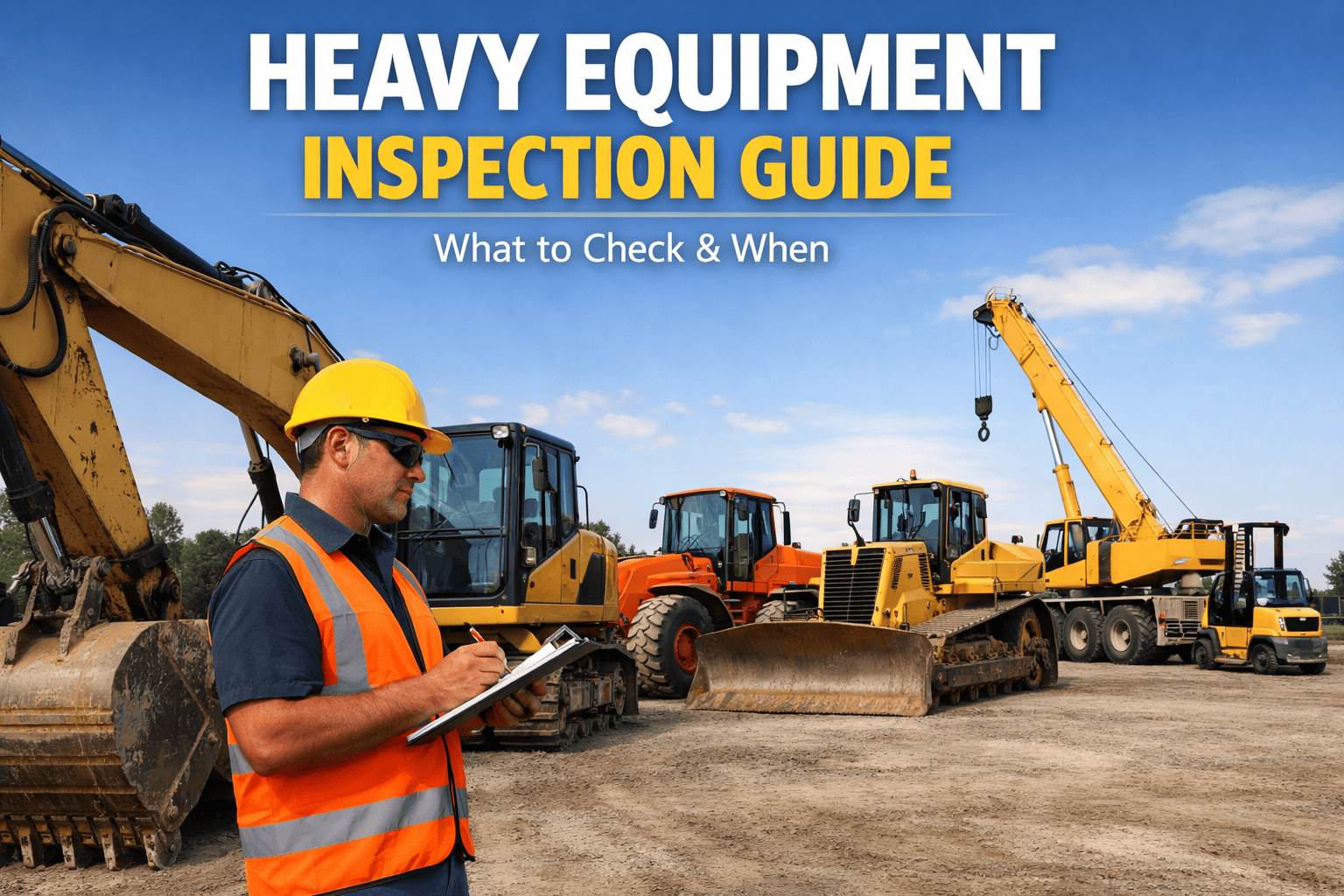
Construction equipment failures cause 1 in 5 workplace fatalities in the industry — and 90% of those failures are preventable with proper inspections. A burst hydraulic hose does not just stop one machine. It can shut down an entire site, delay concrete pours, hold up crews, and cost $2,000 or more per day in unplanned downtime. OSHA requires pre-shift inspections for all heavy equipment under 29 CFR 1926.20 and 1926.600, performed by a "competent person." Yet the most common finding on construction safety audits is not a missing guard rail — it is inadequate equipment inspection documentation. OSHA fines start at $16,550 per serious violation and reach $165,514 for willful or repeated offenses. Beyond fines, equipment failures that cause injuries lead to criminal liability, work stoppages costing $25,000-$75,000 per day, and insurance premium increases of 30-50%. This guide covers what to inspect on excavators, loaders, dozers, cranes, and forklifts — the pre-operation walk-around, the critical safety systems, the PM inspection intervals, and how HVI's digital inspection platform catches 35% more defects than paper while completing inspections 60% faster. Book a demo to see equipment-specific templates, or start your free trial.
Pre-operation checklists for excavators, loaders, dozers, cranes, and forklifts — plus PM inspection intervals, common failure modes, and how to document everything digitally.
The Universal Pre-Operation Walk-Around
Before any heavy equipment starts, every operator must complete a 360-degree walk-around. These checks apply to all equipment types — excavators, loaders, dozers, cranes, and forklifts. Complete this before entering the cab.
Engine oil, hydraulic fluid, coolant, transmission fluid, fuel level. Check with engine cold, machine level. Look for puddles, drips, and active leaks underneath.
ROPS/FOPS structure unmodified and undamaged. Seatbelt functional. Fire extinguisher present and charged. First aid kit accessible. Horn and backup alarm operational.
Tire inflation and tread depth (wheeled). Track tension, shoe condition, roller wear (tracked). Check for cracks, missing bolts, foreign objects, and uneven wear.
Hoses: cracking, bulging, chafing, pinhole leaks. Fittings: seepage or looseness. Cylinder rods: scoring, pitting, seal leaks. 45% of major equipment failures originate here.
Windows and mirrors clean and intact. All gauges and warning lights functional. Controls respond correctly. Seat adjustment and lock. Entry/exit steps and handrails secure.
Boom, stick, bucket, blade, forks — check for cracks, bends, weld failures. Pins and bushings: excessive play. Quick couplers: locked and verified. Cutting edges: worn but serviceable.
Equipment-Specific Inspection Points
Beyond the universal walk-around, each equipment type has critical inspection points unique to its design and failure modes. These are the items that generic checklists miss.
Swing bearing play and bolt torque. Boom-stick pin play. Bucket teeth condition and retention pins. Track tension and shoe wear. Hydraulic cylinder rod scoring. Quick coupler lock verification. Counterweight mounting bolts.
Articulation joint pins and bearings. Bucket cutting edge and bolt-on teeth. Tire condition and lug nut torque. Steering cylinder rod condition. Loader arm pin bushings. Transmission shift quality. Parking brake holding on grade.
Blade cutting edge wear and mounting bolts. Track tension and shoe condition. Final drive oil level and leaks. Undercarriage roller and idler wear. Ripper shank and tip condition. Steering clutch response. Blade lift cylinder condition.
Wire rope condition (broken wires, kinking, crushing, corrosion). Boom structural integrity. Load moment indicator (LMI) calibration. Anti-two-block device. Outrigger pads and pins. Hook latch and throat wear. Monthly + annual inspections required per 29 CFR 1926.1412.
Mast chain tension and lubrication. Fork condition (cracks, bends, heel thickness). Overhead guard integrity. Load backrest. Hydraulic tilt cylinder. Propane connections and tank mount (if LPG). 29 CFR 1910.178 requires daily checks before each shift.
Inspection Frequency: What to Check & When
Top 5 Failure Modes Inspections Catch
45% of all major equipment failures. Cracking hoses, weeping fittings, scored cylinder rods. A burst hose under pressure causes uncontrolled boom drop and fluid injection injuries. Cost per failure: $2,000-$35,000.
Service brakes, parking brakes, and steering cylinders. A machine that cannot stop or steer on grade is an immediate danger. Pre-shift brake test on grade catches degradation before catastrophic loss.
Boom, stick, frame, and ROPS/FOPS cracking. Often invisible until catastrophic failure. Weld joints and high-stress points require visual and sometimes NDT inspection. Never weld on ROPS without re-certification.
Track shoe wear, roller and idler degradation, sprocket tooth wear. Undercarriage is 50% of tracked machine maintenance cost. Measuring wear at 250-hour intervals prevents $35,000-$85,000 replacement surprises.
Dead backup alarms, non-functional lights, faulty interlocks, disabled load moment indicators. These are the defects that cause struck-by fatalities — 75% of which involve heavy equipment.
How HVI Digitizes Equipment Inspections
Pre-built checklists for excavators, loaders, dozers, cranes, forklifts, and dump trucks. Each covers OSHA-required points for that equipment type. Fully customizable — add company-specific items, required photo points, and OEM-specific checks.
Operator flags defect with photo → maintenance notified instantly → work order auto-generated → mechanic documents repair → digital sign-off → machine returned to service. Complete chain in one linked record. No paper gaps.
Every inspection stored with timestamp, GPS location, operator name, and photo evidence. Search by equipment ID, date, site, or defect type. Produce records in seconds when OSHA shows up. Digital systems achieve 96% audit pass rates vs 73% for paper.
Every inspection works without internet — built for construction sites, mine pits, and remote operations. GPS and timestamps captured at event time, not sync time. Multi-site dashboard shows compliance status across all jobsites from one screen.
Frequently Asked Questions
OSHA requires pre-shift inspections before each use under 29 CFR 1926.20 and 1926.600. Cranes have additional monthly and annual inspection requirements under 29 CFR 1926.1412. Beyond daily checks, PM inspections should follow OEM intervals — typically at 250, 500, 1,000, and 2,000 operating hours. HVI automates scheduling based on your equipment's actual hours. Start your free trial.
OSHA requires a "competent person" for daily pre-shift checks — someone who can identify hazards and has authority to take corrective action. Typically the trained equipment operator. For comprehensive PM and annual inspections, a "qualified person" with documented training is required. Crane inspections specifically require qualified persons per 29 CFR 1926.1412. Training records must be retained and verifiable during audits.
As of 2025, OSHA can fine up to $16,550 per serious violation and up to $165,514 for willful or repeated violations. Missing or inadequate inspection documentation is the most common citation on construction equipment audits. Beyond fines, equipment failures causing injuries lead to criminal liability, work stoppages costing $25,000-$75,000 per day, and insurance premium increases of 30-50%. Book a demo to see how digital records protect your operation.
Yes — OSHA's 2025-2026 enforcement priorities actively favor digital documentation. Digital systems provide timestamped, geotagged records instantly accessible during audits. Paper-based systems achieve only 73% audit pass rates compared to 96% for digital. Electronic records are fully compliant under OSHA's recordkeeping framework, and digital platforms provide automatic defect routing, maintenance alerts, and searchable history that paper cannot match.
Tag and remove from service immediately for: active hydraulic leak or burst, non-functional brakes, ROPS/FOPS structural damage or modification, seatbelt failure, boom or structural cracks, non-functional horn or backup alarm, missing fire extinguisher, quick coupler lock failure, and any condition where loss of control could result in injury. The machine must not operate until repaired and documented. HVI tracks out-of-service machines until repair sign-off.
Yes — cranes have the most prescriptive requirements under 29 CFR 1926.1412. Pre-shift visual inspections are required daily. Monthly documented inspections must include items checked, results, competent person identity, and date — retained 3 months. Annual comprehensive inspections by a qualified person must include all items plus signature — retained 12+ months. Operators must be NCCCO-certified per 1926.1427. HVI provides crane-specific templates that match these requirements exactly.
Equipment-specific digital checklists, photo verification, instant defect routing, work order automation, and OSHA audit-ready records — on every operator's phone, at every jobsite, even without internet.
No credit card • No hardware • Works offline • OSHA-compliant records