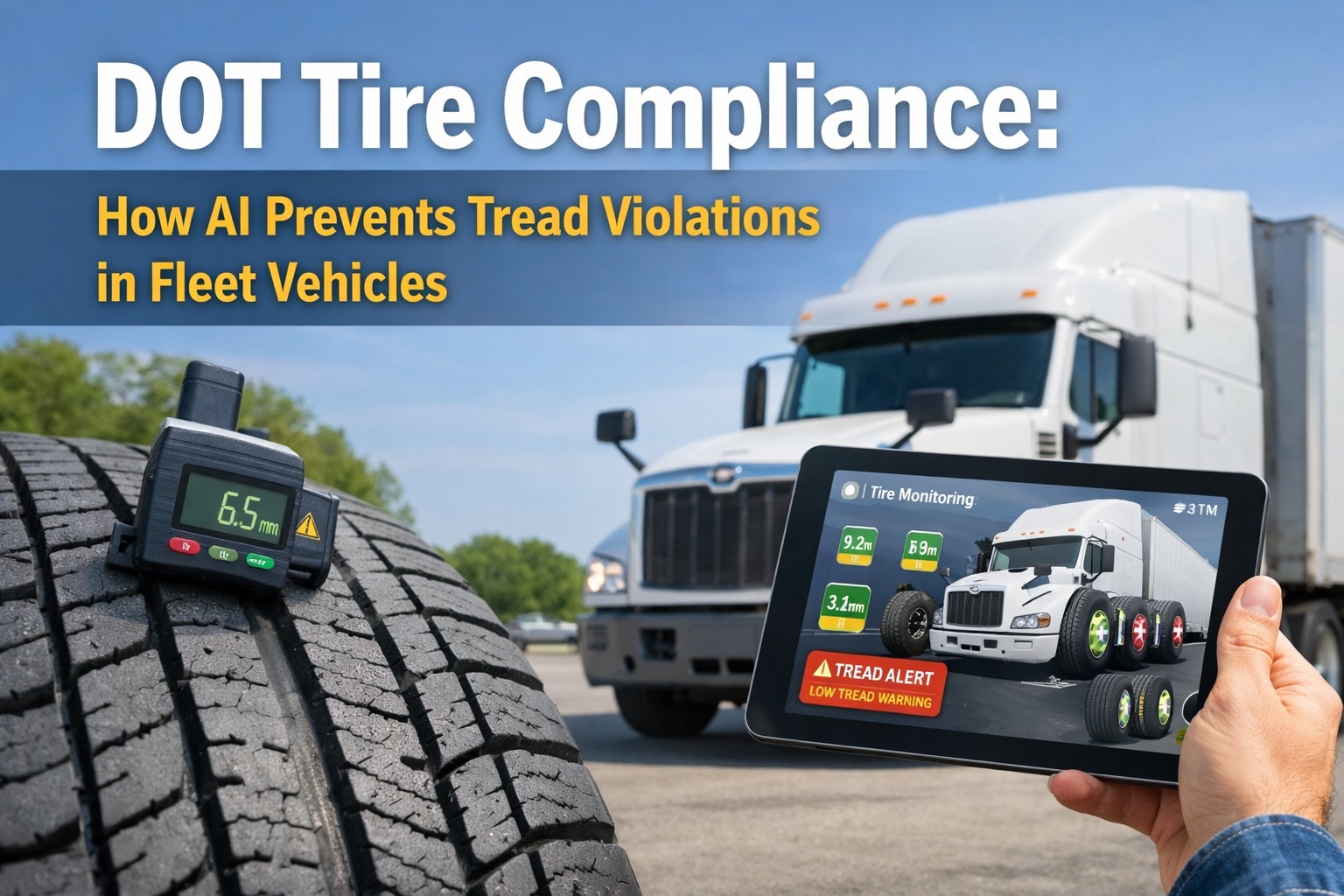
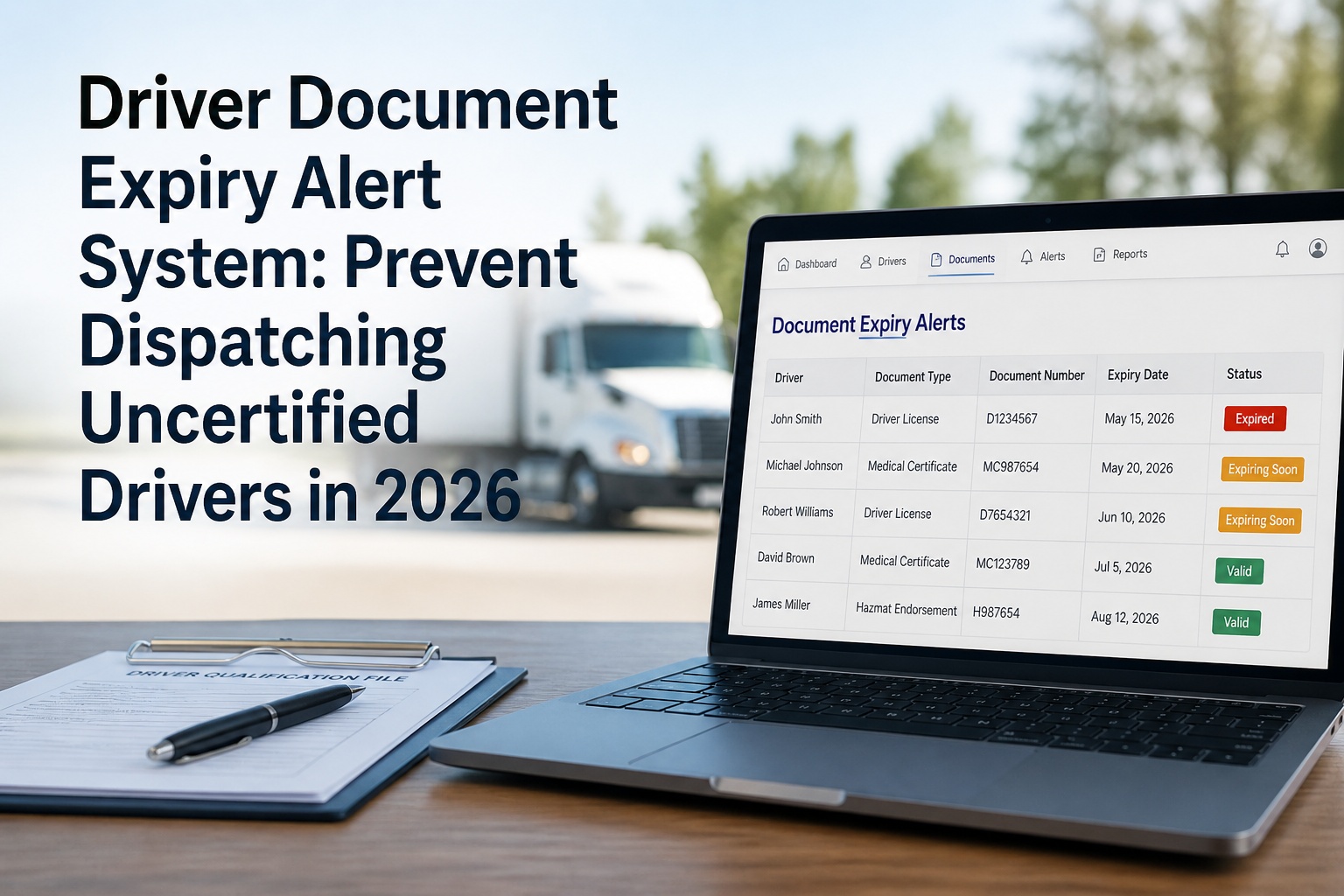
Tires are the second most-cited out-of-service violation in North American roadside inspections — second only to brakes. In 2025 alone, CVSA inspectors issued 2,899 tire-related out-of-service orders during the International Roadcheck blitz, while FMCSA recorded 65,184 separate violations nationwide for tires leaking or under-inflated below 50% of maximum pressure. Every one of those violations adds 8 points to the carrier's Vehicle Maintenance BASIC score, triggers fines from $1,000 up to $16,000 per incident, and immediately grounds the vehicle until the issue is repaired — often at 4x the cost of scheduled maintenance. The problem is that tire tread wears down continuously, and manual gauge checks only catch issues on whatever day the inspection happens. HVI's AI-powered tire management software monitors tread depth, inflation, and physical condition across your entire fleet in real time — flagging at-risk tires weeks before they hit violation thresholds, and preventing every category of DOT tire violation before it becomes a roadside citation. Start your free HVI trial and activate AI tire monitoring across your fleet today, or book a 30-minute demo to see the full tire compliance dashboard live.
The DOT tread depth rules — and the CVSA gap that catches fleets
The single biggest compliance mistake fleets make with tires is assuming federal minimums are the whole picture. Two different standards apply at once, and the stricter CVSA out-of-service criteria is what gets your vehicle grounded at the roadside — even when you are technically legal under federal rules.
Steer axle tires
49 CFR § 393.75(b)
6/32"
Safe zone · replace target
4/32"
DOT minimum — violation below this
2/32"
CVSA OOS — vehicle grounded immediately
Steer tires carry the strictest requirement because they control steering response, braking, and hydroplaning resistance. Retreads are prohibited entirely on bus steer axles, and on truck steers require load capacity above 4,920 lbs.
Drive & trailer tires
49 CFR § 393.75(c)
4/32"
Safe zone · replace target
2/32"
DOT minimum — violation below this
1/32"
CVSA OOS — vehicle grounded immediately
Drive and trailer tires carry a lower minimum but are equally critical to stability under load and emergency braking. Drive tires typically wear faster on the inside shoulder, an alignment signal AI catches early.
The compliance trap: A steer tire at 3/32" passes the DOT minimum but fails CVSA criteria — and the CVSA inspector has the authority to ground your vehicle on the spot. This is why fleets running real tire management programs target 6/32" replacement on steer and 4/32" on drive/trailer — maintaining a buffer against both standards simultaneously.
Beyond tread depth — the full DOT tire violation checklist
Tread depth is only one of several conditions that can put a tire — and the entire vehicle — out of service. Here are every compliance trigger HVI's AI tire monitoring is designed to catch.
Immediate OOS
Exposed body ply or belt material
Any cord or belt visible through tread or sidewall is an instant out-of-service condition — no exceptions, no warnings, vehicle grounded.
Immediate OOS
Tread or sidewall separation
Any visible separation of tread from the casing or sidewall failure constitutes an immediate safety risk and automatic OOS.
Immediate OOS
Flat tire or audible air leak
A flat tire or any audible leak grounds the vehicle immediately. One of the single most-cited tire violations each year.
Immediate OOS
Inflation below 50% of max pressure
Under CVSA criteria, any tire inflated to less than 50% of its maximum rated pressure is automatically out of service regardless of other condition.
Immediate OOS
Cuts exposing ply or belt
A cut or gouge deep enough to expose ply or belt material — regardless of how much tread remains — is an immediate OOS violation.
Immediate OOS
Sidewall bulge or bubble
A bulge in the sidewall signals internal structural failure. The tire can fail catastrophically at any moment and is grounded on sight.
Citation risk
Load rating below vehicle weight
Every tire has a load rating marked on the sidewall. Exceeding it — even if the tire looks fine — is a citation and a liability exposure in any crash investigation.
Citation risk
Retread on steer axle violation
Retreads are prohibited on bus steer axles, and on truck steers the load capacity must exceed 4,920 lbs. Getting this wrong is an automatic § 393.75(d) or (e) citation.
Is your fleet's tire inspection process catching all eight of these conditions consistently?
Book a free HVI demo and see how AI monitoring flags every one of these in real time across every vehicle.
Why tires fail compliance — the 2025 numbers
Tire violations are not rare edge cases. They are one of the most consistent compliance failures across the entire commercial trucking industry, year after year.
21.4%
Of all vehicle out-of-service violations in 2025 were tire-related — second only to brakes.
2,899
Tire OOS violations issued during the 2025 CVSA International Roadcheck 72-hour blitz.
65,184
FMCSA violations nationwide in 2025 for tires leaking or inflation below 50% — the 4th most-cited violation overall.
8 points
Added to the Vehicle Maintenance BASIC score for every tire violation — triggers audit scrutiny at cumulative thresholds.
4x
Cost multiplier on roadside tire service vs. scheduled tire replacement at the shop.
$16,000
Maximum federal penalty per tire violation — before accounting for CSA impact or insurance premium increases.
How HVI's AI tire monitoring actually works
Manual tread depth gauge checks catch a point-in-time snapshot on whatever day someone happened to measure. AI monitoring runs continuously in the background — learning each tire's wear pattern and flagging problems weeks before they become violations.
Step 01
Continuous data capture
HVI ingests data from TPMS sensors, DVIR tread readings, and telematics — every tire on every vehicle, every day. No manual gauge-by-gauge workflow.
Step 02
Per-tire baseline learning
AI builds a unique wear baseline for every tire position on every vehicle — drive tires, trailer tires, steer tires — each with its own expected rate of wear.
Step 03
Deviation & risk scoring
When a tire wears faster than baseline — uneven wear, sudden pressure drop, accelerated tread loss — HVI scores the risk and identifies the underlying cause.
Step 04
Auto work order + replacement
At-risk tires generate a prioritized work order routed to the shop with the correct tire size, load rating, and replacement date — before the vehicle hits a violation threshold.
Inside shoulder wear
Alignment issue or underinflation
Outside shoulder wear
Overinflation or camber problem
Center wear
Chronic overinflation
Cupping / scalloping
Suspension wear or imbalance
Feathering
Toe alignment problem
Rapid single-tire wear
Driver behaviour or specific-route issue
AI doesn't just flag worn tires — it identifies what is causing the wear, so you fix the root cause instead of replacing tires over and over.
Start your free HVI trial and see your fleet's wear patterns analyzed in real time.
Manual tire inspections vs. HVI AI monitoring
Compliance factor
Manual inspection
HVI AI monitoring
Frequency of checks
Pre-trip / post-trip only
Continuous, every operating hour
Tread depth precision
Gauge at single points
Multi-point trend analysis
Pressure monitoring
Gauge at pre-trip
Real-time TPMS + alerts
Wear pattern diagnosis
Visual judgment by tech
Automated cause identification
Pre-violation lead time
Hours to days
Weeks ahead of threshold
Replacement scheduling
Reactive when worn
Auto work orders on trend
Audit documentation
Paper DVIRs, gaps common
Timestamped digital records
The ROI math for AI tire management — 50-vehicle fleet
Avoided tire violations — 2 citations/yr at $11,000 average fine
$22,000
Avoided roadside replacement premium — 3 events × $1,200 excess cost vs shop
$3,600
Extended tire lifespan — 8% improvement via optimized inflation and rotation
$14,400
Fuel savings from correct inflation — 2.5% improvement across fleet
$18,750
Avoided CSA score impact — prevented audit + premium increase exposure
$9,000
Estimated total annual value — tire compliance program
$67,750+
Frequently asked questions — DOT tire compliance & AI monitoring
QWhat is the federal minimum tread depth for commercial vehicle tires?
Under 49 CFR § 393.75, the federal minimums are 4/32" for tires on the front (steer) axle of a bus, truck, or truck tractor, and 2/32" for all other tires (drive and trailer positions). However, CVSA out-of-service criteria are stricter — 2/32" for steer tires and 1/32" for all others — meaning a tire can technically meet federal minimums but still get the vehicle grounded at a roadside inspection. Best practice is to replace at 6/32" on steer and 4/32" on drive/trailer to maintain buffer against both standards.
Start a free HVI trial to see your fleet's current tread compliance status instantly.
QHow does HVI's AI tire monitoring detect problems before manual inspections catch them?
HVI's AI continuously ingests tread depth, pressure, temperature, and wear pattern data from TPMS sensors and DVIR inspections — then builds a unique baseline for every tire position on every vehicle. When any tire deviates from baseline (accelerated wear, sudden pressure loss, uneven pattern), HVI flags the risk and identifies the likely cause — alignment, inflation, driver behaviour, or route stress. Manual gauge checks only capture a snapshot on inspection day. AI monitoring catches the trend weeks before that snapshot would have caught anything.
QWhat happens if a vehicle is placed out-of-service for a tire violation?
When a tire triggers a CVSA out-of-service order, the vehicle is prohibited from operating — it cannot be driven to the nearest truck stop or shop for replacement. A mobile tire service must come to the OOS location to replace the tire, at typically 4x the cost of scheduled shop maintenance. The carrier also receives a citation (up to $16,000 federal penalty), 8 CSA points on the Vehicle Maintenance BASIC, and the violation stays on the carrier profile affecting insurance rates and future audit risk.
Book a demo to see how HVI prevents OOS scenarios.
QAre retreaded tires legal on commercial vehicles?
Retreaded (recap) tires are legal under 49 CFR § 393.75 for drive and trailer positions on trucks and truck tractors. They are entirely prohibited on the front wheels of buses (§ 393.75(d)), and on truck steer axles a regrooved tire must have a load-carrying capacity of 4,920 lbs or greater to be permitted (§ 393.75(e)). HVI tracks each tire's type (new, retread, regrooved) against the axle position it is installed on and flags any non-compliant placement automatically.
QHow quickly does HVI produce tire compliance alerts after deployment?
HVI begins monitoring tire data the moment your vehicles connect to the platform. Initial alerts fire within 24–48 hours based on current tread depth readings and pressure data — immediately flagging any tires already approaching violation thresholds. Full per-tire baseline learning completes within 2–3 weeks, at which point AI-driven predictive wear alerts reach peak accuracy. Most fleets see the first prevented citation within the first month of deployment, easily covering the platform cost for the year.
Stop chasing tire violations. Start preventing them before they happen.
HVI's AI tire management software monitors every tire on every vehicle in real time — tread depth, pressure, condition, wear pattern — with weeks of lead time before any tire approaches a DOT violation or CVSA out-of-service threshold. No more roadside surprises, no more paper gauge logs, no more 8-point CSA hits that could have been avoided.
No credit card required · AI tire monitoring live within 48 hours · Works with existing TPMS systems