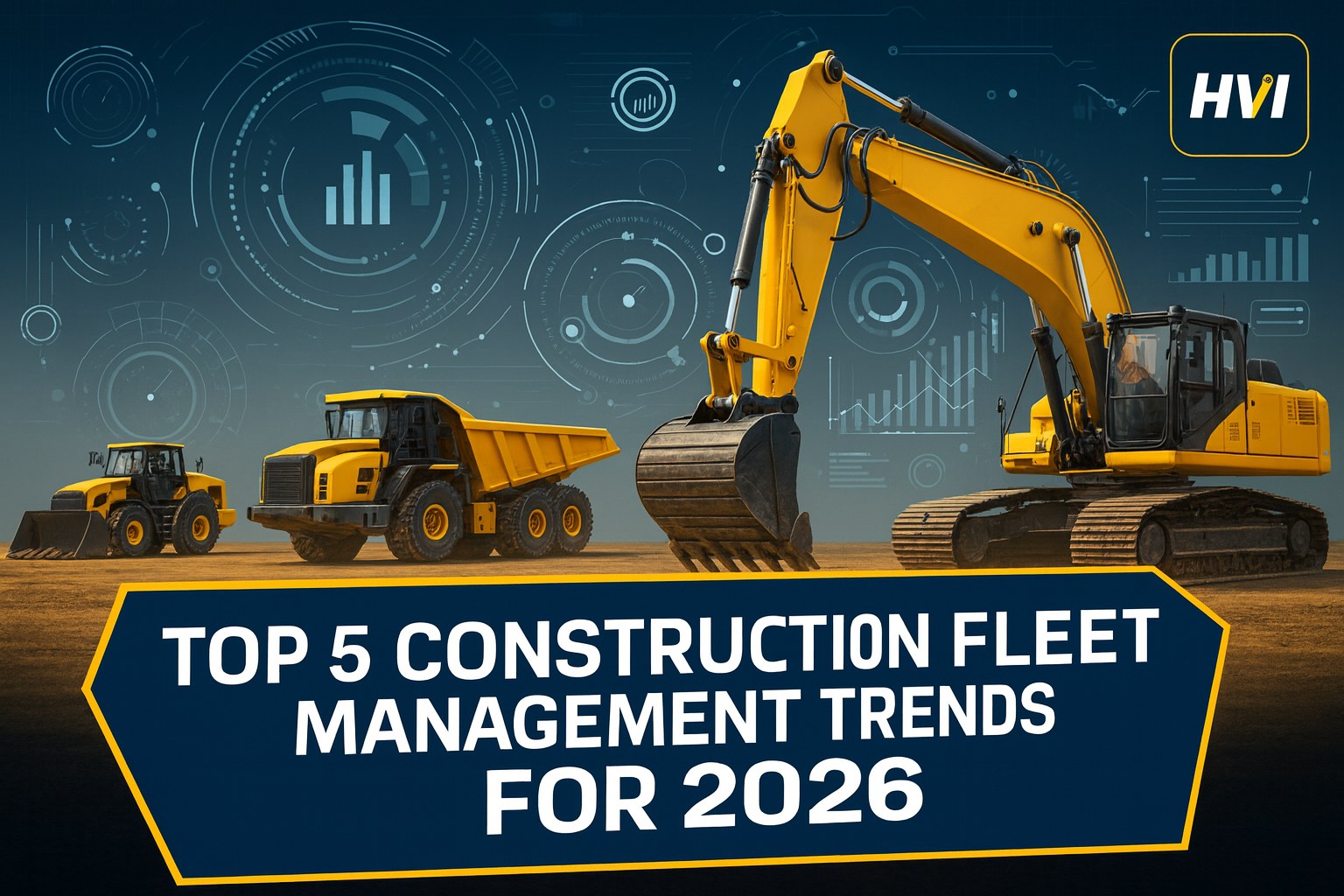
Construction fleet management is entering a transformative period in 2026, with 68% of contractors planning major technology investments to combat rising equipment costs and labor shortages. AI-powered predictive maintenance, autonomous equipment integration, electric fleet transitions, advanced telematics platforms, and workforce optimization tools are reshaping how construction companies manage their assets. Understanding these five critical trends helps fleet managers prepare for industry changes, reduce operating costs by 25-40%, and maintain competitive advantages in an increasingly technology-driven market. Start your fleet modernization today to stay ahead of 2026's construction technology revolution.
Top 5 Construction Fleet Management Trends for 2026
How leading contractors are leveraging AI, automation, sustainability, and next-gen telematics to cut costs by 30%+ while tackling the industry's biggest challenges
Why 2026 Is Different
Construction fleet management has reached an inflection point. Equipment costs have increased 35% since 2020, skilled operators are retiring faster than they can be replaced, and sustainability mandates are tightening across major markets. Meanwhile, technology that was "experimental" in 2022 is now proven, affordable, and delivering measurable ROI.
The 5 Trends Reshaping Construction Fleets in 2026
AI-Powered Predictive Maintenance Goes Mainstream
What's Changing: AI predictive maintenance is transitioning from "early adopter" to "industry standard" in 2026. Systems that once cost $200K+ are now available at $50-75K for mid-sized fleets, with 90%+ accuracy in failure prediction.
Why It Matters: Construction equipment downtime costs $2,000-$10,000 per day per asset. AI systems predict failures 2-4 weeks in advance, cutting unplanned downtime by 40% and emergency repair costs by 60%.
Real Implementation Example
A Texas-based commercial contractor with 35 excavators implemented AI predictive maintenance in Q1 2025. Within 6 months, they reduced hydraulic failures by 73% and extended equipment life by 18%. Their maintenance budget dropped from $620K to $410K annually—a $210K savings that paid for the system three times over.
Semi-Autonomous Equipment Hits Construction Sites
What's Changing: Fully autonomous construction equipment remains 3-5 years away, but semi-autonomous features (automated grading, collision avoidance, remote operation) are production-ready in 2026. Major OEMs are offering these as standard features on premium equipment.
Why It Matters: With 70% of contractors reporting difficulty finding skilled operators, semi-autonomous systems allow less experienced operators to achieve expert-level productivity while reducing accidents by 40-60%.
Semi-Autonomous Features Available in 2026
GPS-guided blade control achieves spec tolerances 3x faster
Radar and camera systems prevent 95% of proximity incidents
One operator manages 2-3 machines from climate-controlled station
Reality Check: What This Actually Costs
New equipment premium: $75K-$150K per unit (15-20% above standard models)
Retrofit kits for existing fleet: $25K-$50K per unit
Typical payback: 18-24 months through productivity gains and accident reduction
Best candidates: Dozers, excavators, and graders on large, repetitive projects
Electric Equipment Reaches Practical Viability
What's Changing: Battery technology advances and charging infrastructure expansion make electric construction equipment genuinely practical for 2026. Electric excavators, loaders, and compact equipment now match diesel performance while cutting operating costs by 60-70%.
Why It Matters: Beyond environmental compliance, electric equipment delivers immediate financial benefits: 70% lower fuel costs, 40% lower maintenance, zero emissions penalties, and access to green building incentives worth $15K-$50K per project.
Electric vs. Diesel: 2026 Total Cost of Ownership
25-Ton Diesel Excavator
25-Ton Electric Excavator
Current Limitations (Improving Rapidly)
- Runtime: 6-8 hours per charge (sufficient for most single-shift operations)
- Charging time: 2-4 hours (fast charging); 6-8 hours (standard)
- Best applications: Urban projects, indoor work, multi-shift sites with charging infrastructure
- Not ideal yet: Remote sites without reliable power, 24/7 operations, extreme cold climates
Next-Gen Telematics Become Standard Equipment
What's Changing: 2026 telematics platforms go far beyond "GPS tracking." New systems integrate equipment diagnostics, operator behavior scoring, jobsite productivity analytics, fuel optimization, and automated compliance reporting—all in real-time dashboards accessible via mobile.
Why It Matters: Modern telematics cut fuel costs by 15-25%, reduce idle time by 40%, improve operator efficiency by 20%, and automate OSHA/DOT compliance documentation that previously consumed 10+ administrative hours weekly.
What's New in 2026 Telematics Platforms
Real-Time Asset Visibility
Live location tracking, geofencing alerts, utilization rates by equipment/project/operator. Instantly identify underutilized assets costing $200-500/day in idle capital.
Operator Performance Scoring
Automated scoring of harsh braking, excessive idling, speed violations, and inefficient operation patterns. Top-performing operators reduce fuel costs 18% compared to bottom quartile.
Automated Compliance
One-click generation of OSHA inspection logs, DOT hours-of-service reports, maintenance records, and emissions documentation. Reduces compliance admin from 12 hours/week to 1 hour.
2026 Pricing Reality
Hardware: $150-$400 per vehicle (one-time)
Software subscription: $15-$45 per vehicle per month
Typical breakeven: 60-90 days through fuel savings and efficiency gains
ROI after Year 1: 300-500% for fleets over 15 units
Workforce Optimization Through Smart Scheduling & Training
What's Changing: Construction's labor shortage intensifies in 2026 (440,000 open positions projected), forcing companies to maximize productivity from existing crews. New workforce management platforms use AI to optimize operator-to-equipment matching, predict project labor needs, and deliver just-in-time digital training that reduces onboarding time by 50%.
Why It Matters: Poor operator-equipment matching costs 15-20% in productivity. Finding and training new operators takes 6-9 months. Smart scheduling systems optimize both, increasing output by 25% with the same headcount while cutting training costs by 40%.
Three Technology Solutions Solving the Labor Crisis
AI-Powered Operator Scheduling
Algorithms match operators to equipment based on skill level, equipment familiarity, and project requirements. Tracks productivity by operator-equipment pair to continuously improve assignments.
VR/AR Training Simulators
Virtual reality training cuts equipment training time from 200+ hours to 80-100 hours while eliminating wear-and-tear on actual equipment. Operators achieve proficiency 60% faster with 95% knowledge retention vs. 45% for traditional methods.
Digital Skills Assessment & Micro-Credentialing
Ongoing digital assessment tracks operator skill development across equipment types. Micro-credentials create clear advancement paths, improving retention by 35% while building a data-proven skills inventory for better project planning.
Case in Point
A Colorado general contractor with 85 operators implemented AI scheduling and VR training in early 2025. Results after 10 months:
- Project productivity up 23% with no new hires
- Operator turnover dropped from 38% to 24%
- Training costs reduced by $127K annually
- Equipment damage incidents down 41%
Total system cost: $95K. First-year savings: $340K. Payback period: 3.4 months.
Ready to Adopt 2026's Fleet Management Technologies?
See how leading contractors are implementing these five trends to cut costs and boost productivity
Your 2026 Implementation Roadmap
You don't need to adopt all five trends simultaneously. Here's a practical, phased approach based on fleet size and current technology maturity:
Foundation Phase
- Upgrade to modern telematics platform (all fleet sizes)
- Launch AI predictive maintenance pilot on 5-10 highest-value assets
- Assess current operator-equipment matching efficiency
- Research electric equipment options for urban projects
Expansion Phase
- Roll out AI maintenance fleet-wide based on pilot results
- Implement AI-powered operator scheduling system
- Add 1-2 electric units to fleet for appropriate applications
- Launch VR training program for new operators
Advanced Integration Phase
- Test semi-autonomous equipment on controlled project
- Expand electric fleet based on TCO analysis
- Integrate all systems into unified operations dashboard
- Develop data-driven equipment replacement strategy
Recommendations by Fleet Size
Small Fleets (5-20 units)
Start with: Modern telematics + AI maintenance pilot
2026 goal: 15-20% cost reduction through better utilization and prevented failures
Investment: $15K-$35K initial, 2-3 month payback
Medium Fleets (20-75 units)
Start with: Full telematics + fleet-wide AI + operator optimization
2026 goal: 25% cost reduction, 15% productivity gain, one electric equipment trial
Investment: $75K-$150K initial, 4-6 month payback
Large Fleets (75+ units)
Start with: Comprehensive technology stack across all five trends
2026 goal: 30%+ cost reduction, industry-leading productivity, competitive advantage in bidding
Investment: $200K-$500K initial, 6-8 month payback
Overcoming Implementation Challenges
Challenge: "Our operators resist new technology"
Challenge: "We can't afford $200K+ in technology"
Challenge: "We don't have IT staff to manage this"
Common Questions About 2026 Fleet Trends
Absolutely. In fact, smaller fleets often see higher percentage ROI because one prevented failure or 10% fuel reduction has immediate impact on tight margins. Modern telematics platforms start at $15/unit/month. AI predictive maintenance pilots begin at $15K-25K and typically pay for themselves with the first prevented breakdown. Start with telematics and AI maintenance—these deliver fastest payback regardless of fleet size.
Modern telematics platforms (Trend #4). They deliver fastest payback (60-90 days), require minimal change management, and create the data foundation needed for other technologies. Telematics typically reduces fuel costs 15-25% immediately while improving utilization 10-15%. This generates cash flow to fund other initiatives while building your team's confidence in technology adoption.
Run a site audit. Electric equipment excels at: (1) Urban sites with power access, (2) Single-shift operations (6-8 hour runtime is sufficient), (3) Indoor or enclosed work (zero emissions), and (4) Projects with noise restrictions. It struggles with: (1) Multi-shift 24/7 operations, (2) Remote sites without reliable power, and (3) Extreme cold climates. Start by electrifying your urban fleet while keeping diesel for remote/challenging sites. Many contractors run 30-40% electric by 2027 through strategic deployment.
No—it addresses the shortage, not creates one. Construction has 440,000 unfilled operator positions in 2026. Semi-autonomous systems allow less-experienced operators to be productive while veterans tackle more complex work. Think of it like power steering—it didn't eliminate drivers, it made driving accessible to more people and reduced fatigue. Contractors using semi-autonomous equipment report higher operator satisfaction and retention, not job losses.
Phased implementation over 2026: $180K-$250K total (telematics: $35K, AI maintenance: $75K, workforce optimization: $40K, 2-3 electric units: $80K incremental, semi-autonomous trial: $50K). Expected first-year return: $420K-$580K through 25-30% cost reduction + 15% productivity gain. Net benefit Year 1: $170K-$330K positive cash flow. Most contractors finance this through equipment loans, vendor payment plans, or lease-to-own arrangements that keep monthly cash flow positive from day one.