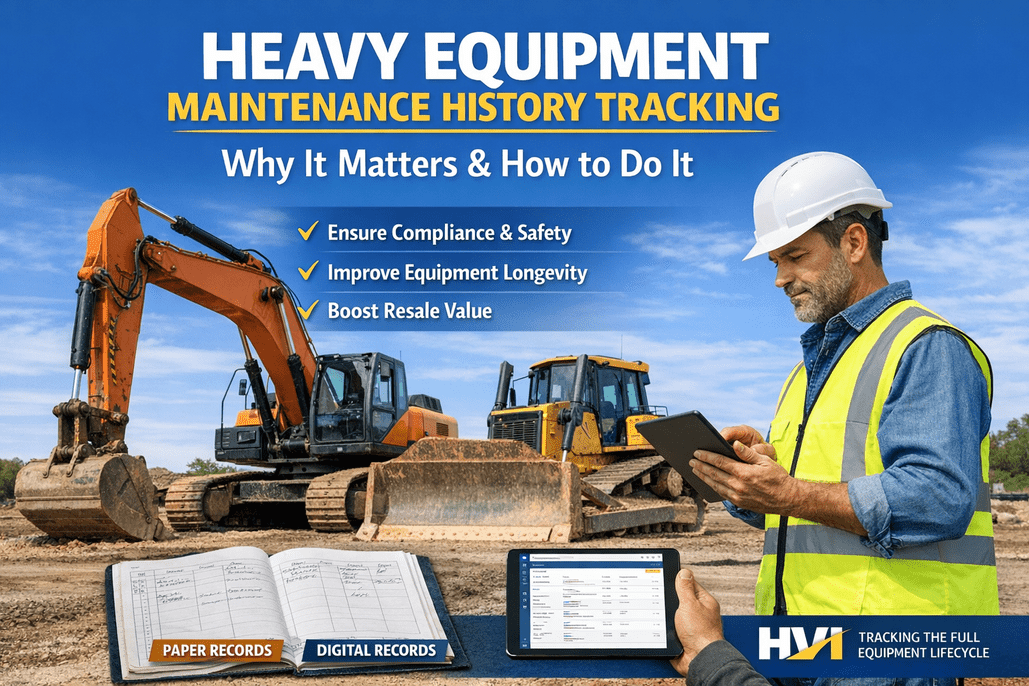
A $300,000 excavator with complete digital maintenance history sells for 5-10% more than an identical machine with scattered paper records. That premium translates to $15,000-$30,000 recovered at disposal — from documentation alone. But resale is only one reason maintenance history matters. During a DOT audit, investigators trace defects from roadside and driver inspection reports back to repair records — verifying that defects were actually fixed, that PM schedules are being followed, and that the overall maintenance program is "systematic" under 49 CFR 396.3. 93% of carriers audited in 2025 received at least one violation. Missing or disorganized documentation was the most common trigger. In litigation following an equipment failure or accident, the first thing opposing counsel subpoenas is the maintenance file. If that file has gaps, illegible entries, or missing repair records, it becomes evidence of negligence — even if the maintenance was actually performed. And predictive maintenance — the technology that reduces unplanned downtime by 30-50% — is entirely dependent on historical data. Without years of structured maintenance records per machine, predictive algorithms have nothing to learn from. Every maintenance event you fail to record is data your future self cannot use. This guide covers why maintenance history tracking is critical, what records must be kept, how paper fails and digital succeeds, how HVI tracks the full equipment lifecycle, and the compliance, resale, insurance, and predictive maintenance benefits that come from doing it right. Book a demo to see HVI's maintenance history module, or start your free trial.
Complete maintenance history for every piece of heavy equipment is essential for compliance, resale value, insurance defense, and predictive maintenance. Learn how HVI tracks full equipment lifecycle history.
Why Maintenance History Is Critical for Heavy Equipment
Maintenance history is not a filing exercise — it is the operational backbone of every fleet decision. Without structured, accessible records per machine, you cannot prove compliance, defend against litigation, plan replacements, forecast costs, enable predictive maintenance, or maximize resale value. Here are the six reasons every fleet must track complete maintenance history:
FMCSA requires a "systematic" maintenance program under 49 CFR 396.3 — meaning documented, scheduled, and consistent. Auditors trace defects from roadside inspections to repair records. If the repair record does not exist, the defect was never fixed — regardless of what actually happened. DVIRs retained 3 months, annual inspections 14 months, general maintenance 1 year + 6 months minimum.
After an equipment failure or accident, opposing counsel subpoenas the maintenance file first. Complete records prove the machine was maintained per manufacturer specs and regulatory requirements. Gaps in the record — even one missing oil change — become evidence of negligence. Digital records with timestamps, photos, and audit trails are significantly more defensible than paper.
Complete maintenance documentation commands 5-10% resale premiums. On a $200,000 machine, that is $10,000-$20,000 recovered from documentation alone. Buyers and auction houses verify service history before pricing. A machine with 10,000 hours and complete records sells for more than the same machine with 8,000 hours and no records. Documentation proves care, not just age.
AI-powered predictive maintenance achieves 92-95% accuracy in predicting failures 3-8 weeks in advance — but only with historical data. Every oil analysis result, vibration reading, temperature trend, and repair event feeds the algorithm. Without years of structured records per machine, predictive analytics has nothing to learn from. The fleet that starts tracking today has a data advantage over the fleet that starts next year.
When repair costs exceed 60% of replacement cost, or when a component will require another major repair within 2,000 hours, replacement is typically more economical. Engine rebuilds: $45,000-$125,000. Hydraulic pump replacements: $25,000-$55,000. Undercarriage: $35,000-$85,000. These decisions require accurate cost-per-hour data — which only comes from complete maintenance history.
Insurance carriers increasingly review maintenance records during claims investigations. A machine that failed due to a component the manufacturer says should have been serviced at 2,000 hours — but has no record of that service — may have the claim denied. Warranty claims require proof of adherence to OEM maintenance schedules. Digital records with timestamps prove compliance automatically.
What Records Must Be Kept
Paper vs Digital History Tracking
The comparison is not close. Paper records create the illusion of documentation while producing systemic gaps that only surface during audits, litigation, or equipment failures.
7.5% of all documents lost entirely. 3% misfiled. 73% of paper DVIRs never reach the office. Average search time: 18 minutes per document. Admin labor: 8-12 hours/week on filing and data entry. Cannot be presented during offsite DOT audits (increasingly common). No photo evidence. No GPS proof. No timestamps. Backdate-able. Illegible handwriting produces unverifiable records. Audit pass rate: 73%. Annual cost for 50 vehicles: $48,600.
100% capture rate — auto-synced to cloud. Search any record in seconds. Admin labor: near zero — data auto-captured. Cloud accessible for offsite audits. Photo + GPS + timestamp on every entry. Cannot be backdated (server-side timestamps). Required fields prevent incomplete entries. Defects auto-route to work orders — no paper handoffs. Audit trail shows who accessed/modified every record. Audit pass rate: 96%. Annual cost for 50 vehicles: $1,800-$4,800.
How HVI Tracks Full Equipment Lifecycle
Every inspection, repair, PM service, annual inspection, parts replacement, fluid analysis, operator assignment, and cost entry attaches to a single digital equipment file. That file is the complete history of the machine — from acquisition to disposal. Search by equipment ID, date range, record type, technician, or defect category. Export as PDF or CSV in seconds.
Operator flags defect during pre-shift → photo + severity attached → maintenance notified instantly → work order auto-generated → mechanic documents repair with parts used and photos → digital sign-off → equipment returned to service. The entire chain is one linked record. No paper handoffs. No gaps. Auditors can follow the chain in seconds.
Every PM event logged: tier (A/B/C/D), date, hours, work performed, parts used, labor, cost, technician. PM compliance rate tracked over time — target 95%+. Overdue PM flagged on dashboard. Historical PM data feeds cost-per-hour calculations and identifies machines where maintenance costs are trending upward (replacement signal).
Total maintenance cost (parts + labor + outsourced repairs) divided by operating hours = cost per hour per machine. Tracked over time. Compare machines of the same type: which ones cost more to maintain? When cost-per-hour exceeds replacement threshold (typically 60% of replacement value annualized), the data makes the case for replacement — no opinions needed.
Fleet-wide compliance status at a glance: green/yellow/red per vehicle. Overdue inspections, expired certifications, overdue PM, open defects — all visible instantly. When FMCSA requests records with 48-hour notice, produce them in minutes. Demonstrate the "systematic" program that 49 CFR 396.3 requires.
Every feature works without internet — inspections, work orders, parts lookups, PM schedules, photo capture. Data syncs when connectivity returns. GPS and timestamps captured at event time, not sync time. Built for construction sites, mine pits, and remote operations where cellular signal is zero.
Compliance, Resale & Insurance Benefits
Key Maintenance KPIs That History Tracking Enables
Without structured maintenance history, these KPIs are impossible to calculate. With HVI, they are automatic.
Percentage of scheduled PM completed on time. Target: 95%+. Below 85% signals a program that exists on paper but is not executed. HVI tracks completion automatically and flags overdue services.
Ratio of planned (PM) work orders to unplanned (emergency) repairs. Target: 3:1 or better. A high ratio means predictable costs and fewer surprises. Rising unplanned work signals deteriorating fleet health.
Total maintenance cost (parts + labor + outsourced) ÷ operating hours per machine. Track over time. When cost/hour exceeds the replacement threshold, data justifies the capital request. Compare identical machines to identify poor performers.
Average operating hours between unplanned breakdowns. Higher = more reliable. Track per machine and per equipment type. Declining MTBF is the earliest signal that a machine is entering the end-of-life cost curve.
Percentage of repairs completed correctly on the first attempt. Target: 97%+. Low rates indicate parts quality issues, technician training gaps, or incomplete diagnostic procedures. Track per technician and per equipment type.
Percentage of scheduled operating hours that equipment is actually available. Target: 92-95% for heavy equipment. The gap between actual and target availability — multiplied by hourly operating value — is your maintenance program's cost of failure.
Frequently Asked Questions
DVIR records: 3 months minimum. Annual inspection reports: 14 months. General maintenance and repair records: 1 year + 6 months under FMCSA. Best practice: retain for the equipment's entire lifetime plus 3 years after disposal. This covers warranty claims, litigation defense, resale documentation, and regulatory requirements. HVI stores all records indefinitely in the cloud — exceeding every minimum.
Complete maintenance documentation commands 5-10% resale premiums. Buyers and auction houses verify service history before pricing. A $200,000 excavator with 10,000 hours and complete digital records sells for more than the same machine with 8,000 hours and no documentation. Records prove care — not just age and hours. Digital records with photos and timestamps are significantly more credible than paper logbooks.
Yes — existing paper records can be scanned or photographed and attached to digital equipment files in HVI. This creates a baseline history. Going forward, all new inspections, repairs, PM services, and work orders are captured digitally with full metadata. Most fleets start fresh with digital capture and add historical records selectively for high-value or recently-maintained equipment.
HVI integrates with OEM telematics systems (Cat Product Link/VisionLink, Komatsu KOMTRAX, Volvo CareTrack, John Deere JDLink) for automatic hour meter updates and fault code capture. This feeds PM scheduling with real-time hours data and creates automatic maintenance history entries from telematics events. Additional integration via API with ERP/CMMS platforms (SAP, Oracle, Maximo) for work order and cost data sync.
Predictive maintenance algorithms analyze historical patterns: oil analysis trends, component replacement intervals, failure modes per equipment type, cost escalation curves, and operating condition data. This requires years of structured, machine-specific records. HVI's digital history creates the data foundation that makes predictive maintenance possible. Without it, predictive analytics has nothing to learn from. The fleet that starts tracking today builds a compounding data advantage.
In litigation following an equipment failure or injury, opposing counsel subpoenas the complete maintenance file. Gaps in records — missing oil changes, undocumented repairs, unsigned inspection reports — become evidence of negligence, even if the maintenance was actually performed. "If it was not documented, it did not happen" is the legal standard. Digital records with timestamps, photos, technician signatures, and audit trails are significantly more defensible than paper.
Complete equipment lifecycle history — inspections, repairs, PM, parts, costs, certifications. One digital file per machine. Searchable, exportable, audit-ready. Start building the data that drives compliance, resale value, and predictive maintenance.
No credit card • No hardware • Works offline • Stores records indefinitely