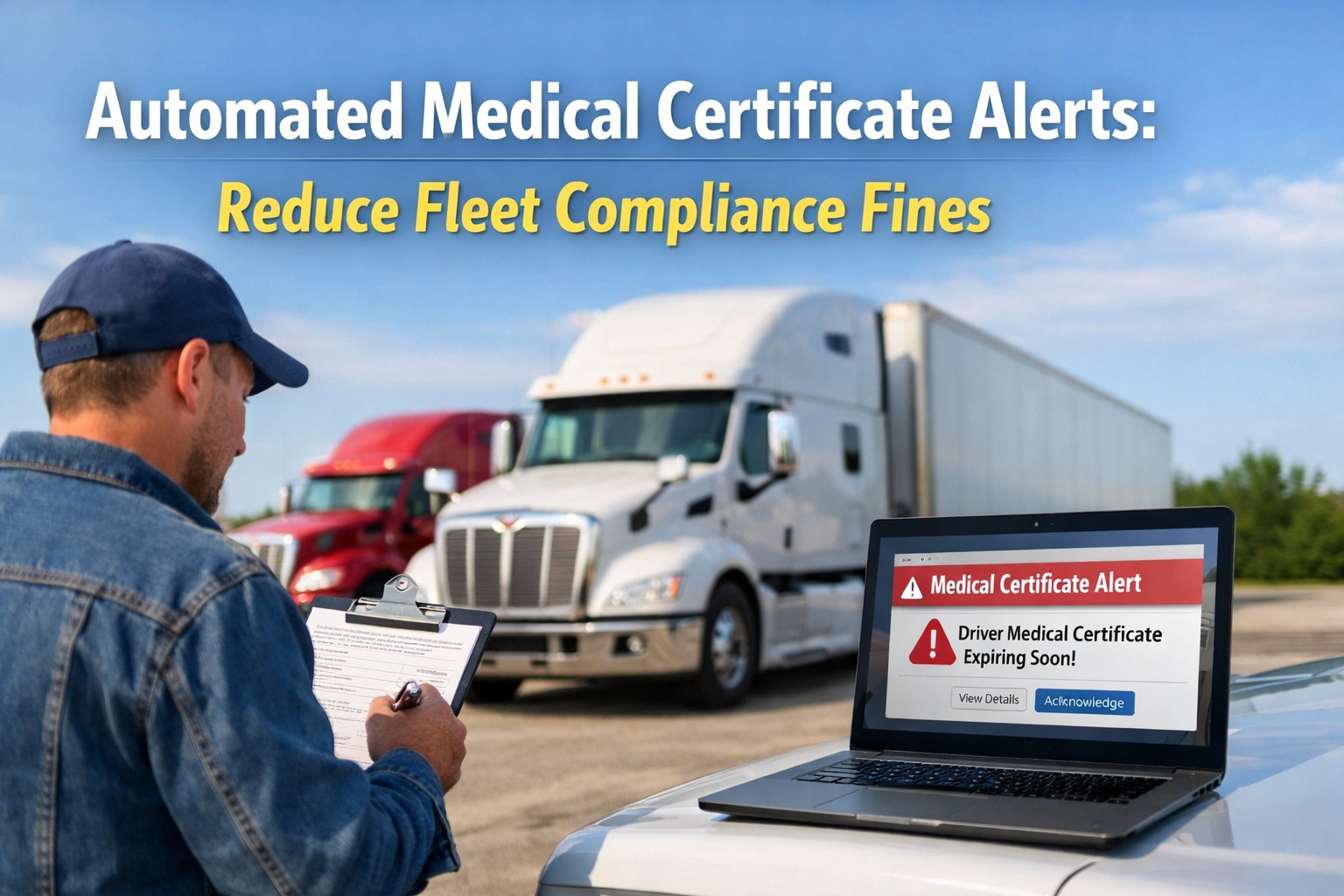
The moment a driver's DOT medical certificate expires, they are immediately disqualified from operating a commercial motor vehicle — zero grace period under federal law. Yet medical certificate expirations are one of the most preventable compliance failures in the industry, with more than 450,000 violations issued in the past five years and nearly 80,000 of them resulting in out-of-service orders. The single biggest reason fleets get caught? No one was watching the expiration dates. HVI's automated medical certificate alert system tracks every driver's medical card expiration in real time, pushes 90/60/30/7-day countdown notifications to fleet managers and drivers, and blocks dispatch on any driver whose certification has lapsed — eliminating the single largest source of Driver Fitness BASIC violations at its source. Start your free HVI trial and set up automated medical certificate alerts across your fleet today, or book a 30-minute demo to see the full driver compliance tracking dashboard live.
The real cost of a single expired medical certificate
Most fleet managers vastly underestimate what one missed medical card expiration actually costs. It is not just a fine — it is a cascade of penalties, lost revenue, and liability exposure that can stack into six figures on a single incident.
Why manual tracking fails — the 5 breakdown points
Every fleet that gets cited for medical certificate violations thought they were tracking them. These are the five specific places manual systems fall apart.
The expiration tracker was built once, six months ago. No one has updated it since a driver renewed in March. The cells that auto-highlight red have been red for weeks and no one notices anymore.
You set an Outlook reminder 9 months ago for "Driver Johnson med renewal." It fires today — right next to 47 other emails and a vendor meeting. You dismiss it thinking you'll handle it tomorrow.
You discover an expiration 5 days out. The driver's doctor has no appointments for 3 weeks. Now you are looking at a grounded driver, a reassigned load, and a scramble to find any NRCME-listed examiner.
The driver has the card. The office doesn't have a copy. The spreadsheet says "renewed 3/15" but no one has seen the actual document since. An auditor asks for it — awkward silence.
Under the new NRII electronic system, CDL medical status lives on the driver's MVR — not a paper card. If you don't pull a fresh MVR after each exam, you can't prove the driver is currently certified in the federal system.
One or more drivers operating with expired certification, unnoticed until the next roadside stop, audit, or insurance claim. Automated alerts eliminate every one of these breakdown points.
How HVI's automated alert cadence works
HVI's medical certificate tracking system pushes structured, escalating alerts to both the fleet manager and the driver — giving your team enough lead time to schedule an exam long before the expiration date becomes a compliance emergency.
Email notification to fleet manager with driver name and exact expiration date. Provides plenty of runway to schedule the DOT physical without operational disruption.
Dashboard flag turns amber. Driver receives direct notification via HVI driver app. Manager gets second email with link to the driver's full qualification file.
Dashboard flag turns red. Daily notifications to both driver and manager. SMS alerts enabled. Compliance officer added to distribution list.
Vehicle assignment flagged. Pre-dispatch warning blocks automatic load assignment until renewal is confirmed. Manager receives escalation call option.
Driver automatically removed from available dispatch pool. Cannot be assigned new loads until renewed certification is verified in HVI.
What HVI tracks — beyond just the expiration date
A true medical certificate tracking system does more than count down to a single date. Here is everything HVI monitors per driver to keep Driver Fitness BASIC scores clean.
Certificate copy stored per driver with expiration date, examiner name, and NRCME verification status. Alerts fire on the expiration clock HVI maintains for every certificate in the system.
Every certificate uploaded to HVI is checked against the examiner's National Registry status. Any driver with a cert from a de-listed or voided examiner (like the 15,000+ FMCSA voided in 2025) is immediately flagged.
Under the FMCSA NRII rule, CDL medical status is verified via MVR. HVI tracks when the last MVR was pulled after each exam and alerts if the refresh window has not been closed.
Drivers with conditions requiring 1-year or 90-day certifications (insulin-treated diabetes, certain vision or cardiovascular conditions) trigger custom alert cadences based on their actual renewal cycle.
Non-CDL drivers operating vehicles over 10,001 lbs still need DOT medical cards — paper copies stored in the DQ file. HVI tracks both groups in one dashboard with the correct workflow applied to each.
Beyond medical, HVI tracks MVRs, Clearinghouse queries, road tests, CDL expirations, and annual reviews — every document with an expiration clock feeds into the same unified alert system.
Before & after — manual tracking vs HVI automation
- Visibility: Spreadsheet checked weekly at best
- Lead time: Often 0–14 days before expiration
- Alert cadence: Inconsistent or non-existent
- Document storage: Paper cards + scanned PDFs scattered
- Dispatch control: Nothing stops a lapsed driver from loading
- Audit export: 2–4 hours to compile per driver
- NRII compliance: MVR re-check often missed
- Annual time cost: 180–220 hours of HR/compliance work
- Visibility: Live dashboard with real-time status
- Lead time: 90/60/30/7-day structured alerts
- Alert cadence: Email + SMS + app notifications escalating
- Document storage: Central digital DQ file per driver
- Dispatch control: Auto-block on any expired certification
- Audit export: One-click packet export in 2 minutes
- NRII compliance: MVR refresh tracked per exam cycle
- Annual time cost: ~20 hours of oversight + approvals
Frequently asked questions
Stop tracking medical certificates on spreadsheets. Start preventing violations before they happen.
Every day you rely on manual tracking is another day you risk a $16,000 fine, a grounded driver, or a denied insurance claim. HVI's automated medical certificate alerts keep your entire driver roster compliant — with 90-day lead times, escalating notifications, and dispatch blocks that make expired certification structurally impossible.
No credit card required · Alerts live same day · Unlimited drivers on all plans