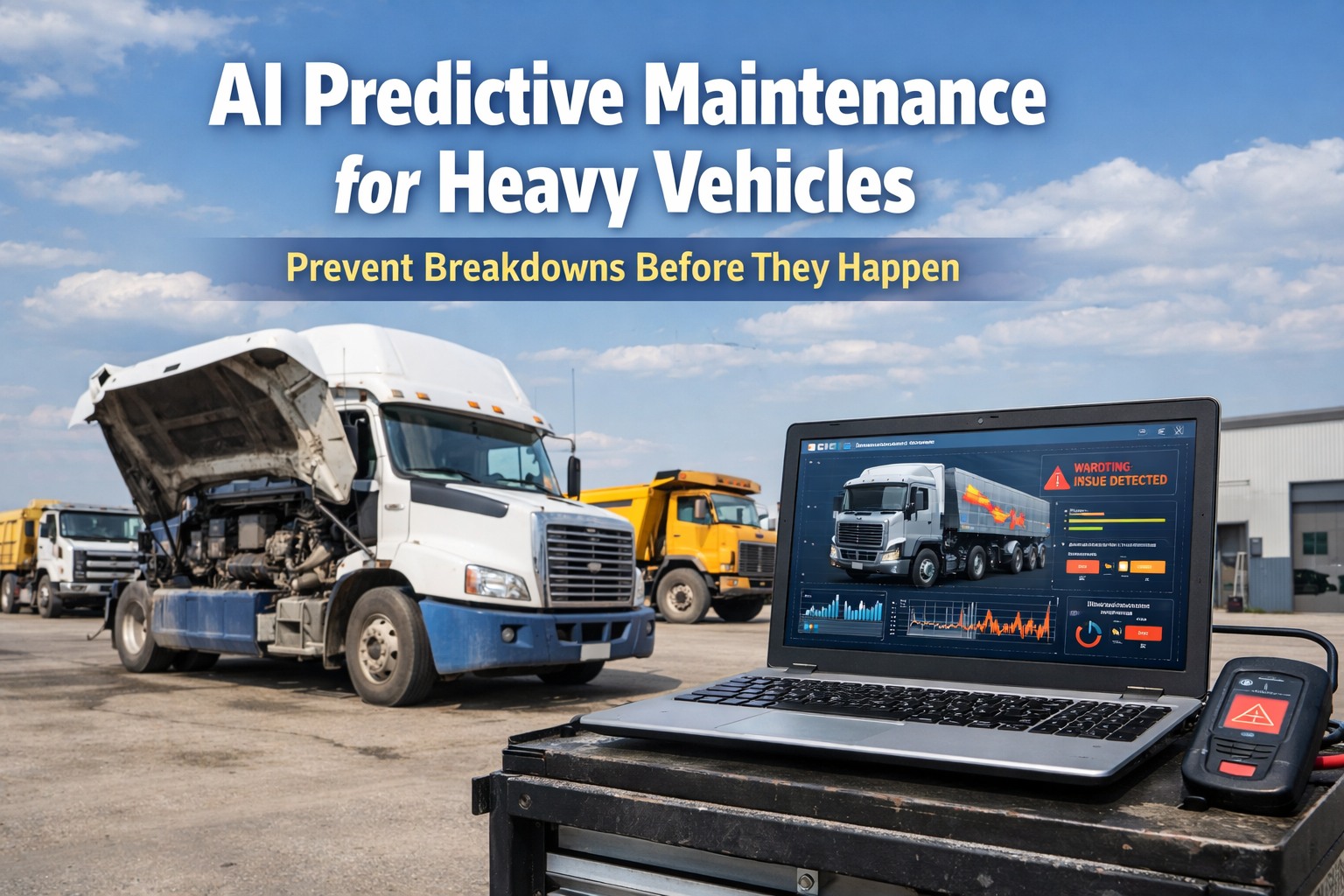
A Class 8 truck breaking down on the highway does not fail without warning. Days or weeks before the tow truck arrives, the data was already there — unusual vibration patterns in the drivetrain, a gradually rising coolant temperature, a subtle change in fuel consumption, an intermittent fault code that cleared itself but signalled a developing problem. Traditional maintenance misses these signals because it operates on schedules, not data. AI predictive maintenance operates on data, and it sees the breakdown coming long before your driver does. HVI's AI Predictive Maintenance system monitors your heavy vehicles in real time — analysing telematics data, inspection records, fault codes, and component wear patterns to identify vehicles that are trending toward failure and alert your maintenance team in time to intervene before the breakdown occurs. The result is fewer roadside breakdowns, lower repair costs, higher vehicle availability, and a maintenance program that gets smarter with every kilometre your fleet drives. Start your free HVI trial today and activate AI predictive maintenance for your fleet, or book a 30-minute demo to see HVI's predictive maintenance AI in action on a live fleet dataset.
Reactive vs. preventive vs. predictive — understanding the difference
Most fleets sit somewhere between reactive and preventive maintenance. Very few have moved to predictive. Understanding the gap between each stage is the fastest way to see why AI changes the economics of fleet maintenance so dramatically.
Fix it when it breaks. The vehicle fails, a tow is called, an emergency repair is completed at premium cost. No planning, no prevention. The most expensive maintenance strategy — but still the default for many fleets.
Service on a fixed schedule — every 10,000 km or every 90 days. Reduces some breakdowns but creates over-servicing (replacing parts that still have useful life) and under-servicing (missing high-use vehicles that burn through intervals faster than the schedule allows).
HVI's AI monitors actual vehicle condition in real time — engine health, component wear trends, fault code patterns, and inspection data — and predicts failures before they occur. Service happens when the vehicle needs it, not when the calendar says so. The result is fewer breakdowns, lower parts waste, and dramatically higher vehicle availability.
What data HVI's AI monitors to predict failures
HVI's predictive maintenance AI does not rely on a single data stream. It monitors seven interconnected data sources simultaneously — building a vehicle health profile that becomes more accurate with every inspection, every fault event, and every kilometre driven.
Engine hours, odometer, RPM patterns, coolant temperature, oil pressure, and battery voltage — syncing every 15 minutes from the vehicle ECU. The baseline for all predictive modelling.
Every DTC that has fired — including codes that cleared themselves. Recurring fault codes, even intermittent ones, are one of the strongest predictors of impending failure. The AI tracks frequency, severity, and code correlation.
Driver-reported defects, AI photo assessments, and inspection item pass/fail trends. A tyre flagged as borderline on three consecutive inspections is a leading indicator the AI factors into its wear prediction model.
Full service records — what was replaced, when, at what mileage. Combined with current usage data, this lets HVI calculate actual remaining component life rather than relying on generic replacement intervals.
A vehicle consuming more fuel than its fleet peers on the same routes is exhibiting a performance degradation signal. Gradual fuel efficiency decline is an early indicator of injector wear, air filter restriction, or drivetrain issues developing below the threshold of obvious failure.
HVI compares each vehicle's performance metrics against similar vehicles in the fleet and against HVI's wider fleet database. A vehicle running hotter, consuming more oil, or generating more faults than its peers is flagged even before its own historical trend shows a clear deterioration.
A vehicle running heavy loads on mountainous terrain deteriorates faster than an equivalent vehicle on flat highway routes. HVI factors route gradient data, payload estimates, and operating conditions into its component life calculations — eliminating one-size-fits-all interval assumptions.
How HVI AI identifies a developing failure — the signal chain
Predictive maintenance is not magic. It is pattern recognition at a scale and speed that human analysis cannot match. Here is exactly how HVI's AI processes signals and escalates a developing failure from background data to actionable maintenance alert.
Coolant temperature running 4°C above the vehicle's historical average for the past 8 hours. Individually, this is within acceptable range. The AI logs it as a first-order signal — not yet an alert.
The AI checks for correlating signals. It finds that the same vehicle had an intermittent coolant level fault code (DTC P0217) 12 days ago that self-cleared, and that the last inspection flagged the coolant expansion tank as "borderline" 18 days prior. Three correlated signals now active.
HVI compares the vehicle's cooling system health against four similar vehicles in the fleet on equivalent routes. Three of those vehicles are running 2°C below this vehicle's temperature. The deviation is 6°C above peer average — triggering the AI's intermediate risk threshold.
Based on the pattern match against historical failure data in HVI's model — correlated temperature rise + intermittent DTC + inspection flag — the AI calculates an 82% probability of cooling system failure within 12–18 days if no intervention occurs.
HVI fires a predictive alert to the maintenance manager with the full signal chain: temperature deviation, correlated DTC history, inspection finding, peer comparison, and estimated failure timeline. A planned cooling system service is scheduled for the next available depot day — avoiding a roadside breakdown that would have cost $4,800+ and 3 days of vehicle downtime.
AI predictive vs. calendar PM — what changes in practice
| Maintenance Decision | Calendar / Interval PM | HVI AI Predictive |
|---|---|---|
| When to service | Fixed date or mileage — same for all vehicles | When condition data indicates actual need |
| Breakdown prediction | Not possible — discovers problems at failure | 7–14 days advance warning on tracked systems |
| Parts replaced | By schedule — regardless of actual wear | When condition data indicates end of useful life |
| High-use vehicle treatment | Same interval as low-use vehicles — over-runs | Monitored continuously — flags earlier when needed |
| Intermittent fault codes | Ignored if self-cleared — missed as leading indicator | Tracked and correlated — patterns trigger alerts |
| Planned vs. unplanned downtime | High unplanned rate — breakdowns happen | Planned interventions replace emergency repairs |
| Driver-reported concerns | Logged but not integrated with maintenance data | Correlated with telematics and fault data automatically |
Annual impact: 50-truck fleet, AI predictive vs. calendar PM
| Breakdown events avoided — 73% reduction × 12 events × $4,800 avg cost | - $42,048/yr |
| Over-servicing eliminated — 20% fewer unnecessary PM services × $280 avg | - $5,600/yr |
| Vehicle downtime reduction — 73% × 36 days lost × $650/day revenue impact | - $17,082/yr |
| Emergency parts and labour premium eliminated (40% premium × avoided events) | - $8,400/yr |
| Total estimated annual value — 50-truck fleet | $73,130+/yr |
Frequently asked questions about HVI AI Predictive Maintenance
Your next breakdown is already showing its signals. HVI's AI can see them.
Every kilometre your fleet drives generates data that predicts the next failure. HVI's AI Predictive Maintenance turns that data into 7–14 day advance warnings — so you plan an intervention, not a tow. Start free today and give your maintenance team the tool that prevents breakdowns instead of responding to them.
No credit card required · AI monitoring begins on first data sync · All major heavy vehicle makes supported