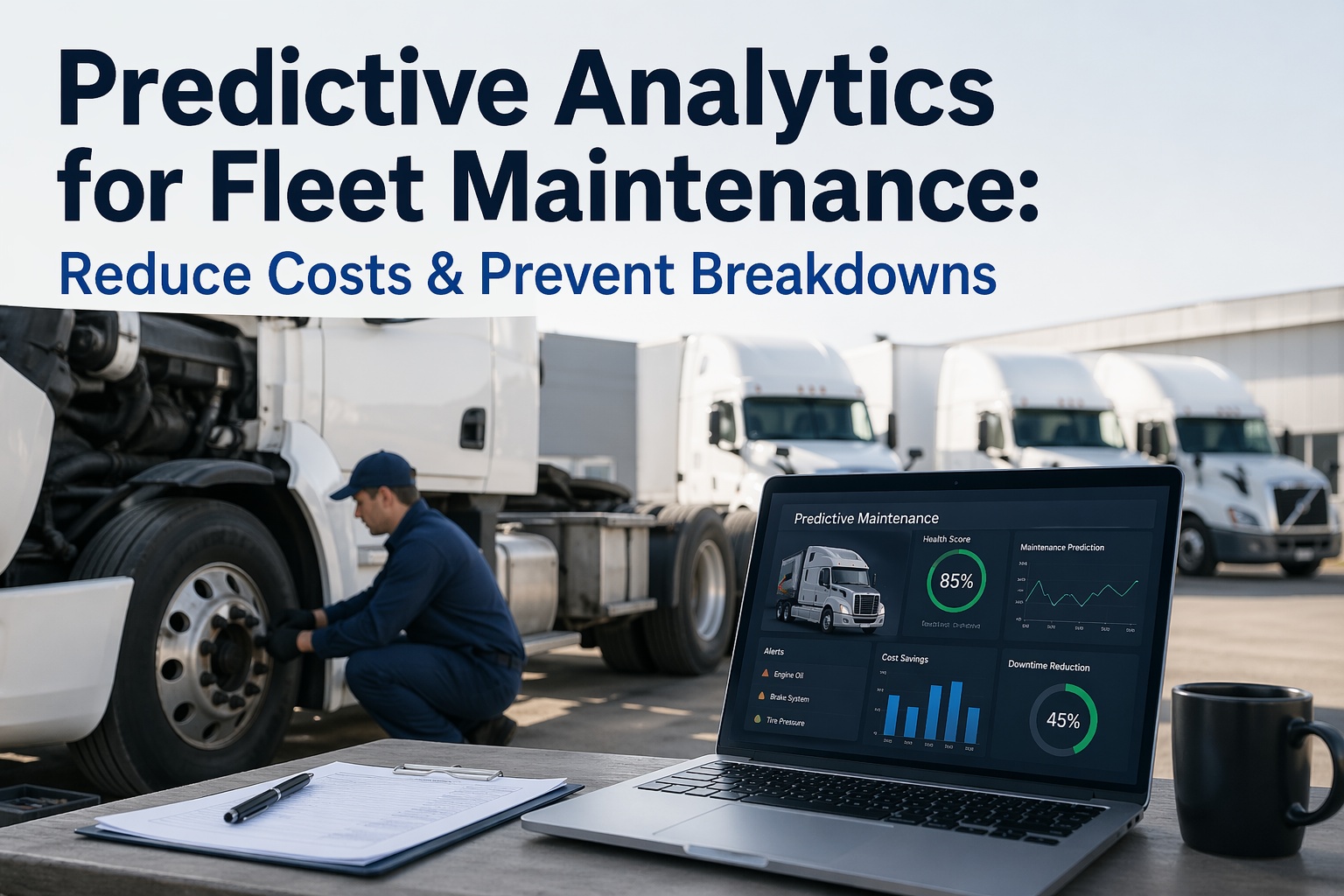
The average unplanned truck breakdown costs $1,900 when you combine direct repairs, driver downtime, towing, and lost productivity. Across a 50-vehicle fleet where unplanned maintenance consumes 11% of annual operating hours, that is six figures of avoidable cost every year. The uncomfortable truth reshaping fleet maintenance in 2026: 75–85% of these breakdowns are now predictable using AI — yet only 27% of fleets have deployed predictive maintenance, while 73% still run reactive programs that cost 3–5x more than planned repairs. Predictive analytics does not eliminate maintenance — it eliminates surprise. AI analyses engine sensor data, telematics, inspection findings, and historical repair records to forecast component failures 2–4 weeks before they happen, giving maintenance teams time to schedule repairs during planned downtime instead of emergency roadside stops. Documented results: 30% lower maintenance costs, 45% fewer breakdowns, and ROI payback in 44 days to 6 months. HVI's predictive maintenance platform combines AI analytics with the inspection data layer that makes predictions accurate — because physical defects precede sensor alerts by weeks.
Stop Paying the Reactive Maintenance Tax
73% of fleets still run reactive programs that cost 3–5x more than planned repairs. HVI's predictive analytics platform catches 75–85% of failures 2–4 weeks before they happen — with ROI payback in as fast as 44 days.
Reactive vs. Preventive vs. Predictive
Understanding where your fleet sits on this spectrum reveals the cost gap between your current approach and what is achievable.
When You Repair
After it breaks
Fixed schedule (miles/calendar)
When data says it will fail
Repair Cost
Emergency rates — 3–5x higher
Planned rates — but overservices
Planned rates — right time only
Parts Waste
Emergency rush — 35–60% premium
Replaces parts with 40% life remaining
Replaces at optimal wear point
Downtime Impact
$500–$2,000/day unplanned
Scheduled — but unnecessary visits
Scheduled — only when needed
Failure Prevention
0% — waits for failure
~50% of failures prevented
75–85% of failures predicted
Annual Cost per Vehicle
Highest — $127K+ (bus benchmark)
Mid — over-maintenance adds cost
Lowest — $84K (34% reduction)
Fleet Adoption (2026)
73% of fleets (declining)
Standard in most operations
27% deployed — 65% planning by year end
HVI combines predictive analytics with physical inspection data — the layer that catches defects sensors miss.
Schedule a 30-minute demo to see predictive analytics running on sample fleet data. Or
sign up free and start building your prediction baseline today.
How Predictive Analytics Actually Works
Predictive maintenance is not magic — it is pattern recognition at a scale and speed humans cannot match.
1
Continuous Data Collection
Telematics streams engine temperature, oil pressure, transmission behaviour, fuel trim, and vibration data. Inspection records add physical condition — tyre wear depth, fluid leaks, visible cracks, brake pad measurement. Combined, these create a complete vehicle health profile updated every mile and every walk-around.
2
AI Pattern Detection
Machine learning models compare current data against historical failure patterns. An engine running 12 degrees hotter than baseline with declining oil pressure follows the same trajectory that preceded 847 engine failures in the training set. The AI sees this weeks before a fault code fires.
3
Failure Probability Scoring
Each component receives a failure probability score updated in real time: 15% risk = monitor at next PM. 45% risk = schedule repair this week. 80% risk = immediate action before next trip. Modern models achieve 85–95% precision on major component failures.
4
Automated Work Order + Scheduling
When failure probability crosses the threshold, HVI auto-generates a work order with the predicted component, recommended repair, required parts (checked against inventory), and an optimal service window that minimises operational disruption.
Where Inspection Data Makes Predictions Accurate
Most predictive maintenance platforms rely on telematics sensor data alone. This creates a critical blind spot — physical defects that sensors cannot detect.
What Sensors See
Blind Spot
What Inspections Catch
Engine temperature trending +12 degrees
Cannot see why
Inspection photos show coolant hose bulging — root cause identified
Brake pressure within normal range
Sensors read pressure, not pad thickness
DVIR measurement shows brake pads at 3mm — replacement needed before pressure drops
No tyre fault codes
No sensor on tread depth
Walk-around photo shows inner tread at DOT minimum — AI flags before blowout
Transmission shift data normal
Fluid leaks are invisible to sensors
Driver photographs fluid seepage — slow leak caught 3 weeks before sensor alert
HVI combines both layers — telematics sensor data and physical inspection findings — into unified prediction models. This dual-layer approach catches failures that sensor-only platforms miss entirely. Schedule a demo to see how inspection data improves prediction accuracy on your fleet.
The ROI: What Predictive Maintenance Saves
The financial case is no longer theoretical — it is calculated from documented fleet deployments. Start free with HVI and begin building your prediction baseline from day one.
30%
Lower Maintenance Costs
Planned repairs at shop rates vs. emergency repairs at premium rates with rush-shipped parts. A 35-vehicle fleet documented $210K annual savings.
45%
Fewer Breakdowns
AI surfaces failure risks 20–45 days before traditional diagnostics — giving maintenance teams time to schedule repairs during planned windows.
44 days
Average ROI Payback
Industry average for AI predictive maintenance. The first prevented breakdown often covers the entire system cost for months.
10:1–30:1
ROI Ratio (12–18 months)
Documented across industry research. A 250-vehicle fleet achieved $1.8M annual savings combining cost reduction with downtime decrease.
15–20%
Extended Vehicle Life
Components maintained at optimal condition last longer. On a $150K Class 8 tractor, 2–3 additional years of service before replacement.
65%
Planning AI by Year End
65% of maintenance teams plan to implement AI by end of 2026. The 27% who have deployed it already hold a 12–18 month competitive advantage.
Ready to see what predictive analytics could save your fleet?
Schedule a free ROI assessment — we will calculate projected savings based on your fleet size, vehicle mix, and current maintenance costs. Or
sign up free and let the data build from your first inspection.
The Breakdowns You Cannot See Are the Ones That Cost the Most
Every fleet has breakdowns waiting to happen. The difference between a $1,900 roadside emergency and a $400 scheduled repair is whether someone saw it coming. Predictive analytics sees it coming — 2–4 weeks in advance, with 85–95% accuracy, across every vehicle in your fleet simultaneously. HVI adds the critical layer most predictive platforms miss: physical inspection data from daily DVIRs that catches the defects sensors cannot detect — tyre wear, fluid leaks, visible cracks, and brake pad measurements that precede sensor alerts by weeks. Combined with telematics data, this dual-layer approach delivers the most accurate prediction models available for heavy vehicle fleets. The technology is proven. The ROI is documented. The 73% of fleets still running reactive maintenance are paying a tax that predictive analytics eliminates. Start free today and stop paying the reactive maintenance tax.
Predict Failures Before They Cost You
AI predictions 2–4 weeks ahead. 30% lower costs. 45% fewer breakdowns. 44-day ROI payback. Inspection + telematics dual-layer accuracy. Trusted by 25,000+ users.
Frequently Asked Questions
Q: What is the difference between predictive and preventive maintenance?
Preventive maintenance services vehicles on fixed schedules — every 15,000 miles or 90 days regardless of actual condition. It often replaces parts with 40% of useful life remaining. Predictive maintenance uses real-time data analysis to determine when service is actually needed based on measured component condition and failure probability. The result: 34% lower costs and zero unnecessary service visits. Most fleets in 2026 run both: preventive for routine items and predictive for high-value and failure-critical components.
Q: Do I need special hardware for predictive maintenance?
Most vehicles manufactured after 2015 have factory telematics that already broadcast the diagnostic data AI needs. HVI integrates with Geotab, Samsara, Motive, Verizon Connect, and OEM telematics via standard APIs. For older vehicles without telematics, an affordable OBD-II device ($50–$150 per vehicle) provides the data connectivity. HVI also uses physical inspection data from DVIRs — captured on any smartphone with zero hardware.
Start free.
Q: How accurate are AI failure predictions?
Modern machine learning models achieve 85–95% precision on major component failures (bearings, pumps, motors, alternators). False positive rates have dropped to 5–15% through advanced algorithms. Accuracy improves over time as the AI trains on your fleet-specific patterns — vehicles with 12+ months of history produce the highest prediction precision. HVI generates initial predictions within 72 hours of connecting your data.
Schedule a demo to see prediction accuracy on sample data.
Q: How quickly will I see ROI?
Industry data shows an average 44-day payback for AI predictive maintenance. Most fleets see measurable savings within 30–90 days through reduced emergency repairs, lower towing costs, and fewer rental replacements. The first prevented breakdown typically covers the system cost entirely. Documented results: 10:1 to 30:1 ROI within 12–18 months. A 35-vehicle fleet saved $210K in year one.
Q: Why does HVI combine inspection data with telematics for predictions?
Telematics sensors cannot see physical defects — tyre wear, fluid leaks, visible cracks, brake pad thickness. These physical conditions often precede sensor alerts by 2–3 weeks. HVI's daily inspection data from DVIRs adds this physical-condition layer to the prediction model, catching failures that sensor-only platforms miss entirely. The dual-layer approach (telematics + inspections) produces the most accurate predictions available for heavy vehicle fleets.