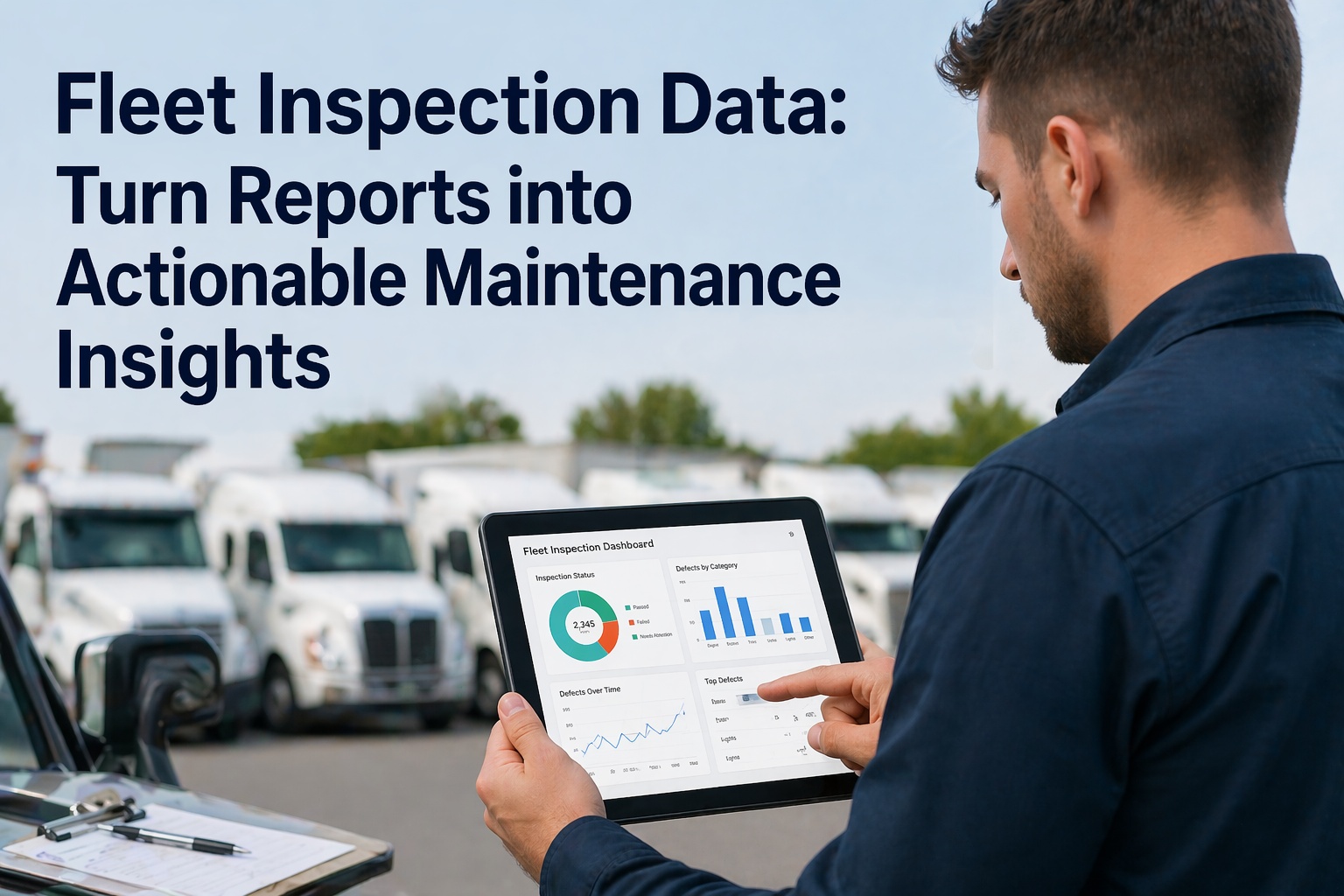
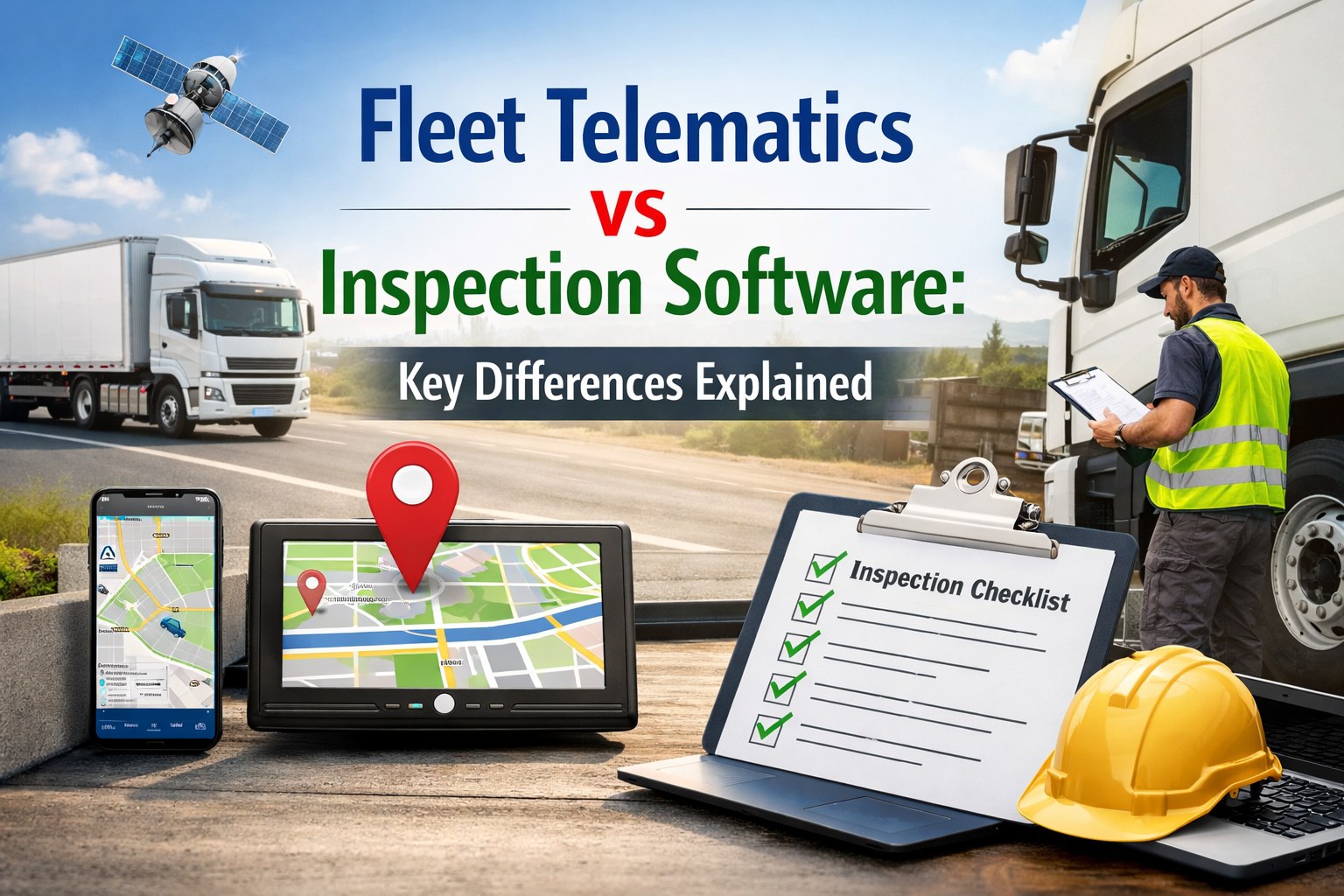
Your fleet completed 4,200 inspections last quarter. That is 4,200 data points on vehicle condition, defect frequency, component wear, driver thoroughness, and repair response time — sitting in a database doing nothing. Most fleets treat inspection data as compliance documentation: it exists to survive an audit, not to drive decisions. But the fleets achieving the lowest downtime, the best CSA scores, and the most predictable maintenance budgets in 2026 are doing something different — they are mining their inspection data for patterns that predict failures, identify problem vehicles, expose training gaps, and time replacements perfectly. The shift from "inspection data as paperwork" to "inspection data as intelligence" does not require data scientists or BI tools. It requires a platform that surfaces the patterns automatically. HVI's fleet analytics dashboard transforms every DVIR every defect report, and every repair record into the actionable insights your fleet is already generating — but currently ignoring.
The 5 Questions Your Inspection Data Already Answers
You do not need to collect more data — you need to ask the right questions of the data you already have.
01
Which vehicles are about to break down?
A vehicle whose defect frequency increases 30%+ over 8 weeks is 3x more likely to have an unplanned breakdown in the next 30 days. Inspection data reveals this trend weeks before a fault code fires — because physical defects precede sensor alerts.
Action: Flag vehicles with accelerating defect rates for proactive PM scheduling — before the breakdown strands the truck.
02
Which components fail most across my fleet?
Defect data grouped by component type reveals the Pareto pattern: typically 20% of component categories cause 80% of all defects. If brake-related defects account for 35% of all findings, that tells you where PM investment has the highest ROI.
Action: Reallocate PM resources to the component categories with the highest defect concentration — targeted prevention instead of blanket maintenance.
03
Which drivers are catching defects — and which are not?
Inspection thoroughness varies 50% between drivers. The ones who consistently find zero defects are not driving perfect vehicles — they are rushing through inspections. AI-scored inspection quality (time, completeness, photo quality) exposes pencil whipping with data.
Action: Target coaching at low-thoroughness drivers. The 2026 CSA "Driver Observed" category now scores this behaviour separately.
04
When should I replace a vehicle instead of repairing it?
12+ months of digital inspection and work order data reveals each vehicle's maintenance cost trajectory. When annual maintenance exceeds 50% of market value — and the defect rate is climbing — the data makes the replacement case objective, not emotional.
Action: Use cumulative defect + cost data to build CFO-ready replacement proposals with concrete break-even dates.
05
How fast is my maintenance team actually responding?
Defect-to-repair time — measured from inspection timestamp to work order closure — reveals maintenance responsiveness by severity level, technician, vehicle type, and shift. World-class is under 4 hours for safety-critical defects. Industry average is 18 hours.
Action: Set severity-based MTTR targets. Track weekly. Identify bottlenecks — parts delays, technician capacity, or routing gaps.
HVI surfaces all five of these insights automatically from your inspection and work order data — no manual analysis required.
Schedule a 30-minute demo and see your fleet's patterns in the dashboard. Or
sign up free — insights begin building from the first inspection.
Raw Data vs. Actionable Insight
The same inspection event produces very different value depending on whether it is stored as a record or analysed as a data point.
Unit 247: brake defect reported 3 times in 60 days
→
Unit 247 has a recurring brake issue — previous repairs addressed the symptom, not the root cause. Escalate to senior technician for root-cause diagnosis.
Driver J. Martinez: 0 defects found in last 40 inspections
→
Statistical improbability — inspections averaging under 3 minutes with no photos. Likely pencil whipping. Targeted coaching session needed.
Tyre defects: 142 reports across fleet in Q1
→
Tyre defects are 38% of all findings — 2x the next category. Current tyre supplier or rotation intervals may need review. Potential $40K+ annual savings from supplier change.
Average defect-to-repair: 14.2 hours
→
Night shift repairs average 22 hrs vs. day shift 8 hrs. Parts staging is not set up for second shift. Fix this one bottleneck and fleet-wide MTTR drops 30%.
Unit 312: $18,400 maintenance cost over 14 months
→
Unit 312's annual maintenance now exceeds 55% of market value with accelerating defect rate. Replace — not repair — within 90 days to avoid $12K+ in projected costs.
The 4 Analytics Layers That Turn Data into Decisions
Inspection data delivers value at four levels — each layer building on the data beneath it. Start free with HVI and begin building your analytics foundation from day one.
Layer 1: Compliance
Did inspections happen? Are DVIRs complete? Is the 3-signature chain intact? This is the baseline — the layer that passes audits. Every fleet needs this. Most stop here.
Layer 2: Operational
How fast are defects being repaired? What is the PM compliance rate? Which vehicles have the most open defects? This layer manages the shop — work order backlogs, technician throughput, parts availability.
Layer 3: Predictive
Which vehicles are trending toward failure? Which components are degrading faster than fleet average? Which routes cause accelerated wear? This layer prevents breakdowns 2–4 weeks before they happen.
Layer 4: Strategic
When should each vehicle be replaced? Which PM intervals should be adjusted? Where should training investment go? This layer drives capital decisions, budget planning, and fleet-wide optimisation.
Most fleets operate at Layer 1. HVI automatically delivers Layer 2 from day one and builds Layers 3 and 4 as your inspection history grows.
Schedule a demo and see which analytics layer your fleet is ready for today.
What HVI's Analytics Dashboard Surfaces
HVI does not require you to build reports or export spreadsheets — the dashboard surfaces patterns and anomalies automatically from your inspection and work order data.
Defect Trend Analysis
Recurring defects by component, vehicle, driver, route, and time period. Identifies patterns before they become roadside failures — the most valuable intelligence inspection data produces.
Driver Inspection Quality Scoring
AI rates each inspection on time, completeness, photo quality, and consistency. Flags rushed or pencil-whipped inspections. Directly maps to the 2026 CSA "Driver Observed" scoring category.
Defect-to-Repair Time Tracking
MTTR measured from inspection timestamp to work order closure — filterable by severity, technician, vehicle type, shift, and terminal. Identifies the specific bottleneck causing delays.
Vehicle Health Scoring
Each vehicle receives a composite health score based on defect frequency, MTBF trend, PM compliance, and age-adjusted maintenance cost. Vehicles scoring above threshold auto-flag for replacement analysis.
Fleet-Wide Compliance Dashboard
Inspection completion rates, DVIR chain compliance, PM adherence, and credential status across every vehicle, driver, and terminal — one screen, real time, with drill-down to any individual record.
Cost-per-Vehicle Analytics
Maintenance cost trending per vehicle, per department, per vehicle class. Benchmarked against fleet averages. Identifies the 10% of vehicles causing 50% of costs — the highest-ROI replacement candidates.
Every inspection your drivers complete feeds these analytics automatically — no manual entry, no end-of-month reporting, no spreadsheet exports.
Sign up free and start building the data foundation that drives smarter maintenance decisions. Or
schedule a demo to see the analytics running on sample fleet data.
The Data Already Exists — Start Using It
Every fleet generates inspection data. The question is whether that data sits in a filing cabinet (paper) or a database (digital) — and whether it is treated as compliance documentation to survive audits or as operational intelligence to prevent failures, optimise costs, and drive strategic decisions. HVI transforms every DVIR, every defect report, and every work order into searchable, analysable, actionable data — with an analytics dashboard that surfaces defect trends, driver quality scores, MTTR bottlenecks, vehicle health trajectories, and cost-per-vehicle benchmarks automatically. No data scientists. No BI tools. No manual reporting. Just inspections that generate intelligence as a byproduct of daily compliance. Start free today — the analytics build from the first inspection.
Turn Your Inspection Data into Maintenance Intelligence
Defect trends. Driver quality scores. Vehicle health tracking. MTTR analysis. Cost benchmarking. All automatic — from the inspections your drivers already complete. Trusted by 25,000+ users.
Frequently Asked Questions
Q: How much inspection data do I need before analytics become useful?
Compliance-level analytics (completion rates, DVIR chain status) are useful from day one. Operational analytics (MTTR, defect frequency) become meaningful within 30 days. Predictive analytics (failure trends, degradation patterns) require 60–90 days of history. Strategic analytics (replacement timing, cost trajectories) need 6–12 months. Start now — every inspection builds the foundation.
Sign up free.
Q: Do I need data analysts to use HVI's analytics?
No. HVI's dashboard surfaces insights automatically — defect trends, driver quality scores, MTTR analysis, and vehicle health scores are generated without manual report-building. The dashboard is designed for fleet managers and maintenance supervisors, not data scientists. Drill-down is one click; export is one click; alerts fire automatically when anomalies appear.
Q: How does inspection data feed predictive maintenance?
Physical inspection data catches defects that sensors miss — visual wear, fluid seepage, structural cracks, tyre condition. When combined with telematics sensor data, inspection findings provide the physical-condition layer that makes predictive models accurate. A vehicle whose inspection defect rate increases 30% over 8 weeks is 3x more likely to break down — and inspection data reveals this trend before any fault code fires.
Schedule a demo to see predictive analytics on sample fleet data.
Q: Can I benchmark my fleet against industry averages?
Yes. HVI benchmarks your fleet's KPIs — PM compliance, defect-to-repair time, inspection completion rate, vehicle availability — against industry averages and top-quartile performers. This context turns your data from numbers into actionable insights: knowing your MTTR is 14 hours means nothing in isolation; knowing the industry average is 18 and top-quartile is 4 tells you exactly where to focus.
Q: What ROI does data-driven maintenance deliver?
Fleets using inspection data for predictive maintenance report 35% lower repair costs, 89% fewer preventable breakdowns, and $8,500 per vehicle in annual savings. The ROI comes from three sources: preventing breakdowns (each one costs $1,900+), eliminating wrong-part orders (accuracy-driven savings), and timing replacements correctly (avoiding the 50%+ maintenance-cost-to-value threshold). Most fleets see full ROI within 60 days.
Start free.