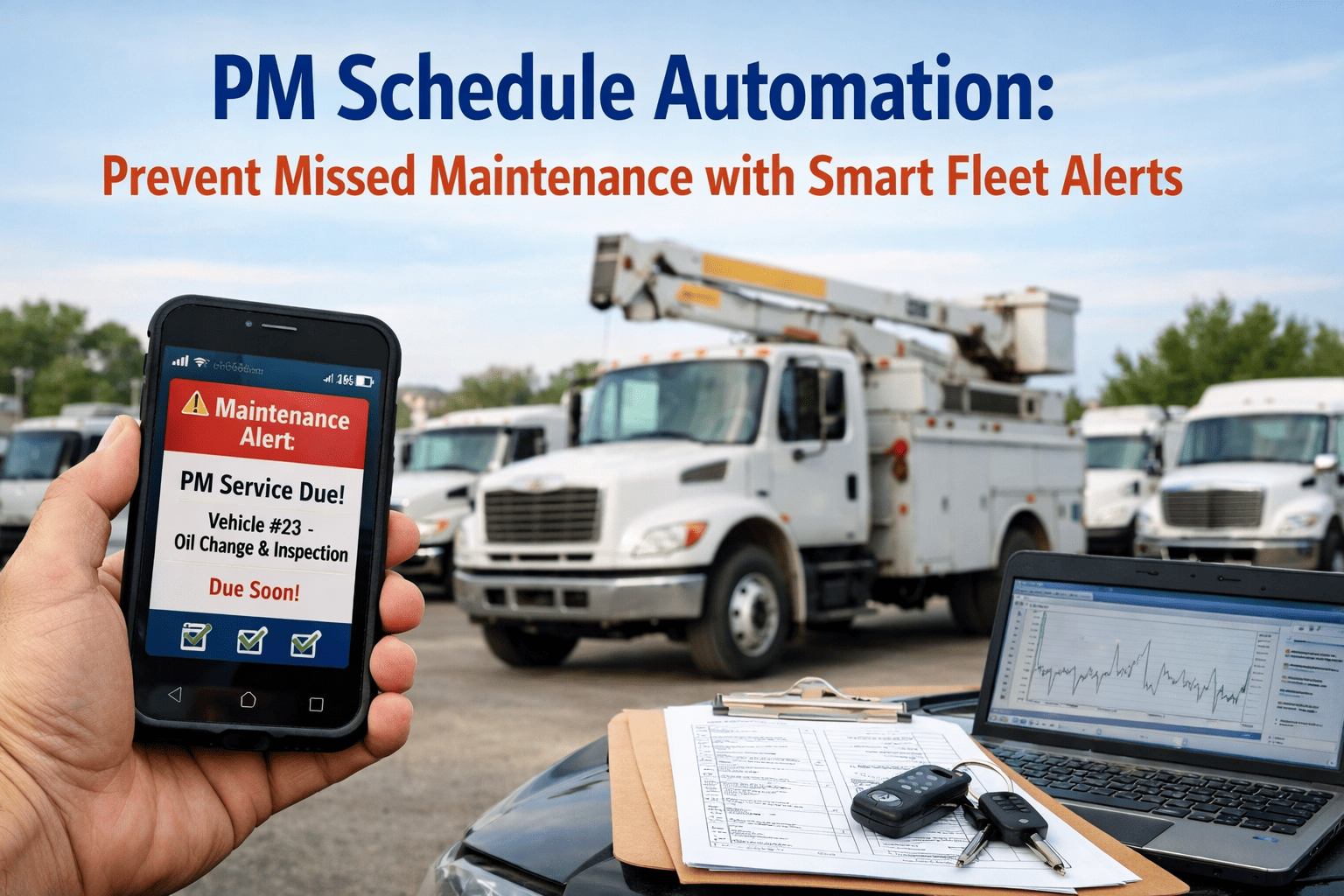
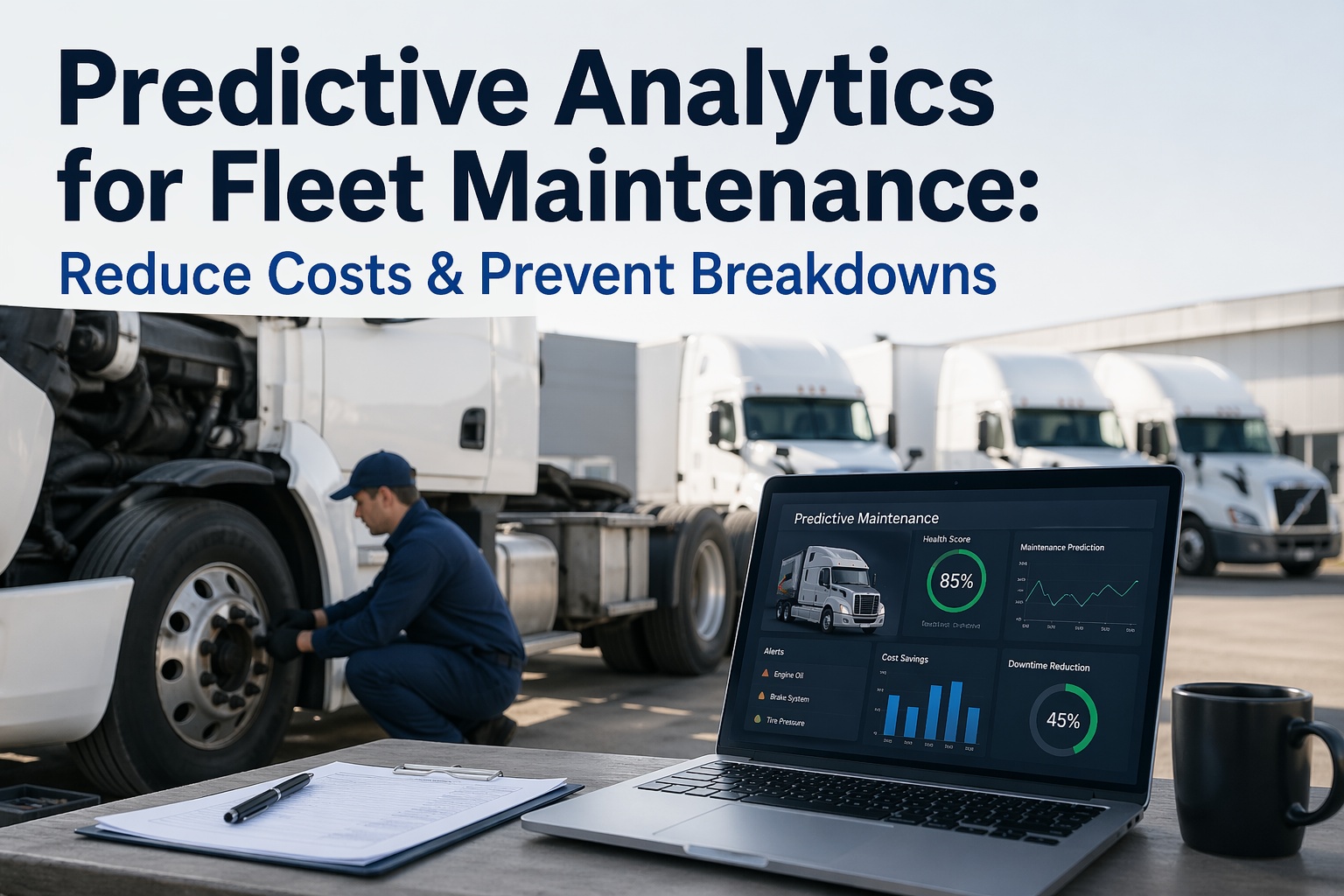
A brake job that costs $420 during a scheduled PM service runs $1,850+ after a roadside failure — plus towing, lost revenue at $500+ per day of downtime, and a DOT violation that follows your CSA score for two years. The root cause in 78% of unplanned breakdowns is deferred or missed maintenance that a properly scheduled PM would have prevented. Yet most fleets still manage PM scheduling through spreadsheets, wall calendars, or driver memory — systems that cannot track 50 vehicles with 8 PM items each across mileage, engine hours, and calendar triggers simultaneously. That is 1,200 tracking points that no manual process maintains accurately. HVI's PM schedule automation eliminates this complexity: it monitors every vehicle continuously, fires alerts at the right time based on the right trigger, auto-generates work orders before services are due, and documents every completed PM in an audit-ready record. The result is a fleet where nothing slips through the cracks — not because someone remembered, but because the system made it impossible to forget.
Why Manual PM Scheduling Fails
Manual PM tracking does not fail because fleet managers are careless — it fails because the math of fleet maintenance exceeds human tracking capacity. Here are the four failure modes that automation eliminates.
Vehicles accumulate mileage at different rates. A truck running 500 miles/day hits its 15,000-mile oil change in 30 days. A truck running 150 miles/day takes 100 days. A single spreadsheet interval catches neither on time — one gets over-maintained, the other gets under-maintained.
Calendar-only scheduling misses high-use vehicles that need service sooner and over-services low-use vehicles that do not. A seasonal truck parked for 3 months still shows "due" on the calendar — while a truck that ran 40,000 miles in 60 days sits un-serviced because the calendar date has not arrived yet.
10 vehicles with 8 PM items on 3 trigger types = 240 tracking points. At 50 vehicles, that is 1,200. At 200, it is 4,800. No spreadsheet, whiteboard, or calendar system maintains this volume at the accuracy PM requires. Complexity scales non-linearly — the missed-service rate accelerates as fleet size grows.
When a PM is overdue in a spreadsheet, nothing happens — no alert, no escalation, no flag. The fleet manager discovers it during a monthly review (if they review at all), or worse, during a DOT audit. Manual systems have no mechanism to escalate missed services before they become breakdowns or violations.
How HVI's PM Automation Works
HVI does not just send reminders — it manages the entire PM lifecycle from trigger detection to work order completion to audit-ready documentation. Here is the five-stage automation pipeline that keeps every vehicle serviced on time.
1
Configure PM Intervals
Set PM-A through PM-D intervals by mileage, engine hours, calendar, or whichever-comes-first — per vehicle type. Class 8 tractors get mileage-based triggers. Construction equipment gets hours-based triggers. Seasonal fleet gets calendar triggers. Each vehicle type gets its own PM template with the correct service items.
2
Continuous Monitoring
HVI tracks every vehicle continuously — mileage from telematics sync or driver-reported odometer, engine hours from equipment meters, and calendar time counting down automatically. No manual mileage entry, no spreadsheet updates, no "I forgot to check." Every tracking point updates in real time.
3
Tiered Alert System
Lookahead alerts fire at 90, 60, and 30 days before service is due — giving dispatchers and shop managers time to schedule vehicles without disrupting operations. Alerts escalate: notification to driver, then to supervisor, then to fleet manager if PM remains unscheduled. Nothing falls through the cracks.
4
Auto-Generated Work Orders
When a PM trigger fires, HVI auto-generates a work order with the correct service items for that PM tier, assigned to the right technician based on vehicle type and shop location. Parts needed for the service are cross-referenced against inventory — no delays waiting for parts when the vehicle arrives at the shop.
5
Documented Completion
Technician completes the PM, records parts used, captures completion photos, and applies digital sign-off. The service record is permanently stored in the vehicle's maintenance history — with timestamp, odometer reading, and technician ID. Ready for DOT audit at any time.
The PM Tiers: What Gets Serviced When
HVI supports the industry-standard PM-A through PM-D tier system — each progressively more comprehensive, each with its own interval triggers. Start free and configure your PM tiers in the first session.
PM-A
Basic Service
Every 10,000–15,000 mi / 250 hrs / 30 days
Oil and filter change, fluid level checks, visual brake inspection, tire pressure and tread depth, belt and hose inspection, lights and reflectors, air filter check
PM-B
Intermediate Service
Every 25,000–30,000 mi / 500 hrs / 90 days
All PM-A items plus brake measurement and adjustment, steering and suspension inspection, coolant condition test, transmission fluid check, battery and charging system, exhaust system inspection
PM-C
Comprehensive Service
Every 50,000–60,000 mi / 1,000 hrs / 6 months
All PM-B items plus transmission service, differential fluid change, wheel bearing inspection and repack, fuel system inspection, complete electrical system test, cab and chassis hardware torque check
PM-D
Major Service / Annual
Every 100,000 mi / 2,000 hrs / 12 months
All PM-C items plus DOT annual inspection, complete brake overhaul assessment, frame and structural inspection, fifth-wheel rebuild evaluation, full system diagnostics, capital replacement review
The ROI: What Automated PM Scheduling Saves
Every dollar spent on preventive maintenance saves $4–8 in emergency repairs, towing, and downtime costs. Here is what the numbers look like when PM scheduling moves from manual to automated. Book a demo to see ROI projections for your fleet size.
Unplanned Downtime Reduction
45–70%
Automated triggers catch every service interval. No missed PMs = fewer emergency breakdowns. Fleets report 45% less unplanned downtime within 90 days of implementing PM automation.
Maintenance Cost Reduction
25–35%
Planned repairs at standard rates vs. emergency repairs at premium rates with expedited parts (35–60% markup). One prevented engine failure ($12K–$22K) covers 12–18 months of platform cost.
Vehicle Life Extension
15–20%
Proper PM extends vehicle lifecycle by 15–20%. On a $150K Class 8 tractor, that is 2–3 additional years of service before replacement — $50K+ in deferred capital expenditure per vehicle.
PM Compliance Rate Improvement
61% → 95%+
Industry average PM compliance is 61% in 2026. Automated scheduling pushes fleets above 85% within 60 days and above 95% within 6 months. Every percentage point above 80% correlates with measurable downtime reduction.
Annual Savings per Vehicle
$6,000–$8,500
Combined savings from prevented breakdowns, reduced emergency parts costs, extended vehicle life, lower insurance premiums from improved safety scores, and eliminated admin time from manual PM tracking.
The System That Never Forgets
Manual PM scheduling works until it does not — and when it fails, the cost is a breakdown, a violation, or a vehicle that dies 50,000 miles before its time. HVI's PM schedule automation replaces human memory with systematic precision: multi-trigger monitoring by mileage, engine hours, and calendar; tiered alerts at 90/60/30 days; auto-generated work orders with the right service items for the right PM tier; and audit-ready documentation from every completed service. The fleets achieving 95%+ PM compliance, 45% less downtime, and declining cost-per-mile are not working harder — they are running their PM programs through a system that makes missed maintenance impossible. Sign up free and automate your PM scheduling starting today.
Never Miss a PM Service Again
Multi-trigger scheduling. Tiered alerts. Auto-generated work orders. Audit-ready documentation. All on one platform — purpose-built for heavy vehicle fleets and trusted by 25,000+ users worldwide.
Frequently Asked Questions
Q: What PM triggers does HVI support?
HVI supports mileage-based, engine-hours-based, calendar-based, and whichever-comes-first triggers — each configurable per vehicle type. Road vehicles typically use mileage triggers. Heavy equipment uses engine hours. Seasonal fleet uses calendar. HVI applies the correct trigger logic automatically so no vehicle is over-maintained or under-maintained.
Book a demo to see multi-trigger scheduling in action.
Q: How far in advance does HVI alert for upcoming PMs?
HVI sends lookahead alerts at 90, 60, and 30 days before service is due. Alerts escalate if the PM remains unscheduled: notification to driver first, then supervisor, then fleet manager. Overdue PMs are flagged on the dashboard and in daily summary reports — visible to everyone who needs to act.
Q: Does PM automation work without telematics hardware?
Yes. HVI supports driver-reported odometer readings through the mobile app as well as telematics integration. Without telematics, drivers update mileage during inspections — HVI calculates PM due dates from that data plus calendar triggers. Telematics integration eliminates manual entry entirely, but the system works effectively either way.
Start free with manual entry or telematics.
Q: How does PM scheduling connect to inspections?
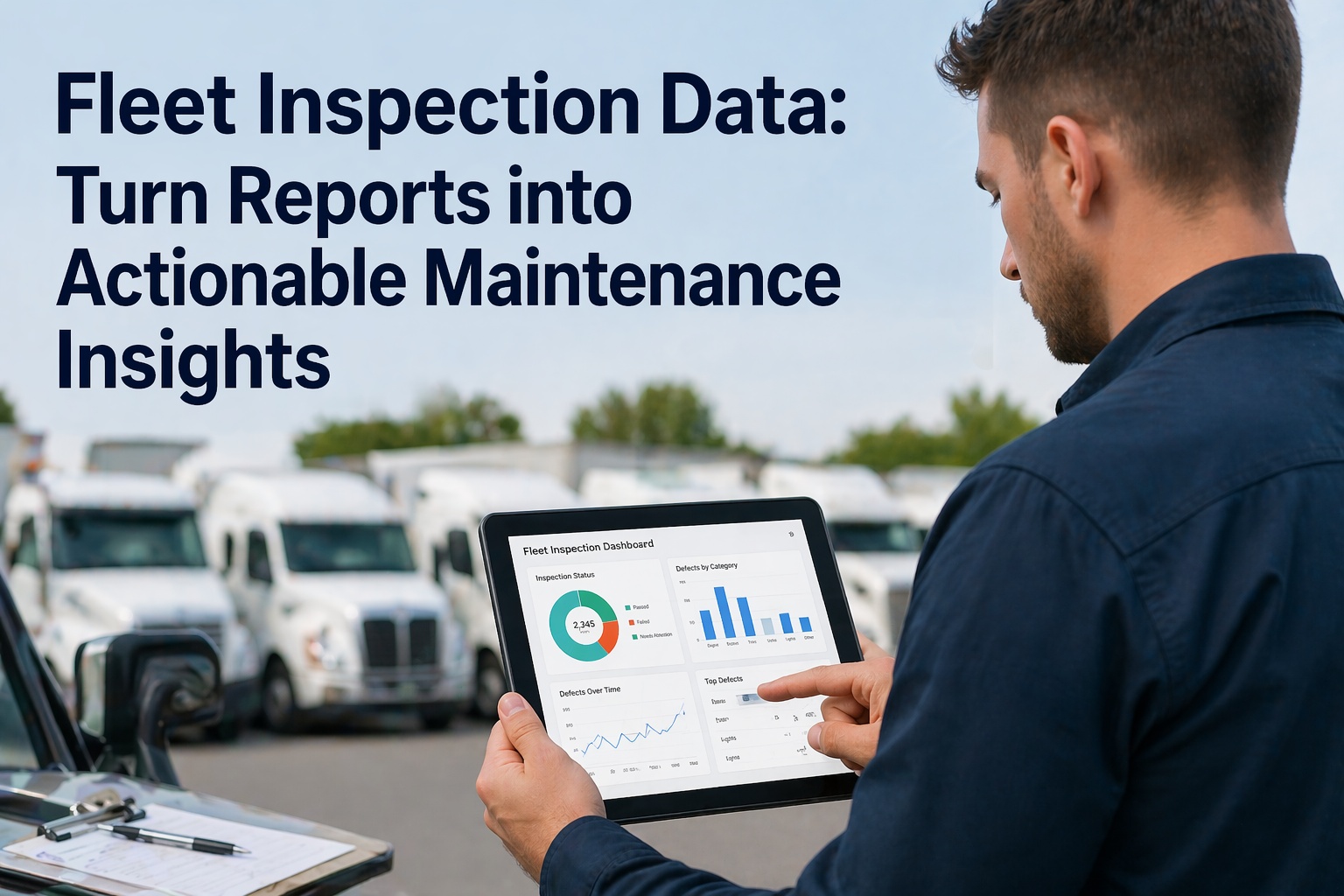
This is where HVI's integrated platform creates unique value. Defects found during daily driver inspections auto-generate work orders that feed into the maintenance queue alongside scheduled PMs. Inspection data also informs PM interval adjustments — if a vehicle shows accelerated brake wear in DVIR photos, HVI can flag it for earlier brake service. The inspection-to-maintenance chain and PM scheduling work as one connected system.
Q: What ROI can I expect from PM automation?
Fleets report 300–500% ROI on PM programs through reduced downtime ($500+/day saved per prevented breakdown), lower maintenance costs (25–35% reduction), extended vehicle life (15–20% longer), and eliminated admin time. Most fleets see measurable improvement within 30 days and full ROI within 90 days. One prevented engine failure ($12K–$22K) covers a year or more of platform cost.